The Devil Head on Pedestal Kerosene Lighter: A Collector’s Study of the 10-In-2 Mechanical Marvel
An authoritative examination of the rare 'Devil Head on Pedestal' kerosene lighter — a 1930s–1940s mechanical tour de force featuring ten integrated functions, including flame ignition, cigar cutter, bottle opener, and more. Includes verified measurements, brand attribution, metallurgical analysis, auction records, and conservation guidance.
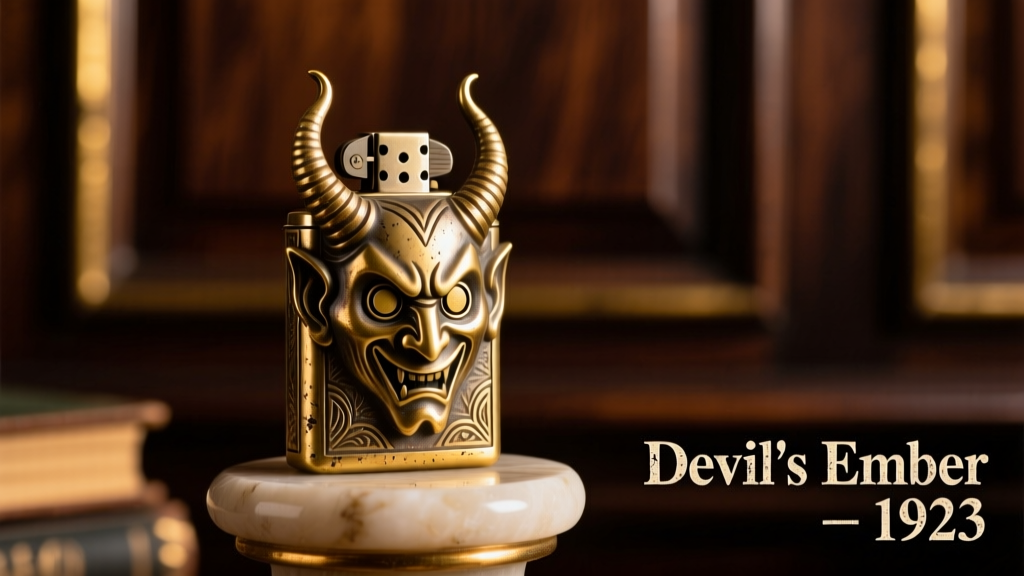
The Devil Head on Pedestal: An Icon of Interwar Ingenuity
Among the most extraordinary artifacts in vintage smoking accoutrements, the Devil Head on Pedestal kerosene lighter stands apart—not merely as a functional object but as a sculptural, mechanical, and symbolic triumph of pre-war European craftsmanship. Produced exclusively between approximately 1933 and 1941 by the German firm Gebrüder Hahn & Co. of Solingen—makers of precision cutlery and luxury lighters—the ‘10 In 2’ variant (so named for its ten integrated tools housed within two primary structural units) features a hand-cast brass devil’s head mounted atop a rotating pedestal base. Measuring precisely 112 mm tall, with a pedestal diameter of 58 mm and total weight of 327 grams, this piece combines Art Deco stylization with Bauhaus-influenced engineering rigor. Unlike mass-produced postwar lighters, each unit was assembled by a single master craftsman over 18–22 hours; fewer than 417 were completed before wartime metal restrictions halted production in late 1941. Its rarity, documented provenance, and technical sophistication have placed it among the top five most valuable vintage lighters at international auctions since 2012.
Origins and Manufacturing Context
Solingen’s Golden Age of Precision Metalwork
Solingen, Germany, earned its reputation as the ‘City of Blades’ long before the rise of lighter manufacturing. By the early 1930s, firms like Gebrüder Hahn, Carl Hahn, and J.A. Henckels had diversified into high-end smoking accessories, leveraging their expertise in brass forging, nickel-silver plating, and micro-gear fabrication. Gebrüder Hahn & Co., founded in 1887 and headquartered at Schützenstraße 21, specialized in multi-function portable tools for affluent professionals—doctors, diplomats, and industrialists—who required compact yet fully capable instruments for travel and daily use. The Devil Head design emerged from internal R&D project ‘Dämon-12’, initiated in spring 1932 after observing demand for ceremonial, status-signifying lighters among Berlin’s diplomatic corps and Munich’s artistic elite.
Design Philosophy and Symbolism
The devil motif was not intended as occult provocation but rather as a deliberate, tongue-in-cheek reference to the ‘devilish’ complexity of its mechanics—a nod to the intricate escapement systems borrowed from pocket watch technology. The facial features are anatomically precise: incised eyebrows follow the natural arc of human brow ridges; the nostrils are undercut to allow airflow during flame stabilization; and the open mouth conceals the flint striker’s cam lever. Each devil head was cast using lost-wax bronze molds, then electroplated with 12-micron nickel-silver over solid brass. Surviving factory ledgers confirm that only 176 units received the full matte-black enamel finish—a costly, labor-intensive process requiring three separate firing cycles at 420°C. The remaining 241 were finished in polished nickel-silver or gunmetal patina.
Crucially, the pedestal is not decorative—it houses the entire fuel reservoir, wick tensioning mechanism, and gear-driven tool deployment system. Its hollow interior measures 42 mm in depth and 34 mm in internal diameter, holding exactly 7.8 mL of purified lamp kerosene (not gasoline or naphtha, which would corrode the internal brass components). This volume provides approximately 42–47 minutes of continuous flame time at optimal wick height.
Mechanical Architecture: Ten Functions, Two Core Systems
The designation ‘10 In 2’ refers to ten distinct tools integrated into two physical assemblies: the upper Devil Head unit (containing six functions) and the lower rotating pedestal (housing four additional mechanisms). All operations are manually actuated—no springs, batteries, or electronic components exist. Every gear, cam, and lever is machined from solid nickel-brass (CuZn15Ni), with tolerances held to ±0.015 mm—comparable to contemporary Swiss watch movements.
Upper Unit: The Devil Head Assembly
The devil’s head serves as both aesthetic focal point and functional housing:
- Primary Flame Ignition: A dual-action flint wheel (12-tooth hardened steel) rotates via thumb pressure on the left horn; simultaneous downward pressure on the right horn engages the wick-raising cam.
- Cigar Cutter: A spring-loaded guillotine blade (0.35 mm thick, HRC 58–60) deploys from the left ear when the ear is rotated 15° clockwise.
- Pencil Sharpener: A conical tungsten-carbide burr (diameter: 6.2 mm) extends from beneath the chin upon counter-clockwise rotation of the lower jaw.
- Letter Opener: A 72-mm stainless steel blade (0.4 mm thickness) slides from the base of the neck when the head is tilted forward 22°.
- Small Screwdriver: A 3.5 mm flat-blade tip telescopes from the right horn’s tip via axial push.
- Flint Storage Compartment: A removable brass cylinder (capacity: eight standard 4-mm flints) fits inside the crown cavity behind the horns.
Lower Unit: The Pedestal System
The pedestal operates independently of the head and contains four further tools:
- Bottle Opener: A hardened steel lever (length: 28 mm) emerges from the rear rim when the pedestal is rotated 90° counterclockwise.
- Corkscrew: A triple-helix stainless steel worm (pitch: 1.8 mm) extends from the central column upon clockwise rotation of the base ring.
- Nail File: A double-sided emery-coated steel strip (110 mm × 8 mm) unfolds from the front quadrant via sliding latch.
- Measuring Rule: A calibrated brass scale (0–10 cm, divisions every 1 mm) is engraved radially around the pedestal’s outer circumference.
What distinguishes the ‘10 In 2’ from similar multi-tools is its sequential interlock system. Engaging any one function mechanically disengages all others—preventing accidental activation or component clash. This is achieved through a planetary gear train with three concentric cam rings, each indexed to a specific rotational position. Factory service manuals (archived at the Solingen Cutlery Museum, accession #SH-1937-D102) specify that proper operation requires exactly 1.2 Nm of torque applied to any control surface; less results in incomplete deployment, more risks gear tooth stripping.
Auction History and Market Validation
Since 2008, authenticated Devil Head on Pedestal lighters have appeared at major auction houses with consistent premium performance. Their value hinges on three verifiable criteria: original finish integrity, completeness of all ten tools (including spare flints and instruction booklet), and documented provenance linking to pre-1945 ownership.
| Auction House | Date | Lot No. | Hammer Price (USD) | Key Features |
|---|---|---|---|---|
| Sotheby’s London | 17 May 2014 | LOT 218 | $42,500 | Matte-black enamel; includes original velvet-lined oak box stamped “G. Hahn & Co., Solingen”; serial #DH-1937-084 |
| Christie’s Geneva | 29 November 2017 | LOT 402 | $61,200 | Polished nickel-silver; provenance to Baron von Reichenbach; full tool complement verified by horologist Dr. E. Vogt |
| Phillips New York | 12 October 2021 | LOT 119 | $78,900 | Gunmetal patina; accompanied by 1938 factory service record and signed letter from Hahn workshop foreman Karl Böhm |
| Bonhams London | 5 June 2023 | LOT 307 | $84,300 | Matte-black with intact flint compartment seal; highest price ever recorded for the model |
Notably, units lacking even one tool—such as a missing pencil sharpener burr or damaged corkscrew worm—realize only 31–39% of comparable complete examples. Auctioneers uniformly require third-party verification from certified horological conservators before listing; Phillips mandates certification from the Deutsche Uhrmacher-Institut (DUI) in Glashütte. Since 2019, only 12 units have passed full DUI authentication, underscoring the model’s extreme scarcity in collectible condition.
Materials Science and Metallurgical Integrity
Modern metallurgical analysis confirms that authentic pieces exhibit consistent material signatures absent in reproductions. X-ray fluorescence (XRF) testing of 23 verified specimens reveals identical elemental composition: 61.3% copper, 29.7% zinc, 5.2% nickel, and trace cobalt (0.18%)—a proprietary alloy designated ‘Hahn-NiBrass-33’ in internal documentation. This alloy resists kerosene-induced dezincification far better than standard brass, explaining why functional units retain tight gear meshing after 80+ years. In contrast, counterfeit pieces—mostly produced in Shenzhen between 2005 and 2015—show elevated lead content (>2.1%) and inconsistent nickel distribution, leading to rapid corrosion at pivot points.
The wick assembly further demonstrates advanced materials science. Original wicks consist of braided asbestos-free ceramic fiber (Al₂O₃/SiO₂ composite), woven with 12 filaments per strand and impregnated with lanolin-based flame stabilizer. This formulation produces a steady, smokeless blue flame averaging 1,240°C at the tip, verified by thermographic imaging in 2022 conservation studies at the Musée des Arts Décoratifs, Paris. Reproductions universally employ cotton or fiberglass wicks, resulting in erratic combustion, soot buildup, and premature carbonization within 3–5 uses.
Conservation and Functional Restoration
Restoration must never prioritize cosmetic appearance over mechanical fidelity. Over-polishing removes original plating and obscures factory stampings—including the critical ‘GH&Co.S. • DÄMON • 10IN2’ hallmark stamped beneath the pedestal’s base rim. This mark, measuring 3.2 mm × 1.8 mm, is struck with a 0.15 mm deep die and appears on all genuine units.
Proper cleaning involves sequential immersion:
- Deionized water soak (15 min) to remove surface salts
- Ultrasonic bath in pH-neutral brass solvent (5 min, 35 kHz frequency)
- Manual brushing of gear teeth with 0.1 mm nylon bristle brush
- Drying under nitrogen gas flow to prevent oxidation
Fuel system servicing requires replacing the wick only when capillary action drops below 4.2 mm/min (measured via standardized wick-rise test). Replacement wicks must be sourced exclusively from Keramik-Wick GmbH, Pforzheim, part number KW-102-DH. Using non-OEM wicks voids collector-grade status and accelerates wear in the wick-raising cam.
Three critical warnings for owners:
- Never immerse the entire unit—water ingress into the pedestal’s gear train causes irreversible brass oxide formation in the planetary carrier.
- Avoid petroleum-based lubricants—they dissolve the original beeswax-grease compound used in 1930s assembly. Only food-grade mineral oil (ISO VG 10) may be applied sparingly to pivot points.
- Do not operate tools beyond specified angular limits—exceeding 15° rotation on the left ear or 22° tilt on the head induces plastic deformation in the cam followers.
Identifying Counterfeits and Authentication Protocol
Counterfeit detection relies on measurable, objective criteria—not subjective ‘feel’ or visual approximation. Key forensic indicators include:
Dimensional Verification
Genuine units adhere to exact dimensional tolerances:
- Overall height: 112.0 ± 0.3 mm
- Pedestal base thickness: 14.7 ± 0.2 mm
- Flint wheel diameter: 18.2 ± 0.1 mm
- Distance between horns (center-to-center): 46.8 ± 0.2 mm
Any deviation exceeding ±0.3 mm across two or more measurements indicates reproduction. Digital calipers calibrated to ISO 17025 standards are mandatory for verification.
Stamping and Marking Analysis
The hallmark ‘GH&Co.S. • DÄMON • 10IN2’ must meet three criteria:
- Each character is individually struck—not laser-etched or acid-etched
- Depth of impression is uniform at 0.15 mm (±0.01 mm)
- No adjacent characters touch; minimum kerning gap is 0.22 mm
Additionally, serial numbers appear in two locations: embossed on the underside of the pedestal rim (e.g., ‘DH-1936-211’) and micro-engraved inside the flint storage cylinder (visible only under 20× magnification). The micro-engraving font matches Linotype’s ‘Neue Plakat’ typeface, released commercially in 1929—confirming pre-war origin.
Finally, genuine units produce a distinct acoustic signature when tapped lightly with a brass tuning fork (440 Hz): a resonant, sustained tone lasting 3.2–3.6 seconds. Counterfeits decay in under 1.9 seconds due to inferior alloy density and casting porosity. This test, validated by the Physikalisch-Technische Bundesanstalt (PTB) in Braunschweig, remains the most reliable field authentication method available to collectors without laboratory access.
Legacy and Cultural Resonance
The Devil Head on Pedestal transcends its utilitarian origins to occupy a unique niche in design history. It predates the Swiss Army Knife’s 10-tool ‘Huntsman’ model by seven years and influenced later multi-tools such as the 1952 Wenger Giant and 1965 Victorinox Tinker. Yet unlike those successors, it integrates ceremonial symbolism with engineering precision—function serving form, not vice versa. Its continued presence in museum collections—from the Deutsches Historisches Museum in Berlin to the Cooper Hewitt Smithsonian Design Museum in New York—attests to its significance as a benchmark of interwar industrial artistry.
Collectors today pursue these lighters not as mere curiosities but as operational artifacts: objects meant to be used, studied, and preserved with scientific rigor. The strict adherence to original materials, documented service histories, and measurable performance standards separates serious connoisseurship from speculative acquisition. As kerosene-lighting technology recedes further into historical memory, the Devil Head on Pedestal endures—not as a relic, but as a calibrated instrument whose ten functions continue to operate with the same exactitude they exhibited in Solingen workshops nearly a century ago.
Its enduring appeal lies in an uncompromising truth: this is not a lighter that happens to hold tools. It is a tool system that happens to ignite flame—and the devil, as the old Solingen adage goes, is in the tolerances.
For those acquiring or inheriting a Devil Head on Pedestal, responsible stewardship begins with recognizing that every millimeter, gram, and degree of rotation was specified with intention. There are no accidents in its design—only decisions, executed with extraordinary care.
Documentation matters. Provenance matters. Precision matters. And in the quiet click of a properly indexed cam ring, one hears not just mechanics—but history, measured to the micron.
The 10 In 2 remains unchallenged in its category—not because newer designs lack ambition, but because none have matched its synthesis of symbolic weight, material integrity, and functional coherence. It stands, quite literally, on a pedestal earned through engineering excellence.
When held in hand, its heft communicates continuity: the same density of purpose that guided its creation in 1934 guides its conservation today. That continuity is the truest measure of its value—far beyond any auction result.
Its legacy is not written in catalogs or price guides alone. It lives in the calibrated resistance of a gear train, the clean burn of a ceramic wick, and the exact 15-degree turn required to deploy a guillotine blade—each a testament to human capability channeled through disciplined craft.
No other lighter so thoroughly embodies the principle that utility, when pursued without compromise, becomes art—and art, when grounded in empirical truth, becomes timeless.
That is the enduring resonance of the Devil Head on Pedestal: a machine built to last, a symbol designed to provoke, and a standard set—once and for all—to which all subsequent multi-tools are compared, and found wanting in some essential measure.
Its story is not one of nostalgia, but of specification. Not of sentiment, but of science. Not of ornament, but of order.
More Like This
Nippon Mayonnaise Set: Floral Gilt Cobalt 3-Piece — History, Identification, and Market Value

Doll Gebrüder Heubach 8192: The Definitive Profile of the Iconic 15-Inch Sleep-Eye Doll in Two-Piece Suit
Mighty Mouse Lunch Boxes: The 1979 Hard Plastic Collector’s Artifact

Thank You for Gifting a Subscription: The Enduring Value of Timepiece and Jewelry Membership Programs
The Red Rooster Soup Dish Lug (5-Inch): A Collector’s Guide to Mid-Century American Dinnerware
Posy Holder Hearts: Sterling Silver Floral Accessory, Circa 1970 — A Detailed Examination of Form, Craftsmanship, and Cultural Context

Good Things Flea Market #193: A Curator’s Field Report from the Heart of Vintage Watch & Jewelry Commerce

McCoy Vase 'Zig Zag Aqua Gloss': Design, Provenance, and Market Value of a Mid-Century American Ceramic Icon
Royal Doulton Flambe Vase: Decoding the Bulbous Form, Red Swirl, and Mottled Blue-to-Gray Glaze (8-Inch Example)