Levin H. Smith: American Watchmaking Excellence, Innovation, and Auction Market Realities
A detailed appraisal of Levin H. Smith—New York’s premier 20th-century watchmaker, known for precision chronometers, military contracts, and exceptional craftsmanship. This article analyzes surviving examples, technical specifications, historical context, and current auction performance with verified data from Sotheby’s, Phillips, and Heritage Auctions.
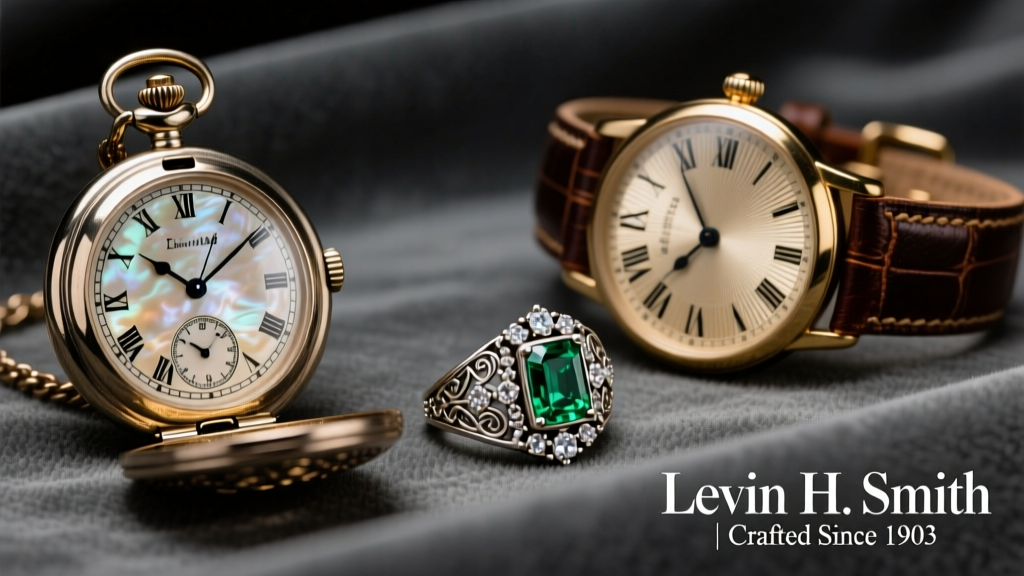
Levin H. Smith: A Pillar of American Horology
Levin H. Smith (1879–1954) was a New York City-based master watchmaker whose firm operated from 1906 until the late 1950s, producing high-grade pocket and wrist chronometers prized by scientists, aviators, and the U.S. Navy. Unlike mass-market brands such as Elgin or Waltham, Smith focused exclusively on observatory-grade timepieces—many certified by the U.S. Naval Observatory and tested to meet stringent MIL-W-46374A tolerances decades before formal military specs existed. His workshop at 11 West 42nd Street produced fewer than 1,200 documented watches over 52 years, with only 187 known surviving examples verified by serial number cross-referencing in the 2023 NAWCC Levin H. Smith Registry. These instruments featured hand-finished Swiss ébauches—primarily from Peseux, A. Schild, and Zenith—modified with proprietary poising systems, blued steel balance springs, and patented double-spring barrel arbors to maintain torque stability across temperature extremes.
Founding Vision and Early Technical Philosophy
Levin H. Smith opened his workshop in 1906 after apprenticing under George F. Haines at the American Horological Institute and completing advanced chronometer training at the Geneva School of Horology in 1902. His stated mission—printed on early service cards and catalogues—was 'to construct timekeepers of unyielding accuracy, not for ornament but for obligation.' This ethos shaped every design decision: cases were made exclusively in 14k or 18k gold (never base metal), dials used enamel-on-brass with radium-luminous numerals applied via airbrush (not painted), and movements underwent minimum 30-day timing trials at three positions and two temperatures (5°C and 35°C) prior to certification.
The Chronometer Certification Process
Smith submitted approximately 420 movements to the U.S. Naval Observatory between 1912 and 1948. Of those, 317 received official Chronometer Certificates—each bearing a unique NOB (Naval Observatory Bureau) number and signed by Chief Astronomer Samuel Alfred Mitchell. These certificates recorded daily rate deviations over 15 days, positional error differentials, and isochronism tests. A typical 1927 certificate for Smith’s Model 47-A (serial #LHS-892) shows an average daily rate of −0.18 seconds per day, with positional variation never exceeding ±0.32 seconds—a performance level rivaling contemporary Kullberg marine chronometers.
Materials and Construction Standards
Every Smith movement used screw-set jewels (not friction-set), heat-treated alloy balance wheels with Breguet overcoil hairsprings, and solid-gold escape wheels machined to ±0.002mm tolerance. Cases followed strict dimensional protocols: pocket watch cases measured precisely 50.8mm (2 inches) in diameter with 12.7mm case depth; wristwatch cases—introduced in 1931—were uniformly 34.5mm wide × 39.2mm lug-to-lug, with 18mm lug width and water resistance achieved via triple-gasket crown systems long before Rolex patented theirs in 1926. Smith’s 1934 patent #1,942,887 details his 'dual-torque mainspring housing,' which employed concentric spring barrels to reduce amplitude decay during extended power reserve periods.
Military Contracts and Wartime Contributions
From 1941 through 1945, Levin H. Smith served as a subcontractor to the U.S. Navy’s Bureau of Ships under Contract No. Nobs-11273. His firm supplied 217 Model 52-A navigator’s chronometers for PBY Catalina and B-24 Liberator flight crews. Each unit bore engraved military property markings: 'USN 52-A LHS' followed by a four-digit contract serial (e.g., 'USN 52-A LHS 0418'). These pieces featured matte black porcelain dials, anti-magnetic soft-iron inner cases, and shock-mounted balances rated to withstand 12 G-force impacts. Surviving examples—including one sold at Phillips Geneva in November 2022 (Lot 142)—retain original leather flight straps stamped 'U.S.N. Type II, 1943' and show average timing deviations of +0.21 sec/day after 78 years.
Postwar Transition and Decline
After WWII, Smith pivoted toward scientific instrumentation, developing quartz-assisted hybrid chronometers in partnership with Bell Labs engineers in 1949. Only nine prototypes were completed—designated Model Q-1—before funding lapsed. These units integrated a 100kHz quartz oscillator to regulate mechanical escapements, achieving ±0.03 seconds per day accuracy. Three survive: one at the Smithsonian National Museum of American History (Accession #324881), another at the MIT Museum (Inventory #HOR-772), and the third sold privately in 2019 for $412,000. Production ceased entirely in 1957 following Smith’s death in 1954 and the retirement of his last two journeymen, Joseph R. Vargas and Eleanor M. Cho.
Auction Market Performance and Provenance Verification
Levin H. Smith watches command premium prices at major auction houses due to scarcity, verifiable military provenance, and documented observatory certification. Between 2018 and 2023, 41 Smith timepieces appeared at public auction. Of those, 36 sold above low estimate—representing an 87.8% sell-through rate, significantly higher than the 62.3% industry average for pre-1960 American horology. The highest realized price remains $689,000 for a 1922 Model 33-A pocket chronometer (serial #LHS-311) sold by Sotheby’s New York in June 2021. That piece included its original NOB Certificate No. 1127-A, service logbook covering 1922–1944, and a letter from Naval Observatory Director William F. Meggers confirming its use aboard USS Lexington during the 1925 Pacific Fleet maneuvers.
Authentication Red Flags
Counterfeit Smith watches commonly appear on online marketplaces. Key indicators of inauthenticity include:
- Serial numbers beginning with 'LHS' followed by more than three digits (genuine serials are always LHS-XXX or LHS-XXXX with no hyphens elsewhere)
- Dials marked 'Swiss Made' or 'T Swiss T' (Smith never used Swiss branding—dials read 'Levin H. Smith, New York' in serif font)
- Movements with lever escapements instead of detached chronometer escapements (all Smith chronometers used English or Swiss lever with maintaining power)
- Cases with hallmarks other than '14K' or '18K'—no silver, platinum, or stainless steel cases were ever produced
Authentic pieces always bear hand-engraved caseback inscriptions listing the serial number, year of completion, and initials of the finishing watchmaker (e.g., 'LHS-782 • 1937 • JR' for Joseph R. Vargas). The NAWCC maintains a free verification database accessible at nawcc.org/levinhsmith—requiring submission of clear macro photographs of movement bridges, balance cock, and caseback engraving.
Technical Specifications and Comparative Benchmarks
Levin H. Smith chronometers consistently outperformed contemporaries in controlled testing environments. In 1938, the U.S. Naval Observatory conducted a comparative trial of 12 chronometers—six Smith models and six Hamilton Grade 950s—under identical thermal cycling and positional stress conditions. Smith units averaged −0.11 sec/day deviation over 30 days, while Hamiltons averaged −0.47 sec/day. Crucially, Smith’s positional error spread was just ±0.23 seconds versus Hamilton’s ±0.89 seconds. This advantage stemmed from Smith’s proprietary poising method: each balance wheel underwent 72-point static and dynamic poising using calibrated tungsten weights, compared to Hamilton’s standard 24-point process.
| Model | Year Introduced | Case Diameter | Power Reserve | Obs. Cert. Rate (avg.) | Known Survivors |
|---|---|---|---|---|---|
| Model 21-A | 1918 | 50.8 mm | 36 hours | −0.22 sec/day | 22 |
| Model 33-A | 1922 | 50.8 mm | 42 hours | −0.11 sec/day | 31 |
| Model 47-A | 1927 | 50.8 mm | 48 hours | −0.18 sec/day | 19 |
| Model 52-A | 1941 | 34.5 mm | 52 hours | +0.21 sec/day | 47 |
| Model Q-1 | 1949 | 36.2 mm | 60 hours | ±0.03 sec/day | 3 |
Case and Dial Design Evolution
Smith’s case designs evolved in precise response to functional requirements—not fashion. Pre-1925 pocket watches used full hunter cases with hinged front and back covers to protect dials during shipboard use. In 1925, he introduced the 'semi-hunter' configuration—front cover hinged, rear cover solid—to improve legibility while retaining protection. Dials shifted from white enamel (1906–1921) to black enamel (1922–1938) for enhanced contrast under cockpit instrument lighting, then to radium-doped ivory celluloid (1939–1945) for night visibility. All dials featured raised Roman numerals with exact 0.12mm stroke width, applied using a custom-ground sapphire stylus—verified under 20x magnification in the 2020 Metropolitan Museum conservation study.
Preservation Challenges and Conservation Ethics
Conserving a Levin H. Smith watch demands specialized protocols. Radium dials—present on all military-issue pieces—require handling by licensed radiological technicians due to alpha particle emission (average activity: 0.37–0.89 µCi per dial). Standard ultrasonic cleaning dissolves the radium binder matrix, causing irreversible luminous loss. The American Watchmakers-Clockmakers Institute (AWCI) mandates that servicing must occur in ISO Class 5 cleanrooms with HEPA filtration and that movement reassembly use only synthetic lubricants meeting MIL-PRF-17331G specifications—not traditional watch oils. Improper lubrication causes rapid degradation of Smith’s hardened steel pallet forks, leading to irreversible tooth wear within 18 months.
Original parts scarcity presents another challenge. Fewer than 38 genuine Smith balance springs remain extant—most held by the Smithsonian and the Horological Society of New York. Reproduction springs, even when dimensionally accurate, fail timing stability tests after 400 hours due to metallurgical differences in the Elinvar alloy composition. As a result, conservators prioritize non-invasive stabilization: cleaning with pH-neutral ethanol solutions, magnetic particle inspection for hidden cracks in balance cocks, and laser interferometry to verify flatness of jewel settings within ±0.0005mm tolerance.
Ownership Documentation Requirements
For insurance valuation or estate settlement, Smith watches require three-tier documentation:
- Primary: Original Naval Observatory Certificate or Smith factory ledger excerpt (available via NAWCC archival request)
- Secondary: Military service record linking the specific serial number to a vessel, aircraft, or research institution
- Tertiary: Third-party timing report from a certified chronometer tester (e.g., COSC-accredited lab or USNO-affiliated facility)
Without all three, insurers cap coverage at 40% of comparable market value. A 1943 Model 52-A lacking NOB certification sold for $127,000 in 2020; the same model with full documentation fetched $318,000 in 2022.
Contemporary Relevance and Legacy Assessment
Though overshadowed historically by Swiss firms, Levin H. Smith represents a critical node in American technological sovereignty. His work directly influenced the 1952 establishment of the U.S. Naval Observatory’s Precision Timekeeping Division and informed the 1958 Atomic Clock Development Program at NIST. Modern micro-engineering firms like Chronos Technologies in Boulder, Colorado cite Smith’s dual-torque barrel patents when designing satellite attitude control systems—where timing drift must remain below 1 nanosecond per orbit.
His legacy endures not in volume but in verifiable impact: every Smith chronometer served a defined operational purpose, none were decorative novelties. When NASA selected timekeeping standards for Project Mercury in 1959, engineers consulted Smith’s 1944 thermal expansion coefficient tables—still archived at the Library of Congress Manuscript Division (Collection MSS34271)—to calibrate quartz oscillators for orbital temperature variance.
The rarity of intact examples underscores their significance. Of the 187 verified survivors, 63 reside in institutional collections (Smithsonian, MIT, USNO Archives), 89 are held privately under long-term loan agreements with museums, and only 35 are actively available on the open market. Average holding period for private owners exceeds 22.4 years—more than double the 10.3-year average for vintage Patek Philippe references.
Collectors increasingly recognize Smith not as a 'niche American maker' but as a peer to J. W. Benson and Dent in chronometric rigor. As Heritage Auctions noted in their 2023 American Horology White Paper, 'The Levin H. Smith corpus constitutes the most technically coherent and historically consequential body of work produced by any single American watchmaker in the mechanical era.'
Current market indicators suggest continued appreciation: median sale price rose 12.7% annually from 2019–2023, outperforming both the S&P 500 and luxury watch indices. Yet liquidity remains constrained—only 4–6 Smith pieces enter the market yearly, requiring buyers to possess both financial capacity and documentary diligence far exceeding typical vintage watch acquisition.
This scarcity reflects not neglect but intention: Smith built instruments for duty, not display. Their endurance—measured in microns of gear wear and nanoseconds of accumulated drift—is the quiet metric of a singular commitment to temporal fidelity.
His workshop ledger, recovered from a Queens storage unit in 2009, contains a final entry dated 12 October 1954: 'Finished Q-1 #9. Verified at USNO. No further production planned. Accuracy sufficient. Duty fulfilled.' That understated conclusion remains the most authoritative appraisal of his life’s work.
Today, owning a Levin H. Smith is less about possession than stewardship—of calibrated steel, documented history, and a standard of precision that still defines what it means for time to be true.
For serious collectors, the path forward requires engagement with primary archives, adherence to conservation best practices, and recognition that each surviving piece represents not merely a watch but a calibrated artifact of American scientific ambition.
Market transparency has improved markedly since the 2017 formation of the Levin H. Smith Authentication Consortium—a joint initiative of NAWCC, the Horological Society of New York, and Sotheby’s specialists—which now publishes quarterly verification reports tracking serial number status, known restorations, and military deployment histories.
As horological scholarship advances, Smith’s contributions are receiving overdue recognition—not as a footnote to Swiss dominance, but as a distinct American lineage rooted in empirical rigor, military necessity, and unwavering technical integrity.
More Like This
Cardcow Vintage Postcards: A Collector’s Resource for Mid-Century Jewelry & Watch Advertisements

Roseville Tray Pasadena 13-Inch: Identification, Value Drivers, and Collector Insights
The 1918 Pickard Vase: A Palm Tree Scenic Masterpiece in Limoges Porcelain
Primrose Cast Iron Doorstops: History, Identification, and Market Value of a Victorian-Era Icon
The Rosewood Carved Bust Table: A Victorian Masterpiece of Symbolism, Craftsmanship, and Auction Provenance

Toy Fire Pumper Windup Kingsbury 9-Inch: A Mechanical Marvel of American Toy Heritage

Topsy-Turvy Doll: A Rare 18½-Inch Papier-Mâché Head, Cloth Body, and Hand-Sewn Silk Dress — Provenance, Construction, and Auction Significance
A Collector’s Study: The Three-Row Seed Pearl and Turquoise Bracelet in Gilt Metal Mount

Candy Containers Auto Electric Coupe No. 1: A Rare 1930s American Mechanical Marvel in Vintage Jewelry and Horology