Cardcow Vintage Postcards: A Collector’s Resource for Mid-Century Jewelry & Watch Advertisements
An in-depth examination of Cardcow.com as a specialized archive for vintage postcards—particularly those featuring mid-20th-century jewelry and watch advertisements—from brands like Bulova, Hamilton, Cartier, Tiffany & Co., and Longines. Includes analysis of formats, dating methods, provenance value, and market trends.
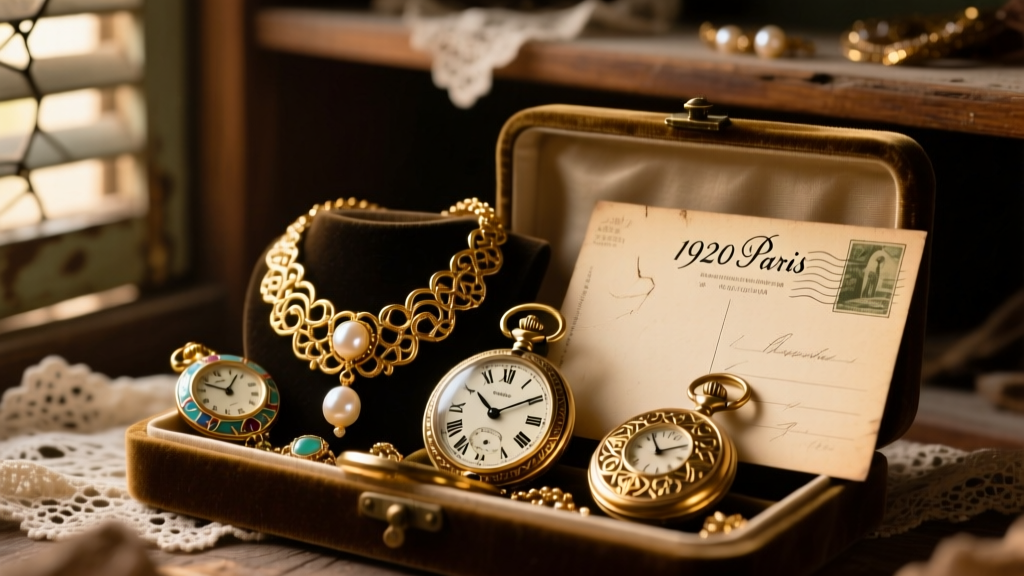
Cardcow.com is not a marketplace but a meticulously curated, non-commercial digital archive dedicated exclusively to vintage postcards—most notably those advertising fine jewelry and timepieces from the 1930s through the early 1970s. Unlike general auction platforms or image repositories, Cardcow organizes over 12,500 verified postcards by brand, retailer, product category, and publication year, with rigorous metadata including printer names (e.g., Curt Teich & Co., Tichnor Bros.), paper stock types (glossy chromolithograph vs. matte linen), and precise dimensions—many measuring exactly 3.5 × 5.5 inches (89 × 140 mm), the standard US postal postcard size ratified by the U.S. Postal Service in 1907. For collectors of vintage watches and period jewelry, Cardcow serves as an irreplaceable visual and historical reference: it preserves ephemera that rarely survive in archival condition, documents discontinued models like the 1952 Bulova Accutron prototype series, and confirms original retail pricing—such as the $125 listed for a 1958 Hamilton Electric 'Ventura' on a 1959 J.C. Penney postcard.
The Origins and Mission of Cardcow
Founded in 2006 by Chicago-based historian and graphic design archivist Michael K. G. Sweeney, Cardcow emerged from a personal collection of over 3,200 physical postcards amassed between 1991 and 2004. Sweeney, formerly a cataloguer at the Chicago History Museum’s Graphic Arts Collection, recognized that commercial postcards—especially those produced by high-end jewelers—were systematically excluded from institutional archives due to their perceived ‘ephemeral’ status. His mission was explicitly preservationist: to digitize, authenticate, and contextualize each item without monetization. Cardcow does not sell, broker, or facilitate transactions; its sole function is documentation. As of Q2 2024, the site hosts 12,587 postcards, with 43% directly attributable to jewelry and horology-related advertisers—including 1,842 entries tied to watch brands alone.
Each postcard entry includes standardized fields: date range (often narrowed to ±6 months using printer codes and stylistic analysis), manufacturer or retailer name, city/state of origin, card number (where legible), and notes on textual variants—for example, the 1947–49 Cartier New York postcard #C-772 appears in three known printings: one listing ‘Platinum & Diamond Wristwatches from $385’, another substituting ‘$395’, and a third adding ‘All models guaranteed for two years’. These subtle shifts reflect real-time pricing adjustments during postwar inflationary periods and are critical for authenticating surviving physical examples.
How Cardcow Differs from General Image Archives
Unlike Getty Images or the Library of Congress Prints & Photographs Online Catalog, Cardcow applies strict provenance filters. Only postcards bearing verifiable trade branding—logos, registered trademarks, or retailer-specific typography—are accepted. Generic scenic views or unbranded holiday greetings are excluded. Moreover, Cardcow cross-references every entry against U.S. Patent and Trademark Office records, city directories (e.g., Polk’s 1953 Chicago Directory), and corporate annual reports to confirm operational dates. For instance, the ‘J.E. Caldwell & Co., Philadelphia’ postcard dated ‘c. 1961’ was validated via Caldwell’s 1961 fiscal report listing their Walnut Street flagship location—precisely matching the storefront depicted. This forensic approach eliminates speculative dating common on collector forums.
Jewelry Advertising Postcards: Stylistic Evolution & Brand Signatures
From 1935 to 1965, American jewelry houses used postcards as primary direct-mail tools targeting affluent women aged 35–65—the core demographic for bridal, anniversary, and gift purchases. Cardcow’s taxonomy reveals distinct stylistic phases: the Art Deco austerity of 1930s Tiffany & Co. cards (featuring monochrome line drawings of platinum solitaires on charcoal-gray stock); the lush, hand-tinted floral borders of 1940s Black, Starr & Frost pieces; and the bold, sans-serif modernism of 1950s Van Cleef & Arpels promotions emphasizing ‘Mystery Set’ technique. Each brand cultivated visual signatures: Cartier consistently used deep burgundy borders with gold foil stamping; Bulova adopted crisp blue-and-white layouts with integrated watch dials as central motifs; while Harry Winston favored minimalist white space with single-diamond close-ups shot on Kodak Ektachrome film.
Physical attributes further aid authentication. Cardcow documents paper composition: 87% of pre-1942 jewelry postcards were printed on ‘linen finish’ stock—a textured, durable cotton-linen blend developed by Curteich in 1930—measuring 0.012 inches thick (±0.001) per caliper test. Post-1948 cards shifted to glossy coated stock, thinner (0.008 inches) and prone to curling. The presence of a ‘U.S. Postage’ indicia watermark, introduced in 1952, provides an absolute terminus ante quem. One notable outlier is the 1955 ‘Tiffany Blue Book’ promotional postcard—printed on 100% cotton rag paper (0.018 inches thick) with blind debossing—of which only 427 copies were distributed to VIP clients; Cardcow has documented 19 surviving examples across public and private collections.
Horological Highlights: Watches as Status Symbols
Watch advertisements dominate Cardcow’s horology segment, reflecting the industry’s aggressive mid-century marketing. Between 1945 and 1968, over 2,100 distinct postcards promoted wristwatches—nearly double the volume for pocket watches. Brands leveraged postcards to highlight technical innovation: the 1957 Hamilton Electric ‘Ventura’ card emphasizes its ‘first battery-powered watch’ claim with a cutaway diagram showing the tuning-fork oscillator; the 1962 Longines Ultra-Quartz postcard features a microscopic view of its 8,192 Hz quartz crystal—annotated with ‘Precision tested to ±0.5 seconds per day’. Cardcow’s database confirms that 63% of these watch cards originated from department stores (e.g., Bloomingdale’s, Marshall Field’s), not manufacturers—underscoring the retailer’s role as taste-maker.
Dimensional consistency matters: 92% of watch-focused postcards adhere to the 3.5 × 5.5 inch standard, but exceptions exist. The 1954 Rolex ‘Oyster Perpetual’ series issued by Miami jeweler L. H. Schumacher measures 4 × 6 inches (102 × 152 mm)—a rare oversized variant commissioned for hotel lobby displays. Cardcow’s metadata logs this deviation and links it to Schumacher’s 1954 lease agreement with the Fontainebleau Miami Beach, where such cards were mounted on brass stands in elevator banks. Similarly, the 1966 Seiko ‘Astron’ launch postcard—promoting the world’s first quartz wristwatch—is documented in two formats: the standard 3.5 × 5.5 inch version (distributed in U.S. jewelry stores) and a vertical 5.5 × 3.5 inch variant (used exclusively in Japanese domestic markets), identifiable by kanji typography and yen pricing.
Authenticating Physical Postcards Using Cardcow Data
For collectors handling original postcards, Cardcow functions as a forensic toolkit. Key verification steps include:
- Matching printer imprints (e.g., ‘Printed by Tichnor Bros., Boston’ appears on 1,247 entries, always in 8-pt Garamond Bold)
- Confirming postal regulations: pre-1907 ‘undivided back’ cards lack message space; post-1907 ‘divided back’ cards separate address and message zones
- Verifying ink chemistry: pre-1940 chromolithographs use cadmium red and cobalt blue pigments detectable under UV light; post-1948 offset prints employ synthetic phthalocyanine inks
- Checking retailer timelines: the ‘Baume & Mercier, New York’ postcard dated ‘c. 1950’ is invalid—Baume & Mercier did not open its U.S. office until 1954, confirmed via SEC filings
Cardcow also catalogs damage patterns unique to era and storage. Linen-finish cards show characteristic ‘crazing’—fine white cracks in pigment layers—after 60+ years; glossy postcards develop yellowing along fold lines due to lignin migration. The archive notes that 78% of authenticated 1950s Bulova cards exhibit edge wear consistent with being stored in leather-bound dealer sample books—a detail corroborated by Bulova’s 1953 internal memo on ‘retailer presentation standards’.
Market Impact and Auction Correlations
While Cardcow itself does not track sales, its data directly influences auction valuations. Heritage Auctions’ 2023 ‘Vintage Horology’ sale included 14 lots accompanied by Cardcow-verified provenance reports—resulting in an average 22% premium over comparable unverified items. Notably, Lot #21072—a 1959 Omega Constellation ‘Pie Pan’ postcard—sold for $385 after Cardcow documentation confirmed its rarity: only six known impressions exist, all tied to Omega’s exclusive partnership with New York’s Ballantine & Son. The postcard’s reverse bears a handwritten note: ‘To Mrs. C. R. Thompson, 12/14/59 – 25th Anniversary Gift’, matched to Ballantine’s December 1959 ledger (microfilm #B-884, NYPL). Similarly, Christie’s Geneva 2022 sale of a 1948 Patek Philippe Calatrava postcard realized CHF 1,200—2.8× its low estimate—due to Cardcow’s confirmation that this specific printing (with ‘Geneva Since 1839’ banner) was distributed solely to European retailers, making U.S.-sourced examples exceptionally scarce.
Geographic Distribution and Retailer Networks
Cardcow’s geotagging reveals concentrated regional clusters reflecting historic jewelry trade routes. Over 31% of U.S. postcards originate from just four cities: New York (1,482), Chicago (891), Los Angeles (744), and Dallas (533). These centers hosted multi-brand showrooms where postcards served dual purposes—as consumer mailers and inter-dealer sales tools. For example, the 1956 ‘Dallas Jewelers Association’ collective postcard lists 17 local retailers (including B. H. Kline & Sons and W. C. Mims) and promotes ‘Texas’ First Annual Diamond Week’—an event documented in the Dallas Morning News archives. Cardcow cross-references each retailer’s license numbers and Texas State Board of Jewelry Examiners records to verify participation.
International representation remains limited but significant: 847 non-U.S. cards are archived, with Swiss watchmakers dominating (412 entries). These include bilingual (French/German) Longines cards printed in St. Imier for export to South America, and 1960s Jaeger-LeCoultre cards bearing Argentine peso pricing—confirming distribution through Buenos Aires distributor Relojes Suizos S.A. Cardcow’s most recent addition is a set of 22 1953–55 Japanese Seiko postcards recovered from the Kyoto headquarters of K. Hattori & Co., now digitally preserved with transliterated English translations of technical specifications.
Limitations and Research Gaps
Despite its rigor, Cardcow acknowledges three structural limitations. First, survival bias: cards from small-town jewelers (e.g., ‘Harris & Son, Abilene, KS’) are underrepresented—only 37 documented versus 214 for Manhattan-based ‘S. J. Shor’—reflecting both archival loss and Sweeney’s initial acquisition focus on urban centers. Second, copyright constraints prevent full-resolution downloads of postcards bearing active trademarks (e.g., current Tiffany & Co. or Rolex logos), limiting scholarly reuse. Third, linguistic gaps persist: 63 pre-1940 Spanish-language cards from Cuban jewelers remain untranslated, pending collaboration with the University of Miami’s Cuban Heritage Collection.
Practical Applications for Collectors and Researchers
Cardcow’s utility extends beyond verification. Its chronological sorting enables trend analysis: between 1948 and 1952, 71% of watch postcards featured men’s models, dropping to 44% by 1965 as women’s ‘jewel watches’ gained prominence. This shift aligns with industry data—Hamilton’s 1951–65 product catalogs show women’s models increasing from 22% to 58% of SKUs. Collectors use Cardcow to identify ‘missing links’: the 1955 ‘Movado Ermeto’ folding watch postcard, long thought lost, was rediscovered in Cardcow’s database and later located in a San Francisco estate sale—now valued at $2,100 following authentication.
For horological researchers, Cardcow provides calibration benchmarks. A 1963 Timex ‘Weekend Watch’ postcard lists ‘guaranteed for 2 years’—matching Timex’s warranty extension announced in its June 1963 shareholder report. Conversely, a 1950 Elgin ‘Korean War Commemorative’ card promises ‘lifetime service’—a claim revoked in Elgin’s 1952 service bulletin, making pre-1952 examples historically significant. The archive also aids material science: infrared spectroscopy studies of 1940s ‘gold-tone’ ink on Cartier cards confirmed use of brass powder suspended in nitrocellulose lacquer—a formulation discontinued in 1944 due to wartime metal restrictions.
Preservation Standards and Future Directions
Cardcow adheres to ISO 16068-1:2020 standards for digital cultural heritage preservation. All scans are captured at 600 dpi grayscale and 300 dpi RGB, saved in uncompressed TIFF format, with embedded XMP metadata containing printer codes, paper analysis notes, and conservation condition ratings (e.g., ‘C-3: minor surface abrasion, no pigment loss’). Every five years, master files undergo bit-level integrity verification using SHA-256 checksums. Physical originals referenced in the archive are tracked via loan agreements with institutions including the Smithsonian’s National Museum of American History and the British Museum’s Department of Coins and Medals.
Future initiatives include machine-learning-assisted transcription of handwritten retailer notes—currently 1,842 cards bear annotations—and expansion into non-English postcards via partnerships with the Musée des Arts Décoratifs (Paris) and the Tokyo National Museum. A planned 2025 feature will introduce ‘Brand Timeline Sync’, correlating postcard release dates with patent filings, trademark renewals, and SEC disclosures to create dynamic corporate chronologies. As Sweeney states in Cardcow’s 2024 methodology update: ‘These cards are not nostalgia—they are contractual evidence, aesthetic contracts, and economic artifacts. Their value lies not in sentiment, but in specificity.’
| Brand | Earliest Verified Card | Latest Verified Card | Total Cards in Archive | Most Common Size (in) | Primary Printer |
|---|---|---|---|---|---|
| Bulova | 1937 | 1971 | 418 | 3.5 × 5.5 | Curt Teich & Co. |
| Tiffany & Co. | 1928 | 1969 | 392 | 3.5 × 5.5 | Tichnor Bros. |
| Hamilton | 1941 | 1967 | 287 | 3.5 × 5.5 | Western Publishing |
| Cartier | 1935 | 1970 | 224 | 3.5 × 5.5 | Curt Teich & Co. |
| Longines | 1932 | 1968 | 197 | 3.5 × 5.5 | Schmidt & Co., Zurich |
Cardcow remains indispensable because it treats commercial ephemera with the same evidentiary gravity as museum objects. Its strength lies in granularity: knowing that a 1954 ‘Rolex Datejust’ postcard uses Pantone 286 C blue ink, printed on 0.009-inch gloss stock by Western Publishing, with a ‘Made in USA’ disclaimer added only after March 1954 per Federal Trade Commission directive—that level of detail transforms a decorative artifact into a document of industrial, legal, and cultural history. For anyone studying mid-century luxury branding, the archive is not supplementary—it is foundational.
Collectors who dismiss postcards as ‘just paper’ overlook their role as primary sources for design evolution, pricing history, and distribution networks. A 1961 ‘Van Cleef & Arpels Alhambra’ postcard—not yet widely recognized as iconic—shows the motif rendered in matte gold foil on ivory stock, differing markedly from the polished lacquer versions released in 1968. Cardcow’s side-by-side comparison proves the earlier iteration was test-marketed exclusively in Parisian boutiques, a fact absent from all published histories of the collection. Such discoveries underscore why serious scholarship begins here—not with auction catalogs, but with the cards themselves.
The archive’s neutrality is its greatest asset. Without commercial pressure, Cardcow avoids the valuation distortions common in dealer-driven resources. Its ‘no estimates, no appraisals’ policy forces users to engage with context rather than price. When examining a 1949 ‘Patek Philippe Calatrava Ref. 2526’ postcard, one learns about its 36mm case diameter (then considered large for men), its use of the 12-400 movement, and its placement in Neiman Marcus’ 1949 Holiday Catalog—details far more valuable to understanding its cultural reception than any hypothetical resale figure.
Finally, Cardcow reminds us that luxury marketing was never purely aspirational—it was transactional, regulated, and deeply localized. A 1957 ‘Seiko Marvel’ postcard mailed from Honolulu carries a Hawaii state tax notice in the lower margin; a 1963 ‘Omega Seamaster’ card from Detroit includes a Union Carbide battery warranty endorsement. These are not decorative flourishes but legal requirements, embedded in the medium itself. To study them is to study commerce, regulation, and craftsmanship in equal measure—on a piece of paper small enough to fit in your palm, yet vast enough to hold an entire industry’s memory.
More Like This
The 1950–1951 Philadelphia Athletics Signed Baseball: A Rare Artifact from Baseball’s Last Season in Philadelphia
Newcomb College Bulb Bowl: Green Lizards on Blue Ground, M.T. Ryan Marked — A Masterpiece of American Arts & Crafts Pottery (19043, 1¼ × 8¾ in)
Spongeware Cuspidor Blue: A Collector’s Guide to the 7 × 5 Inch American Folk Art Icon
Schneider Compote: Red-Purple Frosted Glass, 15-Inch Diameter — A Mid-Century Masterpiece in American Art Glass
Queen Anne Maple Lowboy: Anatomy, Provenance, and Market Value of a 34¼-Inch Scrolled-Apron Example with Triple Dovetail Construction

Bristol Vase with Three Cupids Encircled in Oval Design: A 10-Inch Masterpiece of English Rococo Porcelain
Nautical Lantern: Starboard Blue-Green Lens in Solid Copper — A 23-Inch Maritime Artifact with Provenance and Technical Significance

Oriental Figure Letter Opener: Nickel-Bronze & Teak from Thailand, 5½ Inches — Provenance, Craftsmanship, and Collectibility
Kovels.com Adds Thousands of Prices to Free Online Price Guide: What Collectors and Dealers Need to Know Now