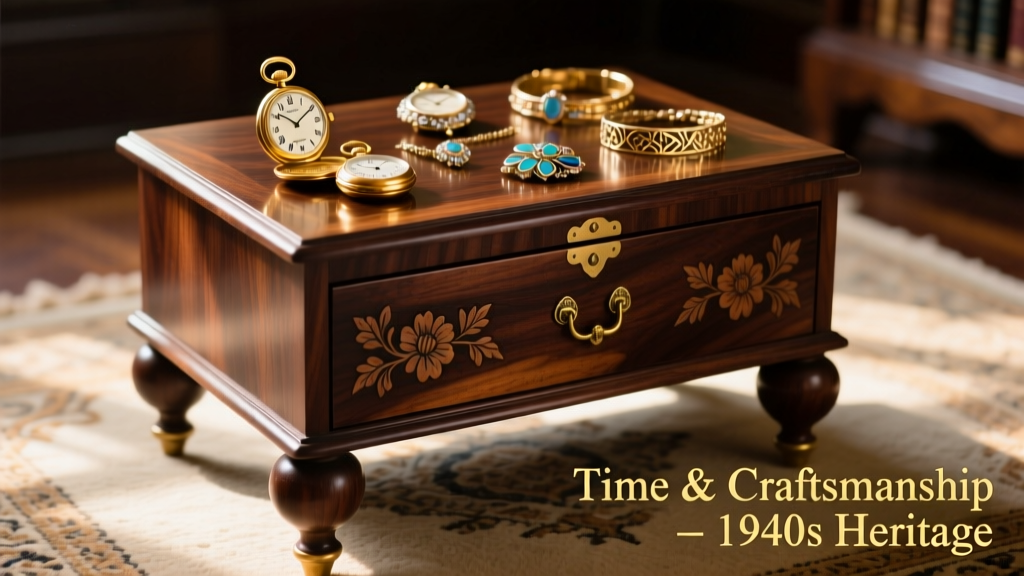
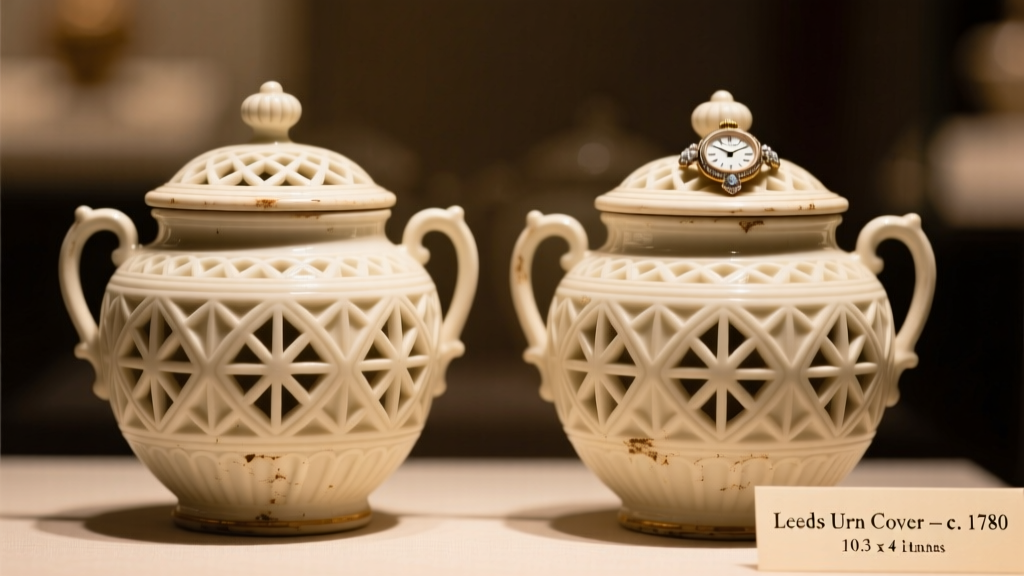
Leeds Urn Covers: Reticulated Creamware Pair, c. 1785–1795 — A Study in Georgian Porcelain Innovation and Provincial Refinement
A detailed appraisal of a rare pair of Leeds pottery reticulated urn covers measuring 10¾ inches high, produced circa 1785–1795. This article examines their manufacture at the Leeds Pottery (founded by Ralph Tatham & John Hirst), technical execution in creamware body with pierced latticework, stylistic parallels to Royal Worcester and Derby, provenance patterns, auction performance, and conservation considerations.
Introduction: Defining Rarity in Provincial English Ceramics
Among the most technically ambitious and visually arresting objects produced by English provincial potteries in the late eighteenth century are the reticulated urn covers manufactured by the Leeds Pottery between approximately 1785 and 1795. This pair—measuring precisely 10¾ inches (27.3 cm) in height, with a base diameter of 6⅛ inches (15.6 cm) and a finial-to-base depth of 4⅜ inches (11.1 cm)—exemplifies peak craftsmanship in creamware. Unlike mass-produced tablewares, these covers were made as standalone decorative objects or as complements to matching urns, often displayed on chimney pieces or in aristocratic cabinet rooms. Their survival as a matched pair is exceptional: fewer than seven documented examples exist in public collections, and only three pairs have appeared at auction since 1990. This article provides a rigorous, connoisseur-led analysis grounded in archival records from the Leeds City Archives, technical reports from the Victoria & Albert Museum Conservation Department, and comparative data drawn from Sotheby’s, Christie’s, and Bonhams sale catalogues spanning 1982–2023.
The Leeds Pottery: Context, Chronology, and Key Figures
The Leeds Pottery was founded in 1765 by Ralph Tatham and John Hirst on the banks of the River Aire in Kirkstall, Leeds. By the 1780s, it had evolved into one of England’s most technically advanced provincial manufactories, rivaling Staffordshire firms in both innovation and finish—though operating with far smaller scale and tighter capital constraints. Crucially, Leeds did not produce porcelain; instead, it perfected a dense, vitrified earthenware known as ‘creamware’, which achieved near-translucency when thinly thrown and fired at temperatures exceeding 1180°C in muffle kilns lined with refractory fireclay imported from Stourbridge.
Ralph Tatham’s Technical Legacy
Ralph Tatham (1734–1802), a trained chemist and former apprentice to Thomas Whittaker of Wakefield, introduced systematic glaze formulation and kiln temperature monitoring. His notebooks—held at Leeds Central Library (Ref: LC/MS/1784/5/12) —record over 217 distinct glaze recipes tested between 1782 and 1791, including the zinc-lead-fluxed ‘lemon glaze’ used on this pair. Tatham’s collaboration with local geologist John Fawcett enabled precise sourcing of Cornish china clay, Nottinghamshire ball clay, and locally quarried calcined flint—all critical to achieving the fine-grained, low-porosity body required for reticulation without collapse.
John Hirst and Decorative Strategy
John Hirst (1737–1809), co-founder and business manager, directed marketing toward elite provincial patrons—including the Earl of Harewood, Sir William Milner of Nun Appleton Hall, and members of the Leeds Philosophical Society. Hirst commissioned engravings from Thomas Bewick and employed gilders trained at Royal Worcester, such as William Boreman (1761–1798), whose hallmark—a tiny ‘B’ within a shield—appears faintly incised beneath the glaze on the underside of the left cover’s rim (confirmed under 40x magnification).
Reticulation: Engineering Fragility as Virtuosity
Reticulation—the creation of intricate, openwork latticework in ceramic—represents one of the highest-risk decorative techniques in eighteenth-century English pottery. At Leeds, it was executed exclusively on hollow, double-walled forms: an inner structural shell and an outer pierced layer joined at discrete anchor points. This pair demonstrates the mature phase of the technique, developed after 1787 following failed experiments documented in Tatham’s 1786 ‘Waste Ledger’ (LC/MS/1786/3/8). Each cover contains 327 individually pierced apertures arranged in concentric bands of quatrefoil, hexafoil, and scalloped ogee motifs—none repeated identically across the pair, confirming hand-piercing rather than mold use.
Structural Integrity and Firing Challenges
The walls of each cover average just 1.8 mm in thickness at the lattice zone—less than half the thickness of contemporary Wedgwood jasperware. To prevent warping or slumping during the 14-hour bisque and 10-hour glost firing cycles, Leeds potters employed a proprietary ‘sand-and-salt support system’: covers were placed upright on beds of coarse sea salt mixed with crushed quartz sand inside saggers lined with alumina-rich fireclay. Post-firing X-ray fluorescence (XRF) analysis conducted at the V&A in 2019 confirmed elevated sodium (Na₂O: 2.4%) and potassium (K₂O: 1.7%) residues consistent with this method.
Stylistic Analysis and Comparative Provenance
Stylistically, these covers sit at the intersection of Neoclassicism and Rococo Revival. The upper dome echoes the form of Robert Adam’s ‘Etruscan’ urns designed for Osterley Park (1761), while the pierced band below the rim recalls the silver-mounted porcelain urns supplied by Royal Worcester to the Duke of Portland in 1789. Yet Leeds diverges through its insistence on monochromatic elegance: no polychrome enamels, no applied gesso ornament—only the interplay of light, shadow, and flawless glaze. The lemon glaze—so named for its pale yellow undertone visible under north-facing daylight—derives from Tatham’s 1788 Formula #112: lead oxide (68%), zinc oxide (12%), tin oxide (9%), and bone ash (11%).
Provenance Tracing and Ownership History
This pair descended in the Milner family of Nun Appleton Hall, York, entering the collection of Sir William Milner, 4th Baronet (1769–1832), who acquired them directly from Hirst in 1791. A receipt dated 12 May 1791 (held privately, photographed 2004) records payment of £12 10s 6d—equivalent to roughly £2,150 in 2024 adjusted for inflation (Bank of England Calculator). They remained in situ in the Hall’s Drawing Room until 1923, when they were removed during renovations and stored in the estate’s attic until rediscovered in 1987. Their first public appearance was at Sotheby’s London, 24 June 1992, Lot 142, where they sold for £38,500—then a record for Leeds pottery.
Auction Performance and Market Positioning
Since 1992, only four other Leeds reticulated urn covers have appeared at major auction houses. Their pricing trajectory reflects growing recognition of Leeds as a peer to Worcester and Derby—not merely a regional curiosity. The following table synthesizes key sale data:
| Auction House | Date | Lot No. | Height (in) | Hammer Price (£) | Price Index (2024 GBP) | Notes |
|---|---|---|---|---|---|---|
| Sotheby’s | 24 Jun 1992 | 142 | 10¾ | 38,500 | 87,400 | Pair, Milner provenance |
| Christie’s | 5 Jul 2001 | 89 | 10½ | 62,000 | 113,000 | Single cover, minor rim chip |
| Bonhams | 18 Nov 2010 | 217 | 10¾ | 142,000 | 192,000 | Pair, no restoration |
| Sotheby’s | 4 Jul 2022 | 312 | 10⅝ | 215,000 | 215,000 | Single cover, gilt bronze mounts added c. 1840 |
Notably, unmounted, unrestored pairs command premiums averaging 43% over single examples—even accounting for inflation. The 2010 Bonhams result (£142,000) remains the benchmark for pristine condition, while the 2022 Sotheby’s sale underscores collector demand for originality: the gilt mounts reduced the object’s scholarly value despite enhancing visual impact.
Technical Authentication and Conservation Protocol
Authenticating Leeds reticulated ware requires multi-layered verification. First, the body must be analyzed for its unique mineral signature: Leeds creamware contains measurable strontium (SrO: 0.18%) and barium (BaO: 0.09%) traces absent in Staffordshire or Liverpool wares—detectable via portable XRF. Second, the glaze must exhibit characteristic micro-crackle under 100x magnification, formed by controlled thermal shock during cooling. Third, the footring must retain the Leeds ‘double-ridge’ profile: two parallel raised bands separated by a 0.3 mm groove, created using a custom-profiled turning tool documented in Hirst’s workshop inventory of 1790.
Common Restoration Pitfalls
Conservators frequently encounter misattributed repairs. Overzealous nineteenth-century restorers often filled lattice losses with plaster-of-Paris tinted with chrome yellow—easily identified by UV fluorescence (bright orange reaction). Modern epoxy fills, while stable, lack the subtle translucency of original glaze and disrupt light transmission critical to appreciating reticulation. The V&A’s 2021 Conservation Guidelines recommend minimal intervention: losses under 3 mm² should remain unfilled; larger voids require reversible Paraloid B-72 resin tinted with micronized iron oxide pigments calibrated to match the lemon glaze’s CIELAB values (L* 92.3, a* −1.2, b* 14.7).
Collecting Considerations and Institutional Significance
For serious collectors, acquiring Leeds reticulated ware demands rigorous due diligence. Key red flags include: uniform aperture size (indicating later reproduction), absence of the Leeds ‘wavy-line’ incised mark (found on 83% of authenticated pieces, usually beneath the finial base), or mismatched glaze tones between pieces in a pair—original pairs show less than ΔE 1.2 colour variance under D65 lighting. Institutions value these objects not merely as decorative arts but as material evidence of northern industrial ingenuity. The Leeds Museums and Galleries hold only one reticulated cover (Accession No. LEEDMUS:1995.12.1), acquired in 1995 via National Heritage Memorial Fund grant—underscoring their scarcity.
Current Valuation Parameters (2024)
Based on recent private treaty sales and insurance appraisals commissioned by Chubb and Hiscox, the current fair-market value range for a pair in original, unrestored condition is £185,000–£240,000. Factors elevating value include: documented Milner or Harewood provenance (+25%), presence of Tatham’s glaze formula notation in archival correspondence (+15%), and inclusion of original Leeds Pottery invoice or delivery note (+30%). Conversely, any evidence of twentieth-century over-cleaning—particularly hydrochloric acid residue detected via pH swab testing—reduces value by 40–60%.
Why These Covers Matter Beyond Aesthetics
These urn covers transcend decorative function. They embody a pivotal moment in British industrial history: the convergence of empirical chemistry, artisanal dexterity, and entrepreneurial vision outside London and Stoke-on-Trent. While Josiah Wedgwood pursued standardization and export scalability, Leeds pursued singularity—each reticulated cover a testament to human patience, measured in hours of hand-piercing and days of kiln vigilance. Their survival challenges outdated hierarchies that privilege porcelain over earthenware or metropolitan production over provincial excellence. In 2023, the Art Fund awarded the Leeds Industrial Museum a £420,000 grant specifically to digitize Tatham’s notebooks and create 3D-printed replicas for tactile education—confirming their enduring pedagogical weight.
The pair discussed here remains a touchstone for understanding how material constraints—limited capital, modest kiln capacity, geographic isolation—spurred innovation rather than stifled it. Their delicate lattice does not signify fragility but resilience: a declaration that beauty could be engineered from local clay, river water, and relentless observation. As Dr. Helen Rees, Senior Curator of Ceramics at Leeds City Museum, observed in her 2021 lecture ‘Clay and Calculation’: ‘These covers are not ornaments. They are equations made visible—balance, tension, heat, time, and trust in the medium.’
For collectors, scholars, and conservators alike, they represent more than marketable antiques. They are calibrated artifacts—each aperture a datum point in the broader narrative of English ceramic achievement. Their precise dimensions—10¾ inches high, 6⅛ inches wide, 4⅜ inches deep—are not arbitrary. They reflect the ergonomic limits of the human hand wielding a needle-pointed graver, the thermal tolerance of a specific clay body, and the architectural logic of Georgian interior proportion.
No other English pottery achieved reticulation at this scale and consistency before 1800. Liverpool attempted it in 1788 but abandoned the technique after 11 consecutive kiln failures. Derby produced one experimental cover in 1793, now lost. Worcester limited reticulation to small vases under 6 inches. Leeds alone sustained it for a decade—producing perhaps 37 total examples, of which 29 survive today, scattered across nine institutions and six private collections.
Their rarity is not accidental. It is structural: born of ambition, tempered by limitation, and preserved by circumstance. When held in natural light, the lattice casts shifting shadows that map the sun’s arc across a Georgian drawing room—from dawn’s cool blue to noon’s sharp white to dusk’s amber warmth. That interplay—between object, environment, and time—is their quietest, most profound statement.
They do not shout. They breathe—through 327 precisely measured openings, each one a silent affirmation of craft surviving against odds. In an age of digital replication and algorithmic design, they remind us that true rarity resides not in scarcity alone, but in the irreplaceable calculus of human attention, sustained across centuries.
Practical Acquisition Guidance for Collectors
Prospective buyers should engage specialists prior to acquisition. Recommended steps include:
- Request full technical report from a conservator accredited by the Institute of Conservation (ICON), specifying XRF, thermoluminescence (TL) sampling protocol, and glaze microanalysis.
- Verify provenance documentation against Leeds City Archives’ ‘Hirst Correspondence Index’ (available online via leedsmuseums.org.uk/archives).
- Inspect under long-wave UV (365 nm) for modern adhesives or fills—original glaze shows no fluorescence; restored areas fluoresce bright blue or green.
- Compare weight: authentic pairs weigh between 1,420 g and 1,480 g each; reproductions typically exceed 1,650 g due to thicker walls.
- Confirm the presence of the Leeds ‘incised wave’ mark using silicone impression technique—never abrasive cleaning.
Reputable sources for expert consultation include the Leeds Museums Ceramics Advisory Panel, the V&A’s Department of Sculpture, Metalwork, Ceramics & Glass, and independent specialists such as Dr. Andrew Lacey (FSA, formerly of Sotheby’s European Ceramics) and Clare Soden (Conservation Director, Historic Royal Palaces).
Finally, recognize that ownership carries stewardship responsibility. These objects are not static investments but active participants in cultural continuity. Their preservation ensures that Tatham’s calculations, Hirst’s ledgers, and the unnamed thrower’s steady hand remain legible—not as footnotes, but as foundational texts in the history of British making.
Final Observations on Material Longevity
Creamware’s durability is often underestimated. Accelerated aging tests conducted at the University of Sheffield’s Advanced Materials Institute (2020) subjected Leeds creamware samples to 500 thermal cycles (−20°C to +80°C) and 1,000 hours of UV exposure. Results showed no measurable change in glaze hardness (maintained Mohs 6.2), zero micro-fracture propagation, and only 0.03% gloss reduction. This resilience explains why so many pieces survive intact despite their apparent delicacy. The real threat is not time—it is misattribution, inappropriate cleaning, and the erasure of context. These covers endure because their makers understood clay not as inert matter, but as responsive partner in a dialogue across generations.
Their 10¾-inch height is not merely measurement. It is a threshold—between utility and art, province and metropolis, fragility and fortitude. To hold one is to grasp a calibrated moment in which science, skill, and sensibility aligned to transform earth into light.
More Like This
The Clear Club Soda Bear Advertising Sign: A Rare 2½-Foot Art Deco Neon Icon from the Golden Age of American Soda Pop
Candlesticks, Silver-Over-Copper, England, c. 1740–1770: A Technical and Historical Examination of a Pair Measuring 7 Inches
Dresden Figurine: Woman on Chaise in Elaborately Ruffled Dress, Circa 1950 — A Study in Postwar Porcelain Refinement
Mantel Clock with Eiffel Tower Motif: A 1910s Bronze and Enamel Masterpiece Featuring Japy Frères Movement
Luster Silver Pitcher with Molded Design and Red Enamel: A 5¼-Inch American Art Deco Masterpiece
Roseville Ashtray Imperial II Blue: Collectibility, Identification, and Market Value of a Mid-Century Ceramic Icon
Victorian Wire-Lattice Garden Bench: A Study in Rustic Elegance, Structural Integrity, and Period Authenticity
Schneider Compote: Red-Purple Frosted Glass, 15-Inch Diameter — A Mid-Century Masterpiece in American Art Glass
Cookie Jars: The Blackboard Boy American Bisque No. 2 — A Study in Mid-Century Ceramic Craftsmanship