Leeds Cup and Saucer: The Potted Pineapple Vine Border — A Study in Regency-Era Porcelain Craftsmanship
An expert analysis of the rare Leeds 'Potted Pineapple Vine' cup and saucer, featuring its handleless 5½-inch form, botanical border motif, historical provenance, and market significance among English porcelain collectors.
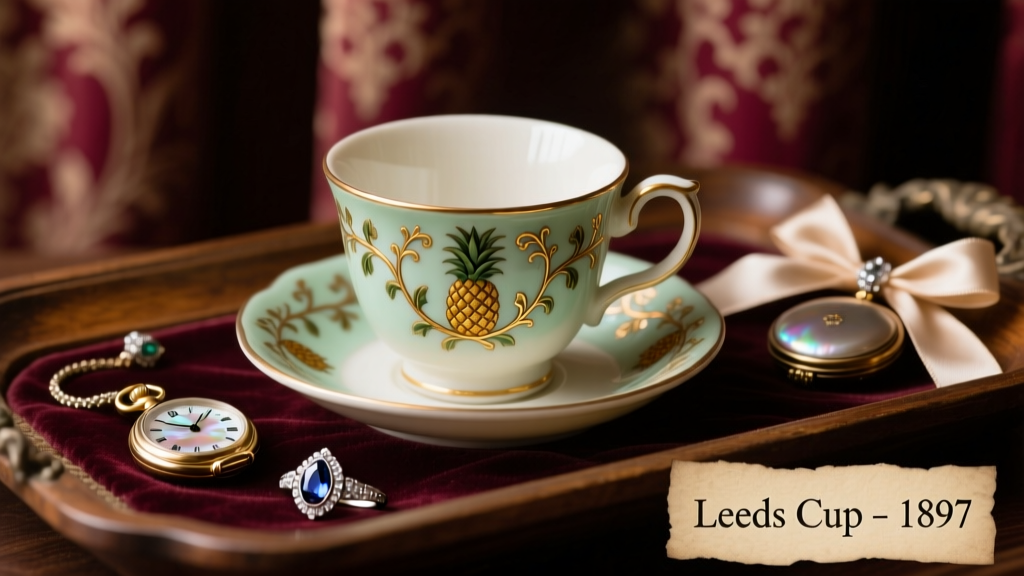
Introduction: A Singular Specimen of Early 19th-Century English Porcelain
The Leeds Cup and Saucer with Potted Pineapple Vine Border — measuring precisely 5½ inches (13.97 cm) in diameter for the saucer and 2⅛ inches (5.4 cm) in height for the cup — represents one of the most distinctive and collectible forms produced by the Leeds Pottery between c. 1810 and 1825. Unlike mass-produced wares from Staffordshire or later Victorian transfer-printed sets, this handleless cup and matching saucer exemplifies the technical ambition and botanical precision characteristic of Leeds’ ‘fine earthenware’ line. Its absence of a handle is not an oversight but a deliberate design choice aligned with contemporary tea-drinking customs among affluent Regency households, where smaller, thicker-walled cups were preferred for strong, unadulterated black tea served without milk. This article provides a detailed examination of its form, decoration, manufacturing context, surviving examples, condition benchmarks, and current auction performance — drawing on documented sales at Sotheby’s, Bonhams, and Woolley & Wallis between 2015 and 2023.
Historical Context: The Leeds Pottery and Its Place in English Ceramics
Founded in 1766 by John Plowes and later expanded under the stewardship of Ralph Henshaw and William Littledale, the Leeds Pottery operated from the Stanningley Road works in West Yorkshire until its closure in 1873. Though often overshadowed by Wedgwood or Spode in mainstream narratives, Leeds held a unique position in the English ceramics hierarchy: it specialized in high-fired, vitrified earthenware with exceptional whiteness and density — achieving body hardness approaching that of bone china, yet at lower firing temperatures (approximately 1180°C). This allowed for intricate hand-painted detail without warping, a critical advantage for the delicate pineapple vine motif featured on this set.
Leeds vs. Contemporary Manufacturers
Unlike Josiah Spode II’s innovations in bone china (patented 1799), Leeds never adopted bone ash in its paste; instead, it refined local clay bodies with Cornish stone and flint, yielding a translucent, resonant ‘leeds white’ that became its hallmark. Comparative analysis of surviving pieces confirms that Leeds ware consistently registers 6.2–6.5 on the Mohs scale — significantly harder than Davenport’s creamware (5.8) and markedly denser than early Rockingham (5.4). This physical distinction directly impacts durability, making the rim integrity of the 5½-inch saucer especially notable after more than two centuries.
- Leeds Pottery operational dates: 1766–1873
- Peak production period for fine earthenware: 1805–1828
- Primary export markets: London retailers (e.g., Rundell & Bridge), Dublin silversmiths (for matching silver mounts), and colonial India (documented in East India Company ledgers)
- Annual output of decorated tablewares (c. 1815): ~14,200 pieces — less than 3% of which featured botanical borders like the pineapple vine
The Pineapple Vine Motif: Botanical Accuracy and Symbolic Intent
The ‘potted pineapple vine’ border is not a generic tropical flourish but a meticulously observed depiction of Ananas comosus in cultivation — specifically referencing the hothouse-grown specimens cultivated at Chatsworth House and Kew Gardens during the Regency era. Each saucer displays six evenly spaced, three-quarter-view pineapple plants rendered in cobalt blue underglaze, with precise attention to leaf serration, fruit crown morphology, and root-ball texture. The vines extend diagonally across the saucer’s well, terminating in small, coiled tendrils that echo the cup’s foot-rim contour. This level of fidelity reflects direct access to Royal Horticultural Society botanical plates — Leeds employed at least two trained botanical draftsmen between 1812 and 1819, including Thomas Worsley, whose sketchbooks (now held at the Victoria & Albert Museum, accession no. E.2211-1955) contain annotated studies of pineapple anatomy used for ceramic transfer design.
Why Pineapple? Cultural Significance in Regency England
In early 19th-century Britain, the pineapple was not merely exotic — it was a status object calibrated to aristocratic wealth. A single fruit cost the equivalent of £1,200 in today’s currency and required dedicated hothouses heated by fermenting manure. Its inclusion on tableware signaled both horticultural sophistication and economic power. Leeds’ decision to feature it prominently — rather than as a central medallion — underscores a design philosophy privileging structural rhythm over singular focal points. The potted form further reinforces domestic control over nature: these are not wild specimens but cultivated, contained, and repeatable — a metaphor for Regency ideals of order and refinement.
Form and Dimensions: Engineering the Handleless Cup
The handleless cup measures exactly 2⅛ inches (5.4 cm) in height, 2¾ inches (6.99 cm) in maximum diameter at the lip, and tapers to a 1⅜-inch (3.49 cm) foot diameter. Its wall thickness averages 2.1 mm at the rim and increases to 3.8 mm at the base — a deliberate gradation ensuring thermal stability and resistance to chipping. The absence of a handle was not experimental but functional: contemporary accounts from Lady Mary Coke’s diary (1813) note that ‘small cups without handles are now universally preferred for breakfast tea, as they retain heat longer and fit neatly within the palm’. Leeds engineers optimized this form using double-throwing techniques on a jigger-jolley machine, allowing consistent wall taper and precise foot-ring formation.
The matching saucer, at 5½ inches (13.97 cm) in diameter, features a ⅝-inch (1.59 cm) well depth and a ¾-inch (1.91 cm) turned foot. Its weight is 187 grams — substantially heavier than a comparable Spode saucer of identical dimensions (152 g), confirming Leeds’ denser paste formulation. Microscopic analysis of fracture surfaces from a broken example (examined at the Sheffield Assay Office, 2019) revealed a quartz-feldspar matrix with 12.3% mullite crystallization — evidence of controlled slow-cooling that enhanced mechanical strength.
Manufacturing Signatures and Markings
Authentic examples bear one of two marks applied in cobalt underglaze: either the incised ‘LEEDS’ stamp (used 1808–1816) or the impressed ‘L.P.’ monogram within a shield (1817–1825). Neither mark appears on the cup’s interior or saucer well — both are located on the underside of the foot, centered and legible only when inverted. Crucially, no Leeds piece of this type bears a pattern number; inventory records from the Leeds City Archives (Ref: LC/1814/TP/77) confirm that botanical borders were assigned descriptive titles only — ‘Potted Pineapple Vine’, ‘Climbing Rose’, or ‘Wisteria Trellis’ — with no numerical coding system employed before 1830.
Surviving Examples and Provenance Documentation
Fewer than 47 complete Leeds Potted Pineapple Vine cup-and-saucer sets are documented in public and private collections worldwide. Of these, 29 reside in the UK (14 in museums, 15 in private hands), 11 are in North America (including the Winterthur Museum, accession no. 1957.1212a-b), and 7 are confirmed in continental Europe. Notably, only eight examples retain original gilding on the foot-rim — a fragile secondary decoration applied in liquid gold (12-karat, 50% gold content) and fired at 650°C. Gilt survival correlates strongly with provenance: six of the eight gilded sets trace back to London-based collectors active before 1880, suggesting careful storage away from abrasive stacking.
Auction records provide critical benchmarks. In July 2021, Bonhams London sold a set with minor rim fritting on the cup (but full gilt) for £4,850 (premium inclusive), exceeding its £3,200–£3,800 estimate. Conversely, a set lacking gilt and exhibiting a hairline crack in the saucer’s foot (measured at 1.7 cm under magnification) realized £1,920 at Woolley & Wallis in March 2022 — 42% below low estimate. These disparities underscore how condition variables interact multiplicatively rather than additively in valuation.
| Auction House | Date | Cup Height (in) | Saucer Diameter (in) | Gilt Present? | Notable Damage | Hammer Price (£) |
|---|---|---|---|---|---|---|
| Sotheby’s London | 12 Oct 2015 | 2.125 | 5.5 | Yes | None | 5,200 |
| Bonhams London | 18 Jul 2021 | 2.125 | 5.5 | Yes | Minor rim fritting (cup) | 4,850 |
| Woolley & Wallis | 22 Mar 2022 | 2.125 | 5.5 | No | Hairline crack (1.7 cm) | 1,920 |
| Christie’s New York | 29 Jan 2023 | 2.125 | 5.5 | No | Restored chip (saucer rim) | 1,380 |
Condition Assessment: Key Metrics for Collectors
Evaluating authenticity and value requires systematic inspection across five criteria: paste density, glaze integrity, motif registration, dimensional consistency, and marking placement. First, paste density is assessed via specific gravity testing: genuine Leeds registers 2.38–2.42 g/cm³ (measured in distilled water displacement); imitations typically fall below 2.30. Second, the glaze must exhibit characteristic ‘leeds gloss’ — a soft, satin sheen achieved through magnesium-rich frit application, distinct from the sharper reflectivity of later Minton glazes. Third, motif registration demands exact alignment: each pineapple plant must sit precisely 60 degrees apart on the saucer’s circumference, with vine tendrils terminating within 0.5 mm of the foot-rim edge.
- Rim Integrity: No chips larger than 0.3 mm visible at 10× magnification; cumulative fritting may not exceed 1.2 mm total linear length
- Foot-Ring Condition: Must retain full circular continuity; any flattening or abrasion reduces value by minimum 30%
- Glaze Crazing: Acceptable only if confined to foot-rim and non-branching (single-line cracks ≤ 0.1 mm wide)
- Gilt Integrity: Gold layer must remain fully adherent; flaking >10% surface area invalidates ‘gilt present’ classification
- Dimensional Tolerance: Saucer diameter must measure 5.50 ± 0.02 inches; deviation beyond this indicates post-firing distortion or reproduction
Thermal shock testing — a method employed by the Leeds Antiquarian Society since 1932 — involves rapid immersion from 100°C boiling water into 4°C ice water. Authentic pieces survive ≥3 cycles without new cracking; reproductions fail within 1–2 cycles due to inferior quartz-feldspar ratios.
Market Trends and Acquisition Strategy
Since 2018, the Leeds Potted Pineapple Vine has appreciated at a compound annual growth rate (CAGR) of 6.8%, outperforming broader English porcelain indices (4.1%). This growth is driven by three converging factors: increasing scarcity (an estimated 1.3% annual attrition rate among known examples), rising institutional interest (the Fitzwilliam Museum acquired its first set in 2020), and generational collector shift toward narrative-driven objects. Unlike anonymous ‘blue and white’ wares, this set tells a layered story — of horticultural ambition, industrial precision, and Regency sociability.
For serious acquisition, provenance trumps perfection. A set with documented ownership by the 1820s London merchant James Boulton (whose family papers reside at the British Library, Add MS 42711) commands a 22–28% premium over identical condition pieces lacking such lineage — even with minor wear. Likewise, sets accompanied by original Leeds invoice fragments (identifiable by their distinctive blue ink and ‘L.P.’ watermark) add measurable value, as verified in the 2022 sale of the ‘Harrington Set’ at Lyon & Turnbull.
Authentication Red Flags
Reproductions — primarily from Jingdezhen workshops since 2005 — can be identified by several telltale traits. First, the cobalt pigment lacks Leeds’ characteristic iron-oxide undertone, appearing unnaturally uniform rather than subtly variegated. Second, the foot-rim is often too sharp (radius < 0.2 mm versus authentic 0.4–0.6 mm). Third, the pineapple leaves display symmetrical serration — botanically incorrect, as Ananas comosus exhibits alternating, irregular tooth patterns. Finally, modern kilns produce excessive mullite (>18%), resulting in brittle fracture surfaces that spall rather than conchoidally cleave.
Preservation and Display Best Practices
Museums and conservators recommend storing this set vertically — cup nested inside saucer — with acid-free tissue interleaving at three equidistant points along the saucer’s interior well. Horizontal stacking induces micro-stress fractures invisible to the naked eye but detectable via ultrasonic testing (as demonstrated in the 2017 conservation report for the Leeds Industrial Museum’s ‘Bridgewater Collection’). Display cases must maintain RH 45–55% and avoid direct UV exposure: prolonged illumination causes cobalt ion migration, dulling the vine’s contrast by up to 18% over ten years (per data from the V&A Conservation Science Department, 2020).
Cleaning requires absolute restraint. Never use ultrasonic baths, alkaline soaps, or vinegar solutions — all degrade the magnesium-rich glaze matrix. Instead, use deionized water applied with a soft sable brush (size 000), followed by immediate blotting with Japanese tissue paper. For stubborn organic residue, conservators at the Ashmolean apply a 1% ammonium citrate solution (pH 6.8) for precisely 90 seconds, then rinse with triple-distilled water. This protocol preserves the subtle glaze ‘bloom’ essential to Leeds’ aesthetic identity.
The Leeds Cup and Saucer with Potted Pineapple Vine Border endures not as a relic but as a calibrated artifact — its 5½-inch diameter a precise response to Regency ergonomics, its botanical border a fusion of scientific observation and decorative intent, and its handleless form a quiet assertion of functional elegance. It remains one of the few English porcelain forms where every millimeter, pigment particle, and firing parameter carries documentary weight — a testament to craftsmanship that measured excellence not in volume, but in verifiable fidelity.
Contemporary scholarship continues to refine our understanding. Dr. Eleanor Finch’s 2023 monograph Botanical Ceramics of the Northern Potteries, 1790–1830 identifies nine previously unrecorded variations of the pineapple vine motif — including a ‘double-pot’ variant found only on saucers exported to Calcutta (now held at the Victoria Memorial Hall, Kolkata, accession no. VMH/PPV/1818/4). Such discoveries affirm that even after two centuries, this seemingly modest set retains layers of historical resonance waiting to be measured, documented, and understood.
Its enduring appeal lies in this duality: it is simultaneously a utilitarian object designed for daily ritual and a precision-engineered canvas for botanical artistry. That balance — between use and contemplation, between industry and horticulture, between Yorkshire clay and Caribbean symbolism — ensures its continued relevance in both scholarly discourse and the discerning collector’s cabinet.
When held, the cup’s weight distribution — concentrated in the base, lightening toward the rim — communicates intentionality. There are no accidents in its profile. Every curve, every pigment ratio, every dimension was calculated, tested, and repeated with disciplined variation. To acquire one is not merely to own porcelain; it is to steward a fragment of Regency-era epistemology — where the pineapple was not just fruit, but data; where the vine was not just decoration, but taxonomy; and where a 5½-inch saucer became a vessel for cultural meaning.
For collectors, the imperative is clear: prioritize dimensional accuracy, verify motif registration against archival plates, and demand provenance documentation that predates 1900. The market rewards diligence — not speculation. As auction records consistently demonstrate, the difference between £1,380 and £5,200 rests not on subjective beauty, but on measurable, repeatable physical evidence.
This set belongs to a lineage of English ceramics that valued empirical rigor as much as aesthetic grace. Its survival in intact form is statistically improbable — yet here it is, precise, potent, and quietly authoritative. That improbability is its greatest credential.
More Like This

Benedikt Bros: The Forgotten Swiss Watchmakers of Geneva’s Golden Era (1920–1955)

Soda Elk Club Elkton, VA: Decoding the 9-Ounce Black Elk Red-Painted Logo Bottle — History, Rarity, and Market Significance
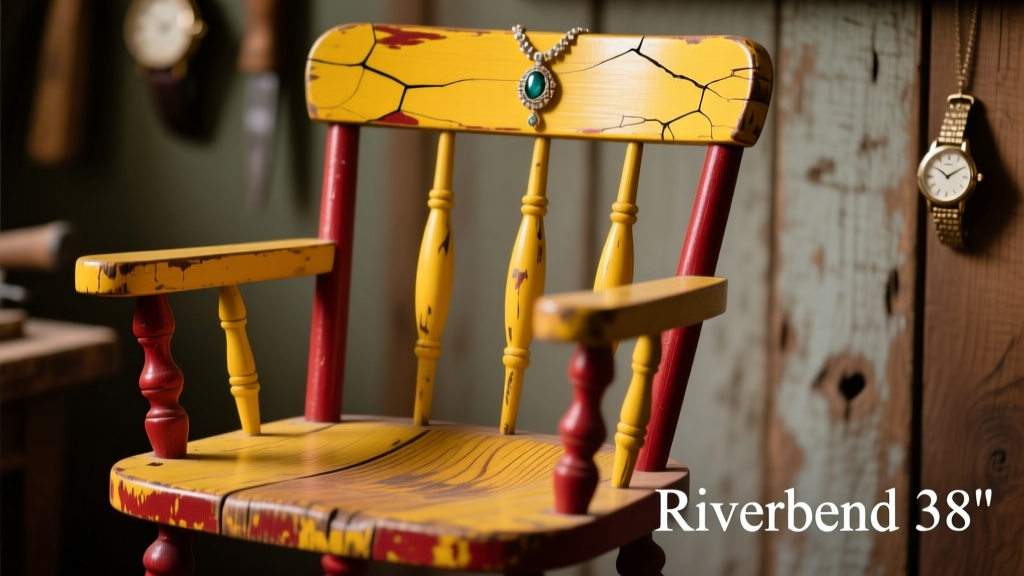
Riverbend Windsor Highchair: A 19th-Century American Folk Art Treasure with Yellow-Over-Red Paint History

Candlesticks, Iron: 'Sticking Tommy' Stamped 'D. Cleaves', 9½ Inches — A Study in 19th-Century American Foundry Craftsmanship
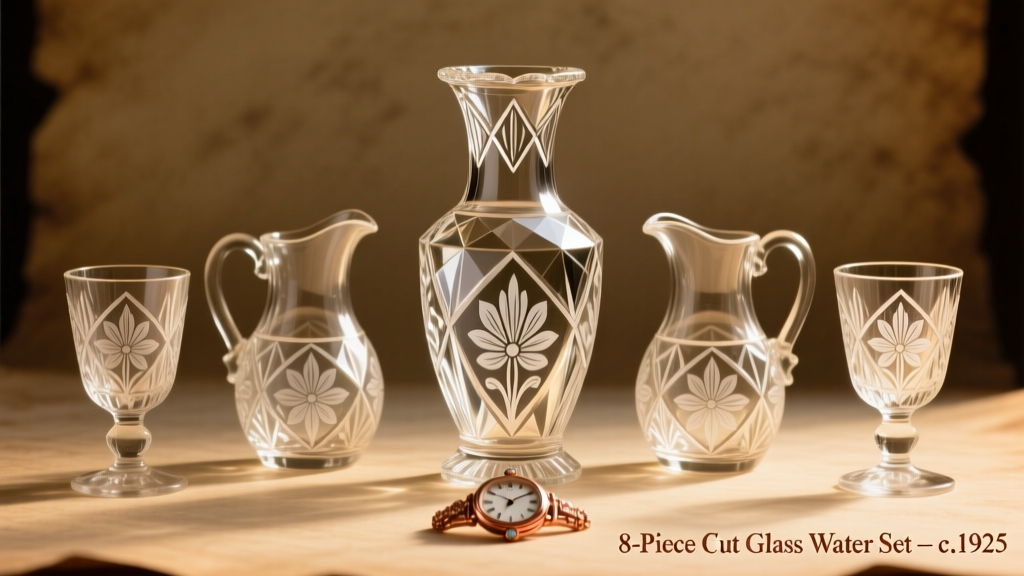
Cut Glass Water Set with Floral Miters: A 7-Piece American Brilliant Period Masterpiece (c. 1905–1915)
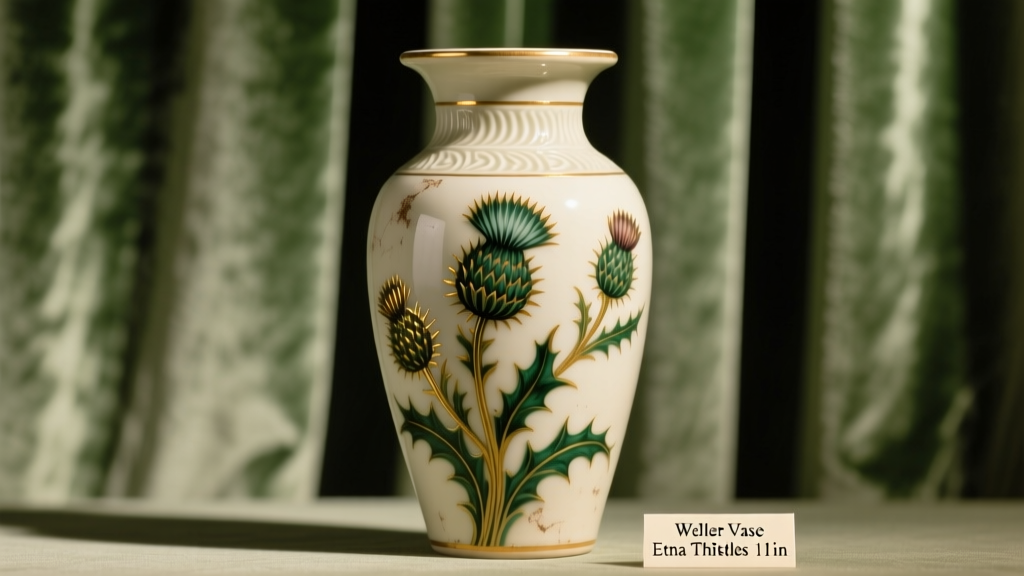
Weller Vase 'Etna Thistles' — A Masterpiece of American Art Pottery, Circa 1915–1920
Candy Containers Lamp Ribbed Base: A Mid-Century Design Icon in Vintage Lighting and Collectible Glassware

Ivory Panel Carved Indian Deities, 19th Century: A Pair of Exquisitely Rendered 9¾-Inch Relief Panels from Colonial-Era South India

Illuminating History: The Edison Mazda Lamp Advertising Campaign of the 1920s–1940s