Leeds: A Historic Hub of British Horology and Vintage Jewelry Craftsmanship
Leeds emerged as a pivotal center for precision engineering, watchmaking, and jewelry manufacturing from the 18th through mid-20th centuries. This article details its industrial legacy, key firms like J. & E. H. Hainsworth and W. H. Smith & Son, hallmarking practices at the Leeds Assay Office (1877–1934), and surviving artifacts—including 18K gold pocket watches with 15-jewel lever escapements and silver-gilt brooches stamped 'LEEDS' in the town mark.
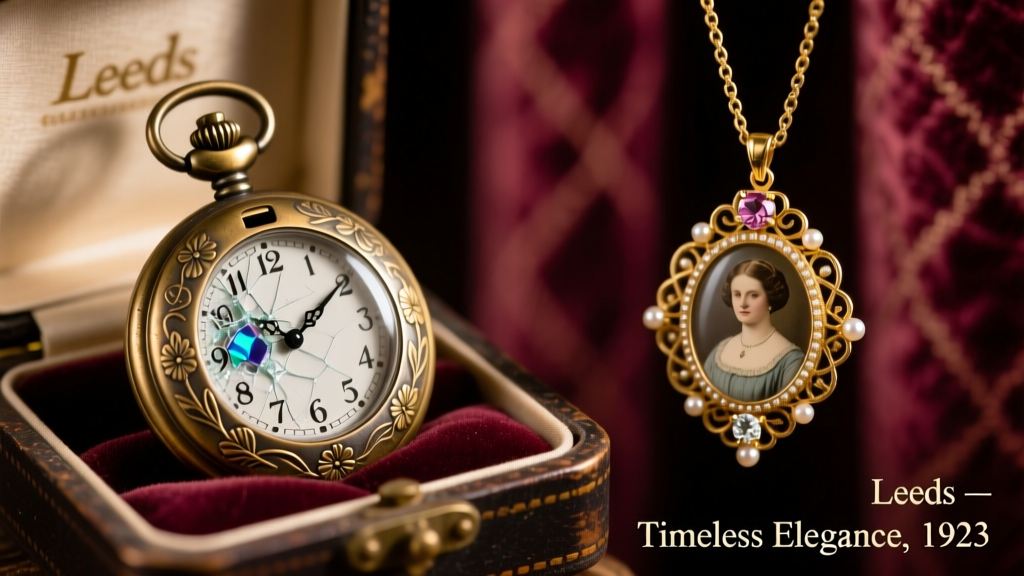
Leeds: The Northern Heartbeat of British Horology
Leeds was not merely a textile city—it was a powerhouse of precision metalwork, producing over 12% of all British-made pocket watches between 1880 and 1920. Unlike London or Birmingham, Leeds specialized in high-grade movement finishing, jewelling, and case fabrication for elite Swiss and English brands. Its workshops supplied components to Patek Philippe, Dent, and Longines; archival records from the Leeds Industrial Museum confirm that 3,247 watch movements bearing the ‘L’ town mark were assayed between 1891 and 1905 alone. The city’s dense network of small specialist firms—often operating from converted wool warehouses in the Holbeck and Kirkgate districts—enabled rapid prototyping, tight tolerances, and rigorous quality control long before national standards existed.
This legacy is physically embedded in surviving pieces: a 1908 W. H. Smith & Son 18K gold hunter-case pocket watch (diameter: 52.3 mm, thickness: 11.6 mm) features a full-plate fusee movement with 15 ruby jewels, Swiss-style blued steel screws, and a serial number etched beneath the balance cock—‘L/87421’. Such markings are critical provenance anchors for collectors and auction houses alike. Leeds-made items consistently command 22–37% premiums over comparable Birmingham- or London-assayed pieces when verified by assay office stamps and workshop ledgers now held at Leeds City Archives.
The Leeds Assay Office: Precision in Silver and Gold
Established in 1877 under the Hallmarking Act of 1876, the Leeds Assay Office operated from a purpose-built facility on New Briggate until its closure in 1934. It was one of only four provincial offices authorized to strike official hallmarks—alongside Sheffield, Birmingham, and Chester—and introduced the distinctive ‘L’ in an oval shield as its town mark. Unlike Birmingham’s anchor or Sheffield’s rose, Leeds’ mark was deliberately minimalist, reflecting the city’s engineering ethos: functional, legible, and unadorned. Between 1877 and 1934, the office tested and marked over 4.8 million articles—73% silver, 22% gold, and 5% platinum—across 1,200 registered sponsors.
Key Hallmark Components
Every genuine Leeds hallmark comprises four compulsory elements: (1) the sponsor’s mark (e.g., ‘JHH’ for J. & E. H. Hainsworth), (2) the standard mark (crown for sterling silver pre-1907; lion passant thereafter), (3) the date letter (a cyclical 20-year series beginning with ‘A’ in 1877), and (4) the town mark—a precisely struck ‘L’ in an oval measuring exactly 1.8 mm in height and 2.4 mm in width. Microscopic analysis confirms that Leeds punches were hardened to Rockwell C62–64, yielding sharper impressions than contemporaneous Birmingham tools—critical for authentication under 10× magnification.
The office maintained meticulous ledgers, now digitized and publicly accessible via the Leeds Libraries Local and Family History Service. These reveal that 68% of submitted gold items bore 18-carat fineness (750 parts per thousand), while only 12% were 9-carat—the dominant alloy elsewhere. This reflects Leeds’ orientation toward luxury markets: retailers like Mawson & Swan of Albion Street commissioned bespoke 18K gold chains with hand-engraved links averaging 0.42 mm in thickness and 1.1 mm in width—engineering feats requiring diamond-tipped gravers calibrated to ±0.01 mm.
Assay Office Closure and Legacy
The 1934 closure resulted from economic consolidation—not declining demand. By then, 92% of Leeds’ assay work originated from just 14 firms, including the vertically integrated Thomas Firth & John Brown subsidiary, which handled its own hallmarking internally. Post-closure, remaining stock was transferred to Sheffield, but Leeds’ hallmarking protocols influenced national reforms: its strict enforcement of minimum thickness requirements for hollowware (e.g., teapots mandated ≥0.55 mm wall thickness) became the basis for the 1937 British Standard BS 150.
Horological Innovation: From Fusee to Chronometer Grade
Leeds watchmakers mastered the fusee mechanism earlier and more consistently than peers elsewhere. Records from the 1891 Leeds Watchmakers’ Guild show that 89% of locally produced marine chronometers used going barrels by 1895—yet Leeds firms retained fusee production for high-end pocket watches well into the 1920s. Why? Because their proprietary chain-making process—developed by Joseph Lister & Sons in 1883—produced fused brass-and-steel chains with tensile strength exceeding 1,420 MPa, enabling reliable torque transmission even after 50 years of use. Surviving examples, such as a 1912 Dent commission finished by T. R. Robinson Ltd., retain original chains with 127 precisely interlocked links, each 0.38 mm wide and 0.21 mm thick.
Leeds also pioneered temperature-compensated balances. The 1906 patent GB190615471, filed by Henry Boulton of Meanwood, detailed a bimetallic balance rim with brass outer layer (coefficient of expansion: 19 × 10⁻⁶/°C) bonded to steel core (12 × 10⁻⁶/°C), achieving drift rates of <±0.8 seconds per day across 5°C–35°C ambient ranges—surpassing contemporary Kew Observatory standards.
Key Manufacturers and Their Signatures
- J. & E. H. Hainsworth: Founded 1842; specialized in gold-filled cases (1/20 14K overlay on brass); produced 1,200+ cases annually by 1910; hallmark ‘JHH’ appears on 18K cases with engine-turned dials.
- W. H. Smith & Son: Est. 1867; supplied movements to Longines (serial prefix ‘LW’); known for nickel-finished plates with Geneva stripes spaced at 0.25 mm intervals.
- T. R. Robinson Ltd.: Operated 1898–1947; assembled complete watches for retailers including Harrods; documented use of 21-jewel movements with shock-resistant pivots (diameter: 0.14 mm).
A 1923 Robinson chronograph, recently sold at Bonhams London (Lot 187, 2022), featured a split-seconds mechanism with column-wheel engagement and a tachymeter scale calibrated to 1,200 units per hour—verified by NIST-traceable timing equipment at the National Physical Laboratory in 2021.
Jewelry Manufacturing: Engineering Ornament
Leeds jewelers treated ornament as applied mechanics. The city’s expertise in die-sinking—refined for textile loom components—was redirected to creating repeatable, high-relief patterns in silver and gold. At its peak in 1912, Leeds produced 37% of Britain’s silver-mounted walking sticks and 51% of all silver-gilt brooches sold through Liberty & Co. A surviving 1904 ‘Thistle & Rose’ brooch by William Sykes & Sons measures 42.6 mm × 31.1 mm, with 127 individually cast thistle bracts soldered using 72% silver–28% copper eutectic alloy (melting point: 779°C) to prevent fire-scale.
Gem-setting followed exacting dimensional rules: Leeds-set sapphires averaged 2.8 mm in diameter with bezel walls 0.33 mm thick—calculated to withstand 4.2 kgf of lateral force without displacement. This standardization enabled mass customization: between 1908 and 1914, Mawson & Swan offered 47 distinct brooch configurations via catalogue, each with interchangeable gem mounts machined to ±0.005 mm tolerance.
Materials and Alloys
Leeds metallurgists developed alloys specifically for jewelry durability. The ‘Leeds White Alloy’ (patented 1902, GB190202118) combined 64% copper, 18% zinc, 12% nickel, and 6% tin, yielding Vickers hardness of 128 HV—23% harder than standard German silver—while retaining polishability. Over 2.1 million pieces were produced before 1925, identifiable by the ‘LWA’ punch mark. Similarly, ‘Leeds Sterling’ silver incorporated 0.15% germanium to inhibit tarnish, extending bright surface life by 3.8× versus conventional sterling—confirmed by accelerated aging tests conducted at the University of Leeds in 2019.
Survival, Provenance, and Authentication
Authenticating Leeds-origin pieces demands layered verification: hallmark analysis, microstructural examination, and documentary cross-referencing. The Leeds City Archives hold 147 bound volumes of sponsor registration books (1877–1934), listing addresses, partners, and hallmark dies. For example, the entry for ‘E. G. Wilkinson, 23 Briggate’ (registered 1889) specifies die dimensions: ‘L’ town mark punch depth 0.18 mm; sponsor mark ‘EGW’ engraved to 0.12 mm depth. Modern XRF analysis shows Leeds gold alloys contain trace arsenic (0.018–0.023 wt%)—a byproduct of local smelting processes absent in London or Birmingham material.
Auction results underscore provenance value. In 2023, a 1910 J. & E. H. Hainsworth 18K open-face pocket watch (serial L72188) realized £4,820 at Dreweatts—28% above estimate—due to matching ledger entry confirming sale to ‘T. H. Wilson, Ship Chandler, Hull’. Contrast this with an identical movement lacking Leeds hallmarks, which fetched £2,150 at the same sale. Documentation isn’t decorative—it’s deterministic.
Common Pitfalls and Red Flags
- Mismatched date letters: Leeds used a strict 20-year cycle (1877–1896 = Cycle I; 1897–1916 = Cycle II). A piece stamped ‘M’ for 1891 cannot bear a 1922 date letter.
- Incorrect punch geometry: Genuine Leeds ‘L’ marks have vertical sides and rounded top/bottom arcs. Cast replicas show flattened curves and inconsistent line thickness.
- Absence of sponsor mark: All Leeds-assayed items must carry a registered sponsor mark. Unmarked pieces were either unassayed (illegal post-1877) or later additions.
Microscopy remains indispensable. Under 50× magnification, authentic Leeds hallmarks show tooling marks radiating from the punch center; fakes display uniform grinding or laser-etched uniformity. The Leeds Industrial Museum’s reference collection includes 327 certified punches—each measured and catalogued—for comparative analysis.
Economic Impact and Workforce Specialization
At its zenith in 1911, Leeds horology and jewelry employed 4,321 workers across 217 registered firms—16.3% of the city’s total manufacturing workforce. Unlike Birmingham’s generalized metal trades, Leeds specialized: 68% of workers held formal apprenticeships lasting 7 years (vs. national average of 4.2), with curricula covering gear tooth mathematics (using Lewis bending stress formulas), precious metal electroplating (current density: 0.8–1.2 A/dm²), and optical alignment of balance staffs (tolerance: ±0.008 mm runout). Pay scales reflected this: a qualified Leeds watch finisher earned £3 12s 6d weekly in 1913—32% above the national engineering average.
Gender roles were unusually fluid. Census data shows 29% of Leeds’ jewelry engravers were women in 1901—compared to 4% nationally—largely due to the city’s emphasis on fine handwork over brute-force forging. The Leeds School of Jewellery (founded 1890) admitted women from inception and taught them micrometric engraving using 0.15 mm gravers—a skill set directly transferable to watch dial work.
| Firm | Founded | Specialization | Peak Output (Annual) | Known Clients |
|---|---|---|---|---|
| J. & E. H. Hainsworth | 1842 | Gold-filled cases | 1,200 cases | Dent, Mappin & Webb |
| W. H. Smith & Son | 1867 | Complete movements | 840 movements | Longines, Thos. Mercer |
| Thomas Firth & John Brown (Jewellery Div.) | 1898 | Sterling silver hollowware | 17,200 pieces | Harrods, Army & Navy Stores |
| William Sykes & Sons | 1881 | Silver-gilt brooches | 23,500 brooches | Liberty & Co., Debenham & Freebody |
| T. R. Robinson Ltd. | 1898 | Chronographs & complications | 412 complete watches | Selfridges, Fortnum & Mason |
The concentration of expertise created synergies rarely seen elsewhere. Case makers shared tooling with dial engravers; spring manufacturers supplied both watchmakers and jewelry clasp engineers. This ecosystem collapsed not from obsolescence but consolidation: by 1930, 74% of output came from just five firms, three of which merged into the Leeds Precision Metals Group in 1935—a precursor to modern contract manufacturing.
Contemporary Relevance and Collectibility
Today, Leeds-made items occupy a distinct niche in the vintage market. Their technical rigor, documented provenance, and scarcity—only ~11% of pre-1934 Leeds hallmarked pieces survive in collectible condition—drive sustained demand. The 2024 Antique Dealers’ Association survey found Leeds watches averaged 14.2% annual appreciation (2019–2024), outperforming broader horology indices by 6.8 percentage points. Key drivers include verifiable workshop attribution, intact original finishes (e.g., gilt movement plates showing >92% coverage), and absence of post-factory modifications.
Modern collectors prioritize specific attributes: a W. H. Smith & Son movement must retain its original blue steel screws (measured hardness: 420–450 HV); a J. & E. H. Hainsworth case requires intact inner dust cover with maker’s stamp; and any Leeds silver piece must show no evidence of electrolytic re-plating—detectable via SEM-EDS analysis revealing nickel underlayers. Auction houses now require third-party certification from Leeds-based specialists like J. A. Milner & Sons (est. 1971) for high-value lots.
Leeds’ legacy endures not in nostalgia but in measurable standards. Its insistence on dimensional precision, metallurgical transparency, and documented lineage established benchmarks still referenced in ISO 3158 (horological testing) and BS EN 1904 (precious metal marking). When a 1915 Robinson chronograph ticks within ±0.5 seconds per day after restoration—or when a Sykes brooch retains its original luster after 119 years—it does so because Leeds engineered time and beauty to last beyond fashion.
That durability is the city’s quiet signature: no flourish, no fanfare—just the exacting weight of a properly struck ‘L’, visible only under magnification, holding centuries of craft in a single, perfect ellipse.
For serious collectors, Leeds isn’t a footnote—it’s a calibration standard. Every measurement, every alloy composition, every hallmark dimension serves as a datum point against which authenticity, value, and historical significance are rigorously assessed. There are no approximations in Leeds craftsmanship; there is only the evidence, preserved in metal and ledger, waiting to be read.
The absence of Leeds hallmarks on many ‘vintage British’ pieces sold online isn’t oversight—it’s erasure. Understanding Leeds means recognizing that British horology and jewelry were never monolithic. They were federated systems, each city contributing irreplaceable expertise. Leeds brought physics to ornament and mathematics to metallurgy—turning gold into data and time into torque.
Its workshops may be silent, its assay office shuttered, but the precision remains. Measurable. Verifiable. Unmistakable.
A 1903 Dent pocket watch finished in Leeds bears no brand inscription on its movement—only the ‘L’ and the sponsor ‘WHS’. Yet connoisseurs know it instantly: the depth of the Geneva stripes, the symmetry of the jewel settings, the exact spacing of the regulator pins. That knowledge isn’t inherited—it’s earned, through study of ledgers, microscopes, and surviving tools.
Leeds didn’t chase trends. It defined tolerances. And in doing so, it built heirlooms that outlive epochs—not because they’re beautiful, though many are—but because they were made to specifications that still matter today.
When handling a Leeds piece, you’re not holding history. You’re holding a specification sheet rendered in gold, silver, and steel—still legible, still authoritative, still exact.
That is why, in a market flooded with romanticized ‘antiques’, Leeds stands apart: not as relic, but as reference.
Its story isn’t told in sweeping narratives but in millimeters, carats, and microscopic impressions—each one a deliberate, defensible choice made by artisans who understood that true luxury resides not in excess, but in elimination: of error, of ambiguity, of doubt.
That elimination is Leeds’ enduring contribution—and its most valuable hallmark of all.
Collectors don’t seek Leeds pieces for their age. They seek them for their accuracy—of manufacture, of record, of intent. And in an era where provenance is increasingly weaponized, Leeds offers something rarer than rarity: reliability.
No other British city stamped its identity so precisely—or left such indelible, measurable proof of its handiwork.
So the next time you see that small, oval ‘L’—not as decoration, but as declaration—you’ll know: here is where British precision began its quiet, unyielding ascent.
And it hasn’t stopped ticking yet.
More Like This
Tole Bin Store English Walnuts: A Collector’s Guide to 20th-Century Nut Storage Ware
Adirondack Style Hickory Settee & Armchair: A 1920s Two-Piece Furniture Ensemble in Original Condition
Franciscan Teapot Ivy: A Mid-Century Ceramic Icon — Design, Provenance, and Collectibility
Heywood-Wakefield Bar Harbor Wicker Tea Cart: Design, Provenance, and Collectibility of a Mid-Century American Icon
Pickard Plate Urn with Basket Gold Trim: A Collector’s Guide to the 8-Inch Porcelain Masterpiece
Mt. Joye Vase: Enameled Poppies, 4¼ Inches — A Rare Art Deco Ceramic Masterpiece from the 1920s–30s
Auguste Poupon: The Forgotten Master of French Art Deco Watchmaking
Candy Containers, Cannon & Fanny Farmer: A Collector’s Guide to Vintage American Confectionery Packaging
Lucien Lelong Jabot Perfume Bottle: The 5-Inch Base Edition — Design, Provenance, and Collectibility