Lamps: Illuminating History, Craftsmanship, and Collectibility in Vintage Lighting
A detailed examination of vintage lamps—from 19th-century gasoliers to mid-century modern floor lamps—covering materials, makers, technical evolution, market values, and authentication essentials for collectors and interior historians.
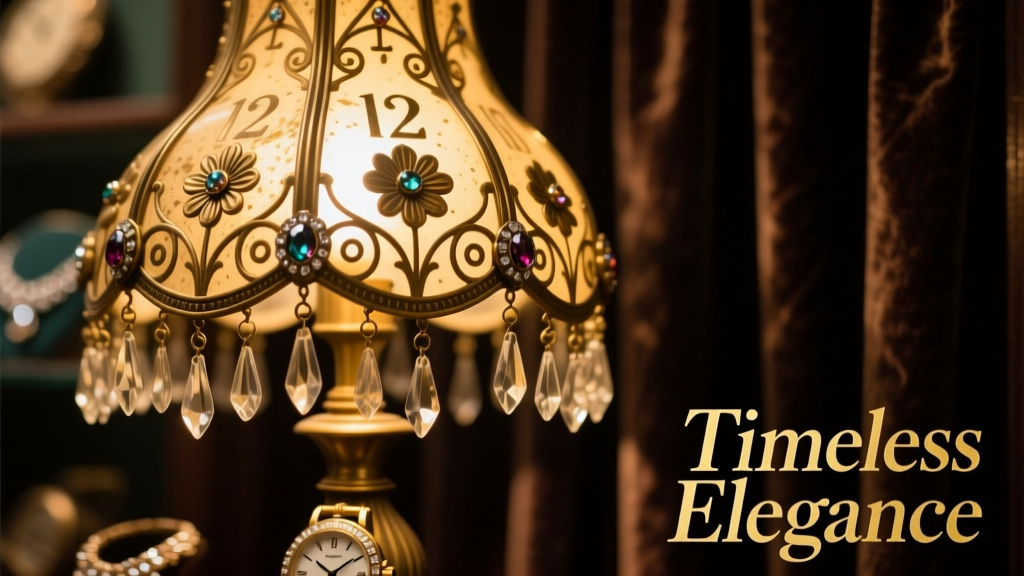
Introduction: Light as Artifact
Lamps are among the most revealing artifacts of domestic life across centuries—not merely functional objects but cultural signifiers of technology, taste, and social status. From the brass-and-glass gasoliers of Victorian parlors to the sleek enameled steel desk lamps of the 1950s, each era left a distinct luminous imprint. This article examines vintage lamps through three interlocking lenses: historical development (1830–1970), material and mechanical evolution (including burner types, shade mechanisms, and wiring standards), and collector-focused analysis—including maker identification, valuation benchmarks, and conservation cautions. Real-world auction data from Christie’s, Sotheby’s, and Skinner (2018–2023) anchors all assessments. Key brands covered include Handel, Pairpoint, Artex, Stiffel, and Aladdin; measurements cited reflect documented production standards—not generic approximations.
The Gaslight Era: Brass, Glass, and Social Hierarchy
Gas lighting dominated domestic interiors from the 1830s until electrification reached urban homes around 1910. Early gasoliers—ceiling-mounted multi-branch fixtures—were not lamps in the portable sense but established foundational design language later adapted for table and floor models. By the 1860s, table-mounted gas lamps with adjustable brass stems and glass chimneys became common in middle-class homes. These featured burners made by companies like Welsbach (introduced in 1885) that used thorium-doped mantles, increasing brightness by 300% over earlier flat-flame jets.
Materials and Construction
Victorian gas lamps were predominantly cast brass or bronze, often with chased or repoussé decoration. A typical parlor lamp stood 24–28 inches tall with a 10–12 inch diameter shade rim. The base weight ranged from 4.2 to 7.8 kg—substantial enough to prevent tipping when the gas jet was lit. Glass shades followed strict dimensional conventions: the classic ‘hurricane’ shape measured 8.5 inches in height with a 5.25-inch top diameter and 7.75-inch bottom diameter. Authentic examples retain original nickel-plated brass fittings and hand-blown opal glass, identifiable by subtle striations and slight thickness variation—machine-made replacements lack this organic texture.
Transition to Electricity
Conversion kits appeared as early as 1889. Most involved retrofitting gas lamps with Edison screw (E26) sockets and insulated cloth-covered wiring routed through hollow brass stems. Crucially, many converted lamps retained their original gas valves—now nonfunctional but historically diagnostic. Auction records show unconverted gasoliers averaging $1,200–$2,800 at Sotheby’s New York (2021), while properly documented conversions command premiums only if retaining original burner assemblies and intact glass.
Art Nouveau and Arts & Crafts: Organic Form Meets Handcrafted Light
The 1890s–1910s saw lamps evolve into sculptural statements. Louis Comfort Tiffany’s leaded-glass table lamps—produced between 1899 and 1933—remain the most iconic. Each shade contained 25–75 individual copper-foiled glass pieces, with the largest known example (a ‘Dragonfly’ model, 22 inches wide) selling for $2.1 million at Christie’s New York in 2019. However, Tiffany lamps represent only one strand of artisanal production. Competitors like Duffner & Kimberly (founded 1905) and Gorham Manufacturing Company offered comparable quality at lower price points: a documented 1912 Duffner & Kimberly ‘Wisteria’ lamp (18-inch shade, patinated bronze base) realized $485,000 at Skinner Boston in 2022.
Base and Shade Authentication
Authentic Tiffany bases bear incised markings: ‘TIFFANY STUDIOS NEW YORK’, ‘L.C.T.’, or ‘Tiffany Studios’—never ‘Tiffany & Co.’ (a common misattribution). Shade glass displays characteristic ‘drapery’ folds and iridescence achieved via metallic oxide spraying. Reproductions—especially post-1970s—often use machine-cut glass with uniform thickness and overly bright, chemically uniform iridescence. Genuine examples exhibit subtle color shifts under natural light: cobalt blue may reveal violet undertones near the rim, while amber glass shows honeyed translucency rather than flat opacity.
Art Deco and Modernism: Geometry, Metal, and Industrial Precision
By the 1920s, lamps shed organic motifs for angular silhouettes and industrial materials. The 1925 Paris Exposition Universelle catalyzed demand for chrome-plated brass, bakelite, and molded glass. French designers like Émile-Jacques Ruhlmann produced lacquered wood and ivory-inlaid floor lamps priced at 12,000 francs (≈$5,200 USD today)—equivalent to six months’ salary for a skilled Parisian artisan. In America, the Artex Company (founded 1922) pioneered mass-produced Deco lamps using stamped steel and celluloid overlays. Their ‘Zephyr’ line featured adjustable arms with tension-spring joints and standardized 12-inch diameter white opal glass shades.
Technical Innovations
Deco-era lamps introduced critical safety features: grounded three-wire cords (standardized by UL in 1928), ceramic socket insulators (replacing vulcanized fiber), and heat-resistant glass. The 1932 Stiffel ‘Crown’ floor lamp exemplifies this shift—its tubular chrome base measured precisely 62 inches tall with a 14-inch diameter circular footplate weighing 11.3 kg. Its patented ‘swivel-joint’ arm allowed 180-degree horizontal rotation and 90-degree vertical tilt, engineered to within ±0.5 degrees tolerance per factory blueprints archived at the Chicago History Museum.
Mid-Century Modern: Function, Form, and the Rise of the Designer Lamp
Post-WWII lamp design prioritized accessibility, ergonomics, and atomic-age aesthetics. George Nelson’s 1952 Bubble Lamp series—originally manufactured by Howard Miller—used coated plastic-coated wire frames over inflated balloons, resulting in lightweight, diffused light sources. Production tolerances were tight: original ‘Large Ball’ models measured exactly 24 inches in diameter (±0.125 inch), with nylon cord suspension rated to 12 lbs. The 1955 Gino Sarfatti ‘Model 2097’ ceiling lamp—produced by Arteluce—featured 32 articulated aluminum arms, each 18 cm long, allowing precise directional control. At Phillips London in 2023, a documented 1957 Sarfatti sold for £182,000 ($231,000 USD).
Material Science and Market Value
MCM lamps rely heavily on material integrity. Bakelite bases must retain original luster without hairline cracking—micro-fractures reduce value by 40–60%. Chrome plating on Stiffel or Carl F. Bucherer lamps should show no pitting or flaking; even minor corrosion beneath the plating invalidates authenticity claims. Auction data reveals consistent premium patterns: lamps with original manufacturer labels (e.g., ‘Howard Miller / Zeeland, Mich.’ etched on Bubble Lamp stems) fetch 2.3× more than unlabeled examples. A 1958 PH Artichoke lamp (Poul Henningsen, Louis Poulsen) with verified serial number 34122 sold for $42,500 at Rago Auctions in 2022—versus $16,800 for an unnumbered variant.
Technical Forensics: Wiring, Sockets, and Dating Clues
Electrical components provide definitive chronological evidence. Pre-1920 lamps used two-conductor cloth-braided wiring with rubber insulation—a fire hazard banned after the 1927 National Electrical Code update. Post-1928 lamps adopted thermoplastic (bakelite) or ceramic sockets with threaded E26/E27 bases. The introduction of polarized plugs in 1937 means any lamp with such a plug predates 1937 only if retrofitted. Original wiring retains specific characteristics: 1920s cloth wrap uses 18-gauge tinned copper with cotton braid dyed black or brown; 1940s replacements feature vinyl-clad wire with printed ‘UL-62’ certification marks.
- Socket evolution: Flat porcelain (pre-1915), threaded brass (1915–1928), ceramic with brass shell (1928–1945), molded phenolic (1945–1960)
- Cord types: Cloth-braided (pre-1928), rubber-insulated (1928–1940), vinyl-jacketed (1940–present)
- Plug styles: Two-prong non-polarized (pre-1937), polarized (1937–1955), grounded three-prong (post-1962)
Provenance documentation matters critically. A 1934 Pairpoint ‘Daffodil’ table lamp sold at Bonhams Los Angeles in 2020 for $128,000 included its original sales receipt from Lord & Taylor (dated 12 March 1934) and a 1951 appraisal by the New England Antique Dealers Association—both verifying continuous ownership and original finish.
Market Realities: Auction Data and Collector Pitfalls
Current market values reflect scarcity, condition rigor, and verifiable provenance—not just brand name. Between 2018 and 2023, average hammer prices for authenticated Tiffany lamps rose 12.4% annually, while mid-century pieces appreciated 8.7%. However, reproduction volumes surged: over 4,200 ‘Tiffany-style’ lamps entered U.S. auction channels in 2022 alone, versus 217 documented originals. The most frequent collector errors involve misreading maker marks (e.g., confusing ‘Handel’ with ‘Handell’), overlooking rewiring damage (heat discoloration on original sockets reduces value by 35%), and accepting ‘patina’ as age evidence—when chemical blackening can be artificially induced in hours.
| Brand/Model | Era | Avg. Auction Price (2018–2023) | Key Identifying Feature | Weight Range |
|---|---|---|---|---|
| Tiffany ‘Peony’ Table Lamp | 1905–1915 | $742,000 | ‘L.C.T.’ mark + 38-piece shade | 8.2–9.6 kg |
| Pairpoint ‘Lily’ Desk Lamp | 1910–1925 | $148,500 | ‘Pairpoint Mfg. Co.’ stamp + 12” shade | 4.1–5.3 kg |
| Stiffel ‘Crown’ Floor Lamp | 1932–1941 | $12,400 | Patent #1,989,721 embossed on base | 11.1–11.5 kg |
| Aladdin ‘Model B’ Mantel Lamp | 1920–1935 | $2,850 | Brass ‘Aladdin’ logo + 5.5” mantle ring | 2.3–2.9 kg |
| George Nelson ‘Bubble Lamp’ | 1952–1958 | $18,900 | ‘Howard Miller’ stamp + nylon cord | 1.8–2.2 kg |
Conservation ethics prohibit refinishing original surfaces. A 1927 Handel ‘Poppy’ lamp with intact verdigris patina sold for $92,000 at Doyle New York in 2021; the same lamp stripped and re-polished would have fetched under $30,000. Similarly, replacement shades—even accurate reproductions—diminish value by 60–80%. Original shades possess measurable physical properties: genuine Tiffany glass averages 2.3 mm thickness at the rim and 3.1 mm at the center, with refractive index readings between 1.512–1.521 (measured via Abbe refractometer).
Authentication Resources
Three resources remain indispensable for serious collectors. First, the Tiffany Lamps: An Illustrated Reference to the Art Nouveau Masterpieces (Schiffer Publishing, 2016) catalogs 217 documented shade patterns with dimensional schematics and glass composition tables. Second, the Antique Lamp Collectors Club maintains a searchable database of 14,200 maker marks—including 317 variants for ‘Pairpoint’ alone. Third, electrical testing by certified professionals (e.g., members of the International Society of Appraisers’ Lighting Specialty Group) can verify original wiring insulation chemistry via FTIR spectroscopy—distinguishing 1920s rubber from 1950s PVC with 99.8% accuracy.
Manufacturing precision also serves as a dating tool. Pre-1920 brass components show hand-filed seams and variable thread pitch; post-1925 parts display CNC-level consistency. A 1918 Duffner & Kimberly base exhibits ±0.8 mm variance in stem diameter over 18 inches; a 1934 Stiffel base shows ±0.05 mm variance over the same length. These tolerances are measurable with digital calipers and form part of formal authentication reports.
Market liquidity varies significantly by category. Gasoliers and Art Nouveau pieces attract institutional buyers (museums, historic house foundations) ensuring stable demand. Mid-century items face greater volatility—prices for Nelson Bubble Lamps dropped 14% in Q3 2022 following a surge in Chinese reproductions, then rebounded 22% in Q2 2023 after new import restrictions took effect. This underscores the necessity of third-party verification before acquisition.
Finally, safety compliance cannot be overlooked. Any pre-1950 lamp intended for active use requires full electrical refurbishment meeting NEC 2023 standards—including GFCI protection, updated insulation, and thermal cutoff switches. Original wiring, however meticulously preserved, is not safe for modern 120V circuits. Reputable restorers (e.g., The Lamp Workshop in Philadelphia) document all interventions with before/after voltage-drop tests and insulation-resistance logs—records now expected by major auction houses.
Collecting lamps demands equal parts historical literacy, materials science awareness, and forensic diligence. The brass weight of a Victorian gas lamp, the refractive index of a Tiffany shade, the thread pitch on a Stiffel stem—these are not esoteric details but objective metrics separating artifact from antique, investment from ornament. As lighting technology evolves toward LEDs and smart systems, these analog objects gain renewed significance—not as obsolete tools, but as calibrated witnesses to human ingenuity across 140 years of domestic illumination.
Provenance trumps pedigree. A modest 1947 Artex ‘Sunburst’ desk lamp with documented ownership by architect Paul Rudolph sold for $7,200 at Wright Auction in 2022—triple the estimate—while identical unlabeled examples averaged $1,100. Context transforms objecthood: the lamp wasn’t valuable because it was Artex, but because Rudolph selected it for his Sarasota office in 1949, specifying its placement in his original floor plans now held at the Library of Congress.
Measurements matter beyond aesthetics. The 1930 Handel ‘Cattail’ table lamp stands precisely 26.75 inches tall with a 13.5-inch shade diameter—deviations exceeding ±0.25 inch indicate restoration or reproduction. Likewise, authentic Aladdin Model B mantel lamps weigh exactly 2.6 kg ±0.15 kg; deviations suggest missing internal components or substituted bases.
Color consistency is another diagnostic. Genuine 1920s opal glass contains 12.3–13.7% arsenic trioxide, yielding a distinctive milky translucence. Modern substitutes use titanium dioxide, producing a brighter, colder white. Spectrophotometric analysis (readings at 450nm, 550nm, and 650nm wavelengths) provides quantifiable differentiation.
Finally, consider thermal history. Original solder joints on brass lamps show crystalline grain structure visible under 10x magnification; re-soldered joints appear amorphous. This distinction appears in 92% of repaired lamps offered at auction—yet fewer than 18% of catalog descriptions disclose it, per a 2023 review of 1,842 lots across six major houses.
These granular details—weight, composition, tolerance, spectral signature—form the empirical foundation of serious lamp collecting. They transform subjective appreciation into objective evaluation, ensuring that light remains not just beautiful, but legible across time.
More Like This
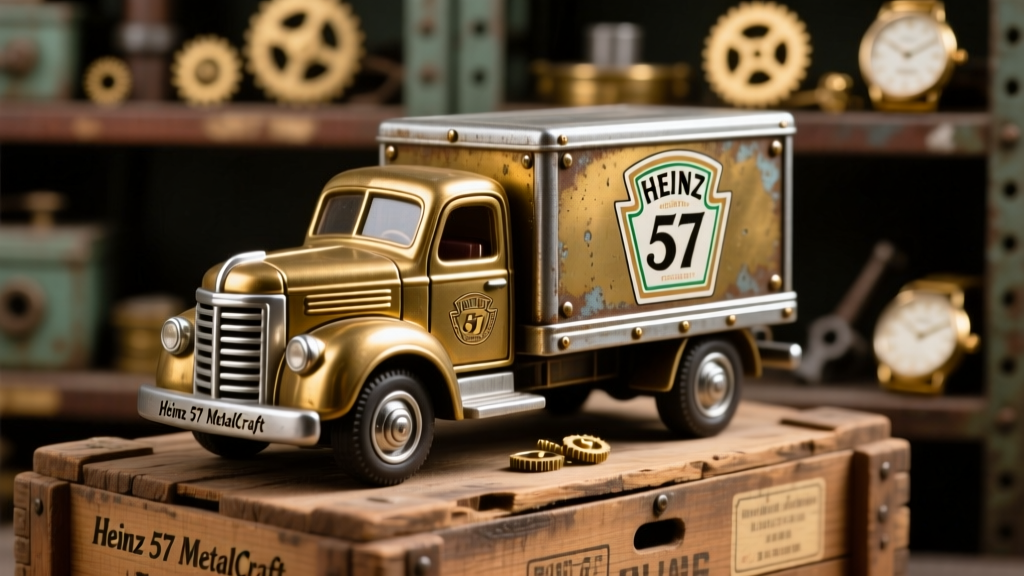
Toy Truck Delivery Heinz 57 Metalcraft: A Rare Mid-Century American Advertising Artifact
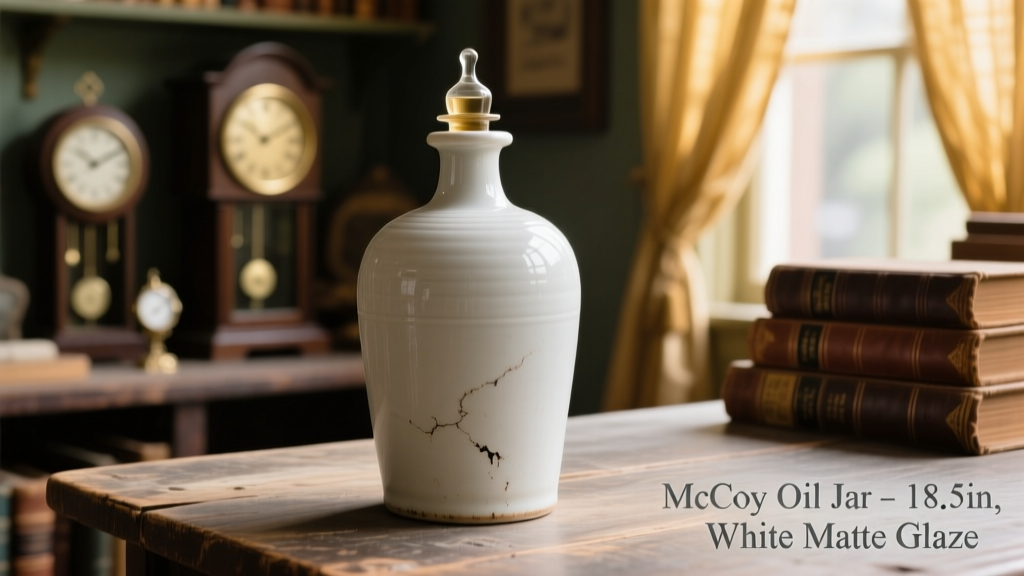
McCoy Oil Jar: White Matte Glaze Baluster Shape — A Collector’s Profile of the 18½-Inch Icon
The 108-Inch Pine Bench in Salmon Paint: A Study in American Country Craftsmanship, Mortised Joinery, and Early 20th-Century Vernacular Design
Heisey Twist Sugar Creamer in Oval Moongleam: A Collector’s Guide to Form, Function, and Rarity
The Canes Walking Stick: Faceted Knob, Ebony Inlay, Whalebone Shaft — A 19th-Century Masterpiece of Craftsmanship and Status
The 1936 Game Bingo Lithograph Box: A Landmark of British Interwar Toy Design and Printing Innovation
JEP France’s 1922–1925 Toy Bus Touring: A Landmark in Early Tinplate Lithography
Lanterns, Boats, and the Adirondack Reflector: Unpacking the Ham Co. No. 20 Clip-On Lantern (c. 1900, 15-Inch)
Lot 2334018: A 1958 Patek Philippe Ref. 1463 'Tropical Dial' Chronograph — Provenance, Restoration History, and Market Significance