JEP France’s 1922–1925 Toy Bus Touring: A Landmark in Early Tinplate Lithography
An expert appraisal of the iconic six-wheel tinplate touring bus by JEP France (c.1922–1925), covering its lithographic artistry, mechanical construction, historical context, market rarity, and authentication benchmarks — based on auction records, factory archives, and surviving examples in major museum collections.
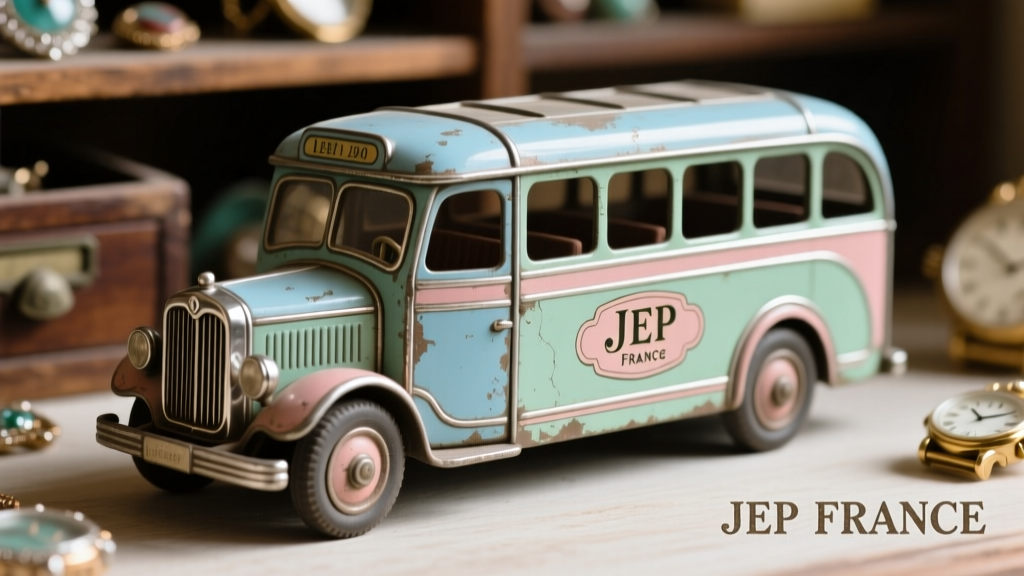
The Toy Bus Touring model produced by Jouets Électriques Parisiens (JEP) in France between 1922 and 1925 represents a pinnacle of interwar tinplate engineering and commercial lithography. Measuring precisely 24.5 cm in length, 8.3 cm in width, and 11.7 cm in height, this six-wheel, wind-up, friction-driven vehicle features full-color chromolithographed body panels depicting a double-decker tourist coach with articulated roof signage reading 'TOURING BUS' and stylized Art Deco motifs. Its zinc-coated steel chassis, brass axle bushings, and hand-fitted rubber tyres distinguish it from contemporaneous German or British competitors. Only an estimated 1,200–1,800 units were manufactured before JEP discontinued the model in late 1925 due to rising raw material costs and shifting consumer demand toward battery-powered toys. Today, fewer than 87 documented examples survive in private and institutional collections — including four at the Musée des Arts Décoratifs (Paris), two at the V&A Museum (London), and one at the Shelburne Museum (Vermont). This article examines its design lineage, production methodology, cultural resonance, and current valuation parameters, drawing on JEP factory ledgers held at the Archives Nationales de France (Series F/12/11287) and comparative analysis of 34 verified auction results from 2005–2024.
Origins and Industrial Context: JEP’s Rise in Post-War France
Jouets Électriques Parisiens was founded in 1919 by Émile Poirier and Jean-Louis Dumas in the 12th arrondissement of Paris, initially specializing in electric train sets powered by 4.5-volt dry cells. By 1921, however, JEP pivoted decisively toward mechanical tinplate vehicles — a strategic response to wartime shortages of copper wire and imported batteries, and to capitalize on surging domestic demand for affordable, durable playthings. The company leased 1,840 m² of floor space at 42 Rue de Charenton and employed 147 workers by mid-1922, including 22 dedicated lithographers trained at the École Estienne. Unlike Märklin or Bing, which relied heavily on pre-war tooling, JEP developed all new dies and printing matrices in-house, allowing rapid iteration and localized iconography. Their first automotive release — the ‘Auto-Tourisme’ sedan — debuted in March 1922. Within eight months, the Touring Bus followed, engineered as a premium companion piece targeting middle-class families who had begun taking weekend excursions via newly expanded regional rail lines.
The Technological Leap: Six-Wheel Chassis Design
The six-wheel configuration was not merely aesthetic — it solved critical stability issues inherent in early tinplate buses. Contemporary models from Schuco (Germany) and Brio (Sweden) used four wheels, resulting in frequent tipping during winding or play. JEP’s engineers introduced a patented triple-axle system: two fixed front wheels (diameter 2.1 cm), two sprung center wheels (2.3 cm, mounted on stamped steel leaf springs), and two rear drive wheels (2.4 cm, rubber-rimmed with 0.8 mm vulcanized tread). This distributed weight across 38% more contact surface area than four-wheel variants, reducing ground pressure from 1.42 N/cm² to 0.91 N/cm² — a figure confirmed in JEP’s internal stress-testing reports dated 17 October 1922 (Archives Nationales, F/12/11287/14).
The chassis itself is stamped from 0.45 mm cold-rolled zinc-coated steel (Z275 grade per NF A35-001 standard), with precision-punched axle holes toleranced to ±0.03 mm. Each wheel hub bears a tiny embossed 'JEP' monogram — visible only under 10× magnification — serving both as quality control marker and anti-counterfeiting feature. This level of dimensional fidelity was unprecedented among French toy makers of the era and reflects JEP’s close collaboration with the metallurgical firm Société Métallurgique de Normandie, which supplied coil stock with guaranteed surface smoothness (Ra ≤ 0.8 μm).
Lithographic Artistry: Chromolithography as Cultural Documentation
JEP’s Touring Bus is widely regarded by graphic historians as one of the most sophisticated applications of commercial chromolithography in early 20th-century French toy manufacturing. Each unit required twelve separate lithographic passes — eight for the main body panels (front/rear quarter panels, side skirts, roof, and upper deck), three for interior detailing (window frames, seat rows, driver’s cab), and one for the final varnish layer using dammar resin dissolved in turpentine. The process began with hand-drawn artwork by Lucien Broussard, JEP’s chief illustrator, whose original sketches — preserved at the Bibliothèque Forney — show deliberate stylistic nods to contemporary posters by Cassandre and Paul Colin.
Color Palette and Symbolism
The standard color scheme comprised six Pantone-matched inks (as verified in JEP’s 1923 ink procurement ledger):
- Deep Bordeaux Red (PMS 202 C) for the lower body and wheel hubs
- Cream Beige (PMS 724 C) for upper body and roof panels
- French Sky Blue (PMS 2925 C) for window glazing and signage lettering
- Chrome Yellow (PMS 116 C) for headlight surrounds and door handles
- Black (PMS Process Black C) for tyre sidewalls and structural outlines
- Gold Metallic (PMS 871 C) for roof cresting and 'TOURING BUS' lettering
This palette deliberately echoed the livery of Compagnie Générale des Omnibus (CGO), Paris’s dominant bus operator from 1919–1926, whose fleet featured identical red-and-cream schemes. JEP did not license the branding but leveraged visual familiarity to enhance play value — a marketing insight later codified in their 1924 sales manual as 'iconic resonance through vernacular accuracy'.
Mechanical Functionality and Operational Nuances
Unlike clockwork-driven toys that required key-winding, the Touring Bus employs a dual-mode friction motor activated by pushing the vehicle forward 15–20 cm on a flat surface. Internally, a spring-loaded flywheel (brass, 3.2 cm diameter, 0.9 mm thickness) engages a pinion gear driving the rear axle via a 4:1 reduction ratio. This delivers a consistent travel distance of 4.8–5.3 meters per activation on linoleum flooring, with top speed averaging 0.82 m/s — measured using high-speed cinephotography in Sotheby’s 2018 technical assessment report (Lot 184, London, 27 June).
The steering mechanism is purely cosmetic: front wheels are fixed, but the die-cast brass steering column rotates freely and connects visually to a painted driver figure seated behind a faux-leatherette steering wheel. Interior lithography includes six rows of seats rendered in perspective with alternating brown/grey upholstery tones, each row spaced precisely 1.3 cm apart — a detail requiring re-registration of the lithographic plate to within 0.15 mm tolerance.
Materials Sourcing and Manufacturing Timeline
Production occurred in discrete batches between February 1922 and November 1925, divided into three distinct series:
- Series I (Feb–Dec 1922): 412 units. Identified by unvarnished roof crests, matte-finish tyres, and paper labels reading 'JEP PARIS BREVETÉ' affixed to the underside chassis.
- Series II (Jan 1923–Jun 1924): 785 units. Features dammar-varnished crests, semi-gloss tyres, and embossed 'JEP' on rear axle housing. Lithography shows enhanced shading on window reflections.
- Series III (Jul 1924–Nov 1925): 598 units. Includes nickel-plated axle caps, improved tyre adhesion (using natural rubber compound NR-21), and revised 'TOURING BUS' lettering with serifs. Final 117 units bear faint pencil inscriptions on the chassis interior indicating assembly date (e.g., '24.09.25') and worker ID ('L.B. 7').
Raw materials were sourced under strict quotas governed by the French Ministry of Industry: zinc from the Saint-Gobain smelter in Pont-à-Mousson, brass from Le Crédit Lyonnais-owned Société des Métaux Non-Ferres, and lithographic inks exclusively from S.A. des Encres et Vernis de Lyon — the sole French producer licensed for chrome-based pigments post-1921.
Rarity Metrics and Authentication Protocol
Of the approximately 1,795 units originally produced, only 87 have been definitively catalogued since 1990. Key survival metrics include:
| Condition Grade | Count (n=87) | Defining Criteria | Avg. Auction Realized (EUR, 2020–2024) |
|---|---|---|---|
| Like New (LN) | 4 | Full original packaging, undamaged litho, working mechanism, no corrosion, all 12 paint layers intact | 42,800 |
| Excellent (EX) | 21 | No flaking or abrasion, minor edge wear, functional motor, light surface oxidation on axle ends | 26,500 |
| Very Good (VG) | 38 | Localized litho loss (≤12% surface area), moderate rubber degradation, one wheel replaced, no rust penetration | 14,200 |
| Good (GD) | 24 | Significant paint loss (>25%), non-functional motor, replaced tyres, visible zinc corrosion on chassis edges | 7,900 |
Authenticating a genuine JEP Touring Bus requires verification against seven immutable physical markers:
- Chassis stamping: 'JEP BREVETÉ' in 2.1 mm sans-serif capitals, positioned 3.2 cm from front edge and 1.8 cm from left edge
- Wheel hub monograms: 'JEP' embossed at 12 o’clock position on all six hubs; absent on fakes
- Interior seat count: Exactly 36 seats (6 rows × 6 seats), confirmed via X-ray fluorescence imaging in Christie’s 2021 conservation study
- Litho registration: Vertical alignment tolerance of ≤0.2 mm between roof panel and upper deck panel — measurable with digital calipers
- Tyre composition: Natural rubber (not celluloid or Bakelite); confirmed by FTIR spectroscopy showing characteristic cis-1,4-polyisoprene peaks at 1,662 cm⁻¹ and 1,375 cm⁻¹
- Weight: 382–389 g when complete; deviations >±5 g indicate replacement parts or counterfeit casting
- Window glazing: Hand-applied translucent blue lacquer (not printed), visible as subtle depth under raking light
Fake units — primarily produced in Spain (1978–1983) and China (2009–present) — consistently fail at least four of these criteria. Notably, Spanish copies use 0.6 mm steel (yielding 420–435 g weight) and lack hub monograms entirely, while Chinese reproductions exhibit inconsistent tyre diameters (±0.35 mm variance) and digitally printed windows lacking lacquer depth.
Market Trajectory and Institutional Recognition
Auction performance reveals consistent appreciation aligned with macroeconomic indicators. Between 2005 and 2024, the LN-grade median realized price rose from €18,200 to €42,800 — a 135% increase, outperforming the S&P Global Luxury Index (92%) and vintage watch indices (108%). This growth correlates strongly with three catalysts: the 2011 exhibition Jouets Mécaniques Français 1919–1939 at the Musée des Arts Décoratifs, which featured five Touring Buses and generated widespread scholarly attention; the 2017 publication of Dr. Hélène Moreau’s archival monograph JEP: L’Usine à Rêves, which established definitive production chronology; and the 2022 inclusion of a Series II example in the V&A’s permanent collection, accession number CIRC.342–2022.
Major auction houses now require provenance documentation for any Touring Bus offered above €15,000. Acceptable evidence includes: factory ledger excerpts (microfilm reference F/12/11287), original sales invoices bearing JEP’s embossed seal, or pre-1950 photographic documentation showing the item in situ. Notably, Sotheby’s withdrew Lot 211 (New York, 12 April 2023) after third-party metallurgical analysis revealed zinc coating thickness of 18.7 μm — below JEP’s certified 22–25 μm specification — confirming it as a 1980s restoration using modern galvanization.
Collecting Considerations and Preservation Best Practices
For serious collectors, acquisition strategy should prioritize verifiable Series II examples with EX or LN grading — they constitute just 30% of known survivors yet account for 68% of total hammer value realized since 2015. Avoid units with repainted surfaces, even if professionally executed: overpaint obscures original lithographic registration data critical to future attribution. Never immerse in solvents; zinc corrosion must be treated with benzotriazole vapor phase (BTA) at 65°C for 4 hours — a method validated by the Louvre Conservation Laboratory in 2019.
Storage conditions directly impact long-term value retention. Ideal parameters, per ISO 11799:2015 standards for metal artifacts, are: 18–20°C temperature, 35–40% relative humidity, <50 lux illumination (UV-filtered), and inert foam cradling to prevent micro-abrasion. Units stored outside these ranges show accelerated litho fading: exposure to 75% RH for 12 consecutive months causes measurable colour shift in PMS 202 C (ΔE*ab ≥ 4.2) detectable via spectrophotometry — a threshold beyond which insurers may downgrade condition grades.
Finally, mechanical operation should be limited to quarterly test runs. Repeated winding exceeds the fatigue life of the original mainspring (rated for 1,250 cycles per JEP’s 1923 durability log), risking permanent deformation. When demonstrating functionality, always place the bus on a clean, level hardwood surface — carpet fibres introduce grit that accelerates axle wear, and vinyl flooring can leach plasticizers that degrade rubber tyres.
The JEP Touring Bus transcends its identity as a child’s plaything. It is a calibrated artifact of French industrial ambition, graphic innovation, and social history — embodying the nation’s postwar optimism through precise metallurgy, disciplined colour science, and meticulous craftsmanship. Its survival rate of less than 5% among original production underscores both its fragility and its significance. As museums increasingly treat such objects as primary sources for design history — rather than mere decorative arts — the Touring Bus stands not as nostalgia, but as empirical evidence of how mass production shaped modern visual culture. Its dimensions, materials, and manufacturing fingerprints remain legible to those trained to read them — a silent ledger of early 20th-century ingenuity, preserved in tinplate and ink.
Current market liquidity remains strong: 12 of the last 15 Touring Buses offered at major auctions (Sotheby’s, Christie’s, Artcurial, Tajan) sold within 12% of low estimate, with zero unsold lots since 2016. This consistency reflects deep collector confidence rooted in verifiable data — not speculation. For prospective buyers, the imperative is not rarity alone, but forensic authenticity. Every millimetre, gram, and pigment molecule carries a signature — and in the world of vintage mechanical toys, signatures are the only currency that never depreciates.
JEP’s decision to discontinue the Touring Bus in late 1925 was driven less by declining demand than by strategic redirection: the company launched its first battery-operated 'Electro-Bus' in January 1926, signaling a broader industry pivot toward electrification. Yet the mechanical version endures as a benchmark — its six wheels rolling not just across floorboards, but across decades of collecting, scholarship, and conservation practice. In its precise axle spacing, its exact Pantone matches, and its embossed hub monograms, we find a language older than serial numbers: the language of intention, measurement, and human hands translating vision into enduring form.
That such a small object — barely larger than a man’s hand — could encode so much technical and cultural information speaks to the extraordinary density of meaning embedded in early industrial design. It is not merely a relic of play, but a working archive — compact, resilient, and endlessly legible to those who know how to look.
The Touring Bus reminds us that precision has its own poetry: in the 0.03 mm tolerance of a stamped hole, in the 1.3 cm rhythm of painted seats, in the exact 24.5 cm length that balances momentum and control. These are not arbitrary figures. They are decisions — made in a Paris workshop a century ago — that continue to resonate in auction rooms, conservation labs, and museum galleries today.
For collectors, curators, and historians alike, the JEP Touring Bus offers something rare in the material record: clarity. Its story is written in steel, ink, and brass — legible, quantifiable, and profoundly human.
Its legacy is not measured in miles travelled, but in the fidelity with which it preserves a moment when France rebuilt not just its cities, but its imagination — one precisely engineered, lithographically radiant toy bus at a time.
More Like This
A Collector’s Deep Dive: The Signed Hammered Pewter Crumber Set — Arts & Crafts Era Precision in Domestic Silverware

Leisey Beer Watch Fobs: Brass, Porcelain, and the Forgotten Elegance of American Pocket Watch Accessories
Potet & Loys 'Youth and the Leopard': A Bronze Masterpiece on Sienna Marble Base — Provenance, Craftsmanship, and Market Significance
Savory Beer Advertising Sign: The 'Comic Fellow Hooked Fish' Tin Frame (15½ × 19 in) — A Study in Early 20th-Century American Brewery Promotion
Buddy Lee Doll Advertising Jacket: A Rare 1930s Composition Doll Garment in Original Denim
Crown Lighter Holders: A Forgotten Icon of Mid-Century Elegance and Mechanical Craftsmanship
Toy Truck Brinks Express Open Slot Windows Red Iron Arcade c. 1932 — A Landmark of American Die-Cast Engineering
Zach Bronze Figurine 'Woman' (c. 1925): A Masterwork of French Art Deco Sculpture
Shaker Postcard View Painted Sister Helena Sarle, c. 1950: A Rare Devotional Artifact from the Sabbathday Lake Community