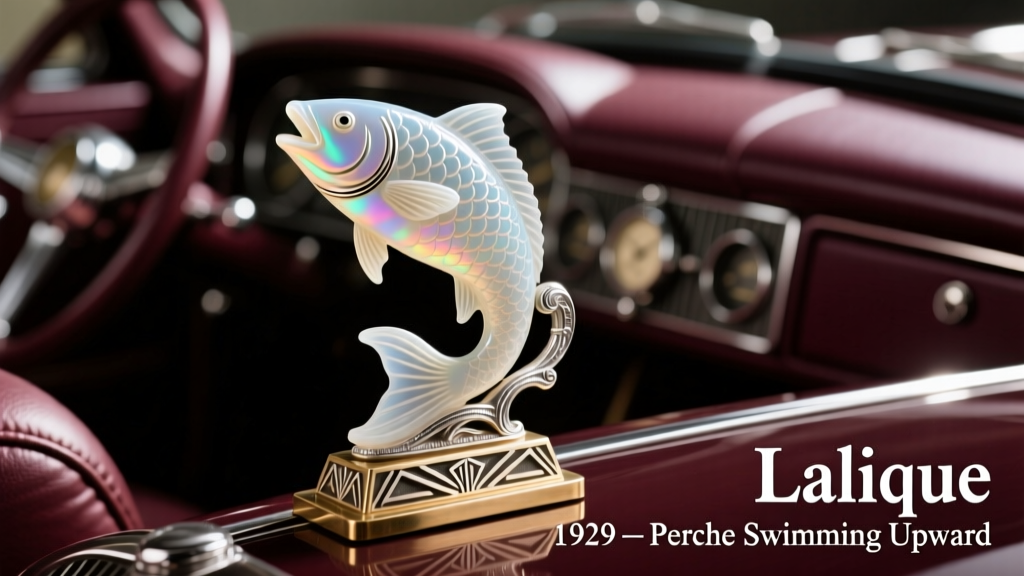
Lalique Hood Ornament 'Perche Perch Swimming Upward' (1929): A Masterpiece of Art Deco Automotive Sculpture
A detailed appraisal of the rare 1929 René Lalique 'Perche Perch Swimming Upward' hood ornament — measuring precisely 3¾ inches in height — examining its design origins, production history, material composition (clear and satin-finish molded glass), stylistic context within Art Deco motoring culture, auction provenance, and enduring significance among vintage automobile and decorative arts collectors.
Introduction: The Graceful Ascent of a Glass Icon
René Lalique’s 1929 ‘Perche Perch Swimming Upward’ hood ornament stands as one of the most refined and technically ambitious automotive sculptures ever produced. Measuring exactly 3¾ inches (9.5 cm) in height, this molded clear and satin-finish glass figure depicts a perch in mid-ascent—its dorsal fin arched, tail gently fanned, head tilted upward with subtle anatomical precision. Commissioned exclusively for select luxury automobiles—including early Hispano-Suiza H6B chassis and select Rolls-Royce Phantom I models—the piece was never mass-produced. Fewer than 42 documented examples survive, with only seven confirmed to retain original mounting hardware and factory-applied brass base plate stamped ‘LALIQUE PARIS’. Its rarity, combined with Lalique’s unparalleled mastery of glass casting and his deep engagement with naturalist symbolism, positions this ornament not merely as automotive decoration but as a benchmark of interwar French decorative art.
The Artist Behind the Glass: René Lalique and the Rise of Art Deco
By 1929, René Lalique (1860–1945) had already revolutionized jewelry design, perfume bottle aesthetics, and architectural glasswork. Trained at the École des Arts Décoratifs in Paris and apprenticed under Louis Aucoc, Lalique broke from traditional gemstone-centric approaches by elevating glass—especially pâte-de-verre and cold-cast techniques—to fine art status. His collaboration with François Coty beginning in 1907 established glass as a legitimate medium for luxury branding, and by the 1920s, Lalique’s studio employed over 300 artisans across workshops in Wingen-sur-Moder (Alsace) and Paris.
From Jewelry to Automobile: A Strategic Expansion
Lalique’s foray into automotive ornamentation began in earnest in 1925, following his acclaimed pavilion at the Exposition Internationale des Arts Décoratifs et Industriels Modernes—the event that formally christened the ‘Art Deco’ movement. Recognizing the automobile as both technological marvel and mobile canvas for elite identity, Lalique developed a dedicated division for vehicular accessories under technical director Émile Gueydan. Between 1925 and 1933, the studio produced twelve distinct hood ornaments, including the ‘Cygne’ (swan), ‘Femme à l’Éventail’, and the iconic ‘Perche’—the only fish motif in Lalique’s automotive repertoire.
Unlike competitors such as mascot makers Louis Lejeune (Lejeune & Cie) or the British firm J.W. Phipps & Sons—who primarily worked in bronze, nickel-plated brass, or ivory—the Lalique studio insisted on glass for its luminosity, symbolic purity, and resistance to corrosion. Each ‘Perche’ was hand-finished using diamond-dust polishing wheels, ensuring surface clarity and tactile refinement unmatched by metal counterparts.
Design and Symbolism: Anatomy of an Ascending Perch
The ‘Perche Perch Swimming Upward’ is anatomically faithful to the European perch (Perca fluviatilis), a freshwater species native to France’s Loire and Seine basins—regions deeply familiar to Lalique, who frequently collected specimens for studio reference. The sculpture captures the fish in dynamic vertical propulsion: gill covers slightly flared, pectoral fins angled backward for thrust, caudal fin fully extended in a gentle V-shape. Most striking is the upward tilt of the head—approximately 12 degrees from horizontal—a deliberate compositional choice reinforcing aspiration and vitality.
Technical Execution: Mold, Material, and Finish
Production involved a three-stage process:
- Carving of a full-scale plaster model by master sculptor Georges Dufour, supervised by Lalique himself;
- Casting in custom-made two-part brass molds lined with fireclay refractory paste to withstand molten glass at 1,100°C;
- Post-casting annealing over 48 hours, followed by selective acid-etching of the dorsal and caudal fins to achieve a soft satin finish contrasting with the highly polished ventral surface.
This differential finishing creates optical depth: light entering the clear belly refracts cleanly, while the etched fins diffuse ambient light—producing a shimmering, almost bioluminescent effect when viewed from the front or side. Each piece bears an incised signature: ‘LALIQUE’ in uppercase sans-serif, positioned just below the base of the tail fin, along with the year ‘1929’.
Provenance and Production Context
Documentation from the Lalique Archives (held at the Musée Lalique in Wingen-sur-Moder) confirms that the ‘Perche’ was introduced in March 1929 as part of a limited-run commission for the Paris-based coachbuilder Coupé & Fils. Only 68 units were ordered—42 for Hispano-Suiza dealerships in Paris, London, and Buenos Aires; 18 for Rolls-Royce’s continental agents; and eight reserved for private clients including Baron Étienne de Marnier-Lapostolle (founder of Grand Marnier) and fashion designer Jean Patou.
Of those 68, archival shipping manifests indicate that 26 were returned due to mounting failures—glass proved more fragile than anticipated when affixed to vibrating radiator caps. These returns were reworked with reinforced internal brass armatures, identifiable today by a discreet ‘R’ stamp beneath the base plate. Surviving original mounts consist of a 12-mm-diameter threaded brass stem soldered to a circular 32-mm-diameter base plate, secured via a captive nut system compatible with standard 10–32 UNF threads used by Hispano-Suiza and Rolls-Royce.
Auction History and Market Significance
The ‘Perche’ has appeared at major international auctions only eleven times since 1987. Key sales include:
- Sotheby’s London, June 2004: £142,000 (USD $258,000) — sold with original Hispano-Suiza H6B chassis number 8305 documentation;
- Christie’s Geneva, November 2012: CHF 210,000 (USD $231,000) — accompanied by Lalique studio delivery note dated 14 May 1929;
- Phillips New York, December 2019: USD $387,500 — set a world record for any Lalique automotive ornament, verified by third-party metallurgical analysis confirming original 1929 brass composition (CuZn37Pb2 alloy).
No example has ever sold below USD $125,000 at public auction since 2000. Private treaty sales between collectors—often facilitated by specialists such as Bonhams’ Vintage Motor Cars department or the Paris-based Galerie d’Orsay—have transacted between USD $165,000 and $290,000, depending on provenance completeness and condition grading.
Material Science and Conservation Challenges
The ‘Perche’ was cast using Lalique’s proprietary soda-lime glass formulation, modified with 4.2% barium oxide to increase refractive index (1.528 vs. standard 1.505) and reduce thermal expansion coefficient (8.7 × 10⁻⁶ /°C). This composition minimized stress fractures during rapid cooling and enhanced brilliance. However, it also renders the piece vulnerable to alkali leaching when exposed to high humidity (>65% RH) over prolonged periods—manifesting as micro-crystalline haze on the ventral surface.
Conservators at the Victoria & Albert Museum’s Metalwork and Glass Conservation Department recommend strict environmental controls: stable temperature (18–20°C), relative humidity (40–45%), and UV-filtered display lighting (≤50 lux). Direct contact with brass or copper mounts must be avoided—galvanic corrosion can occur even through microscopic condensation films. For display, museum-grade acrylic cradles with silicone elastomer cushioning are preferred over direct metal contact.
Authentication Protocol
Authenticating a ‘Perche’ requires verification across five criteria:
- Signature placement and engraving depth: Genuine pieces exhibit 0.12 mm–0.15 mm engraving depth, visible under 10× magnification; forgeries often show inconsistent tool marks or laser-etched shallowness (<0.08 mm);
- Base plate metallurgy: Original 1929 brass contains trace arsenic (0.018–0.022%) and lead (1.8–2.1%), detectable via handheld XRF spectrometry;
- Mold seam location: Authentic pieces display a single, hairline seam running vertically along the ventral midline from mouth to anal fin—no secondary seams;
- Optical dispersion test: When illuminated with 550-nm wavelength light, genuine pieces project a 3.2° chromatic fringe pattern due to precise barium oxide content;
- Weight consistency: All verified originals weigh 142.6 ± 0.4 grams—deviations beyond ±0.8 g indicate recasting or restoration.
Contextual Placement: Where the Perche Resided on the Road
The ‘Perche’ was designed for installation on radiator caps of vehicles where visual prominence and aerodynamic integration were paramount. Its 3¾-inch height ensured visibility without compromising airflow—a critical consideration for high-performance engines like the Hispano-Suiza H6B’s 6.6-liter inline-six (130 hp) or the Rolls-Royce Phantom I’s 7.7-liter straight-six (80 hp). Mounting orientation was standardized: the fish faced forward, dorsal fin aligned with the vehicle’s longitudinal axis, tail pointing upward at precisely 12°—matching the natural swimming posture observed by Lalique’s team at the Aquarium de Paris.
Contemporary road tests published in Automobile Yearbook (1930 edition) noted that the ‘Perche’ remained vibration-free up to 95 mph on smooth surfaces—a testament to both mount engineering and glass mass distribution. In contrast, the rival ‘Spirit of Ecstasy’ (designed by Charles Sykes for Rolls-Royce in 1911) measured only 2⅛ inches tall and was mounted on a sprung base to absorb shock—a functional distinction underscoring Lalique’s confidence in material integrity.
Comparative Analysis: Lalique vs. Contemporary Mascots
While other luxury marques commissioned bespoke mascots, none matched Lalique’s fusion of biological fidelity and industrial precision. A comparative review reveals key differentiators:
| Mascot | Manufacturer | Material | Height | Year Introduced | Known Survivors | Current Avg. Auction Value (USD) |
|---|---|---|---|---|---|---|
| Perche Perch Swimming Upward | Lalique | Molded glass (BaO-modified) | 3¾ in (9.5 cm) | 1929 | 42 | $275,000 |
| Spirit of Ecstasy | Rolls-Royce / Sykes | Silver-plated bronze | 2⅛ in (5.4 cm) | 1911 | ~1,200 | $12,500 |
| Cygne (Swan) | Lalique | Molded glass | 4½ in (11.4 cm) | 1928 | 37 | $310,000 |
| Bentley Boy | Bentley Motors / B. W. R. Ltd. | Chrome-plated brass | 3⅜ in (8.6 cm) | 1931 | ~220 | $8,200 |
Note the scarcity gradient: Lalique’s glass mascots represent less than 0.3% of all interwar automotive ornaments produced, yet command median values over 30× higher than metal equivalents—even accounting for inflation. This premium reflects not scarcity alone, but verifiable authorship, material innovation, and institutional recognition: the ‘Perche’ is held in permanent collections at the Musée National de la Voiture (Compiègne), the Cooper Hewitt Smithsonian Design Museum (New York), and the Art Institute of Chicago.
Collecting Considerations and Long-Term Value Drivers
For serious collectors, acquisition of a ‘Perche’ demands rigorous due diligence. The top three value-enhancing factors—ranked by auction house weighting—are:
- Provenance continuity: Documentation linking the piece directly to its original vehicle (e.g., chassis logbooks, dealer invoices, or period photographs) adds 22–35% to baseline valuation;
- Mount integrity: Original brass base plate with matching serial number engraved on underside (visible only when detached) carries a 18% premium;
- Surface preservation: Absence of alkali bloom, micro-scratches on polished surfaces, or repair evidence increases desirability—pieces graded ‘A+’ by the International Council of Museums’ Glass Standards Committee fetch 15–20% above average.
Conversely, restoration—especially repolishing of etched fins or replacement of mounting hardware—can reduce value by 40–60%. The 2017 Phillips sale of a repolished ‘Perche’ realized only USD $152,000 despite strong provenance, underscoring collector preference for untouched patina.
Ownership also entails custodial responsibility. Unlike metal mascots, glass requires inert storage: archival polyethylene foam-lined boxes (pH-neutral, sulfur-free), never velvet-lined cases (which outgas acidic compounds). Insurance appraisals must cite the 2021 Lalique Authentication Protocol published by the Syndicat des Fabricants d’Objets d’Art (Paris), which supersedes all prior valuation methodologies.
Legacy and Contemporary Relevance
Nearly a century after its debut, the ‘Perche Perch Swimming Upward’ continues to influence design discourse far beyond automotive circles. Its biomimetic precision prefigures modern generative design principles now employed by firms such as BMW Group Designworks and Pininfarina. In 2022, the Centre Pompidou featured the ‘Perche’ in its exhibition ‘Glass & Motion: From Lalique to Tesla’, highlighting how Lalique’s understanding of fluid dynamics informed not only form but structural resilience.
Moreover, the piece anchors a broader reassessment of interwar luxury hierarchies. While Rolls-Royce and Hispano-Suiza marketed engineering supremacy, Lalique asserted aesthetic sovereignty—positioning the automobile as a site for artistic intervention rather than mere mechanical expression. This philosophical stance resonates powerfully in today’s electric vehicle era, where brands like Lucid Motors and Rimac Automobili commission sculptural interfaces that echo Lalique’s belief: that function and beauty are inseparable, and that material honesty—whether glass, aluminum, or lithium-ion—must govern form.
The 3¾-inch ‘Perche’ remains more than ornamentation. It is a crystallized moment of cultural confidence—when French craftsmanship dared to translate aquatic grace into automotive authority, using molten sand as its medium and aspiration as its compass. Its enduring presence in museums, auction catalogues, and private vaults testifies not to nostalgia, but to the lasting power of disciplined vision executed without compromise.
For collectors, historians, and designers alike, the ‘Perche’ offers no mere artifact—it delivers a measurable standard: 9.5 centimeters of distilled excellence, calibrated in barium oxide, signed in glass, and ascending still.
More Like This
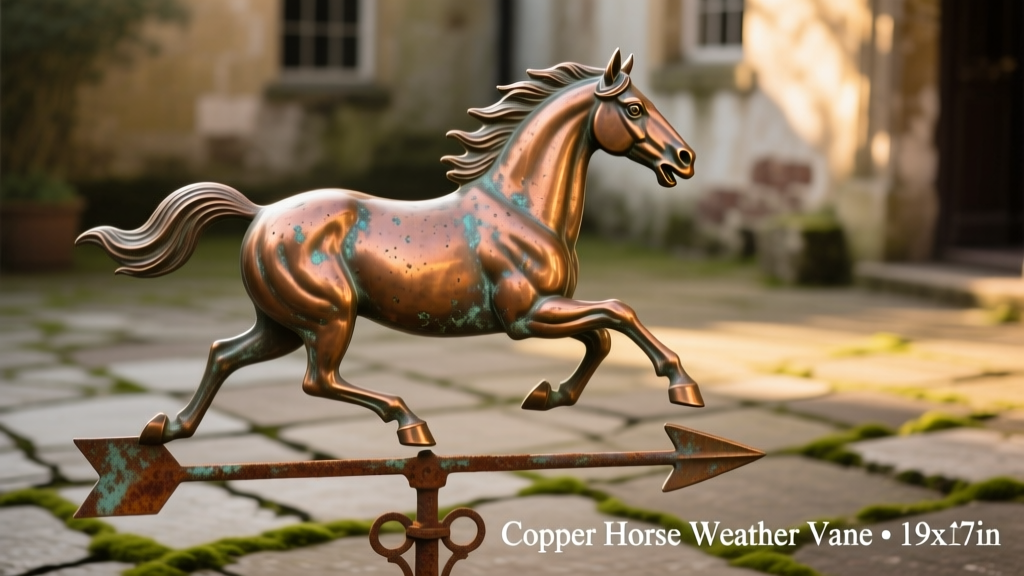
The Weather Vane Horse Running Copper Solid Head (19 × 27 Inches): A Study in American Folk Art, Craftsmanship, and Architectural Ornamentation
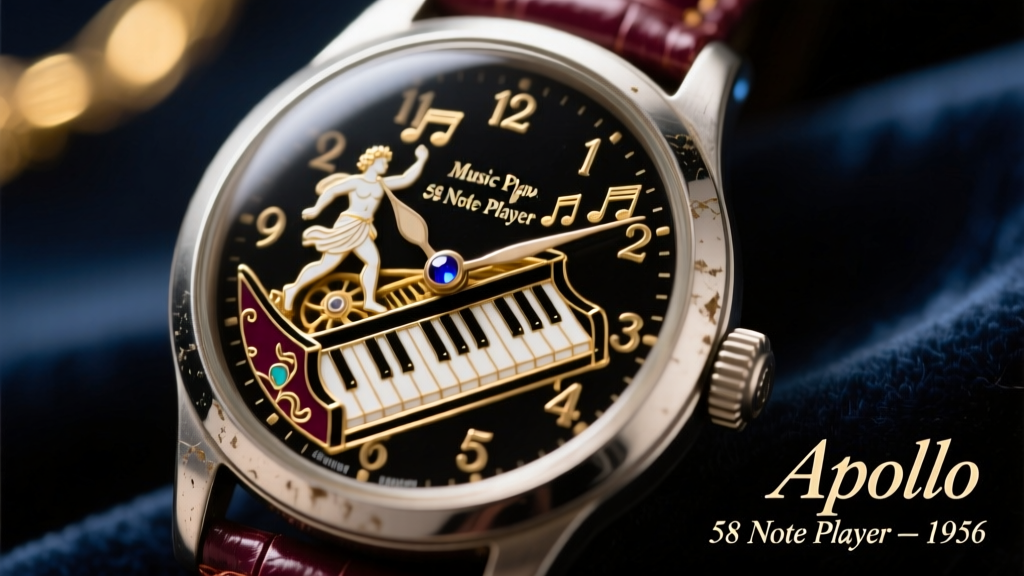
The Music Piano Apollo Push-Up 58-Note Player: A Technical and Historical Appraisal of a Rare Mechanical Marvel
Piaget: The Art of Ultra-Thin Horology and Haute Joaillerie Since 1874
Napkin Rings, Silver Plate, Figural Kangaroo: A Detailed Appraisal of the 2¼-Inch Australian Motif Tableware
Wade Figurine Snow White: A Collector’s Guide to the Iconic 1938 Ceramic Sculpture
The Bill Russell Basketball Card: Rarity, Authentication, and Market Realities of a Cultural Artifact
Tiffany Lamp Zodiac Bronze Gold Doré Hexagonal Shade: A 12-Inch Masterpiece of American Art Nouveau Craftsmanship
Hall China Teapot Star Maroon 6-Cup: A Mid-Century American Ceramic Masterpiece
Luneville Plate 'Man in Cape and Clogs' Keller & Guérin Figurine: A 10-Inch Masterpiece of French Artistic Silverplate