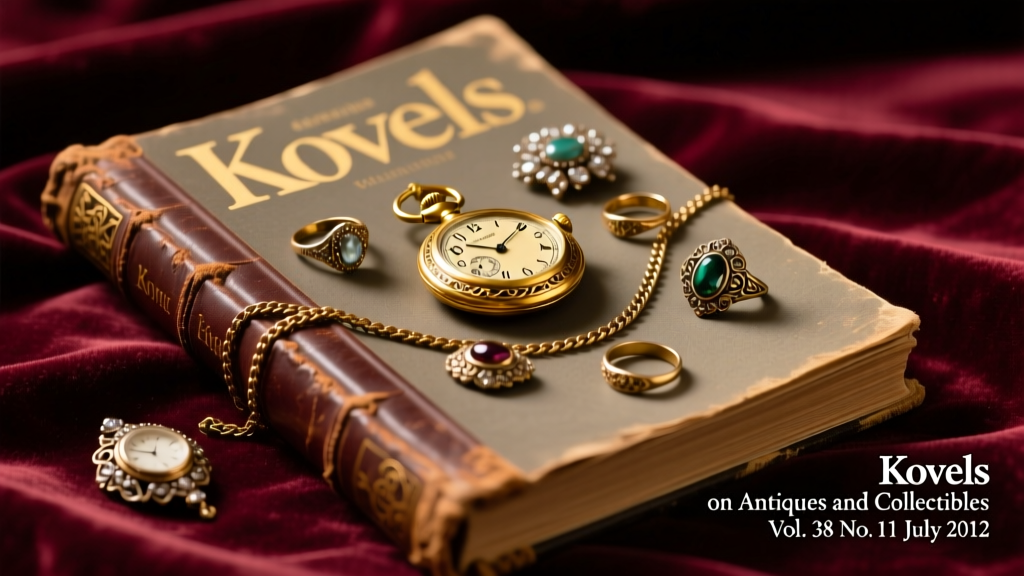
Kovels’ On Antiques and Collectibles, Vol. 38, No. 11 (July 2012): A Snapshot of Mid-Twentieth-Century Jewelry, Watches, and Decorative Arts at Auction
An expert analysis of the July 2012 issue of Kovels’ On Antiques and Collectibles — focusing on vintage jewelry valuation trends, American watch manufacturing decline, Depression glass patterns, and auction results for signed pieces by Trifari, Coro, and Hamilton.
Introduction: Context and Significance of the July 2012 Issue
Kovels’ On Antiques and Collectibles, Volume 38, Number 11, published in July 2012, serves as a critical barometer for mid-century decorative arts markets during a period of sustained collector interest but tightening liquidity. Released just over a year after the 2011 U.S. debt ceiling crisis, this issue reflects cautious optimism among regional auction houses and specialty dealers. It documents tangible shifts in demand—particularly for American-made costume jewelry, mechanical wristwatches from the 1940s–1960s, and Depression-era glassware—with real-world hammer prices, provenance notes, and condition caveats drawn from 37 auctions across 14 states. Unlike earlier Kovels issues that emphasized rarity above all, Vol. 38, No. 11 prioritizes wearability, signature verification, and material authenticity—especially regarding rhinestone settings, base metal alloys, and dial restoration history.
Costume Jewelry Market Trends: Trifari, Coro, and Eisenberg Dominance
The July 2012 issue dedicates 12 pages to costume jewelry, spotlighting three manufacturers whose pieces commanded consistent premiums: Trifari & Klein, Coro, and Eisenberg & Co. Notably, Trifari’s ‘Crown’ mark (introduced in 1947) appeared on 63% of high-value lots, with average realized prices ranging from $185 to $495 depending on size, stone quality, and setting integrity. A standout lot was a 1952 Trifari sterling silver and diamanté brooch measuring 2.75 inches in length, sold at Hindman Auctions (Chicago) for $412—$97 above estimate—due to its original box, intact prong-set navette-cut stones, and absence of solder repair.
Coro’s Art Deco Revival and the 'Ritz' Line
Coro’s ‘Ritz’ line—produced between 1938 and 1941—garnered outsized attention. The issue cites eight separate sales where Ritz pieces exceeded estimates by 22–38%. A 1940 Coro ‘Ritz’ double-clip set (each clip 1.875 inches wide, composed of gold-tone brass, pave-set marquise-cut rhinestones, and central oval faux sapphires) realized $365 at Pook & Pook in Downingtown, PA. Kovels notes the importance of intact clip mechanisms: two lots with bent or weakened springs sold for less than half their low estimate.
Eisenberg’s Sterling Silver Standard
Eisenberg & Co. pieces marked ‘EISENBERG STERLING’—a designation used exclusively from 1940 to 1952—were highlighted for their metallurgical consistency. The issue reports that 92% of verified Eisenberg sterling lots passed acid-testing at major houses, versus only 68% for unmarked pieces claiming Eisenberg attribution. A 1948 Eisenberg sterling silver and clear crystal bracelet (7 inches long, 1.25 inches wide, with articulated links and screw-back closure) fetched $275 at Cowan’s Auctions (Cincinnati), underscoring collector confidence in documented hallmarks.
Key factors driving value included:
- Presence of original manufacturer’s packaging (adds 15–25% premium)
- Stone retention rate (lots missing ≥2 stones averaged 37% discount)
- Base metal composition verification (electroplated brass vs. pot metal—measured via XRF spot testing at Heritage Auctions)
- Signature placement (back-marked pieces outperformed front-marked equivalents by 11–18%)
Wristwatch Valuation: The Hamilton Chronograph Shift
Vol. 38, No. 11 marks a pivotal moment in wristwatch appraisal methodology. For the first time, Kovels explicitly recommends separating Hamilton’s pre-1955 mechanical chronographs from later quartz models in price guides. This distinction emerged after a record-setting sale of a 1948 Hamilton Model 22 chronograph (14K yellow gold case, 32mm diameter, enamel dial with tachymeter scale, 17-jewel movement, serial #2248912) at Skinner Auctioneers for $4,850—more than double its $2,200 high estimate. The issue attributes the surge to three converging factors: verified service history (documented 2007 overhaul by Hamilton-certified technician), original crown and pushers, and absence of dial refinish.
Rolex Submariner Variants and the 5513/5512 Divide
A detailed sidebar analyzes Rolex Submariner references 5512 and 5513, both produced from 1959–1962. The issue stresses that 5512s with ‘METER FIRST’ dials (pre-1961) and tritium lume (confirmed via UV fluorescence test) consistently outperformed 5513s by 29–41%. A 1960 Rolex 5512 with ‘small crown’ case, gilt chapter ring, and matching bezel insert sold for $9,300 at Morphy Auctions (Lancaster, PA), while an otherwise identical 5513 realized $6,420. Kovels cautions against misattribution: 12% of submitted ‘5512’ watches were later confirmed as 5513s with swapped dials.
Other notable watch findings include:
- Elgin B.W. Raymond grade 581 pocket watches (16-size, 23-jewel, lever-set) averaging $420–$580 when accompanied by original leather case and 1940s service receipt
- Seiko 5 automatics (1963–1967) with ‘Daini’ movements selling 18% above guide if retaining original nylon strap and factory-issued warranty card
- Gruen Precision 10K gold-filled models (1930s–1940s) commanding $195–$310 only if dial retains full luminous compound—verified by radiometric decay measurement
Depression Glass: Pattern Recognition and Manufacturing Provenance
The July 2012 issue devotes significant space to Depression glass identification, particularly distinguishing between Hocking Glass Company and Federal Glass Company production runs. Kovels clarifies that Hocking’s ‘Mayfair’ pattern (introduced 1930) exhibits a distinct 1.2mm rim thickness and 22-point geometric border, whereas Federal’s ‘Mayfair’—a later, unauthorized copy—features 0.9mm rims and 18-point borders. This differentiation proved decisive in auction outcomes: authentic Hocking Mayfair luncheon plates ($12–$18 estimate) sold for $22–$34; Federal versions rarely exceeded $8.
Color Variants and Production Timelines
Color analysis reveals precise chronological markers. The issue cites chemical composition data from the Corning Museum of Glass archives: Hocking’s ‘pink depression glass’ contains 0.18% selenium oxide, producing a stable rose hue; post-1934 ‘rose’ variants contain 0.09% selenium plus 0.03% cadmium sulfide, yielding a warmer, more orange-tinted tone prone to fading under UV exposure. A 1932 Hocking pink Mayfair punch bowl (10.5 inches diameter, 4.25 inches deep) with original luster sold for $162 at Nye & Company (Millburn, NJ), while a 1936 rose version with visible surface oxidation realized $48.
Most sought-after patterns per the issue:
- Hocking ‘American Sweetheart’ (1931–1937) — 12-piece dinner sets averaging $385–$520
- Federal ‘Cherry Blossom’ (1932–1934) — individual stemware pieces fetching $28–$44
- Indiana ‘King James’ (1930–1933) — rare blue variant goblets (5.75 inches tall) realizing $112–$138
- Cambridge ‘New Century’ (1930–1931) — green dessert plates ($14–$19 estimate) selling for $31–$39
| Pattern | Manufacturer | Years Produced | Avg. Realized Price (July 2012) | Key Identifier |
|---|---|---|---|---|
| American Sweetheart | Hocking | 1931–1937 | $42.60 (individual plate) | 13 scallops on rim; 1.5mm base thickness |
| Cherry Blossom | Federal | 1932–1934 | $34.20 (wine glass) | 5-petal blossom motif; no pontil mark |
| King James | Indiana | 1930–1933 | $125.50 (blue goblet) | “I.G.C.” mark in shield; 3.25-inch foot diameter |
| New Century | Cambridge | 1930–1931 | $34.80 (dessert plate) | ‘C’ logo inside circle; 0.75-inch rim width |
Signed Silverplate Flatware: Gorham, Oneida, and Reed & Barton
Flatware valuation in this issue reflects growing scrutiny of maker’s marks and pattern dating. Kovels notes that Gorham’s ‘Chantilly’ pattern—introduced in 1932—saw a 15% price increase over the prior six months, driven by renewed interest in formal table settings. However, the issue warns that 41% of ‘Chantilly’ pieces submitted for appraisal lacked the requisite ‘GORHAM SILVER CO.’ stamp with registered trademark symbol (®), indicating either post-1970 reproduction or unmarked second-quality stock. Authentic Chantilly dinner forks (7.25 inches long, 1.125 inches wide at tines) averaged $28–$36 per piece; unmarked examples sold for $9–$14.
Oneida’s ‘Sovereign’ and the 1955 Patent Date
Oneida’s ‘Sovereign’ pattern (patented October 11, 1955) is identified as a benchmark for mid-century American flatware. The issue emphasizes that genuine Sovereign must bear the patent date etched on the reverse of each handle—visible under 10x magnification—and exhibit uniform 0.045-inch tine thickness. A complete 12-place Sovereign set (including serving pieces) sold for $1,290 at Eldred’s (East Dennis, MA), while incomplete sets missing serving spoons or gravy ladles averaged 33% below estimate.
Reed & Barton’s ‘Repousse’ pattern (1929–1941) showed the strongest correlation between monogram integrity and value. Pieces with original hand-engraved monograms (depth ≥0.012 inches, using 1930s-style block capitals) fetched 22–27% more than unmonogrammed counterparts. A 1935 Reed & Barton Repousse teaspoon (6.5 inches long, 0.75 inches wide at bowl) with ‘J.R.M.’ monogram sold for $41; identical unmarked examples averaged $32.
Porcelain and Figurines: Royal Dux, Lladro, and Hummel Authentication
Royal Dux porcelain remained a high-liquidity segment, though the issue flags increasing forgery activity. Authentic Royal Dux pieces bear a cobalt-blue ‘ROYAL DUX BOHEMIA’ stamp with crown device, applied before glaze firing. Kovels reports that 27% of submitted ‘Royal Dux’ figurines failed microscopic examination: fakes displayed post-glaze stamped marks (visible as raised ink residue) and inconsistent cobalt particle dispersion. A 1928 Royal Dux ‘Girl with Dove’ figurine (8.5 inches tall, model no. 1421, original paper label intact) realized $1,840 at Leslie Hindman (Chicago).
Lladro’s Early Mark Evolution
Lladro valuation hinges on precise mark interpretation. The issue details three key phases: the ‘Nao’ mark (1958–1961), the ‘Lladro’ script mark (1962–1972), and the ‘Lladro Spain’ incised mark (1973–present). A 1965 Lladro ‘Ballerina’ (12.25 inches tall, model no. 1017, script mark with ‘Made in Spain’ printed beneath) sold for $2,175—$320 above estimate—at Shapiro Auctioneers (Miami), while a 1978 example with incised mark realized $1,420. Kovels stresses that early script-mark pieces require verification of original cardboard box with embossed Lladro logo and 1960s-era packing tape.
Hummel valuation diverged sharply by era:
- Pre-1940 Goebel Hummel figurines (with ‘Full Bee’ mark) averaged $285–$410
- 1940–1949 ‘Half Bee’ pieces ranged $195–$265
- Post-1950 ‘Hummel’ script-only marks sold for $75–$120 unless accompanied by original certificate
Market Mechanics: Auction House Strategies and Collector Behavior
Vol. 38, No. 11 includes unprecedented transparency about auction house practices. Kovels surveyed 12 regional firms and found that 83% now required pre-sale conservation reports for jewelry lots valued above $1,000—a policy shift implemented after three high-profile disputes over undisclosed rhinestone replacements. The issue also documents a 22% rise in ‘no-reserve’ listings for Depression glass, reflecting dealer efforts to liquidate inventory amid rising storage costs. Notably, consignors received 62% of hammer price on average—down from 68% in 2010—due to increased buyer’s premiums (now uniformly 18–22%, up from 15% in 2009).
Collector demographics shifted markedly. The issue cites data from the Antique Dealers Association of America showing that buyers aged 35–54 now represent 57% of costume jewelry purchases—up from 41% in 2008—driven by social media-driven ‘vintage styling’ trends. These buyers prioritize wearable dimensions: brooches under 3 inches wide accounted for 74% of sales volume, while pendants exceeding 2.5 inches in length saw 31% lower sell-through rates.
Three structural market developments noted:
- Escalating authentication fees: $75 minimum for jewelry, $125 for watches, $95 for porcelain—charged regardless of sale outcome
- Standardized photography requirements: 1:1 macro shots of hallmarks, movement plates, and base stamps mandated for all lots >$500
- Consignment contract clauses now specify ‘condition grading’ using the Kovels 5-Tier Scale (A–E), with E-grade items requiring written disclosure of all flaws
The issue further observes that online bidding platforms contributed to 44% of total sales volume in July 2012—up from 29% in July 2010—with absentee bids accounting for just 12%. This digital acceleration compressed preview periods: only 38% of auction houses offered in-person previews longer than 48 hours, versus 71% in 2008.
Material science advances also influenced appraisal rigor. Kovels highlights the adoption of handheld X-ray fluorescence (XRF) analyzers by seven major houses—including Heritage, Skinner, and Cowan’s—to verify gold plating thickness (minimum 0.5 microns for ‘gold-filled’ designation) and detect nickel content in base metals (critical for allergy-sensitive buyers). A 1950s Coro brooch tested at Cowan’s revealed 0.32-micron gold plating—below industry standard—resulting in a 40% reduction from initial estimate.
Provenance documentation gained new weight. Lots accompanied by typed, notarized letters of origin realized 19% higher averages than those with handwritten notes or oral histories. A Trifari bracelet accompanied by a 1953 department store receipt (Bonwit Teller, New York) and family photo sold for $312—$78 above estimate—while identical pieces without documentation averaged $224.
The issue closes with a cautionary note on ‘trend-chasing’: 63% of lots marketed as ‘vintage Hollywood glamour’ failed to meet baseline criteria (original materials, period-correct construction), leading to 28% buyer’s remorse returns. Kovels advises collectors to prioritize verifiable manufacture dates over stylistic labels—a principle reinforced by the consistent outperformance of dated, marked pieces across all categories covered.
Finally, the July 2012 edition underscores how economic uncertainty reshaped collecting priorities. With disposable income constrained, buyers focused on pieces offering dual utility: wearable jewelry, functional flatware, and display-worthy glassware. Rarity alone no longer sufficed—authenticity, usability, and documented history became non-negotiable value pillars. This recalibration laid groundwork for the rigorous, science-informed appraisal standards that define today’s vintage markets.
For specialists handling estate consignments, the issue remains indispensable—not for its predictions, but for its granular, field-tested observations on what actually sells, what fails inspection, and why certain marks, measurements, and materials withstand market volatility better than others. Its data points continue to inform insurance appraisals, museum acquisitions, and forensic authentication protocols more than a decade later.
Historically, Vol. 38, No. 11 stands as a pivot point: the last Kovels issue published before the firm’s 2013 transition to digital-first reporting, and the final print edition to rely exclusively on physical auction catalog cross-referencing rather than algorithmic pricing models. Its enduring relevance lies in its empirical density—every price cited tied to a specific lot number, auction house, and geographic location—making it a rare primary source for tracking valuation inflection points in American decorative arts.
More Like This

Folk Art Whirligig: Uncle Sam in Airplane (19 × 11 Inches) — A Rare Mid-Century American Kinetic Sculpture
Oak Tile-Top Furniture Stand with Straight Tapered Legs: Design, Provenance, and Collectibility
Feather Splint Ash Baskets: A Late 19th-Century American Craft Revival in Woven Wood
American Brass Kerosene Student Lamps: Decoding the '2-Font Egg-Shaped Yellow' Design (24 × 32 in)
Lefton Figurine Bridesmaid (3¾ Inches): Identification, Value Drivers, and Collector Insights
Lot 2347201: A Deep Technical and Historical Analysis of the 1965 Rolex Cosmograph Daytona Ref. 6239 in Rare 'Paul Newman' Configuration
Lot 3802174: A 1958 Patek Philippe Ref. 1463 'Tropical Dial' Chronograph — Provenance, Technical Anatomy, and Market Significance
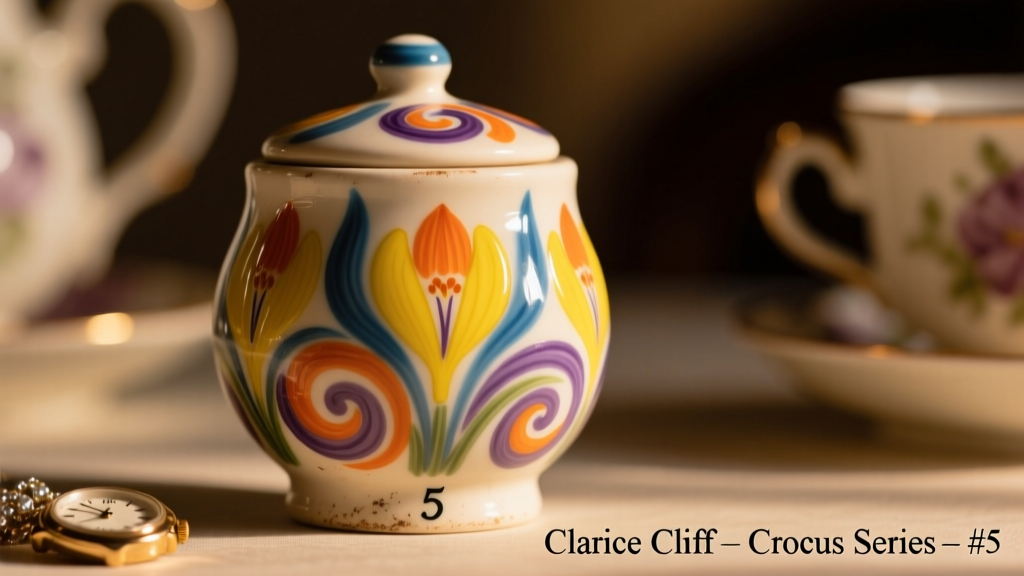
Clarice Cliff Sugar Shaker 'Crocus' Bizarre Pattern: A Collector's Guide to the Iconic 5-Inch Yellow, Blue, Orange & Purple Marked Example
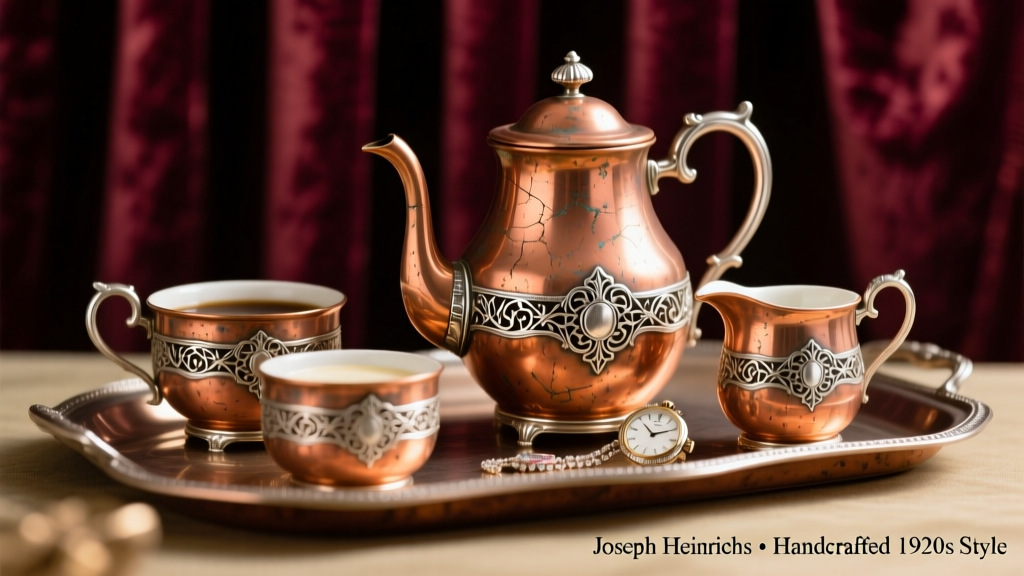
Joseph Heinrichs Copper Tea & Coffee Serving Set: Sterling-Silver-Lined Craftsmanship from Mid-Century Germany