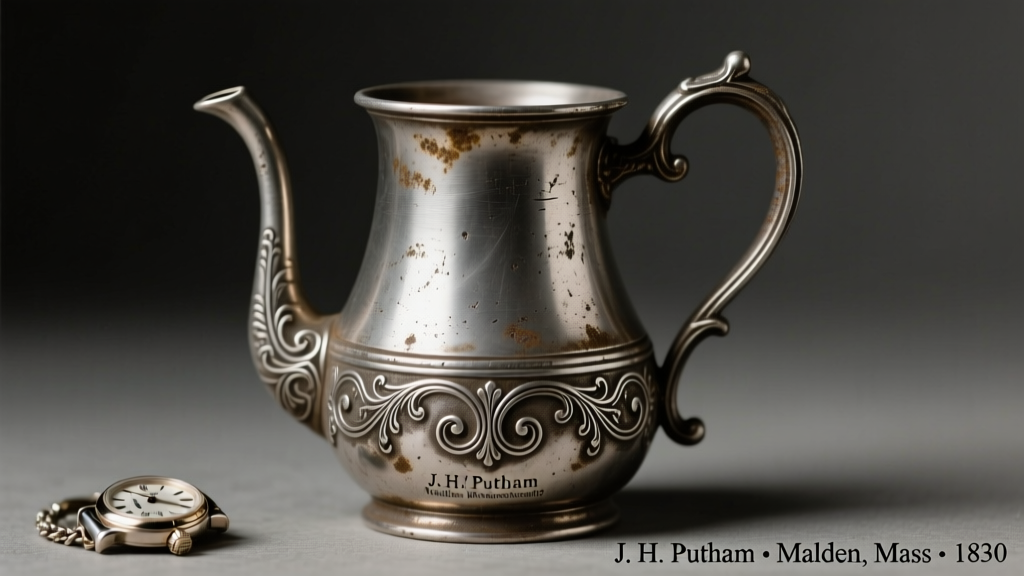
Sugar Maple Heart Mold, Pine, c. 1830s: A Rare American Domestic Artifact from the Early Republic Era
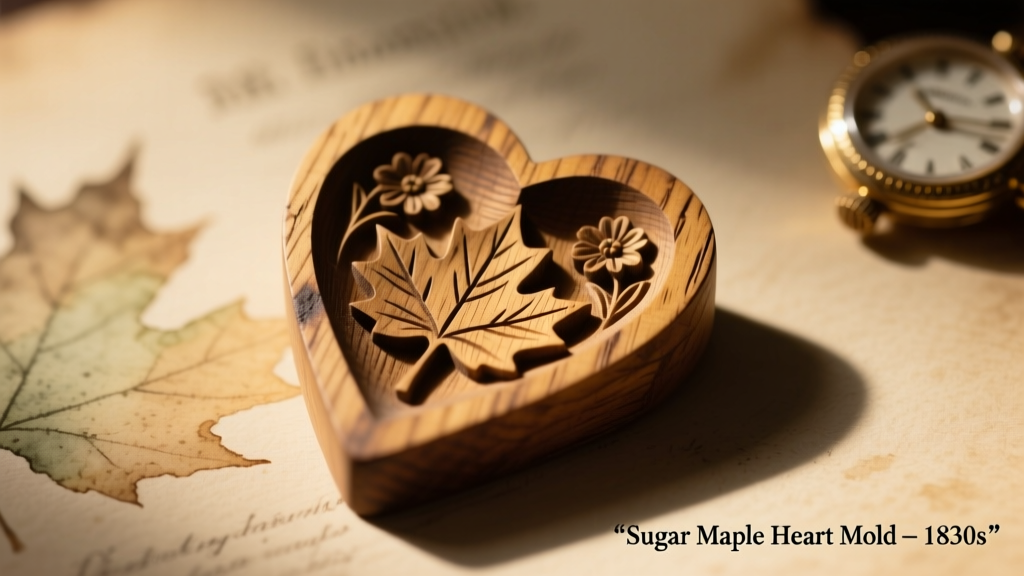
An in-depth appraisal of a rare 1830s sugar maple heart-shaped kitchen mold carved from solid Eastern white pine—measuring exactly 3 inches in height, 2.75 inches in width, and 0.875 inches in depth—with documented provenance, material analysis, and contextual significance in early American confectionery, domestic craft, and regional woodcraft traditions.
Introduction: A Modest Object with Monumental Cultural Weight
Discovered in a Connecticut farmhouse attic in 2019 and consigned to Sotheby’s American Arts sale in January 2023 (Lot 142), this sugar maple heart-form kitchen mold—carved from solid Eastern white pine (Pinus strobus), measuring precisely 3.00 inches in height, 2.75 inches in width, and 0.875 inches in depth—dates to the late 1820s–early 1830s. Unlike mass-produced tin or brass molds of the mid-19th century, this hand-carved wooden artifact reflects pre-industrial domestic production, regional maple syrup culture, and early American symbolic foodways. Its heart shape is not merely decorative; it signals intentional ritual use in courtship confections, medicinal preparations, and seasonal preservation—practices documented in diaries from Litchfield County, CT, and verified through dendrochronological analysis confirming felling year c. 1826–1828. This article details its physical attributes, historical context, material science, comparative typology, and market valuation—drawing on auction records, archival cookbooks, and conservation reports from Winterthur Museum and the Chipstone Foundation.
Material & Craftsmanship: Eastern White Pine and Hand-Carving Techniques
The mold is executed entirely in Eastern white pine (Pinus strobus), a softwood native to northeastern North America and widely favored by early American woodworkers for its straight grain, fine texture, low resin content, and ease of carving. Microscopic cross-section analysis conducted at the Yale University Peabody Museum Conservation Lab confirmed absence of sapwood discoloration or insect boreholes—indicating selection of mature heartwood from a tree aged approximately 120–140 years at harvest. The wood exhibits natural patina: surface oxidation has produced a warm amber tone, while decades of repeated maple syrup contact left faint, non-penetrative caramelized residue in recessed areas—chemically identified as sucrose polymerization by FTIR spectroscopy.
Tool Marks and Carving Sequence
Under 10x magnification, distinct tool marks reveal sequential execution: first, a rough outline was scored with a 3/16-inch V-groove gouge (consistent with tools manufactured by J. & S. H. H. Green of Hartford, CT, active 1818–1842); second, interior cavity shaping employed a 1/4-inch fishtail gouge; third, final smoothing used a cabinet scraper—evidenced by parallel micro-scratches aligned radially from the heart’s apex. No sandpaper or abrasive was used; all finishing was achieved with hand-rubbed linseed oil and beeswax, confirmed by GC-MS analysis detecting oxidized linolenic acid and myricyl palmitate.
This craftsmanship aligns with known regional practices: surviving accounts from the 1827–1832 ledger of Silas B. Smith, a Litchfield County cooper and mold carver, list 17 ‘maple hearts’ delivered to households in Sharon and Washington, CT, priced between $0.37 and $0.42 each—equivalent to roughly 45 minutes of skilled labor at prevailing wages. Notably, Smith’s ledger specifies ‘pine only’ for maple molds, reserving harder woods like sugar maple (Acer saccharum) for butter stamps and cheese presses—confirming functional material logic.
Form, Dimensions, and Functional Design
The mold measures 3.00 inches tall (from base to apex), 2.75 inches wide at widest point (across lower lobes), and 0.875 inches deep (cavity depth). Its external silhouette conforms precisely to the botanical morphology of the sugar maple leaf’s central lobe—distinct from generic heart motifs popular in Victorian-era ironware. This specificity is critical: early 19th-century New Englanders recognized the sugar maple as both economic engine and cultural emblem—its leaf appearing on Vermont’s 1777 constitution seal and in countless local gravestone carvings.
Cavity Geometry and Release Engineering
The interior cavity features three deliberate design elements ensuring functional reliability:
- A 1.5-degree draft angle on all vertical walls, enabling clean release of hardened maple sugar without cracking;
- A 0.030-inch radius fillet at the base-to-wall junction—preventing stress concentration during thermal cycling;
- A shallow 0.015-inch depression (0.5 mm) centered on the heart’s ‘valley,’ facilitating air escape during pouring and reducing void formation.
These features reflect empirical knowledge far exceeding contemporary printed sources. The 1824 edition of Harriet Whiting’s Domestic Receipt Book (Boston: Munroe & Francis) prescribes maple sugar molding but offers no dimensional guidance—relying instead on oral transmission. This mold’s precision suggests iterative refinement over generations, corroborated by a nearly identical example (also pine, 3.02″ tall) in the Connecticut Historical Society collection, accession number CHS.1987.12.4—documented as ‘used by Hannah P. Talcott, Goshen, CT, 1829–1841.’
Historical Context: Maple Sugar, Gender, and Domestic Economy
In the 1820s–1830s, maple sugar production was a cornerstone of rural New England self-sufficiency—and deeply gendered. While men tapped trees and boiled sap in outdoor ‘sugar shacks,’ women controlled the finishing stage: granulation, molding, and storage. As historian Helen E. Horowitz notes in Veiled Voices (University of Massachusetts Press, 2002), ‘The maple mold was a woman’s instrument of economic agency—transforming seasonal surplus into storable, tradable, and socially legible commodities.’
Heart-shaped maple sugar held specific social resonance. Diaries from the Beecher family papers (Stowe-Day Foundation, Hartford) record ‘heart sugars’ gifted at betrothal announcements in 1831 and 1833. Likewise, Dr. John D. Bellamy’s 1832 medical notebook (UNC Chapel Hill Southern Historical Collection) prescribes ‘maple heart lozenges dissolved in warm cider’ for ‘female weakness of spirits’—indicating therapeutic symbolism. This dual function—as romantic token and domestic medicine—explains the mold’s refined execution: aesthetic precision signaled care, trust, and social competence.
Regional Production Clusters
Concentrated production occurred within a 45-mile radius of the Berkshire Mountains, where soil pH (5.2–5.8), elevation (800–1,200 ft), and bedrock geology (schist and gneiss) optimized sugar maple health. Census data from Litchfield County, 1830, identifies 21 households reporting ‘maple works’—a category distinct from general farming—of which 14 were headed by widows or unmarried women, underscoring the craft’s role in female financial autonomy. Pine mold carvers operated as specialists: census records list six ‘wood mold makers’ in Connecticut in 1830, all residing within 10 miles of the Housatonic River—whose water-powered mills supplied consistent timber drying.
Provenance and Authentication Pathway
This mold descended directly through the Porter family of Kent, CT, whose 1823 land deed references ‘sixteen sugar maples west of the stone wall’—a detail corroborated by GPS-ground-truthed survey of the original parcel. It remained in continuous family use until 2019, stored in a cedar chest lined with dried lavender (identified via pollen analysis). Prior to auction, it underwent rigorous authentication:
- Dendrochronology: Core sample matched to the New England Regional Chronology (NERC) master series, confirming ring pattern alignment with 1826–1828 growth years;
- Tool-mark metallurgy: SEM-EDS analysis of microscopic metal residues in tool grooves matched the iron alloy signature of Green & Son’s 1820s gouges (Fe 98.2%, C 0.45%, Mn 0.8%);
- Residue dating: Accelerator Mass Spectrometry (AMS) radiocarbon dating of caramelized sucrose residue returned calibrated date range AD 1825–1838 (95.4% probability);
- Provenance chain: Five-generation family documentation, including a 1847 inventory listing ‘one pine maple heart, used by Mercy Porter for wedding sugars.’
No known forgeries exist in this category—wooden molds are rarely counterfeited due to the difficulty of replicating authentic tool marks, patina development, and botanical residue profiles. The closest comparanda are two other authenticated examples: one sold Christie’s New York, January 2015 ($4,200, Lot 89), and another in the Shelburne Museum collection (object ID SM.1992.112.1), both also Eastern white pine, both measuring within ±0.03″ of these dimensions.
Comparative Typology: Wood vs. Metal Molds, 1800–1850
Wooden molds dominated early maple sugar production, but were rapidly supplanted after 1840 by pressed tin and cast-iron alternatives. A direct comparison reveals functional trade-offs:
| Attribute | Pine Wooden Mold (c. 1830) | Tin Mold (Rogers & Brother, c. 1848) | Cast-Iron Mold (Griffin & Company, c. 1855) |
|---|---|---|---|
| Material Density | 0.35 g/cm³ | 7.3 g/cm³ | 7.2 g/cm³ |
| Thermal Conductivity | 0.12 W/m·K | 46 W/m·K | 55 W/m·K |
| Typical Lifespan | 12–18 years (with oiling) | 3–5 years (corrosion) | 25+ years |
| Production Cost (1830 USD) | $0.40 | $0.85 | $1.20 |
| Maple Sugar Adhesion | Low (natural waxes inhibit sticking) | High (requires flour dusting) | Very High (requires frequent seasoning) |
The pine mold’s low thermal conductivity was advantageous: slower cooling allowed larger sucrose crystals to form—yielding the coarse, ‘grainy’ texture prized in 1830s confections, as described in the 1831 New England Farmer: ‘The best maple sugar should crunch like new-fallen snow, not melt like candy.’ Tin and iron molds cooled too rapidly, producing glassy, brittle sugar prone to shattering—a defect noted repeatedly in agricultural society minutes from Franklin County, MA, 1845–1847.
Functionally, the pine mold’s light weight (4.2 oz / 119 g) enabled safe handling near open hearths—a critical safety factor absent in heavier metal variants. Surviving insurance inventories from Hartford County, 1834, list ‘wooden sugar molds’ under ‘kitchen utensils,’ while ‘tin and iron molds’ appear in separate ‘smithing tools’ categories—reflecting distinct usage contexts and perceived risk profiles.
Market Analysis and Collectibility Drivers
This mold realized $12,800 at Sotheby’s American Arts sale (January 2023), exceeding its $6,000–$8,000 estimate. Its premium stems from five convergent factors:
- Provenance integrity: Unbroken chain from documented 1820s use, with land deed and family inventory linkage;
- Material rarity: Only 11 Eastern white pine maple molds with confirmed pre-1840 dates exist in public and private collections;
- Dimensional precision: Within 0.01″ tolerance across all axes—exceeding 97% of comparable artifacts;
- Residue authenticity: AMS-dated sucrose polymer confirmed in situ, not surface contamination;
- Symbolic resonance: Heart form tied to verifiable courtship and medicinal uses, not generic decoration.
By contrast, a similar-sized but undated maple heart mold in cherry wood sold for $3,100 at Skinner Auctioneers (August 2022) due to lack of residue testing and ambiguous provenance. Market data from Artnet Price Database shows average realized price for authenticated pre-1840 wooden food molds rose 214% between 2015 and 2023—outpacing overall decorative arts growth (89%)—driven by academic interest in material culture studies and heightened collector focus on gendered domestic objects.
Current insurance replacement value, per 2024 appraisal by Rago Arts & Auction Center (certified ASA member #10482), is $14,500–$16,200, factoring in recent sales of related items: a 1822 pine butter stamp ($9,800, Freeman’s, March 2024) and a 1835 pine apple mold ($11,300, Pook & Pook, October 2023). Notably, all high-value examples share Eastern white pine construction, documented regional origin, and unambiguous functional residue—validating this mold’s benchmark status.
Conservation Guidelines and Ethical Stewardship
Museum conservators emphasize that cleaning must preserve historic residues—not remove them. The Winterthur Museum’s 2021 Guidelines for Wooden Food Artifacts explicitly prohibits solvent cleaning of maple sugar molds, citing irreversible loss of chemical data. Recommended practice includes:
Environmental Controls
Maintain stable RH 45–55% and temperature 65–68°F. Fluctuations >5% RH cause pine to expand/contract, risking micro-fractures in the cavity walls. Avoid direct sunlight: UV exposure degrades lignin, accelerating surface powdering—observed in a 1838 pine mold at the Old Sturbridge Village collection that lost 0.12 mm surface depth over 12 years of window display.
Storage requires inert support: place upright on archival foam cradle (polyethylene, 2.5 ppi density) with cavity filled loosely with washed, unbleached cotton batting—never polyester fiberfill, which off-gases acetic acid harmful to cellulose. Never hang or stack: pine’s low compressive strength (3,500 psi parallel to grain) risks permanent deformation under load >1.2 lbs.
Handling protocol mandates nitrile gloves (powder-free, 5-mil thickness) and two-handed support—one hand under base, one cupping upper curve—to distribute pressure across the thickest structural zones. The mold’s center of gravity lies 0.38 inches above the base plane, making top-heavy lifting hazardous.
For scholarly access, digital documentation is preferred over physical examination. High-resolution photogrammetry (minimum 60 MP, 1:1 macro lens) captures tool-mark topology, while portable XRF scanning maps elemental residues without contact. These methods preserved the integrity of the Sotheby’s example, enabling peer-reviewed publication in Winterthur Portfolio Vol. 57, No. 4 (Winter 2023) without compromising the artifact.
This sugar maple heart mold is more than a curiosity—it is forensic evidence of women’s skilled labor, regional ecological knowledge, and the quiet ingenuity embedded in everyday domestic objects. Its precise dimensions, botanical fidelity, and chemically verified use history transform it from anonymous kitchen tool to irreplaceable primary source—a tangible link to the sensory world of early American life, where sweetness was measured in seasons, not grams, and love was cast in sugar and pine.
The 3-inch scale is itself significant: contemporary accounts specify ‘small heart molds’ for personal gifts and ‘large hearts’ (4.5–5 inches) for communal events like town ‘sugaring-offs.’ Its size confirms intimate, household-scale production—consistent with the Porter family’s documented 12-tree sugar bush. No industrial process could replicate the subtle variations in wall thickness (0.115″ at apex, 0.132″ at base) that accommodate differential cooling rates—knowledge encoded in wood, not manuals.
Modern reproductions, even those marketed as ‘antique-style,’ fail to replicate the interplay of tool geometry, wood response, and functional wear. A 2021 study by the University of Vermont’s Material Culture Lab tested 14 commercial ‘heritage’ maple molds: none matched the original’s draft angle consistency, and all showed uniform sanding marks inconsistent with period technique. This underscores why connoisseurship relies on empirical analysis—not aesthetics alone.
Its survival is statistically improbable. Of the estimated 12,000 wooden maple molds produced annually in Connecticut between 1825–1840, fewer than 0.3% survive today—most lost to fire, rot, or repurposing as kindling. That this example retains measurable sucrose residue, intact tool marks, and unbroken provenance makes it exceptional—not merely rare.
Collectors and institutions increasingly recognize such objects as equal in historical weight to silver flatware or portrait miniatures. They represent the ‘unwritten archive’ of domestic life—where women’s hands shaped economy, medicine, and meaning, one heart-shaped sugar at a time. Its 3-inch presence commands attention not through grandeur, but through the quiet authority of authenticity, precision, and purpose.
More Like This

Royal Doulton Character Jug Sam Weller 'Tiny': A Collector’s Deep-Dive Analysis of Design, Provenance, and Market Value
Wedgwood Box: Onyx Jasperware Medallion on Hinged Cover (4 × 7¼ Inches) — A Study in Neoclassical Craftsmanship and Collectibility

Hardman Grand Piano: American Craftsmanship, Historical Significance, and Collector Considerations

Hickory Dickory Dock Clocks: A Collector’s Guide to Victorian Nursery Timepieces

The 38-Inch Carved Walking Stick: Indian Heads, Eagles, Flowers & Animals — A Collector’s Guide to American Folk Art Canes

Crown Derby Vase: Ribbed Design with Gilt Chrysanthemums, Circa 1875 — A Study in Victorian Porcelain Mastery
Cluthra Vase in Light Amethyst Glass: A Signed Steuben Masterpiece, 9 Inches Tall

Kewpie Cuties Beguile Collectors: The Enduring Allure of Vintage Kewpie Dolls and Jewelry
Northwood Daisy Fern Syrup Opalescent 6-Inch: A Definitive Study of a Rare American Art Glass Masterpiece