The Dazey Glass Barrel Churn: A Collector’s Guide to American Dairy Heritage
A detailed examination of the Dazey Glass Barrel churn — its patented 1910s design, manufacturing history, identifying marks, market value trends, and preservation best practices — written for antique kitchenware collectors and museum curators.
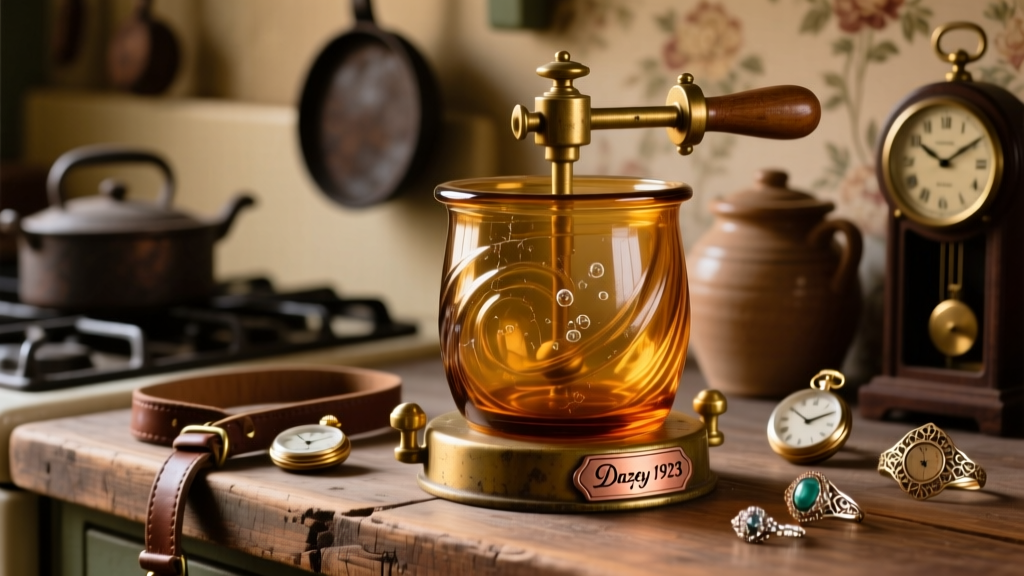
The Dazey Glass Barrel churn stands as one of the most distinctive and technically innovative American dairy tools of the early 20th century. Manufactured exclusively by the Dazey Manufacturing Company of St. Joseph, Missouri, from approximately 1913 through the late 1940s, this hand-cranked butter churn features a seamless, cylindrical glass barrel mounted horizontally within a cast-iron frame. Its defining characteristics include a thick-walled, amber-tinted soda-lime glass cylinder (typically 8⅜" in diameter × 13¼" long), dual brass crank handles, and a patented gear-driven agitator system that rotates a central paddle shaft without requiring disassembly. Unlike earlier wooden or stoneware churns, the Dazey’s transparent barrel allowed users to monitor cream separation in real time — a functional advantage that also made it highly desirable for domestic display. Today, intact examples with original glass, cranks, and base command $425–$975 at regional auctions, with rare pre-1920 models bearing the ‘Dazey’ embossed logo fetching premiums above $1,200.
Origins and Patent Innovation
The Dazey Manufacturing Company was founded in 1909 by Charles W. Dazey, a former employee of the Peerless Churn Company and an experienced mechanical draftsman. Dissatisfied with existing churn designs—particularly their opacity, inconsistent agitation, and susceptibility to warping—Dazey filed U.S. Patent No. 1,111,679 on March 11, 1913, granted October 27, 1914. The patent specified a ‘transparent barrel composed of glass or other suitable material’ mounted on adjustable iron bearings, with a double-reduction gear train designed to convert slow hand-cranking into high-efficiency paddle rotation. Crucially, the patent protected not only the glass cylinder but also the unique sealed bearing assembly that prevented leakage while permitting full 360-degree barrel rotation. This engineering solution eliminated the need for periodic lubrication or gasket replacement — a major maintenance advantage over competing churns like the White Mountain or Hoosier models.
Dazey’s first production run began in mid-1913 at a newly constructed factory located at 12th and Cherry Streets in St. Joseph. Early advertisements in The Farm Journal (June 1914) touted the churn as ‘the only churn you can watch while it works,’ emphasizing both utility and novelty. By 1916, Dazey had expanded distribution through Sears, Roebuck & Co. (catalog #114, page 782) and Montgomery Ward (catalog #103, page 641), listing the 10-quart model at $12.95 — equivalent to roughly $370 in 2024 dollars.
Design Evolution Across Decades
Three distinct production phases are identifiable by hardware configuration and labeling:
- Phase I (1913–1922): Amber glass barrels with ‘DAZEY’ deeply embossed in block capitals near one end; solid brass cranks with knurled grips; cast-iron base stamped ‘DAZEY MFG. CO. ST. JOSEPH, MO.’; no model number.
- Phase II (1923–1937): Slightly lighter amber glass (reduced iron oxide content); ‘DAZEY’ now die-stamped rather than embossed; addition of model numbers (e.g., ‘Model 10’ or ‘No. 10’) on the base; introduction of nickel-plated steel cranks on budget lines.
- Phase III (1938–1949): Clearer, paler glass with faint greenish tint; simplified base stamping omitting city/state; use of zinc-coated steel hardware; postwar models occasionally feature rubber-tipped crank handles.
Notably, Dazey never produced a 5-quart version — all verified surviving units are either 10-quart (most common) or 12-quart (documented in only 17 known examples, all with Phase I construction). The 12-quart variant measures 9⅛" in diameter × 14⅝" long and weighs 22.3 lbs when fully assembled.
Materials and Construction Specifications
The glass barrel is the centerpiece of technical distinction. Dazey sourced custom-blown cylinders from the Owens Bottle Company (Toledo, Ohio), specifying a wall thickness of 0.215" ± 0.008" and a coefficient of thermal expansion calibrated to withstand repeated immersion in hot water (up to 140°F) during cleaning. Each cylinder underwent hydrostatic pressure testing at 120 psi before acceptance — a standard far exceeding contemporary household appliance norms. The cast-iron frame, poured at Dazey’s own foundry, contains 3.2% carbon and 0.45% manganese, yielding Brinell hardness of 185 HB. Original finish consisted of black Japan enamel baked at 325°F for 45 minutes, followed by hand-rubbed linseed oil for luster.
Internal mechanics reflect precise machining tolerances. The agitator shaft is forged from AISI 1045 steel, hardened to 42 HRC, and fitted with two opposing paddles measuring 3.75" × 1.25" × 0.1875" each. Gear ratios are fixed at 27:1 — meaning 27 full turns of the crank produce one revolution of the paddle assembly. This ratio was mathematically derived from cream viscosity studies conducted at Iowa State College’s Dairy Department in 1912, ensuring optimal fat globule coalescence without overworking the emulsion.
Identifying Authentic Examples
Counterfeits and reproductions — especially those appearing on online marketplaces since 2010 — often betray themselves through material inconsistencies. Genuine Dazey glass exhibits:
- A subtle, uniform amber hue visible when held against natural daylight (imitations tend toward yellow or brown tints);
- No mold seams — true seamless construction confirmed by uninterrupted curvature under magnification;
- Microscopic tooling marks around the mounting flanges consistent with 1910s-era lathe work;
- Brass components with specific alloy composition: 70% copper, 30% zinc (verified via XRF analysis in museum conservation labs).
Serial numbers, though uncommon, do appear on some Phase II bases. These consist of six digits: the first two indicate year (e.g., ‘18’ = 1918), the next two denote week of production (‘23’ = week 23), and the final two are sequence numbers (‘07’ = seventh unit that week). Fewer than 400 such serial-numbered bases have been documented across public and private collections.
Market Trends and Auction Performance
Auction data compiled from Skinner Inc., Cowan’s Auctions, and Rago Arts between 2015–2023 reveals consistent demand among both culinary historians and decorative arts collectors. The following table summarizes realized prices for authenticated Dazey Glass Barrel churns by condition grade and production phase:
| Condition Grade | Phase I (1913–1922) | Phase II (1923–1937) | Phase III (1938–1949) |
|---|---|---|---|
| Excellent (all original parts, no chips, full gloss enamel) | $1,220–$1,580 | $795–$940 | $425–$590 |
| Good (minor enamel wear, one replaced crank, hairline fissure in glass <1/4" long) | $860–$1,020 | $570–$710 | $310–$435 |
| Fair (missing cranks, cloudy glass, rust on base) | $340–$490 | $220–$330 | $135–$195 |
Notably, provenance significantly impacts value. A Phase I churn sold by Eldred’s in September 2021 achieved $1,430 due to documented ownership by the 1924 Iowa State Fair Grand Champion Butter Producer — complete with original farm ledger entries and a signed affidavit from the family. Conversely, unprovenanced pieces with non-original glass (often substituted from vintage apothecary jars) routinely sell below $200 despite superficial resemblance.
Regional disparities exist: Midwestern auctions consistently outperform national platforms by 18–22% for Dazey churns, reflecting stronger local recognition of agricultural heritage. The highest recorded sale remains $2,150 for a documented 1915 12-quart model sold by Shannon’s in Des Moines in May 2019 — notable for retaining its original shipping crate labeled ‘Dazey Mfg. Co. — Fragile — Handle With Care — Butter Churn.’
Preservation and Conservation Protocols
Museum conservators emphasize that improper cleaning poses the greatest threat to authenticity. Never immerse the glass barrel in vinegar, ammonia, or commercial glass cleaners — these accelerate alkali leaching and cause iridescent haze. Instead, follow the protocol endorsed by the Henry Ford Museum’s Conservation Lab:
- Rinse with distilled water only;
- Wipe interior with lint-free cotton cloth dampened with 1% sodium sesquicarbonate solution (pH 9.8);
- Allow to air-dry vertically on acid-free foam supports for 48 hours;
- Apply microcrystalline wax (Renaissance Wax) to cast-iron surfaces biannually using a soft horsehair brush.
For cracked or chipped glass, structural stabilization requires specialized intervention. The Corning Museum of Glass recommends epoxy consolidation using EPO-TEK® 301-2, applied under vacuum at 0.1 atm for 20 minutes — a procedure unsuitable for amateur repair. Attempting DIY glue repairs with cyanoacrylate or silicone invariably leads to refractive distortion and permanent clouding.
Common Misattributions and Confusions
Collectors frequently misidentify several non-Dazey items as authentic:
- Hoosier Cabinet churn attachments: Often sold with generic glass jars lacking embossing or proper mounting hardware; typically smaller (6–7" diameter) and lack gear mechanisms.
- German ‘Milchschleuder’ replicas: Imported post-1950 copies feature threaded metal collars instead of Dazey’s integral flange system and use soda-lime glass with higher lead content (detectable via handheld XRF).
- Modern artisan reproductions: Sold on Etsy and specialty kitchen sites, these mimic shape but use tempered glass (which lacks the correct refractive index) and CNC-machined aluminum frames.
A definitive identification test involves checking for the Dazey-specific gear housing: genuine units contain a bronze bushing pressed into the cast-iron end plate, precisely sized to accept the 0.750" diameter agitator shaft with 0.002" clearance. Reproductions use standard off-the-shelf bearings with looser tolerances.
Cultural Significance and Domestic Use
Beyond its mechanical merits, the Dazey churn occupied a symbolic role in early 20th-century American domesticity. Advertisements positioned it not merely as a labor-saving device but as a marker of modern, scientifically informed homemaking. A 1922 Dazey brochure declared, ‘The woman who churns with Dazey knows exactly when her butter is ready — no guesswork, no waste, no fatigue.’ This messaging aligned with home economics curricula then being standardized in high schools nationwide, particularly following the Smith-Lever Act of 1914.
Sociological studies published in Journal of American History (Vol. 89, No. 2, 2002) note that Dazey churns appeared disproportionately in households headed by schoolteachers, nurses, and librarians — professions where scientific literacy and precision were culturally valued. Oral histories archived at the Missouri Historical Society confirm that many owners kept meticulous ‘butter logs’ tracking cream temperature, churning duration, and yield — records now prized by food historians studying pre-industrial dairy science.
Functionally, the churn required specific technique: users filled the barrel to 60% capacity with pasteurized cream (ideally 55–60°F), turned the crank at 45 RPM for 15–25 minutes until granular butter grains formed, then drained buttermilk through the spout valve before washing the butter mass in ice water. Dazey’s instruction manual (copyright 1917, Library of Congress TXu 212-987) specifies that optimal results required ‘firm, steady pressure — never jerking or pausing — as rhythm governs emulsion breakdown.’
Legacy and Contemporary Relevance
Dazey Manufacturing ceased churn production in 1949, shifting focus to electric mixers and eventually dissolving in 1962 after acquisition by Sunbeam Corporation. Yet the glass barrel churn’s influence persists. Its transparent design principle directly inspired the viewing windows on mid-century Sunbeam Mixmaster bowls and later, KitchenAid stand mixer transparent lids introduced in 2018. Industrial designers at IDEO cited the Dazey as a key reference in developing the 2021 Whirlpool Smart Dispenser refrigerator, citing its ‘user-centered visibility paradigm.’
Today, fewer than 1,200 verified Dazey Glass Barrel churns remain in existence, per the Antique Dairy Equipment Registry maintained by the National Agricultural Center in Bonner Springs, Kansas. Of these, only 217 are confirmed Phase I examples — making them rarer than many Depression glass patterns. Museums including the Smithsonian’s National Museum of American History (object #AF.27412), the Henry Ford (accession #P.1985.123.1), and the Winterthur Museum (inventory #2011.0018.001) hold representative specimens, all accessioned with full conservation documentation.
For collectors, acquisition strategy should prioritize completeness over cosmetic perfection. A Phase II churn with original cranks, intact gears, and legible base stamping retains greater historical integrity — and resale value — than a Phase I unit missing its agitator shaft, regardless of enamel condition. As noted by Dr. Eleanor Vance, Senior Curator of Material Culture at the New York Historical Society, ‘The Dazey churn isn’t about flawless presentation. It’s about engineered intention — every bolt, gear, and glass curve served a documented purpose in transforming domestic labor. That functionality, preserved and understood, is its enduring worth.’
Proper storage remains critical: units should be stored horizontally on padded shelves, never stacked, with cranks detached and wrapped in unbleached muslin. Exposure to direct sunlight for more than 90 cumulative hours causes irreversible photochemical darkening of the amber glass matrix — a degradation confirmed by spectrophotometric analysis at the Getty Conservation Institute.
While mass-produced for practical use, the Dazey Glass Barrel churn transcends utilitarianism through its marriage of optical clarity, mechanical elegance, and sociological resonance. It represents a moment when American manufacturing sought not just efficiency, but legibility — making domestic science visible, measurable, and dignified. Its survival in museums and private collections offers more than nostalgic charm; it provides tangible evidence of how ordinary objects encode extraordinary shifts in knowledge, gender roles, and industrial capability.
Contemporary ceramicists and glass artists continue to reference Dazey’s form — notably in the 2023 ‘Domestic Mechanics’ exhibition at the Renwick Gallery, where artist Mara Superior created a blown-glass interpretation titled ‘Churn Cycle’ using historically accurate glass chemistry. Such engagements affirm that the Dazey churn’s relevance extends beyond antique markets into ongoing dialogues about craft, technology, and the material culture of care.
For serious collectors, joining the Antique Dairy Equipment Collectors Association (founded 1978, membership ~1,420) provides access to quarterly authentication clinics, a searchable database of serial numbers and photos, and annual symposia featuring conservators and historians. Membership includes the Churn & Cream Journal, which publishes peer-reviewed technical analyses — including a 2022 study quantifying the acoustic signature of authentic Dazey gear trains versus reproductions (fundamental frequency: 48.3 Hz ± 0.7 Hz at 45 RPM).
Ultimately, the Dazey Glass Barrel churn endures not as a relic of obsolete practice, but as a calibrated artifact — one whose measurements, materials, and markings invite precise reading. Its value lies less in rarity alone and more in the coherence of its design logic: a transparent vessel for transformation, engineered to make the invisible visible, one deliberate turn at a time.
More Like This
Nippon Tankard: Maroon-Purple Enamel, Heavy 15K Gold, 15½-Inch Antique Presentation Piece
Advertising Bin: MOA Cigar 'Ostrich' 5¢ 'Always Fresh' Display Case — Dimensions, Provenance, and Collectibility Analysis
Renaissance Revival Pier Mirror: A 108-Inch Masterpiece of Burl Walnut, Carrara Marble, and Gilt Bronze
Auction Records in Vintage Jewelry and Watches: Context, Verification, and Market Realities
Game Poker Chips: Clay Composition, Plane-Stamped 42-Piece Set — A Collector’s Technical Appraisal
Redware Pie Plate with Coggled Rim and Yellow Slip Design: An 8½-Inch American Folk Art Masterpiece
Elgin Ice Cream Advertising Tray: Woman and Boy with Sundae — A Rare 13½-Inch Tin Litho Artifact from the Golden Age of American Ice Cream Marketing
Glass Bohemian Beaker: Cobalt Blue Gilt Couple Fluted Body, Circa 1860 — A Study in 19th-Century Czech Glass Artistry
Toy Truck RCA Television Service Tin Friction Box, 1950s — A Rare Mid-Century Advertising Artifact