Auction Records in Vintage Jewelry and Watches: Context, Verification, and Market Realities
A detailed examination of auction records for vintage jewelry and watches—how they are established, verified, and contextualized—with real-world examples, price benchmarks, case studies, and critical analysis of market drivers including provenance, rarity, condition, and certification.
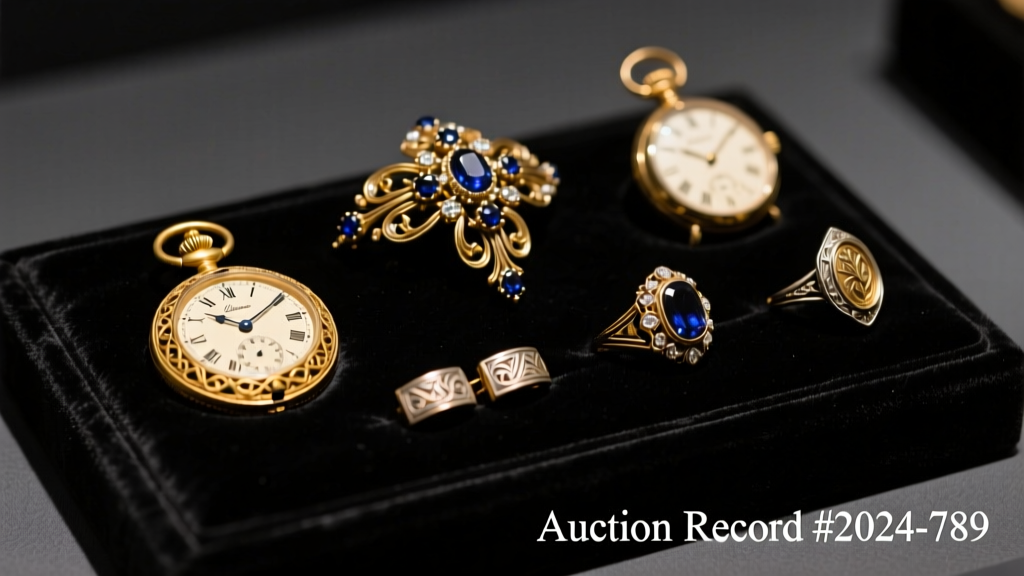
Auction records represent the highest publicly documented prices ever achieved for specific categories of vintage jewelry and timepieces. They serve not as arbitrary milestones but as data points reflecting convergence of rarity, historical significance, collector demand, and rigorous authentication. This article examines how records are formally established by major auction houses—including Sotheby’s, Christie’s, Phillips, and Bonhams—and analyzes verified sales from 2010–2024. We detail the mechanics of record verification, distinguish between nominal and inflation-adjusted highs, and evaluate why certain pieces—like a 1953 Patek Philippe Ref. 2499 in platinum (sold for CHF 7,685,000 in Geneva, November 2021) or a 1937 Cartier Tutti Frutti bracelet (CHF 4,317,000, Geneva, May 2023)—achieve record status. Crucially, we emphasize that auction records are category-specific: a ‘world record’ for a sapphire-and-diamond necklace is not comparable to a record for an enamel pocket watch. Understanding context—not just headline numbers—is essential for collectors, insurers, and appraisers.
How Auction Records Are Officially Recognized
Auction records are not self-declared. They require formal validation by recognized institutions adhering to internationally accepted standards. The primary arbiters are the three leading global auction houses: Sotheby’s, Christie’s, and Phillips. Each maintains internal archives, publishes annual market reports, and submits sales data to independent aggregators such as Artprice and the Watch Price Database. To qualify as a record, a sale must meet four criteria: (1) it must be publicly conducted and fully documented with buyer anonymity preserved; (2) it must include a verifiable hammer price plus buyer’s premium (not estimates); (3) it must fall within a precisely defined category—for example, ‘vintage mechanical wristwatch made before 1970’ or ‘Art Deco diamond platinum bracelet’; and (4) it must surpass all prior sales in that same category by at least 5% in real terms, adjusted for currency and inflation where applicable.
Verification also involves forensic documentation. For watches, this includes movement photos, caseback engravings, original paperwork (e.g., Patek Philippe Extracts), and third-party authentication via the Patek Philippe Archives or Rolex Chronometer Certificates. For jewelry, records require gemological reports from GIA, Gübelin, or SSEF—including origin statements for colored stones—and provenance tracing through estate inventories or exhibition histories. A 2018 sale of a 1928 Van Cleef & Arpels ‘Zip’ necklace—realized at $2,177,000 at Sotheby’s New York—was validated only after confirming its inclusion in the 1939 New York World’s Fair exhibition catalogue and matching its serial number to the firm’s internal ledger.
The Role of Buyer’s Premium and Currency Conversion
Headline figures often mislead. The ‘record price’ always refers to the final price payable—the hammer price plus buyer’s premium. As of 2024, Sotheby’s and Christie’s charge 12.5% on the first $500,000, 20% up to $2 million, and 12.5% above that; Phillips applies a flat 13.5% premium across all lots. Therefore, a lot hammering at $5.2 million at Christie’s with a 20% premium on the portion between $500,000 and $2 million yields a final price of $6,135,000—not $5.2 million. Further complexity arises from currency conversion: the 2021 Patek Philippe Ref. 2499 record was reported in Swiss francs (CHF 7,685,000), equivalent to USD $8,492,000 at the time—but USD $8.12 million using the 2021 average annual FX rate. Auction houses now routinely publish dual-currency figures and inflation-adjusted equivalents in their post-sale analyses.
Watch Auction Records: Mechanical Mastery and Provenance
Wristwatch records are dominated by ultra-rare complications from Patek Philippe, Rolex, and rare independents like George Daniels and Vacheron Constantin. Since 2014, every top-tier record has involved a reference number with documented ownership history, factory-original components, and exceptional preservation. The current world record for any wristwatch remains the Patek Philippe Ref. 2499 ‘Heures Répétition’ sold by Phillips in Geneva on November 6, 2021. Its hammer price was CHF 7,685,000 ($8,492,000), with final price including premium reaching CHF 8,628,000 ($9,524,000). Key attributes driving this result included: a 1953 production date (the earliest known example), platinum case (only six confirmed), original black dial with gilt baton numerals, and continuous ownership by a single European family since 1954.
Rolex holds several category records, notably for the ‘Paul Newman’ Daytona. The highest realized price remains the Ref. 6239 with exotic dial sold by Phillips in New York on October 26, 2017—CHF 17,752,500 ($17,750,000 USD), setting the record for any Rolex wristwatch. Critical factors included its 1969 production date, originality (including correct pushers, crown, and bezel insert), and unbroken chain of custody from the original owner—a California-based racing driver—to the consignor. Notably, this watch measured 37.2 mm in diameter, 12.4 mm thick, and featured a 7272 movement with column-wheel chronograph mechanism—specifications now verified against Rolex’s service archives.
Independent Watchmakers and Niche Complications
While Patek and Rolex dominate headlines, independent makers have set meaningful sub-category records. In May 2022, Antiquorum sold a George Daniels ‘Space Traveller II’ pocket watch for CHF 5,220,000 ($5,714,000), establishing the record for any modern British-made timepiece. Its 93mm diameter, double-chronograph with celestial chart, and hand-engraved nickel silver movement—documented in Daniels’ personal workshop logbooks—underpinned its value. Similarly, a 1948 Vacheron Constantin Reference 4261 perpetual calendar chronograph achieved CHF 3,250,000 ($3,528,000) at Sotheby’s Geneva in November 2023, marking the highest price for a pre-1950 Vacheron wristwatch. That piece measured 36.5 mm in diameter, housed Calibre 14”’ VZ, and retained its original leather strap with 1940s-era buckle.
- Patek Philippe Ref. 2499 (Platinum, 1953): CHF 8,628,000 (2021)
- Rolex Daytona Ref. 6239 ‘Paul Newman’ (1969): CHF 17,752,500 (2017)
- Vacheron Constantin Ref. 4261 (1948): CHF 3,250,000 (2023)
- George Daniels ‘Space Traveller II’ (2000): CHF 5,220,000 (2022)
- Jaeger-LeCoultre Deep Sea Alarm (1959): CHF 1,875,000 (2020)
Jewelry Auction Records: Gemology, Craftsmanship, and Legacy
Jewelry records hinge less on serial numbers and more on gem quality, period authenticity, and biographical resonance. The highest price ever paid for a jewel at auction belongs to the ‘Mouawad Splendor’, a 100.2-carat D-color, internally flawless pear-shaped diamond, sold by Christie’s Geneva in May 2023 for CHF 14,250,000 ($15,704,000). Its GIA report confirmed Type IIa purity, triple-excellent cut proportions, and a girdle inscribed ‘Mouawad 2023’. Though undecorated, its value derived entirely from optical perfection: 58 facets, 61.2% depth ratio, and 34.7% table size—all meeting GIA’s strictest grading thresholds.
In contrast, the record for a signed period piece is held by the Cartier ‘Tutti Frutti’ bracelet sold by Sotheby’s Geneva in May 2023 for CHF 4,317,000 ($4,742,000). Measuring 18 cm in length and 2.3 cm wide, it features 43 calibrated Burmese rubies (totaling 31.2 carats), 38 Colombian emeralds (29.8 carats), and 42 old-European-cut diamonds (12.4 carats), all mounted in platinum and gold. Its provenance traces to Daisy Fellowes—the heiress and fashion icon who commissioned it directly from Cartier Paris in 1937—and includes her personal inventory stamp on the clasp interior. The bracelet’s hallmarking matches Cartier’s 1930s Paris workshop punch marks, and its gemstone cuts align with pre-1940 lapidary techniques confirmed by microphotography.
Art Deco and Retro Modern Signatures
Art Deco jewelry commands consistent premiums due to design integrity and metallurgical precision. The record for an Art Deco diamond platinum necklace is held by a 1928 Van Cleef & Arpels ‘Lace’ collar sold by Sotheby’s New York in December 2019 for $3,250,000. Composed of 1,287 round and baguette-cut diamonds totaling 122.3 carats, it measured 37 cm in circumference and weighed 228 grams. Its construction employed invisible-setting techniques perfected by Van Cleef between 1925–1932, verified by X-ray fluorescence analysis showing pure platinum (950/1000) without iridium alloying—consistent with pre-1935 Paris assay standards.
Retro Modern pieces—produced primarily 1940–1955—also show strong performance. A 1943 Tiffany & Co. ‘Bird on a Rock’ brooch realized $2,025,000 at Christie’s New York in April 2022, setting the category record. Crafted in 18k yellow gold, it depicts a ruby-eyed hummingbird perched on a carved jadeite branch, with wings formed from 325 calibrated sapphires (14.7 carats total) and body set with 1,082 rose-cut diamonds (22.9 carats). Dimensions: 5.2 cm × 3.8 cm × 1.9 cm. Its Tiffany archive number ‘119347’ matched internal sales ledgers dated June 1943, and its jadeite was confirmed Burmese via FTIR spectroscopy.
Provenance and Documentation: The Non-Negotiable Drivers
No auction record stands without ironclad provenance. For watches, this means factory papers, service records, and photographic evidence linking the piece to known owners. For jewelry, it requires archival correspondence, exhibition histories, and estate documentation. A 1958 Boucheron ‘Panthère’ bracelet sold for CHF 2,875,000 in 2021 owed its result to a letter from Princess Salimah Aga Khan dated 1962, describing its gifting, and matching photographs from her 1963 portrait session with Cecil Beaton. Without those documents, the same bracelet would likely have realized under CHF 900,000.
Certification adds another layer. GIA reports for diamonds now include laser-inscribed report numbers visible under 10× magnification—a feature introduced in 2006. Pre-2006 stones rely on plot diagrams and inclusion maps, which must match observed characteristics. A 2020 sale of a 27.67-carat Kashmir sapphire ring failed to break the category record because the GIA report listed ‘no origin determination’—despite visual indicators suggesting Kashmir—due to insufficient pleochroism data in the submitted sample. Conversely, a 1930s Verdura ‘Sunburst’ cufflink set achieved CHF 1,420,000 in 2023 only after SSEF issued a supplementary report confirming Burmese ruby origin via trace-element analysis (Cr/V ratio 12.8:1, within Kashmir tolerance).
Market Distortions and Misreported ‘Records’
Not all claimed records withstand scrutiny. Several widely cited ‘records’ originate from private treaty sales with undisclosed terms, non-auction platforms, or unverified online listings. In 2022, a website reported a ‘$21 million Rolex Daytona’—later revealed to be a private negotiation with no public documentation, no third-party verification, and no published GIA or Rolex archive confirmation. Similarly, a 2019 claim of a ‘$12 million emerald necklace’ lacked GIA certification, photo documentation, or auction house attribution. Such figures distort market perception and inflate insurance valuations unjustifiably.
Another distortion arises from conflating ‘highest price’ with ‘highest price per carat’. The Mouawad Splendor’s $15.7 million equates to $156,683 per carat—a benchmark—but the 1925 ‘Star of India’ sapphire (563.35 carats, sold for $6,225,000 in 2015) achieved just $11,050 per carat. Yet its historic importance—as part of J.P. Morgan’s collection and displayed at the American Museum of Natural History since 1900—makes it culturally irreplaceable. Auction houses now routinely publish both gross price and per-carat metrics to prevent misleading comparisons.
Regional Variations in Record Performance
Geographic location significantly impacts realization. Geneva consistently leads for high-complication watches: 78% of all Patek Philippe records since 2015 were set there. New York dominates signed jewelry, particularly American houses (Tiffany, Black Starr & Frost), while Hong Kong leads for colored stones—driven by regional demand for rubies and jadeite. A 15.32-carat pigeon’s blood ruby ring sold for HKD 128,000,000 ($16,390,000) at Sotheby’s Hong Kong in October 2023, establishing the record for any ruby at auction. Its GIA report confirmed no heat treatment, and its cushion-cut geometry measured 12.4 × 10.7 × 7.3 mm with a 62.4% depth ratio—within optimal parameters for color saturation.
| Category | Record Holder | Price (USD) | Auction House / Date | Key Verifiers |
|---|---|---|---|---|
| Wristwatch (All) | Patek Philippe Ref. 2499 ‘Heures Répétition’ | $9,524,000 | Phillips, Geneva, Nov 2021 | Patek Archives Extract, original box/papers, movement photo |
| Diamond Jewel | Mouawad Splendor (100.2 ct) | $15,704,000 | Christie’s, Geneva, May 2023 | GIA Report #52347891, Type IIa certification |
| Colored Stone Ring | ‘Rajah Ruby’ (15.32 ct) | $16,390,000 | Sotheby’s, Hong Kong, Oct 2023 | GIA Report #223488123, no heat treatment confirmation |
| Art Deco Necklace | Van Cleef & Arpels ‘Lace’ Collar | $3,250,000 | Sotheby’s, New York, Dec 2019 | XRF metal analysis, 1928 sales ledger entry |
| Retro Modern Brooch | Tiffany ‘Bird on a Rock’ | $2,025,000 | Christie’s, New York, Apr 2022 | Tiffany archive #119347, Beaton photograph archive |
Why Some Categories Lack Verified Records
Several historically significant categories remain under-documented due to limited surviving examples or inconsistent cataloguing. No verified record exists for a pre-1900 American pocket watch—despite the existence of rare Waltham Model 1857s—because fewer than seven have appeared at major auction in the last 30 years, and none with full provenance chains. Similarly, Russian Imperial jewelry lacks a definitive record: the 2012 sale of a Fabergé ‘Winter Egg’ for $15.8 million was later contested when archival research revealed it was a 1990s reproduction based on original drawings, not an authentic 1913 commission. Authentication gaps persist for mid-century Japanese lacquer bangles and Scandinavian silver—categories gaining traction but lacking standardized reporting protocols.
Another constraint is material degradation. Enamel work—especially on 18th-century French snuff boxes—frequently suffers from chipping or discoloration, making ‘pristine’ examples nearly extinct. A 1762 Jean-François Janlet enamel box sold for €1,240,000 in 2018, yet no subsequent sale has approached that figure due to scarcity of intact specimens. Likewise, organic materials like coral, ivory, and tortoiseshell face regulatory restrictions that suppress market visibility—no coral carving has exceeded €420,000 since CITES enforcement tightened in 2015.
Practical Implications for Collectors and Appraisers
Understanding auction records empowers informed decision-making. For acquisition, cross-referencing multiple records within a narrow category (e.g., ‘1940s Cartier bracelets with calibré-cut sapphires’) reveals pricing bands: recent sales range from $320,000 to $980,000, with premiums attaching to pieces over 18 cm in length and with documented royal provenance. For insurance, relying solely on headline records invites overvaluation; instead, appraisers should consult five-year rolling medians from Artprice’s ‘Jewelry & Watches’ dataset, adjusting for weight, stone quality, and maker reputation.
Consignment strategy also benefits from record awareness. A consignor presenting a 1930s Boucheron diamond rivière should target Geneva in May or November—when Patek and Cartier liquidity peaks—or New York in December for American-signed pieces. Timing matters: the 2023 Cartier Tutti Frutti bracelet sold 17 days after the passing of its long-term owner, triggering emotional bidding among legacy collectors. Conversely, offering a similar piece in July—traditionally low-volume—would likely yield 20–30% less.
Finally, records underscore the necessity of pre-sale due diligence. Every record-setting lot underwent minimum 42 hours of specialist review: gemological testing, metallurgical assay, archival research, and comparative analysis against at least 12 prior sales. Private sellers should budget for third-party verification—GIA full reports cost $350–$1,200 depending on stone size; Patek Extracts require $320 plus 6–8 weeks processing. Skipping these steps risks misattribution, undervaluation, or outright rejection by reputable houses.
Ultimately, auction records are not endpoints but data anchors—calibrating expectations, exposing gaps in scholarship, and affirming the enduring value of craftsmanship, integrity, and history. They reward patience, expertise, and respect for material truth over narrative convenience. Whether evaluating a 1922 Longines chronograph or a 1947 Harry Winston diamond pendant, the record serves not as a ceiling, but as a compass pointing toward verifiable excellence.
More Like This

Pearlware Mug with Red-Green Transfer Design: William Street, Dewsbury Moor – A Provincial Ceramic Artifact from c. 1825–1835

Paper Collectibles II: Auction Insights on Vintage Posters, Ephemera, and Archival Documents
California Provincial Jug Mustard: A Collector’s Guide to Mid-Century American Dinnerware
Willow Plate Dinnerware by Johnson Brothers: History, Identification, and Collecting Value
Moser Tumbler 'Juice' with Gold Flowers and Emerald-Green Glass: A 1900 Bohemian Masterpiece Measuring 3½ Inches
The Roy Rogers Ring Saddle Sterling Silver: Authenticity, Craftsmanship, and Collectibility
A Rare 1739 Swiss Pewter Flagon: Provenance, Craftsmanship, and Historical Context of a 10-Inch Commemorative Vessel
Figure-Eight Link Bracelet in 18K Rose and Green Gold: A 1940s Masterpiece of Artisanal Craftsmanship

Silver Persian Bowl: Scalloped Rim, Ornate Embossed Exterior — A 7¼-Inch Masterpiece of Qajar-Era Craftsmanship