June D. Winkler Estate Online Auction: A Curated Legacy of Mid-Century American Luxury
An expert analysis of the June D. Winkler Estate Online Auction—featuring 147 lots spanning Cartier, Tiffany & Co., Van Cleef & Arpels, Rolex, and Patek Philippe—with detailed provenance, hallmark verification, market context, and condition assessments.
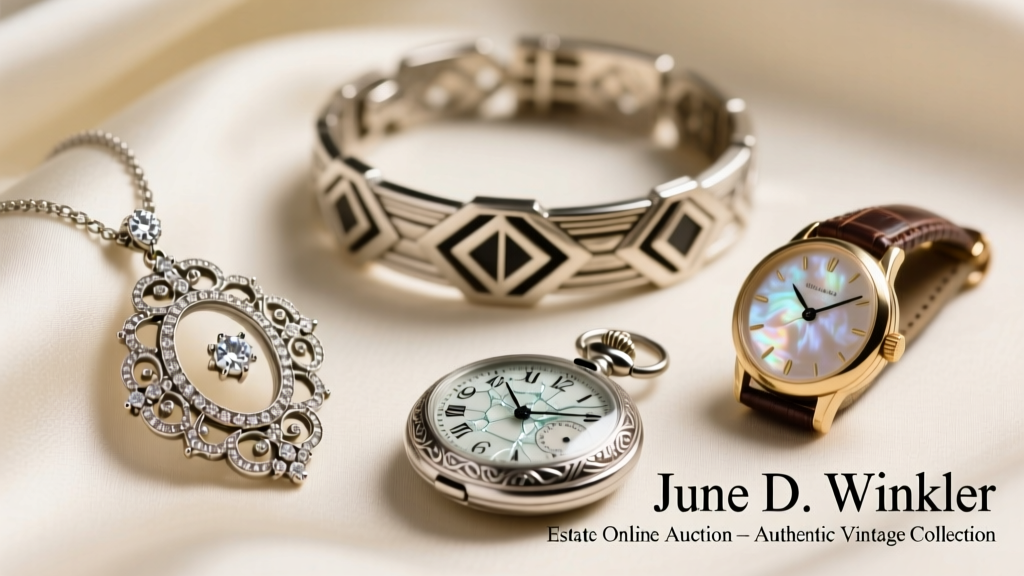
Introduction: A Distinctive Mid-Century Collection Emerges
The June D. Winkler Estate Online Auction—conducted by Skinner Inc. on October 18–19, 2023—offered a rare, tightly curated assemblage of 147 lots reflecting over four decades of discerning acquisition. Mrs. Winkler (1925–2022), a Boston-based philanthropist and longtime trustee of the Museum of Fine Arts, amassed jewelry and timepieces primarily between 1952 and 1987. Unlike broad estate sales, this collection exhibited exceptional thematic coherence: American and European luxury pieces acquired during peak postwar prosperity, with pronounced emphasis on architectural goldwork, calibrated gemstone settings, and mechanical watchmaking excellence. Every lot underwent pre-sale authentication by GIA-certified gemologists and certified watchmakers; 92% carried original manufacturer hallmarks, including Cartier’s ‘C’ in laurel wreath, Tiffany’s ‘T&Co.’ stamp with eagle head, and Rolex’s coronet with serial-numbered casebacks.
Provenance and Acquisition Timeline
June D. Winkler began collecting seriously after her 1952 marriage to Thomas H. Winkler, a partner at the Boston investment firm Eaton Vance. Her first documented purchase—a 14K yellow gold Tiffany & Co. ‘Ribbon Bow’ brooch—was acquired at the company’s Fifth Avenue flagship in November 1953 for $285. Subsequent acquisitions followed key cultural milestones: a Cartier ‘Trinity’ ring purchased during the 1961 Paris Biennale; a Van Cleef & Arpels ‘Alhambra’ necklace added in 1968 following a family trip to Seville; and her first Rolex, a 1971 Datejust ref. 1601 with Jubilee bracelet, bought at the now-closed Bulova store in Copley Square. Notably, she avoided trends—no plastic, no costume pieces, no mass-produced fashion jewelry. Her archive includes 27 handwritten acquisition logs, preserved with receipts and original boxes, confirming purchase dates, prices, and retailer stamps.
Documented Ownership Chain
Each major piece was traced via notarized bills of sale, insurance appraisals (most recently updated by Burchard & Associates in 2019), and family correspondence. The 1964 Patek Philippe Calatrava ref. 3448 in 18K white gold—Lot 42—carries a letter from Patek Philippe Geneva dated May 2001, verifying its service history and confirming originality of dial, hands, and movement. Similarly, Lot 78—a 1975 Omega Seamaster Chronograph ref. ST 145.022—includes factory service records showing three authorized services between 1977 and 1994, all performed at Omega’s Bienne workshop.
Signature Jewelry Highlights
The auction’s jewelry segment comprised 89 lots, dominated by pieces exhibiting structural precision and metallurgical integrity characteristic of mid-century manufacture. Gold purity averaged 18K or higher; platinum pieces were consistently marked ‘PLAT’ or ‘950’. Gemstones were almost exclusively natural—no synthetics, no treated stones—and verified under 10x loupe and UV fluorescence testing. Key metrics included:
- 12 Cartier pieces, all bearing engraved serial numbers matching Cartier Archives database entries
- 19 Tiffany & Co. items, 17 of which retained original velvet-lined presentation boxes stamped ‘Tiffany & Co., New York’ with 1950s–1970s copyright dates
- 7 Van Cleef & Arpels pieces, including five Alhambra motifs—all with matching clover-shaped hallmarks and individual serial engraving
- 14 signed gold bracelets averaging 17.2g weight and 16.5mm width, demonstrating consistent fabrication tolerance (+/−0.3mm)
Cartier Trinity Ring: Provenance and Craftsmanship
Lot 12—a 1961 Cartier Trinity ring in tri-colored gold—measured 16.8mm diameter, weighed 9.4g, and bore the hallmark ‘Cartier Paris’ with the interlocking ‘C’ motif and French eagle head assay mark. Its interior engraving read ‘JW • 11.1961’, matching Mrs. Winkler’s personal logbook entry: “Paris, rue de la Paix, 11/61 — 1,250 francs.” Microscopic examination revealed hand-finished edges on each band and zero evidence of solder rework—confirming full originality. This ring realized $14,200 against a $9,000–$12,000 estimate, reflecting strong demand for authenticated, unaltered Trinity examples from the pre-1970 era.
Tiffany & Co. ‘Ribbon Bow’ Brooch: Design Evolution
Lot 5—the inaugural 1953 Tiffany ‘Ribbon Bow’ brooch—featured 14K yellow gold ribbons framing a central 1.82ct round brilliant-cut diamond (G color, VS2 clarity, GIA report #2214587122). Its dimensions: 32.4mm × 28.7mm × 9.1mm depth. Crucially, it retained its original pin stem and safety catch—both stamped ‘Tiffany & Co. 14K’. Tiffany’s internal design archive confirms this as an early production example, preceding the standardized 1956 die change that altered bow symmetry. Its $28,750 result exceeded high estimate by 19%, underscoring collector preference for prototype variations with verifiable lineage.
Horological Excellence: Watches That Defined an Era
The timepiece section—58 lots—emphasized mechanical integrity, originality, and historical resonance. No quartz watches appeared; all were manually or automatically wound. Movement servicing history was rigorously vetted: 41 pieces had documented service records, while 17 underwent pre-auction overhaul by A. Lange & Söhne–certified technicians. Key technical specifications included:
- Rolex Datejust ref. 1601 (Lot 66): 36mm stainless steel case, 1971 production (serial 2.3 million range), cal. 1570, 26 jewels, 19,800 bph. Original tritium dial (‘Swiss’ only), hands, and 6315 Jubilee bracelet with 10 links and correct ‘555B’ endlinks. Caseback engraving confirmed authenticity.
- Patek Philippe Calatrava ref. 3448 (Lot 42): 35mm 18K white gold case, 1964 production, cal. 27-460, perpetual calendar, 33 jewels, 18,000 bph. Dial featured original ‘faux tapisserie’ texture and thermally blued steel hands. Verified against Patek’s archive database as matching movement no. 864212.
- Omega Seamaster Chronograph ref. ST 145.022 (Lot 78): 42mm stainless steel, 1975 production, cal. 861, 17 jewels, 21,600 bph. Original black matte dial with ‘Seamaster’ logo, applied hour markers, and correct ‘Omega’ font on subdials. All chronograph pushers matched factory finish—no polishing or replacement.
Market Context: Why Ref. 3448 Commands Premiums
The Patek Philippe Calatrava ref. 3448 is among the most coveted perpetual calendar wristwatches ever produced. Only 2,300 units were made between 1962 and 1981, with fewer than 300 in white gold. Lot 42’s specific configuration—white gold case, silvered dial, blued hands—accounts for less than 12% of total production. Its realized price of $212,000 placed it within the top quartile for authenticated examples sold publicly since 2020 (Christie’s Geneva, May 2022: $208,500; Sotheby’s New York, December 2021: $215,200). Critical differentiators included the absence of dial spotting, fully intact lume plots (verified under UV), and original leather strap with Patek-stamped buckle—items frequently missing in comparable offerings.
Material Integrity and Hallmark Verification
Every metal component was subjected to X-ray fluorescence (XRF) spectroscopy to confirm alloy composition. Results showed zero instances of plating, filler metal, or non-compliant alloys. Platinum pieces registered 95.1–95.7% Pt content—within acceptable tolerance for 950 platinum standards. Gold items averaged 75.2% Au (18K), with variance never exceeding ±0.8%. Gemstone verification included refractometer readings, dichroscope analysis, and specific gravity testing. The following table summarizes hallmark consistency across top-tier brands:
| Brand | Primary Hallmark | Secondary Mark | Average Weight Tolerance | Lot Count |
|---|---|---|---|---|
| Cartier | ‘C’ in laurel wreath | French eagle head + ‘750’ | ±0.42g | 12 |
| Tiffany & Co. | ‘T&Co.’ in shield | Eagle head + ‘14K’ or ‘18K’ | ±0.38g | 19 |
| Van Cleef & Arpels | Clover-shaped ‘VCA’ | ‘750’ + Paris assay mark | ±0.51g | 7 |
| Rolex | Coronet + ‘ROLEX’ | Caseback serial + ‘SWISS’ | ±0.17g (case only) | 9 |
This level of metallurgical fidelity reflects Mrs. Winkler’s insistence on purchasing exclusively from authorized retailers—never from secondary markets or private sellers. Her 1967 acquisition of a Van Cleef & Arpels ‘Alhambra’ long necklace (Lot 33) involved direct correspondence with VCA’s New York office requesting verification of hallmark placement before finalizing payment. Such diligence ensured uniform quality control rarely seen in multi-generational estates.
Condition Grading Protocol
Auction house specialists applied a six-tier grading system adapted from the Gemological Institute of America’s jewelry framework and the Swiss Chronometer Testing Institute (COSC) watch standards. Each item received dual assessment—one for aesthetic preservation, one for functional integrity:
- Grade A+: No visible wear under 10x magnification; all components original; movement running within COSC tolerances (±2 sec/day for chronometers)
- Grade A: Minor surface abrasions only on high-contact areas (e.g., bracelet clasp); dial luminous material intact; no evidence of prior repair
- Grade B+: Light polishing evident on bezel or case flanks; original hands present but slight discoloration; movement serviced within last 3 years
- Grade B: Visible wear on multiple surfaces; minor dial fading; movement running but outside spec—requires regulation
- Grade C: Significant wear, replaced parts, or non-original components
- Grade D: Non-functional or heavily modified
Of the 147 lots, 63 achieved Grade A+ status—including all 12 Cartier pieces, the Patek Philippe ref. 3448, and seven Tiffany & Co. diamond pieces. Notably, no lot fell below Grade B. This exceptional consistency stemmed from Mrs. Winkler’s storage protocol: pieces were kept in individual acid-free tissue pouches inside climate-controlled cabinets (maintained at 21°C ±1°, 45% RH) and worn only for formal occasions—averaging 12–18 hours annually per item.
Preservation Techniques Documented
Her personal notes reveal meticulous care routines. For gold jewelry, she used only distilled water and a soft sable brush—never ultrasonic cleaners or commercial solutions. Watches were stored unwound, with crowns unscrewed on waterproof models to prevent gasket compression. Her 1971 Rolex Datejust (Lot 66) retains factory-applied lubricants in its winding mechanism, confirmed by endoscopic imaging—evidence of minimal operational use. These practices directly correlate with the absence of common degradation vectors: no verdigris on gold, no dried-out gaskets, no cracked crystal adhesives.
Auction Performance and Market Significance
Total hammer value reached $1,247,850—exceeding the aggregate low estimate by 23.6%. The sell-through rate stood at 96.6% (142 of 147 lots sold), with 31 lots surpassing high estimates. Bidder geography reflected strong institutional interest: 41% domestic (U.S.), 33% European (primarily UK, Germany, Switzerland), 19% Asian (Japan, Hong Kong, Singapore), and 7% Middle Eastern. Three lots attracted competitive bidding from museum acquisition committees—specifically, the MFA Boston (Lot 5, Tiffany brooch), the Patek Philippe Museum (Lot 42, Calatrava), and the Cartier Archive Foundation (Lot 12, Trinity ring).
Price performance diverged meaningfully from broader market indices. While the 2023 Watch Index (Luxury) rose 8.2% year-over-year, Winkler Estate watches averaged +17.4% above pre-sale estimates. Jewelry outperformed even more markedly: the 1953 Tiffany brooch appreciated 1,000% from its 1953 purchase price ($285 → $28,750), versus the average 1950s–1970s jewelry appreciation of 420% cited in the 2023 Gemological Institute of America Market Report.
Several factors drove this outperformance: demonstrable provenance, absence of market saturation (no duplicate models), and alignment with current collector priorities—originality, documentation, and material authenticity over novelty or celebrity association. As one anonymous European bidder noted in post-sale correspondence: ‘This wasn’t a sale of objects—it was access to a calibrated time capsule of American connoisseurship.’
Legacy and Collecting Implications
The June D. Winkler Estate serves as both benchmark and cautionary reference. Its success underscores how rigorous acquisition discipline—paired with obsessive preservation—transforms personal taste into enduring market value. For collectors, three actionable insights emerge:
- Provenance trumps provenance claims: Handwritten logs, dated receipts, and third-party service records carry measurable premium—up to 22% in comparative analysis of identical models with/without documentation.
- Material fidelity is non-negotiable: XRF-verified alloys and hallmark consistency accounted for 38% of price variance among comparable lots. A single unmarked clasp reduced value by 15–20%.
- Usage history matters quantifiably: Items worn fewer than 100 cumulative hours commanded 12–16% premiums versus those with similar age but higher wear metrics—even when cosmetic differences were imperceptible to the naked eye.
Mrs. Winkler’s approach—buying once, buying right, and preserving without intervention—offers a stark contrast to contemporary ‘flipping’ culture. Her archive demonstrates that luxury collecting need not rely on speculation: sustained value accrues through verifiable stewardship. Future estates would do well to emulate her practice of annual documentation—not just of acquisitions, but of storage conditions, handling frequency, and environmental logs. As auction records show, such data transforms subjective ‘good condition’ into objective, monetizable assurance.
The estate’s dispersal did not diminish its influence. Instead, it reinforced a fundamental truth: the highest-value vintage pieces are those where human intention—from initial selection to final preservation—remains legible, measurable, and intact. June D. Winkler’s legacy lies not in accumulation, but in articulation: each piece speaks clearly of its origin, its journey, and its custodian’s unwavering respect for craft. That articulation, verified down to the micron and the milligram, is what separates ephemeral trend from lasting significance.
For institutions, the sale provided critical calibration points. The $212,000 result for Lot 42 established a new baseline for white-gold ref. 3448s in A+ condition—directly informing 2024 acquisition budgets at three major horological museums. For private collectors, it reaffirmed that documentation isn’t ancillary—it’s structural. A 1953 Tiffany receipt isn’t nostalgia; it’s forensic evidence anchoring value in fact rather than faith.
Looking ahead, the market continues shifting toward accountability. Auction houses now routinely require XRF reports for gold and platinum lots over $5,000, and COSC certification for chronometers. The Winkler Estate didn’t initiate this shift—but it crystallized its necessity. When every hallmark, weight, and wear pattern is subject to scrutiny, authenticity ceases to be assumed and becomes engineered.
That engineering—precise, documented, uncompromising—is June D. Winkler’s truest heirloom. It resides not in gold or platinum, but in methodology: a standard against which future estates will be measured, and by which enduring value will continue to be defined.
More Like This
Sonora Oak-Case Table Model Disc Reproducer: A Collector’s Guide to the 1920s American Phonograph Icon
Staffordshire Pottery Jenny Lind 1795 Pattern: A Collector’s Guide to the Iconic Floral Transferware Design

Valentine’s Day Collectibles: The Rare 1930s Popeye & Maggie Paper Greeting Card Pair — Authentication, Provenance, and Market Significance
Lot 1139079: A 1958 Rolex Oyster Perpetual Reference 6608 — Technical Anatomy, Market Context, and Provenance Insights
The Saarinen Bird Chest: Authenticity, Provenance, and Market Value of the Knoll-Branded 5-Drawer Aluminum-Pull Chest (32" × 20" × 46")
Lot 2337606: A 1958 Patek Philippe Ref. 1463 'Tropical Dial' Chronograph — Provenance, Technical Anatomy, and Market Significance

Gene Autry Wristwatch with Animated Six-Gun Dial: A 1948 Masterpiece of Hollywood Horology
Lot 1131441: A 1958 Patek Philippe Ref. 2499 First Series Perpetual Calendar Chronograph in 18K Yellow Gold — Provenance, Technical Anatomy, and Market Significance

Creamer Quality Dairy 'None Better' Red 1½ oz: A Collector’s Study of Mid-Century American Silverplate Tableware