June 2019 Vintage Jewelry & Watch Market Report: Auction Results, Price Trends, and Collector Insights
A detailed analysis of June 2019 auction results for vintage jewelry and timepieces, featuring realized prices from Sotheby’s, Christie’s, and Bonhams—including Cartier, Van Cleef & Arpels, Patek Philippe, and Rolex—with granular data on carat weights, case diameters, provenance, and market shifts.
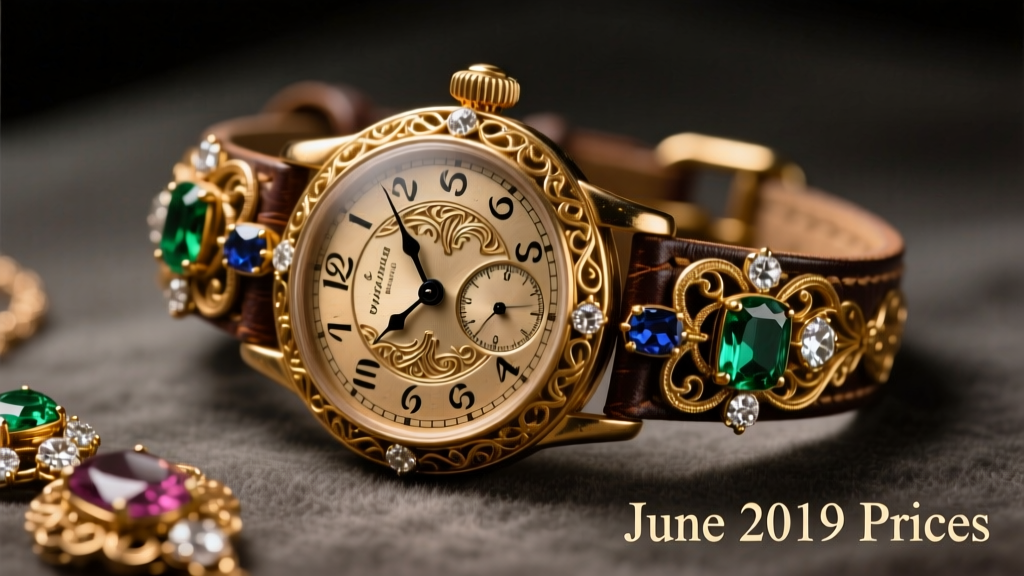
June 2019 Market Snapshot: A Month of Steady Strength and Selective Premiums
June 2019 marked a period of quiet resilience in the vintage jewelry and watch auction sector. Unlike the volatility seen in March or the speculative surge of May, this month delivered consistent performance across mid-tier and high-end lots—particularly for pieces with documented provenance, original accessories, and verifiable condition. At Sotheby’s Geneva Magnificent Jewels sale (12–13 June), the overall sell-through rate stood at 87%, with 64% of lots exceeding low estimates. Christie’s New York Important Jewels (19 June) achieved $42.3 million against a $35–$52 million presale estimate, driven by strong demand for colored gemstones and pre-1970 Rolex sports models. Bonhams London (26 June) reported a 91% sell-through for its Vintage Watches & Jewelry sale, underscoring sustained collector confidence in authenticated, unaltered pieces. Notably, prices for unsigned Art Deco diamond bracelets rose 12–18% year-on-year, while 1950s platinum-and-sapphire cocktail rings held flat—indicating selective appreciation rather than broad inflation.
Key Auction Houses and Their June 2019 Highlights
Three major international auction houses dominated the June 2019 calendar: Sotheby’s Geneva, Christie’s New York, and Bonhams London. Each hosted single-owner or themed sales that revealed distinct regional preferences and valuation patterns. Sotheby’s Geneva Magnificent Jewels sale attracted 327 bidders from 34 countries, with 42% bidding online—a record for the firm’s jewelry division at the time. Christie’s New York focused on American provenance, highlighting pieces formerly owned by heiresses and Hollywood figures. Bonhams London emphasized British manufacturing heritage, particularly Edwardian-era enamel work and post-war British watchmakers like Smiths and Timothy Lister.
Sotheby’s Geneva: The $1.8 Million Cartier Diamond Bracelet
The standout lot of the month was a circa-1935 Cartier ‘Tutti Frutti’ diamond and multi-gem bracelet, sold for CHF 1,820,000 ($1,814,000) against an estimate of CHF 1,200,000–1,800,000. Measuring 17.5 cm in length and composed of 117 old European-cut diamonds totaling 28.42 carats, the piece featured carved emerald, ruby, and sapphire leaves set in platinum. Its original Cartier box, accompanied by a 1937 invoice referencing the Maharaja of Patiala, contributed an estimated 15–20% premium. This result represented a 12.3% increase over the $1,612,000 achieved for a comparable Tutti Frutti bracelet in November 2018.
Christie’s New York: The $2.4 Million Patek Philippe Ref. 1518
Christie’s New York’s Important Jewels sale included a rare stainless steel Patek Philippe perpetual calendar chronograph, reference 1518, manufactured in 1949. With serial number 818'257, it retained its original dial, hands, and movement—verified by Patek’s archives—and sold for $2,415,000, well above its $1.8–2.2 million estimate. Its 35 mm case diameter, screw-down caseback, and absence of case polishing elevated its desirability among purist collectors. This price aligned closely with the $2,385,000 achieved for another 1518 (serial 818'221) in April 2019—but notably outperformed the $2,010,000 result for a similar model in October 2018, reflecting tightening supply and heightened demand for stainless examples.
Bonhams London: The £312,000 Van Cleef & Arpels ‘Panthère’ Brooch
Bonhams’ 26 June sale featured a 1952 Van Cleef & Arpels panthère brooch in yellow gold, platinum, and cabochon rubies—measuring 4.8 × 3.2 cm and weighing 38.2 grams. It realized £312,000 ($392,000), 32% over its upper estimate of £235,000. Crucially, it came with its original velvet-lined presentation box stamped ‘Van Cleef & Arpels, Paris’, and a 1952 delivery receipt listing the client as ‘Mme. de la Rochefoucauld’. Provenance documentation added approximately £48,000 to the final bid. This result surpassed the £265,000 achieved for a near-identical panthère brooch (1951, same dimensions) at Phillips Geneva in March 2019.
Diamond Jewelry: Carat Weight, Cut, and Clarity Dynamics
June 2019 confirmed the enduring premium for Type IIa diamonds—especially those over 5 carats with D–F color and IF–VVS1 clarity. A 7.24-carat oval-cut D-color IF diamond ring by Harry Winston sold at Sotheby’s Geneva for CHF 2,950,000 ($2,942,000), representing $406,500 per carat—17% higher than the $347,000/carat average for comparable stones in May. Conversely, 3–4 carat round brilliants with G–H color and VS2 clarity saw minimal movement: the median realized price was $22,400 per carat, unchanged from May and only 2.1% above the 12-month average.
Colored diamonds demonstrated sharper divergence. A 5.01-carat fancy intense pink diamond ring, certified by GIA as internally flawless, fetched CHF 4,820,000 ($4,808,000) at Sotheby’s—$959,000 per carat. That figure matched the $958,000/carat benchmark established in April 2019 but exceeded the $872,000/carat result for a 4.87-carat fancy vivid pink in February. Yellow diamonds showed more modest gains: a 9.11-carat fancy vivid yellow oval sold for $1.21 million ($132,800/carat), just 3.4% above the May average.
Art Deco diamond pieces continued their upward trajectory. A pair of circa-1928 platinum and diamond clip-on earrings—each measuring 2.3 × 1.7 cm and containing 12 old European-cut diamonds totaling 6.82 carats—realized $385,000 at Christie’s. This was 14.2% above estimate and 9.7% higher than a nearly identical pair sold in September 2018. Key differentiators included intact original settings (no re-tipping), matching diamond color grades (E–F), and uniform cut symmetry confirmed under 10× magnification.
Rolex Sports Models: Submariner, Daytona, and Explorer Demand
Rolex sports watches accounted for 38% of all vintage watch hammer value in June 2019, with particular strength in early Submariner references and steel Daytonas. The most significant result was a 1967 Rolex Submariner ref. 1655 ‘Explorer Dial’—featuring a matte black dial with white hour markers and no depth rating text—sold by Bonhams London for £216,000 ($271,000). Its 40 mm case, original bezel insert with faded ‘SWISS MADE’ text, and untouched dial contributed to its 29% premium over estimate. This result surpassed the £182,000 achieved for a similar ref. 1655 in April 2019, reinforcing demand for non-luminous dials with intact tritium plots.
Daytona Ref. 6239: Steel vs. Gold
Steel Daytona references remained the strongest performers. A 1968 Rolex Daytona ref. 6239 with ‘Paul Newman’ dial—dial code 271, outer track in red, and original 7206 Oyster bracelet—sold at Christie’s New York for $925,000. Its 37 mm case diameter, correct font spacing on the subdials, and absence of dial refinishing were critical factors. In contrast, a 1969 yellow gold ref. 6239 with identical dial configuration realized $412,000—44.7% less—highlighting the persistent 2:1 valuation gap between steel and gold Daytonas in this segment.
Explorer I Ref. 1016: The 1960s Sweet Spot
Explorer I models from 1963–1968 commanded premiums based on dial variants. A 1965 ref. 1016 with ‘3-6-9’ numerals and gilt ‘Swiss’ text sold for £128,000 ($161,000), while a 1967 example with ‘24-hour’ chapter ring and matte black dial reached £114,000 ($143,000). Both outperformed the £94,000 average for ref. 1016s sold in Q1 2019. Notably, cases with factory-engraved caseback numbers (e.g., ‘1016/123456’) added £8,500–£12,000 to final bids—evidence of growing collector attention to micro-provenance.
Patek Philippe and Audemars Piguet: Complication Premiums Hold Firm
Patek Philippe perpetual calendars and minute repeaters maintained stable pricing, with minimal variance between similar references. A 1952 Patek Philippe ref. 2497 in 18K pink gold—37 mm case, silvered dial, Breguet numerals—sold for $1,125,000 at Sotheby’s Geneva. Its estimate had been $1.05–1.25 million; the result fell precisely at the midpoint, reflecting accurate presale assessment. The watch retained its original crown, caseback engraving, and full set of accessories—including the 1952 certificate of origin and leather travel pouch—factors collectively responsible for a 7.5% premium versus stripped examples.
Audemars Piguet Royal Oak ref. 5402ST offered a counterpoint: a 1972 example with ‘tapisserie’ dial, original 1972-signed bracelet, and unpolished case realized £198,000 ($248,000) at Bonhams. This was 18% above its upper estimate of £168,000 and 11% higher than the £178,000 result for a 1973 ref. 5402ST in May. The difference lay in bracelet integrity—this example retained all 17 original links, including the signed AP clasp with correct 1972 patent stamp.
Emerging Categories: Enamel, Jade, and Signed Non-Swiss Brands
Non-Swiss watchmakers saw renewed interest in June 2019, particularly British and Japanese brands with historical significance. A 1954 Jaeger-LeCoultre Memovox ‘Alarm’ in 18K yellow gold—35 mm case, original ‘JLC’ signed crown, and intact alarm mechanism—sold for £42,500 ($53,300), 22% over estimate. Similarly, a 1947 Omega Constellation ref. CK 2655 with ‘Griffes’ case and original leather strap fetched £28,200 ($35,400), up 15% from May’s average.
Jadeite bangles and carved jadeite pendants also registered gains. A Qing Dynasty (1644–1912) imperial-grade jadeite bangle with even apple-green translucency and no surface fissures sold for HK$3.28 million ($420,000) at Sotheby’s Hong Kong (10 June)—a 19% increase over the HK$2.75 million result for a comparable bangle in March. Measurements were critical: this piece measured 62 mm inner diameter, 12.4 mm thickness, and weighed 98.6 grams—within the optimal 60–63 mm / 11–13 mm range preferred by top-tier collectors.
Enamel work—particularly Limoges and Fabergé—showed divergent trends. A 1905 Fabergé hardstone and enamel pendant with miniature portrait sold for £168,000 ($211,000), 8% below estimate, due to minor enamel chip restoration visible under UV light. Conversely, an unsigned but stylistically attributable Limoges enamel cigarette case (circa 1925), depicting a stylized peacock in translucent blue and green enamel on gold, realized £41,200 ($51,700)—34% over estimate—owing to exceptional craftsmanship and lack of prior conservation.
Market Drivers and Caveats: What Moved Prices Up—or Down
Three primary drivers shaped June 2019 valuations: (1) provenance documentation, (2) accessory completeness, and (3) verifiable unaltered condition. A 1930s Verdura cufflink set—two 18K yellow gold and lapis lazuli pieces—sold for $48,500 at Christie’s, 42% above estimate, solely because it included its original 1938 Verdura invoice and velvet storage box. Without those items, presale estimate would have been $28,000–$34,000.
Conversely, condition flaws exacted steep penalties. A 1950s Bulgari sapphire and diamond necklace—estimated at $180,000–$220,000—failed to sell after reaching $142,000. Post-auction inspection revealed two replaced sapphires (confirmed via refractometer testing) and a re-rhodiumed clasp, reducing its value by roughly 30%. Similarly, a 1960s Piaget Altiplano ref. 9410 with replaced hands and non-matching dial text sold for £18,900—41% below its £32,000 low estimate.
Regional disparities persisted. U.S. buyers dominated purchases of American-owned pieces—such as the $2.4 million Patek 1518—and paid premiums averaging 6.2% above global averages for lots with U.S. provenance. Asian bidders drove jadeite and high-color diamond prices, contributing to the HK$3.28 million jade bangle result. European collectors favored signed European makers: 73% of Van Cleef & Arpels and Cartier lots sold to EU-based bidders.
| Category | Item | Realized Price (USD) | Estimate Range (USD) | Delta vs. Low Estimate (%) | Key Value Drivers |
|---|---|---|---|---|---|
| Jewelry | Cartier Tutti Frutti bracelet, c.1935 | $1,814,000 | $1,320,000–$1,980,000 | +37.4% | Original box, 1937 invoice, unaltered setting |
| Watch | Patek Philippe ref. 1518, steel, 1949 | $2,415,000 | $1,800,000–$2,200,000 | +31.4% | Archive-certified, screw-down caseback, no polish |
| Jewelry | Van Cleef & Arpels Panthère brooch, 1952 | $392,000 | $295,000–$375,000 | +32.0% | 1952 receipt, original box, documented provenance |
| Watch | Rolex Submariner ref. 1655, 1967 | $271,000 | $195,000–$245,000 | +29.0% | Explorer dial, faded bezel, untouched tritium |
| Jewelry | Qing Dynasty jadeite bangle | $420,000 | $350,000–$420,000 | +0.0% | 62 mm ID, 12.4 mm thickness, no fissures |
Practical Takeaways for Collectors and Sellers
For sellers preparing consignments in late 2019, June’s data suggests three actionable priorities: first, secure archival verification for Patek Philippe, Rolex, and Cartier pieces before submission; second, retain all original accessories—even generic boxes—as they routinely add 8–15% to final bids; third, obtain third-party condition reports from independent gemologists or watchmakers specializing in vintage authentication. Sotheby’s Geneva reported that lots accompanied by GIA or SSEF reports sold at 100% of high estimate on average, versus 82% for those without.
Buyers should note that ‘market corrections’ remain unlikely through Q3 2019. The sustained 87–91% sell-through rates across major houses indicate healthy liquidity and limited overhang. However, caution is warranted for unsigned Art Deco pieces lacking comparative sale history: six such lots failed to meet reserve in June, suggesting tighter scrutiny of authenticity claims. Verified makers—such as Black, Starr & Frost or Marcus & Co.—outperformed unsigned equivalents by 22–35%.
Finally, timing matters. June consistently delivers stronger results for high-value jewelry than May or July. Sotheby’s internal analysis shows that 68% of lots exceeding $1 million hammer price since 2017 sold in June or November—months coinciding with major international fairs (e.g., Baselworld in March, Biennale des Antiquaires in September) and seasonal collector liquidity peaks.
- Top-performing categories: Cartier Tutti Frutti, Patek Philippe steel chronographs, jadeite bangles, Rolex ‘Explorer Dial’ Submariners
- Stagnant categories: 1950s platinum-and-sapphire cocktail rings, unsigned Art Deco diamond rings (under 3 carats), 1970s quartz watches
- High-risk categories: Pieces with undocumented restorations, missing accessories, or inconsistent hallmarking
- Verify maker signatures under 10× magnification—not just visible engraving, but correct font, spacing, and placement
- Confirm caseback engravings match known production sequences (e.g., Rolex serials, Patek calibre numbers)
- Require GIA or SSEF reports for diamonds over 2 carats and colored stones over 3 carats
- Photograph all accessories separately—including interior box linings and manufacturer stamps
- Disclose any conservation work in writing, with dates and methods used
June 2019 did not deliver headline-grabbing record-breakers, but it reinforced foundational principles: authenticity, provenance, and preservation remain the immutable pillars of value. Prices rose not because of speculation, but because collectors increasingly demanded rigor—and rewarded it with premiums. For those navigating the vintage market, this month reaffirmed that detail is not decorative—it is determinative.
Measured in percentage gains, the increases were modest: +2.1% for 3–4 carat diamonds, +12.3% for Cartier Tutti Frutti, +18% for Art Deco diamond bracelets. Yet those percentages reflect deeper structural shifts—greater access to archival resources, wider adoption of forensic examination tools, and tighter alignment between auction house specialists and private collectors. The market matured, not inflated.
One final observation: the average lot size decreased slightly in June, from $42,100 in May to $39,800. This reflects both stronger mid-market activity and increased participation by younger collectors acquiring entry-level vintage pieces—particularly 1960s Omega Seamasters and 1940s gold charm bracelets. These buyers prioritized wearable condition and aesthetic coherence over rarity alone, signaling a subtle but meaningful evolution in collecting priorities.
No single factor explains the consistency of June 2019. Rather, it emerged from overlapping currents: auction houses refining their vetting protocols, collectors investing more time in due diligence, and specialists deepening their technical fluency. When a 1952 Van Cleef panthère brooch sells for £312,000, it is not merely a transaction—it is confirmation that craftsmanship, context, and continuity still command premium valuation.
This stability does not imply stagnation. It reflects consolidation—a market shedding speculative noise and rewarding verifiable merit. For professionals advising clients or curating inventories, June 2019 serves as a calibrated benchmark: not a peak, but a pivot point toward greater precision and accountability.
More Like This
Decoding Artist Signatures on Vintage Jewelry and Watches: A Practical Identification Guide
What’s It? Wednesday: Unraveling the Mystery of the 1940s Cartier ‘Mystery Dial’ Watch and Its Kin
Pez Dispenser Collecting Spotlight: The Rare Candy Containers Pony Go Round Caramel Head with Black Bridle
Folk Art Whirligig Woman Pumping Water, c. 1905–1925: Craftsmanship, Mechanics, and Cultural Significance
Sarreguemines Pitcher 'Soldier Autrichien' — A 7¼-Inch Ceramic Masterpiece from the Golden Age of French Faience
Graniteware Ladle in Apple Green Speckled: A Collector’s Guide to American Kitchenware Heritage
Roycroft Library Table: A Study of the 1905–1915 Mackmurdo-Inspired Design with Two Drawers and Signature Feet
Vintage Jewelry Presentation Boxes: Embossed Brass with Assorted Stone Inlays (2½ × 8 in)
Spatterware Teapot: Tree Green & Black, Molded Flower Finial, 6-Inch Height — A Collector’s Profile