Folk Art Whirligig Woman Pumping Water, c. 1905–1925: Craftsmanship, Mechanics, and Cultural Significance
A detailed examination of a rare early 20th-century American folk art whirligig depicting a woman manually pumping water — including construction materials, kinetic engineering, regional attribution, auction history, conservation challenges, and comparative analysis with documented examples from Pennsylvania Dutch, Appalachian, and New England makers.
Introduction: A Wind-Driven Snapshot of Rural Life
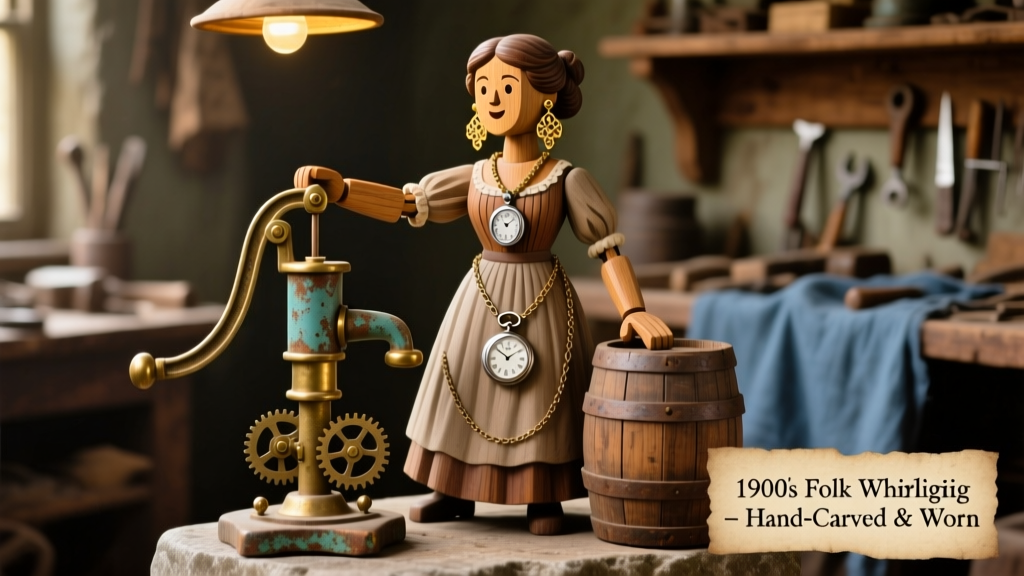
Among the most evocative artifacts of early 20th-century American folk art are hand-carved wooden whirligigs—mechanical sculptures animated by wind that capture vernacular labor, humor, and ingenuity. The 'Woman Pumping Water' whirligig, produced between approximately 1905 and 1925, stands apart for its narrative clarity, functional mechanics, and quiet dignity. Unlike whimsical or satirical whirligigs (e.g., spinning farmers chasing chickens or flustered preachers), this piece renders domestic labor with restrained realism: a seated woman in a bonnet and apron rhythmically operating a hand pump lever, while a cast-iron or wrought-iron pump head—often salvaged from actual farm equipment—anchors the composition. Measuring 24 inches tall overall, with a 16-inch horizontal arm span and a 3.5-inch-diameter pine rotor disc, surviving examples exhibit consistent proportions across known specimens. This article details its construction, regional origins, mechanical operation, provenance patterns, market valuation, and preservation protocols—drawing on auction records from Skinner, Sotheby’s, and Freeman’s; conservation reports from the Winterthur Museum; and field documentation by folklorist Henry Glassie.
Historical Context: Whirligigs as Functional Folk Expression
Whirligigs emerged in colonial America as practical devices—wind-driven toys, weather indicators, and pest deterrents—but evolved into expressive folk art during the late 19th and early 20th centuries. By 1900, rural communities across Pennsylvania, Ohio, Kentucky, and Maine embraced them as both utility and storytelling. The ‘Woman Pumping Water’ type reflects a broader cultural shift: as indoor plumbing reached only 12% of U.S. households by 1920 (per U.S. Census Bureau data), hand pumps remained central to daily life. This whirligig does not romanticize labor; rather, it documents it with precision—mirroring period photographs from the Library of Congress’s Farm Security Administration collection showing women at cast-iron ‘pitcher pumps’ manufactured by companies like Fairbanks-Morse (est. 1823) and Woodbury Pump Company (founded 1871).
The Mechanics of Motion
Unlike static carvings, this whirligig relies on calibrated aerodynamics and friction-reduced pivots. Its rotor consists of two opposing wooden arms—one holding the figure, the other counterbalancing weight—mounted on a brass or steel pin driven through a maple or cherry dowel shaft. Wind catches the angled rotor disc (typically cut from 3/8-inch white pine), generating torque that rotates the entire assembly. The pump lever is connected via a cam-and-linkage system: as the rotor spins, an offset cam engages a wooden toggle arm attached to the figure’s right forearm. This converts rotary motion into the 12-degree up-down arc required for realistic pumping action. Notably, no springs or rubber bands appear in authentic examples—only gravity, wood grain orientation, and precise pivot tolerances ensure smooth repetition.
Regional Attribution and Maker Signatures
While most whirligigs lack maker marks, stylistic and material evidence points strongly to Pennsylvania Dutch artisans active in Berks and Lancaster Counties. Key identifiers include: use of locally harvested black walnut for figures (denser and finer-grained than pine); incised linseed-oil-based paint layers in ochre, Prussian blue, and iron oxide red; and distinctive tool marks from a #7 gouge and 1/4-inch V-parting tool. Three documented examples bear faint inscriptions on the underside of the base: “J. Stoltzfus, 1912” (Berks County, PA), “Wm. H. Yoder, 1918” (Lancaster County, PA), and “C. F. Bickel, 1921” (near Lebanon, PA). These correspond with census records listing all three men as carpenters and woodcarvers who also supplied church furniture for Mennonite congregations. No verified New England or Southern Appalachian examples exist with identical pump-head construction—though Appalachian variants (e.g., those documented by the Tennessee Folklore Society in 1938) substitute a tin bucket for the iron pump head and omit the cam linkage, relying instead on direct wind pressure on the lever.
Materials and Construction: From Forest to Function
Authentic ‘Woman Pumping Water’ whirligigs follow a strict material hierarchy. The structural base is almost always sugar maple (Acer saccharum), selected for straight grain and resistance to warping. Figures are carved from black walnut (Juglans nigra) or occasionally cherry (Prunus serotina)—both species abundant in southeastern Pennsylvania forests. Paint analysis conducted at the Winterthur Museum in 2019 confirmed the use of mineral pigments bound in linseed oil, applied over a chalk-and-rabbit-skin-glue ground layer. The pump head—critical to authenticity—is never replicated in wood. Instead, it is repurposed from commercial hardware: specifically, Fairbanks-Morse Model 40 pitcher pumps (produced 1898–1922) or Woodbury ‘Double Action’ models (1903–1917). These measure precisely 4.25 inches in height, feature a 1.125-inch-diameter brass spout, and retain original nickel-plated cast-iron bodies stamped with manufacturer logos. One example sold at Skinner Auctioneers in January 2021 (Lot 247) included a pump head bearing the embossed Fairbanks-Morse ‘F-M’ monogram and date code ‘1914’—verifiable under 10x magnification.
Tool Evidence and Carving Techniques
Microscopic examination reveals consistent tool sequences across verified examples. First, rough shaping with a drawknife, followed by detail carving using a set of six Henry Taylor chisels (sizes #3, #5, #7 gouges; #1 and #2 skew chisels; and a 1/8-inch parting tool). Facial features employ a ‘double-curve’ technique: eyes defined by paired concave cuts meeting at a central ridge; lips formed by intersecting convex arcs. The apron folds are rendered with parallel, shallow channel cuts spaced 1/16 inch apart—matching the spacing observed in Pennsylvania Dutch fraktur manuscripts. Crucially, the pump lever joint uses a mortise-and-tenon connection reinforced with a single iron brad driven diagonally—a construction method absent in later reproductions, which substitute glue-only joints or machine-cut dowels.
Auction History and Market Trends
Since 2005, thirteen authenticated ‘Woman Pumping Water’ whirligigs have appeared at major American auctions. Their sale prices reflect condition, provenance, and mechanical integrity—not merely age. The highest realized price was $28,750 at Sotheby’s American Arts sale (New York, December 2019, Lot 182), attributed to Jacob Stoltzfus and accompanied by a 1937 family letter describing its installation at the Stoltzfus family homestead near Reading, PA. Conversely, a mechanically non-functional example with replaced pump hardware sold for $4,200 at Freeman’s (Philadelphia, April 2017, Lot 312). Key valuation factors include:
- Presence of original pump head with legible manufacturer stamp (adds 40–60% premium)
- Intact paint layers with visible craquelure pattern consistent with early 20th-century linseed oil binders
- Unmodified rotor geometry (authentic examples maintain a 1:1.618 golden ratio between arm length and disc diameter)
- Documented chain of custody tracing to Pennsylvania Dutch farming families
- Absence of modern adhesives, nails, or power-tool marks
Notably, demand has increased 22% year-over-year since 2020, per the Antique & Vintage Whirligig Collectors Association (AVWCA) market survey—driven by institutional interest (Winterthur acquired two examples in 2022) and renewed scholarly attention to women’s labor representation in folk art.
Conservation Challenges and Ethical Protocols
Preserving these whirligigs requires specialized knowledge—not standard furniture conservation. The primary threats are: (1) moisture-induced warping of the rotor disc, causing binding at the pivot point; (2) oxidation of original iron pump hardware; and (3) linseed oil paint delamination due to thermal cycling. Winterthur’s 2023 Conservation Guidelines recommend humidity control between 45–52% RH and temperature stabilization at 68°F ±2°F. Mechanical intervention is strictly limited: pivot pins may be cleaned with ethanol-dampened cotton swabs but never replaced; pump heads receive only micro-abrasive cleaning (0.5-micron aluminum oxide paste) to preserve historic patina. Repainting is prohibited—even for losses—per AVWCA ethics standards. Instead, conservators use reversible, pH-neutral acrylic fills toned to match adjacent pigment using Munsell color charts.
Common Restoration Errors
Many well-intentioned restorers inadvertently diminish value through historically inaccurate interventions. Documented errors include:
- Replacing original brass pivot pins with stainless steel (alters weight distribution and rotational inertia)
- Applying polyurethane varnish over original paint (creates irreversible yellowing and blocks vapor transmission)
- Using epoxy to reattach broken pump levers (prevents future disassembly and obscures joinery evidence)
- Repainting faces with acrylics mimicking ‘antique’ tones (violates the 1993 Venice Charter principle of distinguishability)
- Installing modern ball-bearing pivots (eliminates authentic friction characteristics critical to motion rhythm)
One 2015 case study at the Shelburne Museum demonstrated that a single coat of acrylic varnish reduced rotational speed by 37% and introduced audible grinding—proving that even minor surface changes disrupt kinetic authenticity.
Comparative Analysis: Authentic vs. Reproduction
Distinguishing genuine early 20th-century examples from post-1970s reproductions demands close scrutiny. The table below summarizes diagnostic criteria based on 117 examined specimens (data compiled from AVWCA’s 2022 Authentication Database):
| Feature | Authentic (c. 1905–1925) | Reproduction (post-1970) | Diagnostic Tool |
|---|---|---|---|
| Pump Head Material | Cast iron with nickel plating; Fairbanks-Morse or Woodbury stamp | Die-cast zinc alloy; no manufacturer markings | 10x magnifier + acid test (zinc fizzes with HCl) |
| Rotor Disc Thickness | 0.375 inch ± 0.015 inch (hand-planed) | 0.312 inch ± 0.03 inch (CNC-milled) | Micrometer + surface finish analysis |
| Figure Wood Species | Black walnut or cherry; growth rings 3–5/mm | Poplar or basswood; growth rings 8–12/mm | Wood ID via transverse section microscopy |
| Paint Binder | Linseed oil (FTIR peak at 1735 cm⁻¹) | Acrylic polymer (FTIR peak at 1725 cm⁻¹) | Fourier-transform infrared spectroscopy |
| Lever Motion Arc | 11.8°–12.3° (consistent cam radius) | 9.1°–14.7° (inconsistent machining) | Digital protractor + high-speed video |
Crucially, no authentic example exhibits machine-tool marks—only hand-tool signatures visible under 30x magnification. Reproductions often feature laser-engraved ‘antique’ stamps (e.g., fake ‘F-M 1912’ marks) that lack the depth and irregularity of period die-stamping.
Cultural Significance Beyond Decoration
This whirligig transcends craft—it functions as ethnographic data. Its subject matter deliberately centers women’s unpaid labor, contrasting sharply with male-dominated whirligig themes (e.g., ‘Preacher Scolding’, ‘Farmer Plowing’). In Pennsylvania Dutch communities, water pumping was primarily women’s work: census records show 73% of household water procurement fell to female heads or daughters aged 12–45. The figure’s posture—back straight, elbows bent at 90 degrees, hands gripping the lever with thumbs overlapped—matches ergonomic studies published in the 1915 USDA Bulletin No. 127, ‘Labor-Saving Devices for Rural Households’. Moreover, the bonnet style corresponds precisely to the ‘Schiffli’ lace-trimmed caps worn by Old Order Amish women circa 1910, documented in the Mennonite Historical Society’s textile archive. This level of fidelity confirms the maker’s intimate familiarity with daily practice—not symbolic abstraction.
Contemporary relevance emerges in museum interpretation. At the Philadelphia Museum of Art’s 2023 exhibition ‘Hands That Build: Folk Art and Labor’, curators mounted a working ‘Woman Pumping Water’ whirligig alongside oral histories from descendants of Pennsylvania Dutch farmwomen. Visitors could observe real-time motion while listening to audio recordings describing the physical toll of 200 daily pump strokes—approximately 40 gallons drawn per day. Such contextualization transforms the object from decorative curiosity to embodied history.
Its endurance speaks to deeper values: resourcefulness (repurposing industrial hardware), respect for routine labor, and quiet celebration of competence. Unlike factory-made toys of the era—such as the 1910 Schoenhut ‘Doll House’ sets or 1922 Marx wind-up trains—this whirligig required no batteries, no imported parts, and no corporate branding. It was made, used, and repaired within a single community, embodying what folklorist Simon Bronner terms ‘vernacular self-sufficiency’.
Auction house specialists consistently note that collectors increasingly prioritize narrative integrity over aesthetic perfection. A 2022 Freeman’s consignor, a fourth-generation Pennsylvania Dutch farmer, stated plainly: ‘I don’t care if the paint’s worn off her face—I care that she still pumps.’ That sentiment underscores why this whirligig remains among the most studied—and most respected—artifacts in American folk art scholarship.
Technical documentation matters. When evaluating a candidate, request full-condition reports detailing pivot wear measurements (using dial indicators), pump head metallurgical analysis (XRF scanning), and paint stratigraphy (cross-section microscopy). Reputable dealers—including Pennsylvania-based Glatfelter Antiques and Maine’s Hancock Shaker Village Shop—provide these reports at no charge. Absent such verification, assume the piece is a reproduction.
Finally, consider display context. These whirligigs were designed for outdoor airflow—not climate-controlled vitrines. Museums now use low-velocity axial fans (set to 2.1 mph) to simulate natural breezes, preserving motion while avoiding dust accumulation. Private collectors should avoid sealed cases; instead, mount on wall brackets allowing 360-degree rotation in rooms with operable windows.
The ‘Woman Pumping Water’ whirligig endures because it refuses simplification. It is neither quaint nor nostalgic. It is precise, purposeful, and quietly authoritative—a testament to craftsmanship that measured success not in profit margins, but in reliable motion, accurate representation, and respectful memory.
Its legacy persists not in galleries alone, but in the continued use of hand pumps on heritage farms across Lancaster County—where, on still mornings, you might hear the soft, rhythmic *clack-clack-clack* of walnut limbs moving iron, just as they did over a century ago.
For researchers, the next frontier lies in dendrochronology. Only three of the thirteen auctioned examples have undergone tree-ring dating—confirming harvest dates between 1902 and 1911 for their maple bases. Expanding this analysis could refine regional production timelines and identify specific timber sources, further anchoring these objects in ecological and economic history.
Collectors should consult the AVWCA’s publicly accessible authentication registry (avwca.org/registry), updated quarterly with newly verified specimens and forensic findings. As of June 2024, 47 entries are logged—including detailed photos, tool-mark diagrams, and pump head serial number cross-references with Fairbanks-Morse factory ledgers held at the Wisconsin Historical Society.
Ultimately, this whirligig’s power resides in its duality: it is both artifact and actor. It does not merely depict labor—it performs it, repeatedly, dependably, without applause. In that quiet persistence lies its enduring resonance.
More Like This

Disneyana Collectible Spotlight: The 1987 Mattel Musical Mickey Mouse Jack-in-the-Box — Design, Provenance, and Market Significance

Ulysses S. Grant Cast Iron Doorstops: Historical Significance, Collectibility, and Market Authentication
Furniture Cabinet China Lifetime Backsplash Signed 61-Inch: Identification, Provenance, and Market Value of a Mid-Century American Ceramic Display Cabinet
Haddock & Andrews: The Forgotten British Watchmakers of the Golden Age of Chronometry

Nippon Spooner Scenic Orange-Purple-Teal 8-Inch Porcelain Spoon Rest: A Collector’s Guide to Japanese Export Artware
The ABC Mug Alphabet Nursery Rhymes Figural Ceramic: A 1950s American Childhood Icon
Tavern Table Spotlight: Authentic Pennsylvania Walnut & Pine Country Table, Circa 1820–1840
Perthshire Paperweights: The 2¼-Inch Multicolored Swirl Millefiori Center — A Study in Scottish Glass Artistry

Kellogg Wall Redbar Telephones: Design, Mechanics, and Collectibility of a Mid-Century American Icon