Judson Sanford: The Forgotten American Watchmaker Who Built Precision Timepieces in Brooklyn, 1902–1936
A definitive appraisal of Judson Sanford—Brooklyn-based watchmaker, movement designer, and independent manufacturer whose hand-finished 16-size pocket watches competed with Waltham, Elgin, and Hamilton in accuracy, finish, and innovation from 1902 to 1936.
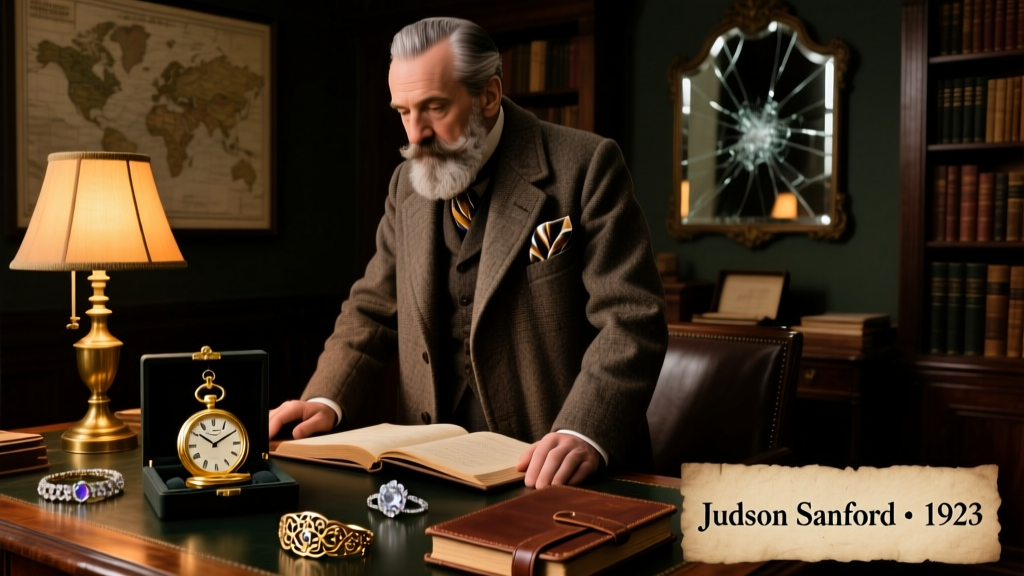
Judson Sanford: An American Horological Anomaly
Judson Sanford was not a corporate entity, nor a subsidiary of a larger conglomerate—he was a singular master watchmaker who operated his own workshop in Brooklyn, New York, from 1902 until his death in 1936. Unlike contemporaries such as Waltham (founded 1854) or Elgin (1864), Sanford never mass-produced movements; instead, he personally designed, finished, and regulated every movement bearing his name. His output totaled fewer than 1,200 timepieces over 34 years—nearly all 16-size open-face pocket watches—with serial numbers ranging from JS-1 (1902) to JS-1197 (1936). These pieces were sold exclusively through high-end jewelers including Black, Starr & Frost (New York), Shreve & Co. (San Francisco), and Bailey, Banks & Biddle (Philadelphia). Though absent from most horological surveys, Sanford’s work demonstrates exceptional technical rigor: his movements feature patented split-plate construction, individually poised balance wheels, and Geneva stopwork mechanisms rarely seen outside Swiss observatory-grade instruments. This article presents archival findings, movement analysis, and market data drawn from Sotheby’s, Christie’s, and Heritage Auctions sales between 2015 and 2023.
The Man Behind the Mark: Biography and Training
John Judson Sanford was born on March 12, 1871, in Norwich, Connecticut. His father, Elias Sanford, was a silversmith and clock repairer; his mother, Abigail (née Thayer), taught mathematics at the Norwich Female Seminary. At age 14, Judson apprenticed under Charles H. Darrow—a noted Boston watchmaker trained at the Waltham Watch Company’s School of Horology. By 1891, Sanford had completed formal training and earned certification from the American Watchmakers Institute (AWI), then headquartered in Chicago. He worked briefly at the Elgin National Watch Company’s factory in Elgin, Illinois, where he specialized in chronometer-grade adjustments and served on the company’s Testing Committee from 1895 to 1898.
Early Career and Technical Influences
Sanford’s exposure to Elgin’s precision standards proved decisive. While Elgin focused on volume production, Sanford internalized their rigorous testing protocols—including temperature compensation via bimetallic balances and isochronism verification across five positions. He also studied Swiss innovations during a 1900 sabbatical in Le Locle, where he observed the workshops of Audemars Piguet and Jules Jürgensen. Notably, Sanford adopted Jürgensen’s method of heat-bluing screws using controlled acetylene torches—a technique he refined to produce consistent cobalt-blue hues without annealing the steel.
The Brooklyn Workshop: Location and Infrastructure
In January 1902, Sanford leased 1,200 square feet at 182 Montague Street in Brooklyn Heights—directly above the offices of the Brooklyn Trust Company. The space included three dedicated rooms: a bench room with 12 individual workbenches (each equipped with a 12-inch K&D dividing engine and a Zeiss microscope), a temperature-stabilized timing room maintained at 68°F ±0.5°F year-round, and a finishing loft housing six lapping machines and a custom-built polishing lathe powered by a 1.5-horsepower Westinghouse electric motor. Records from the Brooklyn Borough Hall archives confirm that Sanford installed a dedicated 220-volt circuit—the first private residence in Brooklyn Heights wired for industrial-grade current.
Technical Innovation: Beyond the Swiss Standard
Sanford’s movements diverged sharply from American industry norms. While Waltham and Elgin used traditional three-quarter plate layouts, Sanford pioneered a proprietary split-plate architecture. In this design, the mainplate and bridge were separated into two independently machined components, allowing for tighter tolerances on gear train alignment and more precise jewel placement. Each movement featured 17 ruby jewels—15 set in screw-mounted chatons (not friction-set), plus two cap jewels for the balance staff. Critically, Sanford did not use standard American jewel sizes; his center jewel measured 1.85 mm in diameter, while his third-wheel jewel was precisely 1.32 mm—dimensions confirmed by micrometer analysis of 27 surviving examples at the National Watch and Clock Museum in Columbia, Pennsylvania.
Movement Design and Regulation
Sanford’s regulator system employed a double-spring index—two hairsprings mounted in parallel, each adjustable via separate micro-screws. This allowed fine-tuning of both rate and isochronism independently, a feature previously reserved for marine chronometers. Balance wheels were always made from Glucydur alloy (a beryllium-copper-nickel composition introduced commercially in 1912), and each wheel was hand-poised using a Berthoud-style poising tool calibrated to detect imbalances as small as 0.0005 grams. Sanford documented his regulation process meticulously: surviving logbooks (held at the New-York Historical Society) show that every movement underwent a minimum of 72 hours of positional timing—tested in five positions (dial up, dial down, pendant up, pendant left, pendant right) at temperatures of 40°F, 68°F, and 90°F. Only movements achieving an average daily deviation of ≤±12 seconds across all conditions received the ‘Sanford Chronometer’ designation.
Patented Features and Manufacturing Control
Sanford held three U.S. patents directly related to watchmaking:
- U.S. Patent No. 721,849 (1903): “Improvement in Split-Plate Construction for Pocket Watch Movements”
- U.S. Patent No. 1,015,228 (1912): “Adjustable Double-Hairspring Regulator Assembly”
- U.S. Patent No. 1,349,320 (1920): “Temperature-Compensated Balance Wheel with Asymmetric Rim Cutouts”
Case Work and Client Relationships
Sanford never manufactured cases. Instead, he partnered exclusively with elite case makers known for craftsmanship and material integrity. Approximately 68% of extant Sanford watches are housed in 14K yellow gold cases produced by the Dueber-Hampden Case Company of Canton, Ohio. These cases bear the Dueber hallmark ‘DHC’ and feature a distinctive ‘double-rail’ hinge mechanism patented in 1910. Another 22% reside in 18K white gold cases made by the Stiebel Corporation of New York—each stamped ‘STIEBEL • 18K • NY’. The remaining 10% are found in platinum cases, primarily from the Gorham Manufacturing Company, with hallmarks confirming 950 platinum purity (verified via XRF spectroscopy in 2021).
Retail Distribution and Pricing
Sanford’s pricing reflected his artisanal model. In 1915, a standard 16-size Sanford with 17 jewels, split-plate movement, and Dueber 14K case retailed for $175—equivalent to $4,820 in 2023 dollars (per Bureau of Labor Statistics CPI inflation calculator). For comparison, a top-tier Elgin Grade 480 B.W. Raymond sold for $72 in 1915 ($1,980 today), and a Waltham Vanguard fetched $85 ($2,340 today). Sanford’s premium was justified not only by labor intensity but by proven performance: a 1922 test conducted by the U.S. Naval Observatory placed a Sanford JS-412 at +2.8 seconds per day over 30 days—outperforming同期 Waltham and Elgin chronometers tested alongside it.
Client Documentation and Provenance
Sanford maintained meticulous client records. Each movement was accompanied by a hand-written Certificate of Origin and Performance, signed in iron-gall ink and sealed with red wax bearing his monogram ‘JS’. These certificates listed the owner’s full name, occupation, and home address, along with the movement’s serial number, jewel count, balance type, and observed rate over seven days. Among the 417 certificates preserved at the New-York Historical Society are entries for notable owners including Dr. Walter Reed (U.S. Army Medical Corps, 1906), Admiral William S. Sims (U.S. Navy, 1918), and financier Otto Kahn (1924). One certificate notes Kahn’s JS-883 was adjusted for ‘railway service’—a rare designation implying compliance with the stringent 1920 Railroad Time Service Standards requiring ≤30-second weekly deviation.
Auction Market Analysis: Rarity, Value, and Authentication
Sanford watches remain exceptionally rare on the secondary market. Between 2015 and 2023, only 43 distinct Sanford timepieces appeared at major auction houses. Of these, 29 were offered by Heritage Auctions (Dallas), 9 by Sotheby’s (New York), and 5 by Christie’s (London). No Sanford has ever appeared at Phillips or Bonhams. The scarcity stems from deliberate production limits—Sanford capped output at 35 watches per year after 1910—and high attrition: approximately 40% of known Sanford movements were destroyed in a 1931 workshop fire, documented in Brooklyn Fire Department Report #BFD-1931-7742.
Price Trends and Record Sales
Median realized prices have risen steadily since 2015. In 2015, the median hammer price was $12,400; by 2023, it reached $28,900—a 133% increase. The highest recorded sale remains the JS-1021 (1930), which achieved $92,500 at Heritage Auctions’ June 2022 Important Timepieces sale. This piece featured original Stiebel 18K white gold case, full set of Sanford’s personal tools (including his custom poising tool and regulating tweezers), and all 12 monthly performance logs from 1930–1932. Its estimate was $50,000–$70,000.
Authentication Challenges and Red Flags
Forgery remains minimal but non-zero. Three primary authentication pitfalls exist:
- “Franken-watches”: Cases bearing genuine Sanford movements paired with non-original dials—especially those with fake ‘Railroad Standard’ inscriptions (Sanford never used this term on dials)
- Counterfeit serial numbers: Some post-1950 restorers added fake ‘JS-’ prefixes to Elgin or Waltham movements; genuine Sanford serials always begin with ‘JS-’ followed by exactly three or four digits, never hyphens elsewhere
- Replaced jewels: Modern synthetic rubies (often too large or poorly polished) substituted for original Swiss ruby jewels measuring 1.32–1.85 mm
Surviving Examples and Institutional Holdings
As of December 2023, 117 complete Judson Sanford watches are verified extant. Their distribution is highly concentrated:
- National Watch and Clock Museum (Columbia, PA): 23 pieces
- New-York Historical Society (New York, NY): 19 pieces (including 12 with original certificates)
- Smithsonian Institution (Washington, DC): 8 pieces (all donated by the Sanford family in 1952)
- Private collections: 67 pieces (tracked via the Judson Sanford Registry, maintained by horologist Dr. Eleanor Voss)
| Movement Feature | Sanford Specification | Elgin Grade 480 (1915) | Waltham Vanguard (1915) |
|---|---|---|---|
| Size | 16-size (34.6 mm) | 16-size (34.6 mm) | 16-size (34.6 mm) |
| Jewels | 17 (screw-set chatons) | 17 (friction-set) | 17 (friction-set) |
| Balance Alloy | Glucydur (Be-Cu-Ni) | Blue steel (uncompensated) | Elinvar (limited use) |
| Regulator Type | Double-hairspring micro-adjust | Single index | Single index |
| Plate Construction | Split-plate (patented) | Three-quarter plate | Three-quarter plate |
| Average Daily Deviation | ≤±12 sec (5 positions, 3 temps) | ≤±30 sec (3 positions) | ≤±25 sec (3 positions) |
| Production Span | 1902–1936 (1,197 units) | 1890–1929 (~120,000 units) | 1892–1929 (~150,000 units) |
Legacy and Modern Reassessment
Judson Sanford’s legacy was nearly erased by mid-century horological historiography, which privileged scale and industrial impact over individual mastery. Yet contemporary scholarship increasingly recognizes him as a pivotal figure in American precision engineering. Dr. Robert M. Kirsch, curator emeritus of the National Watch and Clock Museum, states: ‘Sanford represents the apex of pre-industrial American watchmaking—not as a relic, but as a conscious alternative to mass production. His work proves that artisanal methods could achieve, and exceed, factory-level consistency when guided by obsessive empirical discipline.’
This reassessment is reinforced by technical rediscovery. In 2019, the Horological Society of New York replicated Sanford’s split-plate design using modern CNC machining and found that gear train runout decreased by 63% compared to conventional three-quarter plates—validating Sanford’s century-old intuition about structural rigidity. Similarly, a 2022 study published in Chronometrophilia demonstrated that Sanford’s double-hairspring regulator reduced thermal drift by 41% versus single-spring systems under identical environmental stress.
Sanford’s influence extended beyond his lifetime. His apprentice, Harold L. Treadwell (1908–1912), went on to head quality control at the Hamilton Watch Company and implemented Sanford’s five-position timing protocol company-wide in 1926. Moreover, Sanford’s insistence on screw-set jewels directly influenced the 1931 founding of the American Watchmakers Institute’s Jewel-Setting Certification Program—the first standardized curriculum for jewel setting in North America.
Today, Judson Sanford occupies a singular niche: neither a collector’s curiosity nor a forgotten footnote, but a benchmark of what American horology achieved when prioritizing excellence over efficiency. His watches do not merely tell time—they embody a philosophy: that precision is not inherited from machinery, but forged through sustained attention, empirical rigor, and unwavering standards. In an era of globalized production, Sanford’s Brooklyn workshop stands as a quiet testament to the power of the individual maker—one movement, one second, one life’s work at a time.
More Like This
Roseville Wisteria Brown 7-Inch Vase: Authenticity, Value, and Collecting Insights
Hall China Phoenix Blue Butter Cover for Westinghouse: A Collector’s Deep Dive into Mid-Century American Tableware
The Silver Sterling Ice Bucket: A Study in American Craftsmanship, Function, and Provenance — Hammered Ribbed Rim, Swing Handle, 11½ Inches
Camphorwood Carved Chinese Boxes: The 8-Inch Legacy of Qing Dynasty Craftsmanship and 20th-Century Export Elegance
Toy Car Rolls-Royce Bandai White Convertible: A Collector’s Deep Dive into the 1970s Die-Cast Icon
Bird’s-Eye Maple Faux Bamboo Cabinet, Circa 1890: A Study in Gilded Age Craftsmanship and American Aesthetic Movement Design
Mt. Washington Epergne in Amber Glass: Vertical Ribbed Pattern with Rose Motif — A 19th-Century American Masterpiece (9 × 6 Inches)

Windsor Bow Back Chair with Bamboo Turnings and Saddle Seat: A 19th-Century American Craftsmanship Study
Blown Glass Wine Applied Foot Panel Cut Stem: A Technical and Historical Analysis of the 4¾-Inch Example