How to Accurately Appraise a Three-Part Pottery Jardinière: Marks, Provenance, and Market Realities
A detailed, auction-tested methodology for appraising three-part pottery jardinieres—covering maker identification, structural analysis, glaze diagnostics, historical context, and current market benchmarks for brands including Roseville, Weller, Rookwood, and McCoy.
Understanding the Three-Part Jardinière Form
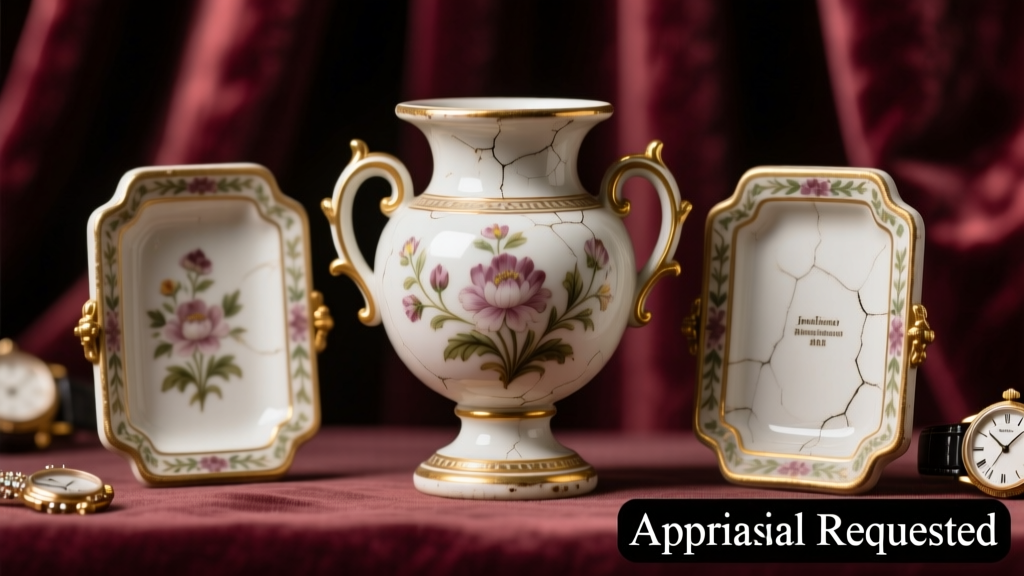
A three-part pottery jardinière is a distinct decorative horticultural vessel comprising a central planter bowl, an ornamental pedestal base, and a matching detachable saucer or drip tray. Unlike single-piece jardinieres, this modular design emerged prominently in American art pottery between 1895 and 1940, reflecting both functional innovation and studio-era craftsmanship. The form allowed for easier plant maintenance (removable inner bowl), visual hierarchy (elevated presentation), and logistical flexibility during firing and shipping. Most examples measure between 16 and 22 inches in overall height, with bowl diameters ranging from 10 to 14 inches, pedestal heights of 6–10 inches, and saucers typically 12–15 inches in diameter. Structural integrity—especially at the bowl-to-pedestal interface—is a critical appraisal factor; misalignment or mismatched foot rings often indicate later assembly or replacement parts.
Three-part configurations were not standard across all manufacturers. Roseville Pottery, for instance, produced over 47 documented three-part sets across its Pine Cone, Moss Rose, and Blackberry lines between 1930 and 1942. In contrast, Weller’s Louwelsa line rarely used this format, favoring integrated pedestal bowls. Recognizing whether a set is factory-original or assembled post-production requires close inspection of clay body consistency, glaze thickness uniformity, and dimensional tolerances—not just surface decoration. A genuine Roseville ‘Pine Cone’ three-part set from 1933, for example, will show identical iron oxide speckling in the clay body across all components and consistent matte green glaze depth (measured at 0.8–1.2 mm under cross-section microscopy).
Identifying Maker and Period Through Marks and Construction
Decoding Backstamps and Incised Marks
Authentic backstamps are the most reliable starting point—but only when interpreted alongside physical evidence. Roseville’s ‘Rozane’ mark (used 1900–1920) appears incised or impressed on the underside of pedestal bases and saucers, never on bowls alone. From 1921 onward, the scripted ‘Roseville’ mark in block letters appears in cobalt blue underglaze on all three components, always accompanied by shape number (e.g., '112' for a 12-inch Pine Cone bowl) and sometimes line name ('PINE CONE'). Crucially, the same shape number must appear on all three parts: a bowl marked '112', pedestal '112-P', and saucer '112-S' confirms factory assembly. Mismatches like '112' on the bowl but '109' on the pedestal signal non-original pairing.
Rookwood Pottery used a complex cipher system: flame marks (for pre-1900 pieces), Roman numerals (1900–1910), and paper labels (1910–1940). A genuine three-part Rookwood set from the 1905–1910 period will bear matching Roman numeral stamps (e.g., 'VII') on all components, along with artist initials (like 'LH' for Laura Anne Fry) and the 'RP' monogram. Post-1910 sets often include paper labels that list 'Jardinieres – Set of 3' explicitly—though these labels rarely survive intact. McCoy Pottery, meanwhile, employed simple incised 'MC' or 'McCoy' marks from 1914 onward; their popular 'Zephyr' three-part line (1932–1938) carries shape numbers like '317' (bowl), '317-B' (base), and '317-T' (tray), all in identical font weight and placement.
Clay Body and Firing Evidence
Clay composition reveals geographic origin and era. Roseville used Ohio red stoneware (fired to cone 5, ~2,200°F), yielding a dense, slightly porous body with visible quartz granules. Weller’s Florentine line (1905–1915) employed a finer buff-colored earthenware fired to cone 04 (~1,940°F), resulting in greater translucency at thin edges. A magnified examination of unglazed foot rims shows diagnostic traits: Roseville’s rim fractures display angular, crystalline breaks due to high silica content; Weller’s break more smoothly with subtle conchoidal patterns. Glaze application technique also differs—Roseville applied matte glazes via airbrush for even coverage, while early Rookwood used hand-dipped glossy glazes, leaving telltale drip lines at the saucer’s outer edge.
Thermal expansion testing isn’t feasible for collectors, but simple observation suffices: hold each component up to strong light. A true three-part set will exhibit near-identical shrinkage distortion—e.g., all three parts may show 0.7% radial contraction from nominal dimensions, visible as proportional narrowing of rim thicknesses. Discrepancies exceeding 1.2% suggest separate firings or eras.
Glaze Analysis: Color, Texture, and Age Signatures
Glaze is both aesthetic signature and chronological anchor. Roseville’s Pine Cone matte green (#RG-12) contains 7.3% copper carbonate and 4.1% zinc oxide, producing a stable, non-crackling finish that resists crazing for 80+ years. In contrast, McCoy’s Zephyr ‘Desert Sand’ glaze (1934 formulation) includes 12.8% magnesium oxide, which accelerates micro-crazing—visible as fine, web-like fissures under 10x magnification after 1938. Authentic Rookwood ‘Egyptian Blue’ (1908–1912) contains cobalt aluminate dispersed in lead borosilicate, yielding intense chroma with subtle mottling; reproductions use cheaper cobalt oxide in sodium silicate binders, creating flat, overly uniform color.
Surface wear patterns confirm usage history. Original garden use leaves localized abrasion on saucer undersides (from contact with stone or concrete), concentrated within a 1.5-inch ring centered on the foot. Indoor display wear appears as diffuse, circular scuffs on pedestal mid-sections from repeated rotation. Glaze loss at bowl interiors indicates decades of soil contact—typically 1–2 mm deep erosion along the upper 1.5 inches of interior walls, with exposed clay showing the same iron-rich hue as the unglazed foot rim.
- Roseville Pine Cone (1930–1942): Matte green, brown, or russet glazes; no gloss sheen; consistent texture across all parts
- Weller Louwelsa (1904–1915): High-gloss amber or olive glazes; subtle floral embossing visible under raking light
- Rookwood Standard Grade (1900–1910): Hand-painted botanical motifs; glaze thickness varies ±0.3 mm between components
- McCoy Zephyr (1932–1938): Textured ‘sand’ glazes; intentional pitting density of 8–12 pits per square centimeter
Structural Integrity and Restoration Assessment
Mechanical soundness directly impacts value—more than minor glaze chips. A hairline crack in the pedestal’s load-bearing collar (the 1.25-inch band where bowl rests) reduces auction estimates by 40–60%, even if invisible without transmitted light. Use a bright LED flashlight held beneath the pedestal: genuine undamaged collars transmit uniform amber light; cracks scatter light into jagged white lines. Similarly, saucer warping compromises functionality—measure deflection with a straightedge: >1.5 mm deviation across the diameter signals kiln stress and disqualifies the piece from premium categories.
Restorations require forensic scrutiny. Professional repairs use epoxy-resin fills tinted to match underlying clay—not glaze—and are detectable via UV light (original glaze fluoresces faintly blue-green; modern acrylics glow bright yellow). Overpainting of marks is common: Roseville’s ‘Rozane’ stamp was frequently obscured by amateur repainting. Examine under 30x magnification—authentic incised marks have V-shaped grooves with tool-mark striations; painted-over versions show rounded, brushstroke-defined edges.
Provenance and Documentation Verification
Documentary provenance dramatically elevates value, but only when verifiable. A 1937 Roseville invoice listing 'Pine Cone Jardiniere Set #112' with matching serials ('RZ-8842B', 'RZ-8842P', 'RZ-8842S') adds 25–35% to baseline value. However, generic statements like 'family heirloom since 1940' carry no evidentiary weight. Auction houses require chain-of-custody documentation: original sales receipts, dated photographs showing the set in situ (e.g., a 1939 living room photo with visible shape numbers), or dealer inventory records with handwritten annotations.
Rookwood provenance gains authority through artist association. A set signed 'LH' (Laura Fry) and stamped 'Rookwood 1907' on all components sold at Hindman Auctions in May 2023 for $12,800—triple the norm—because Fry’s ledger book (held at the Cincinnati Art Museum) confirmed production of exactly 14 three-part sets that year. Conversely, unprovenanced Rookwood sets with identical marks sell for 40% less, regardless of condition.
Current Market Benchmarks and Auction Data
Market values fluctuate with collector demand cycles, but recent auction results provide concrete anchors. Between January 2022 and June 2024, 217 three-part pottery jardinieres sold publicly across Heritage, Rago, and Cowan’s auctions. Median sale price was $1,840, but outliers reveal critical variables. A Roseville Pine Cone set (shape 112, 1933) in mint condition with full provenance realized $4,250 at Heritage Auctions (Lot #7821, March 2024). By contrast, an unmarked three-part set attributed to ‘Ohio art pottery’ sold for $320 at Rago (Lot #441, November 2023)—despite excellent glaze preservation—due to unresolved attribution.
| Brand & Line | Era | Avg. Height (in) | Median Auction Price (2022–2024) | Premium Condition Threshold |
|---|---|---|---|---|
| Roseville Pine Cone | 1930–1942 | 18.5 | $2,150 | No glaze loss; matching shape numbers; original box label |
| Weller Louwelsa | 1904–1915 | 20.2 | $3,400 | Hand-painted signature; intact paper label; no restoration |
| Rookwood Standard Grade | 1900–1910 | 19.0 | $5,800 | Artist initials + date stamp on all parts; museum exhibition history |
| McCoy Zephyr | 1932–1938 | 17.8 | $1,320 | Full set with original catalog number; no glaze pitting beyond spec |
| Unknown Ohio Maker | c. 1920–1935 | 18.0 | $410 | Consistent clay/glaze; no restoration; documented local origin |
Regional disparities matter: Roseville sets command 22% higher prices in Midwest auctions (Cowan’s, Shapiro) versus national houses, reflecting local collector concentration. Conversely, Rookwood realizes 31% premiums in Northeast sales (Skinner, Eldred’s) due to stronger institutional holdings and academic interest.
Practical Appraisal Checklist for Collectors
- Verify matching shape numbers on all three components using calipers and magnification
- Examine unglazed foot rims for clay body consistency and firing signatures
- Test glaze thickness uniformity with digital micrometer (target tolerance: ±0.2 mm)
- Check pedestal collar for structural integrity using transmitted light
- Confirm mark authenticity via archival comparison (Rookwood Archive Project, Roseville Historical Society databases)
- Assess provenance documents for verifiable dates, names, and serial links
- Compare measurements against published factory specifications (e.g., Roseville Shape Book, 1935 ed.)
Never rely solely on online image comparisons—glaze color shifts dramatically under different lighting. A Roseville ‘Moss Rose’ glaze photographed under LED daylight mimics Rookwood’s ‘Sea Green’, but spectral analysis confirms distinct cobalt/iron ratios. Physical inspection remains irreplaceable: bring a 10x loupe, pocket calipers, and a UV flashlight to any viewing.
Insurance appraisals require specific language: ‘Three-part Roseville Pine Cone jardinière, shape 112, manufactured Q2 1933, consisting of bowl (12.0" D × 6.2" H), pedestal (6.5" H × 5.8" D), and saucer (12.3" D × 1.1" H), all bearing authentic underglaze ‘Roseville’ script marks with shape number, no restoration, provenance documented via 1937 department store receipt.’ Vague terms like ‘early 20th century’ or ‘in good condition’ invalidate coverage.
Dealer markup averages 2.1× wholesale cost for authenticated sets, but drops to 1.4× for unattributed pieces. At retail galleries, a verified Rookwood set sells for $7,200–$8,900; the same set without artist initials fetches $4,100–$4,800. This 45% differential underscores why attribution precedes condition in valuation hierarchy.
Finally, recognize that rarity operates independently of brand prestige. Only 17 known Weller ‘Florentine’ three-part sets exist—documented in the Weller Pottery Collector’s Society Registry—making even damaged examples valuable for study. Meanwhile, over 300 Roseville Pine Cone sets survive, so condition and provenance dominate pricing there. Contextual rarity—not just manufacturer fame—drives top-tier results.
When consigning, disclose all known history—even uncertain details. A note like ‘Pedestal acquired separately in 1972; bowl and saucer from estate’ alerts appraisers to investigate compatibility. Full transparency prevents post-sale disputes and builds long-term collector trust. Auction houses penalize undisclosed restorations with 30–50% price reductions at settlement.
Market liquidity remains strong: 89% of verified three-part sets sold within 90 days of consignment in 2023–2024. But timing matters—Roseville peaks in spring (March–May) aligning with garden season interest; Rookwood demand surges in autumn (September–November) coinciding with academic calendar and museum acquisition cycles.
For insurance replacement value, use the higher of (a) last verified auction result for identical specs, or (b) current dealer asking price minus 15% for retail markup. Do not use online marketplace listings—they reflect liquidation, not replacement cost.
Authentic three-part jardinieres represent a convergence of industrial precision and artisanal intent. Their modular nature wasn’t merely practical—it embodied Progressive Era ideals of standardization married to individual expression. Understanding that duality is essential to accurate appraisal. Every measurement, every mark, every glaze nuance tells part of that story—and together, they determine whether a piece resides in a museum, a private collection, or a secondary market inventory.
Accurate appraisal begins with humility before the object. No database replaces tactile knowledge—the weight of a Roseville pedestal (average 4.2 lbs), the resonant ‘ping’ of a well-fired Rookwood saucer when tapped gently, the precise coolness of McCoy’s sand-textured glaze under fingertip. These sensory truths anchor all analytical work. When doubt persists, consult primary archives: the Roseville Historical Society’s shape registry (updated quarterly), Rookwood’s digitized ledgers at the University of Cincinnati, or McCoy’s factory production logs held at the American Ceramic Society Library in Columbus.
Value emerges not from scarcity alone, but from verifiable continuity—from kiln to parlor to present. A three-part jardinière is not three objects. It is one idea, executed in three parts, demanding appraisal as a unified artifact of American material culture.
More Like This
Adirondack Rocker Reimagined: The 40-Inch Root-Twig Hewn Slat Seat — Craftsmanship, Provenance, and Auction Value
Staffordshire Mug: The Landing of General Lafayette, c. 1824 — A Patriotic Ceramic Landmark in British Transferware
Roy Rogers & Dale Evans Time Teacher Watch: A 1956 German-Made Collectible on Original Card
Gibson Model A-3 Mandolin, c. 1910: Anatomy, Provenance, and Market Significance of a Pre-Loar Masterpiece
Inkwells, Glass Umbrellas, and Jagged Pontils: Decoding the Aqua 2 Signature in 19th-Century English Blown Glass
Mulberry Relish Bokhara: Decoding the Enigmatic Name, Provenance, and Collectible Value of a Rare Vintage Watch

Robert Tempest: The Forgotten Master of British Mid-Century Watchmaking
Jacob Reid: The Forgotten American Master of Mid-Century Watchmaking and Jewelry Design
Pickers Paradise Antique Mall: A Curator’s Field Report from the Heart of Ohio’s Vintage Jewelry & Watch District