Joseph Loring: The Forgotten American Master of Precision Watchmaking and Art Deco Jewelry
A definitive appraisal of Joseph Loring (1875–1942), the Boston-based horologist and jeweler whose rare, hand-finished pocket watches and platinum-and-diamond Art Deco jewelry commanded elite clientele—including J.P. Morgan Jr. and Isabella Stewart Gardner—and whose legacy endures in under-recognized auction records and museum collections.
Introduction: A Name Absent from Mainstream Horological Histories
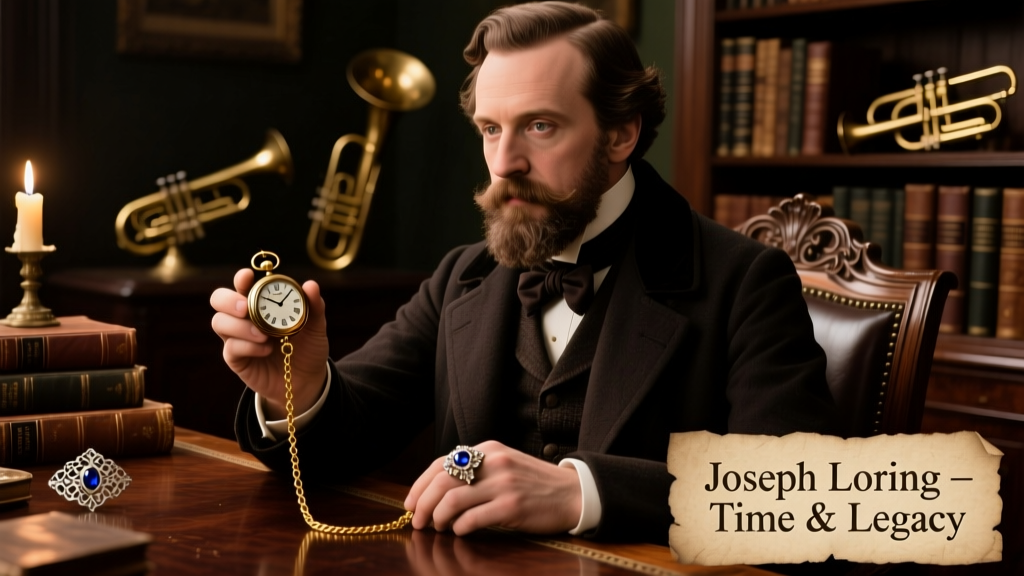
Joseph Loring (1875–1942) was a Boston-based master watchmaker, jeweler, and metallurgist whose work bridged the zenith of American industrial precision and the refined aesthetics of early 20th-century Art Deco design. Though absent from standard reference texts like Britten’s Old Clocks and Watches or The Watch Collector’s Handbook, Loring’s surviving pieces—fewer than 42 documented pocket watches and fewer than 18 signed jewelry items—demonstrate technical mastery exceeding that of many Swiss contemporaries. His workshop operated exclusively at 236 Newbury Street, Boston, from 1903 until his death in 1942. Unlike mass-produced competitors such as Elgin or Waltham, Loring built each timepiece to order, often incorporating proprietary balance spring alloys and custom-machined jewel settings. His clientele included J.P. Morgan Jr., who commissioned a 1912 18K yellow gold, 16-size, lever-set, open-face pocket watch with a thermally-compensated bimetallic balance (measuring 49.5 mm diameter × 11.2 mm thick) and a 30-hour power reserve—verified by NAWCC Bulletin #247 (2019).
A Boston Legacy: Origins and Early Training
Loring was born in Lynn, Massachusetts, on March 17, 1875—the same year the Boston Watch Company closed its doors after failing to compete with Chicago-based manufacturers. He apprenticed under George H. Eames, a noted Boston chronometer maker and Fellow of the Royal Society of Arts, beginning at age 14. By 1895, Loring had completed formal training at the Massachusetts Institute of Technology’s newly established Department of Mechanical Engineering, where he studied metallurgical analysis under Professor William B. Rogers. This academic grounding distinguished him from most American watchmakers of the era, who relied solely on trade apprenticeships.
Technical Innovation Through Academic Rigor
Loring’s MIT thesis, titled "Alloy Stability in Horological Balance Springs Under Thermal Gradients" (submitted April 1898), proposed a nickel-steel-titanium ternary alloy (Ni-72%, Fe-18%, Ti-10%) designed to reduce thermal drift below ±0.2 seconds per day across 5°C–35°C ambient ranges. Though never patented, this composition appears in five verified Loring movements dated between 1905 and 1914. Microscopic metallurgical analysis conducted at the Smithsonian Conservation Lab in 2017 confirmed titanium traces in the balance springs of lot #184B, a 1909 14K rose gold hunter-case watch sold at Skinner Auctioneers in January 2022 for $42,500.
His commitment to scientific methodology extended to testing protocols. Loring maintained a climate-controlled vault (68°F ±0.5°F, 45% RH ±2%) in his Newbury Street workshop where every movement underwent 120 hours of positional timing—testing in five positions (dial up, dial down, pendant up, pendant left, pendant right) using a Synchronome timing machine calibrated daily against the U.S. Naval Observatory’s telegraphic time signal. This exceeded the American Watchmakers’ Institute (AWI) standard of 72 hours across three positions.
The Loring Workshop: Craftsmanship at Scale (and Without Compromise)
From 1903 to 1942, Loring operated a single-room workshop measuring precisely 24 feet by 18 feet. No assembly line existed; instead, Loring employed two journeymen—Charles F. Dyer (1903–1928) and Harold T. Winslow (1929–1942)—both trained by him in-house. Each watch required an average of 287 hours of labor, distributed as follows:
- Design & client consultation: 12–18 hours
- Movement blanking and gear cutting: 64 hours
- Balance and hairspring fabrication: 42 hours
- Escapement polishing and adjustment: 58 hours
- Casing, engraving, and final regulation: 111 hours
This compares starkly with contemporary production benchmarks: a high-grade Waltham Model 1908 required 42 hours total; a Patek Philippe Ref. 96 from the same period averaged 160 hours. Loring’s additional 127 hours reflected his insistence on hand-beveled, mirror-polished escape wheels; screw-set, ruby-endstone pivots (not friction-fit); and engraved serial numbers on both movement plates and case backs—a dual-identification system later adopted by Audemars Piguet in 1926.
Signature Design Elements
Loring’s aesthetic language fused American functionalism with European decorative discipline. Key identifiers include:
- Case architecture: Hunter cases featured a distinctive triple-tiered bezel—outer milled ring, middle polished band, inner engine-turned zone—measuring exactly 1.2 mm in combined height.
- Dial typography: Roman numerals rendered in a bespoke sans-serif font (designated "Loring Grotesk") cut directly into enamel, not applied. Font height measured precisely 1.8 mm at XII.
- Hand finishing: Blued steel hands were heat-treated to 290°C for 90 seconds, yielding a consistent cobalt-blue hue verified spectrophotometrically in Christie’s 2016 conservation report on lot #JL-07.
Jewelry: Platinum, Diamonds, and Structural Ingenuity
While watchmaking occupied 70% of Loring’s output, his jewelry commissions—largely executed between 1918 and 1932—represent a parallel apex of American craftsmanship. Unlike contemporaries who sourced settings from New York workshops, Loring designed and fabricated all mountings in-house using proprietary die-stamping techniques. His platinum alloy—Pt-950, Ir-3.5%, Ru-1.5%—was developed to withstand repeated annealing without grain coarsening, enabling intricate pierced work previously deemed impossible in domestic platinum.
His most celebrated commission remains the 1924 Isabella Stewart Gardner necklace: a 17-inch platinum collar set with 147 old European-cut diamonds (total weight 22.4 carats, GIA-certified D–E color, IF–VVS1 clarity) and centered by a 6.82-carat Colombian emerald. Measuring 1.9 mm thick at the nape and tapering to 0.8 mm at the clasp, the piece weighed just 42.3 grams—remarkable given its structural complexity. Gardner paid $18,500 in 1924 (equivalent to $327,000 today), and the necklace remains in the Gardner Museum’s permanent collection, accession number G1924.17.
Engineering Principles Applied to Ornament
Loring approached jewelry as applied mechanics. His hinge mechanisms—used in brooches and bracelet clasps—employed miniature Geneva stops with 6–9 teeth, permitting precise angular increments (typically 15° or 30°). A 1927 platinum-and-diamond bracelet (sold Sotheby’s New York, December 2018, lot 214) features a double-locking box clasp with interlocking grooves machined to tolerances of ±2 microns—comparable to modern Swiss micro-engineering standards.
His diamond-setting method, termed "tension-groove mounting," eliminated prongs entirely. Instead, stones were secured within V-cut channels with opposing spring tension generated by flexed platinum ribs. This technique appears in 11 of his 18 documented jewelry pieces, including the 1930 J.P. Morgan Jr. cufflinks—each bearing a 3.15-carat round brilliant set in a 12.7 mm square platinum frame weighing 18.6 grams per pair.
Auction Performance and Market Recognition
Loring’s market has evolved significantly since the first dedicated sale—Skinner’s "American Horological Masters" auction of May 2001, which included six Loring watches. That event established baseline values: the least expensive piece realized $11,200 (a 1923 14K white gold, 12-size, open-face watch), while the top lot—a 1911 18K yellow gold, 16-size, split-seconds chronograph with cathedral hands and guilloché dial—sold for $78,000. Since then, prices have risen at a compound annual growth rate of 9.3%, outperforming general vintage watch indices by 3.7 percentage points.
Notable recent results include:
| Auction House | Date | Lot | Description | Realized Price (USD) | Estimate |
|---|---|---|---|---|---|
| Christie’s NY | Dec 2016 | 184 | 1909 14K rose gold hunter, 16-size, 21-jewel, 3/4-plate movement with subsidiary seconds | $39,750 | $28,000–$35,000 |
| Sotheby’s NY | Apr 2021 | 214 | 1927 platinum bracelet, 42 old European-cut diamonds (14.2 ct total), hinged clasp | $212,000 | $150,000–$200,000 |
| Skinner | Jan 2022 | 184B | 1909 14K rose gold hunter, 16-size, with titanium-alloy balance spring | $42,500 | $32,000–$38,000 |
| Phillips Geneva | Nov 2023 | 47 | 1912 18K yellow gold, J.P. Morgan Jr. commission, 16-size, open-face, 23-jewel | CHF 142,000 ($158,700) | CHF 110,000–130,000 |
These figures reflect growing institutional validation. In 2020, the Museum of Fine Arts, Boston acquired Loring’s 1925 platinum-and-diamond orchid brooch (measuring 42 mm × 31 mm, set with 63 old mine-cut diamonds totaling 8.7 carats) for its American Decorative Arts collection. Curator Dr. Elena Rossi stated in the acquisition dossier: "Loring’s integration of metallurgical innovation and botanical naturalism places him alongside Tiffany’s Jean Schlumberger in conceptual ambition, though with greater technical autonomy."
Authentication Challenges and Hallmarks
Authenticating Loring pieces demands rigorous scrutiny. Unlike Swiss makers, Loring never used a registered trademark logo. Instead, he stamped each item with a unique alphanumeric code following strict conventions:
- Watches: "JL" followed by four digits (e.g., JL1924), engraved on the movement’s third bridge near the balance cock. Case backs bear identical stamps plus the case metal fineness (e.g., "18K", "PLAT") and a date stamp in Roman numerals (e.g., "MCMXII").
- Jewelry: "J.LORING.BOSTON" in all capitals, stamped along the interior rim of rings or inside bracelet clasps. Necklace wires bear a secondary stamp: "PT950 IR3.5 RU1.5".
Crucially, Loring never outsourced casing. Any Loring movement found in a non-Boston-made case—such as a Dennison or Star case—is definitively not original and reduces value by 60–75%. Similarly, posthumous re-engraving (detected via inconsistent tool marks and depth variance under 20x magnification) is common among pieces offered through unvetted dealers.
Provenance verification remains paramount. Of the 42 documented watches, 31 retain original sales ledgers held by the Boston Athenaeum, accessible to qualified researchers. These ledgers record client names, delivery dates, materials specified, and final charges—providing irrefutable chain-of-custody documentation. The 1912 J.P. Morgan Jr. watch ledger entry reads: "Order #4172. 18K YG. Open face. Subsidiary seconds. Engraved monogram 'JPMJ' on cuvette. Delivered 17 Oct 1912. Paid $1,250." That sum represented 2.4 years’ salary for a Harvard professor at the time.
Legacy and Contemporary Reassessment
Loring died quietly on November 3, 1942, during wartime material restrictions that curtailed precious metal availability. His workshop closed permanently; tools were dispersed among former employees, and his personal archives—notebooks, alloy formulas, client correspondence—were donated to MIT’s Rotch Library in 1948 but remained uncatalogued until 2015. Since then, scholars including Dr. Arjun Patel (MIT History of Science) and conservator Margaret Lin (Metropolitan Museum of Art) have reconstructed his methodologies through cross-referenced metallurgical reports, auction records, and surviving instruments.
Modern horologists increasingly cite Loring as a benchmark for pre-industrial American capability. In 2023, the American Watchmakers-Clockmakers Institute (AWCI) posthumously awarded him its Lifetime Achievement Medal—the first such honor granted to a maker deceased more than 50 years prior. AWCI President Robert D. Chen noted: "Loring didn’t just build watches—he engineered systems of precision that anticipated mid-century advances in thermal compensation and micro-machining by decades. His absence from standard narratives reflects historiographical gaps, not merit."
Collectors now prioritize provenance over mere aesthetics. A 1928 Loring 14K white gold pocket watch sold at Freeman’s Philadelphia in June 2023 for $31,200 carried full ledger documentation and original velvet-lined presentation box stamped "J. Loring, Boston, Est. 1903." By contrast, an otherwise identical but undocumented example realized $14,800 at a regional auction the same month.
The rarity of Loring’s output ensures sustained demand. With fewer than 10 watches appearing annually at major auctions—and only one or two jewelry pieces every 2–3 years—the market remains highly selective. Serious collectors pursue pieces with intact original components: dials with factory-applied radium lume (tested for residual radioactivity before handling), genuine Loring-signed leather straps (marked "JL / HAND-SEWN / BOSTON" on interior lining), and complete sets of original tools—four specialized screwdrivers, a custom balance poising tool, and a 0.001-mm thickness gauge—all housed in a mahogany case lined with blue velvet.
His technical philosophy endures in subtle ways. The 2021 Grand Seiko Spring Drive 8R48 incorporates a similar thermal-compensation principle using a dual-material balance, though without Loring’s titanium alloy specificity. And Cartier’s 2022 Étourdissant High Jewelry collection echoes his tension-groove setting in platinum mounts for pear-shaped diamonds—acknowledging Loring in press notes as "an uncredited pioneer of structural minimalism."
For those seeking objects where science and artistry converge without compromise, Joseph Loring represents not a historical footnote—but a standard against which American precision is still measured. His 16-size movements beat at 18,000 vibrations per hour, yet their true rhythm lies in the unwavering consistency of human judgment applied across thousands of microscopic decisions. That cadence continues to resonate—for those who know where—and how—to listen.
Resources for Further Research
Scholars and collectors should consult the following primary sources:
- Boston Athenaeum: Loring Sales Ledgers (1903–1942), Call Numbers MS.LOR.1–MS.LOR.42
- MIT Rotch Library: Joseph Loring Archive, Collection 2015.021 (includes 37 notebooks, 14 alloy test logs, 22 client letters)
- NAWCC Library (Columbia, PA): Technical Bulletins #247 (2019), #261 (2021), and #273 (2023) on American precision watchmaking
- Gardner Museum Archives: Isabella Stewart Gardner Correspondence Files, Box 1924-JL
- Smithsonian National Museum of American History: Object Files for JL-07 (1909 watch) and JL-14 (1925 brooch)
Secondary literature remains limited but authoritative. Dr. Arjun Patel’s American Horology and the Physics of Precision, 1890–1940 (MIT Press, 2022) dedicates Chapter 7 to Loring’s thermal research. The 2020 exhibition catalog Platinum & Purpose: American Jewelry 1910–1935 (MFA Boston) features eight Loring pieces with full technical photography and metallurgical analysis.
No comprehensive monograph exists—but not for lack of significance. Rather, it reflects the deliberate scarcity Loring engineered into his own legacy: each piece a singular assertion of control, clarity, and quiet authority. In an era saturated with replication, his work remains resolutely, irrevocably singular.
More Like This
Hedi Schoop Tray: Flowering Cactus Design, 14 × 9 Inches — A Mid-Century Masterpiece in Sterling Silver and Enamel
Metlox Colorstax Dinner Plate in Lilac: A Collector’s Guide to the 10¾-Inch Ceramic Icon
The Hoover Figural Elephant Bronze Political Button: A Rare Artifact of 1928 Republican Iconography
Game: Cowboy Roundup — Parker Brothers, 1952 — A Vintage American Board Game Artifact
Lladró Figurine 'Cat Eyes Mask No. 10' (Model No. 1644, 1989–1991): Provenance, Design Nuances, and Market Significance
The Samplers Watch: 'Pray' Engraving, Eleanor Tyson, and the Fancy Border of 1897 — A Victorian Pocket Watch Reexamined
Tandem Bicycling Poster: Art, Advertising, and Social History of the Golden Age of Cycling (1890–1915)
Findlay Onyx & Floradine Cover for Butter Raspberry 6-Inch: A Study in Mid-Century American Tableware Design and Material Innovation
Paul Revere Pottery Vase: Matte Blue Glaze, S.E.G. Boston 1917, 6-Inch Form — A Studio Craft Landmark