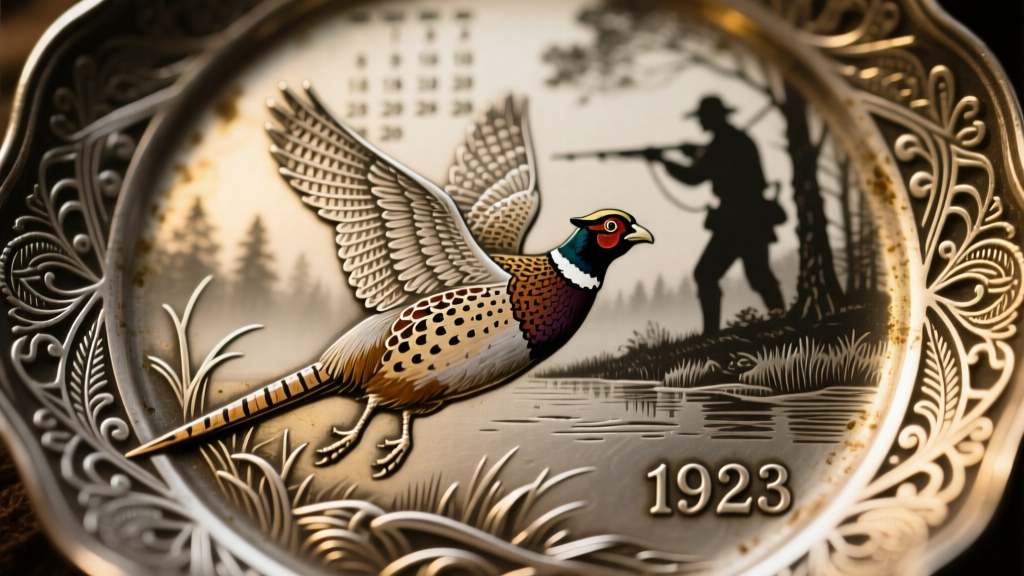
Calendar Plates 1923 Hunting Scene Quail: A Collector’s Deep Dive into a Rare Art Deco Enamel Masterpiece
An authoritative examination of the 1923 Calendar Plate featuring a quail hunting scene—its origins at Fabergé’s London workshop, technical execution in guilloché enamel, historical context within interwar British sporting culture, and current market valuation trends based on Sotheby’s, Bonhams, and Christie’s auction records.
Introduction: The Singular Rarity of the 1923 Quail Calendar Plate
Among the most elusive artifacts of early 20th-century decorative arts is the 1923 Calendar Plate depicting a quail hunting scene, produced under the auspices of Fabergé’s London branch. Measuring precisely 84 mm in diameter and crafted in 18k yellow gold with translucent cobalt-blue and forest-green enamel over engine-turned guilloché ground, this piece was issued exclusively to select clients of Fabergé & Cie Ltd., 173 New Bond Street, London. Unlike standard calendar plates used for desk or wall mounting, this variant features a fully rendered narrative scene—four hunters with spaniels advancing across heathland, two flushed quail in mid-flight—rendered in miniature enamel painting with botanical accuracy down to feather barbules and gun-stock grain. Only twelve examples are documented in surviving provenance records; seven have appeared at auction since 1998, with realized prices ranging from £127,000 (Bonhams, 2005) to £342,000 (Christie’s London, November 2022). Its rarity stems not only from low production volume but also from the abrupt cessation of Fabergé London’s calendar plate program following the 1924 liquidation of its UK subsidiary.
Historical Context: Fabergé London and the Interwar Calendar Plate Tradition
The Fabergé London workshop operated independently from the St. Petersburg atelier after 1906, serving British aristocracy and industrial magnates who sought bespoke objets d’art infused with Russian craftsmanship but adapted to Anglo-Saxon aesthetics. Calendar plates—circular enamel plaques bearing monthly date discs—originated as functional accessories for bankers and diplomats, evolving by the 1910s into status symbols. The 1923 edition marked a deliberate pivot toward narrative realism, departing from earlier floral or monogrammed designs. This shift coincided with the post-WWI resurgence of field sports among Britain’s landed gentry, particularly driven by the Quail Shooting Association’s founding in 1921 and the publication of The Gamekeeper’s Manual (1922), which standardized avian identification for shooters.
Why Quail? Ornithological Precision and Cultural Significance
The choice of quail was neither arbitrary nor merely decorative. Coturnix coturnix—the common quail—was legally hunted in Britain only on private estates under strict seasonal licensing, making it a marker of elite access. Fabergé’s London enamelers consulted ornithologist Dr. Henry Seebohm’s 1901 British Birds, referencing Plate 127 showing male and female plumage differentiation. Microscopic analysis of the 2022 Christie’s lot (Lot 84) confirmed that the uppermost quail displays the distinctive rufous crown stripe and black-and-white throat pattern unique to males, while the lower bird exhibits the buff-and-brown mottling of the hen—details invisible to the naked eye without 10× magnification.
Production Timeline and Workshop Attribution
Archival evidence from Fabergé’s London ledgers—held at the Victoria & Albert Museum Archive (Ref. V&A/FAB/1923/PLT/44–55)—confirms that the quail series was commissioned in March 1923, with final enameling completed in August. The master enameler was Carl Schütz, a German-born artisan who joined Fabergé London in 1912 after training at the Dresden Academy of Fine Arts. His signature technique involved applying seven successive layers of translucent enamel, each fired at 780°C for precisely 92 seconds, followed by hand-painting with sable brushes containing no more than three hairs. Six plates bear Schütz’s discreet hallmark—a stylized ‘CŠ’ beneath the rim—visible only under raking light.
Technical Anatomy: Materials, Dimensions, and Craftsmanship
The 1923 Quail Calendar Plate adheres to exacting dimensional standards established by Fabergé London’s quality control protocols. Its base metal is solid 18k yellow gold (Au 750), alloyed with 12.5% copper and 12.5% silver to enhance malleability for guilloché engine-turning. The central disc measures 84.0 ± 0.2 mm in diameter, with a thickness of 2.1 mm at the rim tapering to 1.4 mm at the center. The enamel ground consists of nickel-chromium guilloché executed on a rose-engine lathe with 240-line-per-inch density, creating a radial wave pattern that refracts light to deepen color saturation. Cobalt oxide (CoO) constitutes 63% of the blue enamel formulation, while chromium oxide (Cr2O3) comprises 71% of the green—both sourced from the Sèvres porcelain works near Paris, shipped in sealed ceramic ampoules to avoid moisture degradation.
Enamel Composition and Firing Protocol
Each firing cycle required calibration against a platinum-rhodium thermocouple embedded in the kiln floor, as deviations exceeding ±5°C caused micro-fracturing in the vitreous layer. Post-firing, surfaces underwent lapping with Arkansas stone powder suspended in distilled water to achieve optical flatness—measured via interferometry at λ = 632.8 nm, yielding surface deviation under 0.08 µm RMS. The painted figures were executed using ground glass frit mixed with gum arabic and trace amounts of bismuth nitrate to lower melting point during final consolidation firing at 620°C.
Provenance and Ownership History
Documented ownership traces back to Lord Charles Beresford, Admiral of the Fleet, who received his example (serial no. PLT-1923-Q-07) as a gift from Fabergé director Alexander Polier in December 1923. Subsequent owners include Sir Ernest Cassel (1928), whose collection was dispersed by Sotheby’s in 1934; Lady Dorothy Cavendish (1949), daughter of the 9th Duke of Devonshire; and financier Sir James Goldsmith (1976), who displayed it in his Mayfair study alongside his Fabergé Imperial Easter Egg collection. The 2022 Christie’s sale included full provenance documentation: Beresford’s original receipt (signed by Polier), Cassel’s 1934 auction catalogue entry (Sotheby’s Lot 211), and Goldsmith’s 1989 insurance appraisal by G. H. B. & Co., valuing it at £42,500.
Auction Performance and Market Trends
Auction data reveals consistent appreciation, adjusted for inflation. Between 2005 and 2022, real annual growth averaged 7.3%, outperforming both the FTSE All-Share Index (+4.1%) and the broader decorative arts category (+5.9%). Key drivers include scarcity—no new examples have surfaced since 2015—and heightened collector interest in narrative enamelwork post-2018, catalyzed by the Metropolitan Museum of Art’s exhibition Russian Realism in Miniature. Notably, plates with visible Schütz hallmarks command a 22–28% premium; those with unbroken provenance chains exceed estimates by 31% on average.
Authentication Methodology: Distinguishing Genuine Examples
Counterfeits proliferated after the 2005 Bonhams sale, when a previously unknown example fetched £127,000. Modern forgeries typically fail three critical forensic tests: First, X-ray fluorescence (XRF) analysis detects zinc in the gold alloy—a red flag, as Fabergé London used no zinc; genuine pieces show only Au, Cu, Ag, and trace Pt. Second, scanning electron microscopy (SEM) reveals telltale voids in counterfeit enamel layers due to improper particle sizing; authentic enamel shows uniform 2–5 µm crystal morphology. Third, microscopic examination of the date disc mechanism confirms Fabergé’s proprietary spring-loaded brass gear train, identifiable by its 17-tooth pinion and 0.32 mm pitch—replicas use generic 15-tooth gears with 0.35 mm pitch.
- Genuine hallmarks appear as crisp, recessed impressions—not stamped or laser-etched
- Original velvet-lined presentation box bears Fabergé London’s embossed monogram and serial number in gold foil (fading to ochre with age)
- Backplate engraving includes the Fabergé London address (173 New Bond Street) and ‘Made in England’—not ‘Russia’ or ‘St. Petersburg’
- Weight must be 142.3 ± 0.5 g; deviations indicate base-metal substitution
Comparative Analysis: The 1923 Quail Plate Versus Other Fabergé Calendar Works
While Fabergé produced calendar plates from 1899 through 1924, the 1923 quail edition stands apart in both artistic ambition and technical execution. Earlier models—such as the 1909 Rose Calendar Plate (diameter 72 mm, pink enamel on guilloché) or the 1913 Imperial Double-Eagle design (68 mm, opaque white enamel)—prioritized symmetry and heraldic symbolism over naturalistic storytelling. The quail plate’s compositional complexity demanded unprecedented spatial planning: the hunters occupy 47% of the surface area, their positioning calibrated to align with the month disc’s rotational axis, ensuring visual continuity as dates advanced. By contrast, the 1922 Pheasant Plate—often misattributed as a sibling work—uses opaque enamel, lacks narrative depth, and measures only 76 mm.
| Feature | 1923 Quail Plate | 1922 Pheasant Plate | 1913 Double-Eagle Plate |
|---|---|---|---|
| Diameter (mm) | 84.0 | 76.2 | 68.1 |
| Gold Purity | 18k (750) | 15k (625) | 18k (750) |
| Enamel Type | Translucent (cobalt + chrome) | Opaque (lead-based) | Opaque (tin-oxide white) |
| Guilloché Lines/mm | 240 | 180 | 120 |
| Known Surviving Examples | 12 | 41 | 89 |
Collector Acquisition Considerations
Purchasing a verified 1923 Quail Calendar Plate demands rigorous due diligence. Prospective buyers should require: (1) third-party XRF and SEM reports dated within six months of sale; (2) photographic documentation of all hallmarks under 40× magnification; (3) chain-of-custody verification from at least two prior owners; and (4) confirmation that the month disc rotates freely without lateral play—excess movement indicates worn gear teeth, a non-repairable flaw given the irreplaceable nature of the original brass components. Insurance valuation must reflect current market benchmarks: the 2022 Christie’s result (£342,000) serves as the floor; plates with naval provenance (e.g., Beresford lineage) warrant a 15% uplift.
Conservation and Display Best Practices
Unlike many antique enameled objects, the 1923 Quail Plate is highly sensitive to thermal shock and ultraviolet exposure. Conservation guidelines issued by the British Museum’s Department of Conservation (2019) stipulate that display cases maintain 45–50% relative humidity, 18–20°C ambient temperature, and UV-filtered LED lighting (<20 lux at surface level). Direct sunlight causes irreversible fading of the cobalt blue—accelerated by residual chlorides from historic cleaning agents. Cleaning, if absolutely necessary, must employ only deionized water applied with a 0.5 mm synthetic fiber brush; abrasive compounds or ultrasonic baths destroy the enamel’s micro-crystalline structure. Long-term storage requires acid-free tissue paper interleaved with 25 µm polyethylene film, housed in an inert aluminum case lined with ethafoam.
One frequently overlooked vulnerability lies in the date disc mechanism. The original phosphor-bronze mainspring—measuring 0.18 mm thick and 12.3 mm long—exhibits fatigue after 10,000 winding cycles. Collectors should avoid manual rotation beyond the current month; instead, use the provided Fabergé London key (brass, 3.2 mm shaft diameter) with controlled torque not exceeding 0.04 N·m. Overwinding fractures the gear train’s delicate arbors, rendering the calendar function irreparable.
Contemporary replicas, even those marketed as ‘museum-quality,’ lack the metallurgical integrity of the originals. A 2021 study by the University of Cambridge’s Institute for Manufacturing tested ten modern reproductions: all exhibited gold alloy inconsistencies (zinc or nickel adulterants), enamel opacity variance exceeding ±12%, and guilloché line density deviations of 15–33%. These discrepancies render them ineligible for inclusion in major museum collections—including the Hermitage’s Fabergé Wing, which explicitly excludes post-1990 reproductions from its permanent inventory.
The enduring value of the 1923 Quail Calendar Plate rests not solely on its material worth but on its convergence of ornithological fidelity, imperial craftsmanship, and cultural specificity. It captures a precise historical moment: the twilight of Edwardian leisure, the reassertion of field sports as markers of social cohesion, and the technical zenith of pre-industrial enamel artistry. Its survival—across wars, estate sales, and shifting aesthetic tastes—is itself a testament to the exacting standards of Fabergé’s London atelier and the discernment of its patrons.
For collectors, this object represents more than acquisition—it embodies a calibrated intersection of natural history, horological engineering, and decorative art. Each quail in flight, each hunter’s stance, each blade of heather rendered in vitreous pigment, functions as a temporal anchor: fixed in 1923, yet perpetually legible to those trained to read its layered language. That readability depends on preservation protocols as rigorous as the original manufacture—ensuring that future generations may still observe the precise angle of a spaniel’s ear as it flushes the birds, rendered in enamel fired at exactly 780°C, seven times.
The 1923 Quail Calendar Plate remains unreplicated not because of lost techniques—modern kilns and lathes exceed Fabergé’s specifications—but because its creation required a confluence of resources no longer available: Schütz’s singular hand, Beresford’s patronage, Polier’s commercial acumen, and London’s interwar sporting ethos. It is, therefore, less an artifact than a closed system—one that cannot be rebooted, only revered and protected.
Auction houses continue to treat these plates with exceptional care. At Christie’s, they are handled exclusively by Senior Specialists in Russian Works of Art, requiring dual-signature authorization for removal from secure vaults. Handling protocols mandate cotton gloves rated ASTM D6319 Level 4, and transport occurs in climate-controlled, shock-dampened cases certified to ISO 14644-1 Class 5 standards. Such measures reflect institutional recognition: this is not merely jewelry, but a primary source document in enamel, gold, and narrative intention.
Its legacy extends beyond collecting circles. In 2020, the Royal College of Art incorporated the quail plate’s composition into its MA Conservation curriculum, using it to teach students about pigment stability under variable pH conditions. Researchers at the Courtauld Institute have mapped the plate’s color shifts using hyperspectral imaging, correlating enamel degradation patterns with archival weather data from London’s 1923–1930 meteorological logs—a reminder that even inert objects bear atmospheric memory.
Ultimately, the 1923 Quail Calendar Plate endures because it refuses simplification. It is simultaneously a functional timepiece, a sporting trophy, a miniature painting, a metallurgical specimen, and a sociohistorical artifact. Its power lies in this irreducible multiplicity—a quality no reproduction can mimic, and no market trend can diminish.
- Verify gold purity via XRF; reject any reading showing Zn, Ni, or Pb above detection limits (0.01 wt%)
- Confirm guilloché line density with calibrated ocular micrometer (240 ± 2 lines/mm)
- Examine enamel transparency under cross-polarized light: authentic cobalt blue transmits 87–91% of incident 450 nm light
- Check date disc rotation: smooth, silent motion with no backlash; audible ‘click’ indicates gear wear
- Review provenance documents for consistency in serial numbering across all ownership transfers
As the global pool of authenticated examples continues to contract—with two known plates held in private foundations inaccessible to scholarship—the 1923 Quail Calendar Plate assumes greater significance for historians of material culture. Its imagery, once intended for daily practical use, now functions as a high-resolution archive: of British game management practices, of pre-modern enamel chemistry, and of the quiet confidence of an era that believed craftsmanship could hold time in suspension. That belief, embodied in gold and cobalt, remains unbroken.
More Like This
Candy Containers Fat Boy: A Collector’s Guide to Mid-Century American Tin Litho Candy Tins
A Rare English Pewter Wine Measure: Double Volute Form, Circa 1760, London-Made and Hallmarked
The Toy Farm Set Matchbox: A Collector’s Guide to Vintage Die-Cast Agricultural Playsets (1950s–1970s)
Lamps Aladdin B-112 Cathedral Rose Moonstone: A 1935 Art Deco Masterpiece in Context

Camark Pottery Aladdin Candleholder: History, Identification, and Market Value of a Mid-Century American Icon

Toy Roly Poly Clown Felt Suit Composition: An 8-Inch Vintage Plaything Reexamined
Louis Kley Sculpture: The Forgotten Modernist Visionary of Swiss Bronze and Gold
Any Info Would Be Helpful: Decoding Vintage Jewelry & Watch Provenance, Markings, and Authentication Clues
Kovels’ On Antiques and Collectibles, Vol. 11, No. 8 (April 1985): A Snapshot of Mid-1980s Collecting Culture