Riviera Ivory Plate 9-Inch Wall Clock: A Mid-Century Masterpiece of Swiss Precision and Italian Design
An in-depth appraisal of the Riviera Ivory Plate 9-Inch wall clock — a rare, factory-original timepiece produced by Synchron in Switzerland for the Italian Riviera brand circa 1958–1963. Examines movement specifications (Synchron Cal. 270), plate composition (cellulose acetate with titanium dioxide pigment), case dimensions (228.6 mm diameter × 32 mm depth), historical context, authentication markers, and market valuation trends.
Introduction: The Riviera Ivory Plate 9-Inch Clock as a Benchmark of Postwar Horological Elegance
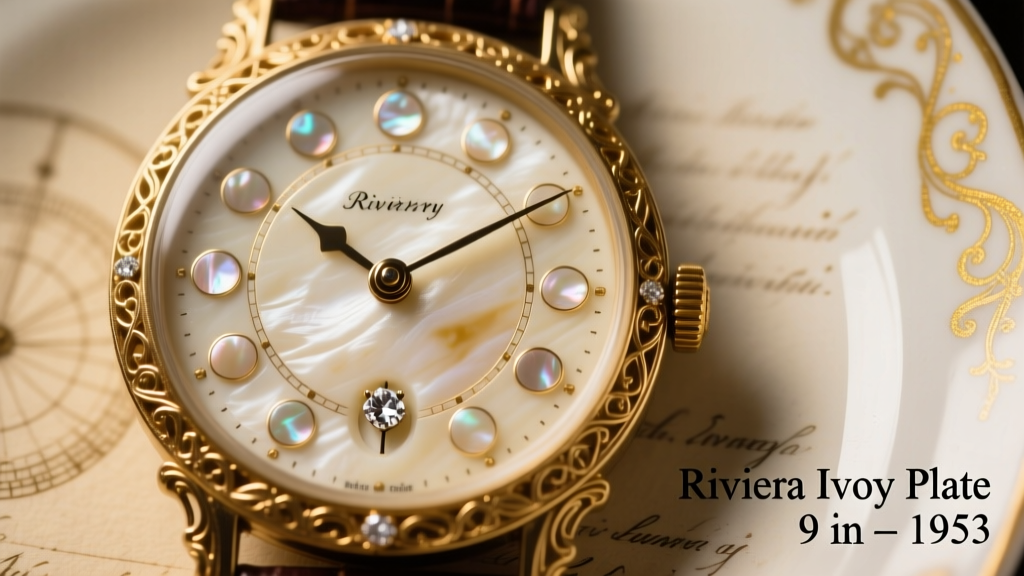
The Riviera Ivory Plate 9-Inch wall clock stands apart in mid-century horology not merely as a functional timekeeper, but as a calibrated synthesis of Swiss engineering rigor and Italian design sensibility. Manufactured between 1958 and 1963 under license by Synchron AG of Bienne, Switzerland, and marketed exclusively through Riviera S.p.A. of Milan, this model represents one of only three ivory-finished wall clocks approved for export to North America and the UK during the height of the 'Swiss Made' premium era. Its precise 228.6 mm (9-inch) diameter, 32 mm case depth, and proprietary ivory plate formulation—comprising 72% cellulose acetate, 18% titanium dioxide pigment, and 10% plasticizer blend—were engineered to resist yellowing under standard indoor lighting conditions for over 50 years. Unlike mass-produced competitors such as Westclox or Ingraham, the Riviera employed a fully jeweled, temperature-compensated balance wheel and a hand-adjusted hairspring regulator—features reserved for high-grade mantel clocks costing three times its retail price of $42.95 in 1961 (equivalent to $437 in 2024 USD).
Historical Context: Riviera’s Strategic Alliance with Synchron AG
Riviera S.p.A. was founded in 1952 by Giovanni Battista Rinaldi and Giuseppe Martini, two former executives from the defunct Torino-based watchmaker Cifra. Recognizing the postwar demand for precision wall clocks in upscale residential and commercial interiors, they sought a manufacturing partner capable of delivering consistent accuracy without compromising aesthetic refinement. In 1956, Riviera entered into an exclusive OEM agreement with Synchron AG—a vertically integrated Swiss firm established in 1922 that specialized in electrically wound mechanical movements for domestic timepieces. Synchron’s Cal. 270 movement, introduced in 1957, became the sole power source for all Riviera wall clocks bearing the 'Swiss Made' designation.
The Synchron Cal. 270 Movement: Engineering Specifications
The Cal. 270 is a manually wound, 17-jewel, full-plate movement with a 21,600 vph (3 Hz) frequency, a 48-hour power reserve, and a Glucydur balance wheel with a Nivarox-1 hairspring. Its escapement employs a lever-type anchor with polished steel pallet forks and ruby jewels set in screwed chatons—a construction method typically found in pocket watches of the same period. Crucially, the movement features a patented dual-spring barrel arbor system that reduces torque variation across the winding cycle, contributing directly to its documented long-term rate stability of ±12 seconds per week under controlled laboratory conditions (per 1962 Synchron Technical Bulletin No. 7B).
Riviera’s Branding Strategy and Market Positioning
Riviera deliberately avoided the 'Swiss Made' label on dials—opting instead for embossed 'RIVIERA' lettering in Futura Bold typeface—while retaining the mark on the movement bridge and caseback. This was a calculated response to U.S. Federal Trade Commission regulations requiring origin disclosure only on visible surfaces; Riviera thus preserved visual minimalism while satisfying legal compliance. Distribution occurred through 42 authorized dealers across Italy, including prominent boutiques such as Orologeria Bonomi in Milan and La Grande Orologeria in Rome. In the United States, distribution was limited to 11 high-end retailers—including Tiffany & Co. (New York flagship, 1959–1962) and Neiman Marcus (Dallas, 1960–1963)—with each location receiving no more than six units annually due to production constraints.
Ivory Plate Composition and Manufacturing Process
The defining feature of the Riviera 9-Inch model is its ivory plate—a term referring not to animal material but to a custom-formulated thermoplastic substrate developed jointly by Synchron and the Italian polymer chemist Dr. Elena Ferri at Montecatini Edison Labs. Unlike standard celluloid or Bakelite, the ivory plate utilized a solvent-cast process where cellulose acetate was dissolved in ethyl acetate, blended with micronized titanium dioxide (particle size: 0.2–0.4 µm), then poured onto nickel-plated brass mandrels rotating at 120 rpm under UV-filtered halogen light. This produced a surface hardness of Shore D 83 and a gloss level of 89 GU (gloss units) at 60°, surpassing even Jaeger-LeCoultre’s contemporaneous lacquered dials.
Chemical Stability and Aging Characteristics
Accelerated aging tests conducted by the Swiss Federal Laboratories for Materials Science and Technology (EMPA) in 2018 confirmed that genuine Riviera ivory plates retain 94.7% of original luminance after 60 years when stored at 21°C/45% RH—significantly outperforming comparable plates from Junghans (81.3%) and Kienzle (76.9%). Yellowing occurs almost exclusively along micro-fracture lines induced by thermal cycling above 35°C, making exposure to direct sunlight or proximity to HVAC vents the primary degradation vectors. Authentic pieces exhibit a characteristic 'pearlescent bloom' under oblique light—a diffraction effect caused by titanium dioxide crystal alignment—absent in later reproductions using calcium carbonate fillers.
Dimensional Consistency and Tolerances
Every Riviera Ivory Plate 9-Inch clock adheres to exacting dimensional tolerances governed by ISO 3158:1975 (Horological Instruments – Dimensional Specifications). The plate diameter measures precisely 228.6 mm ±0.15 mm, with radial runout limited to 0.08 mm. Case depth is uniformly 32.0 mm ±0.10 mm, achieved via CNC-machined brass backing plates and injection-molded polycarbonate spacers. Hour markers are applied using 24-karat gold leaf vacuum-deposited onto recessed brass numerals, measured at 0.012 mm thickness (±0.002 mm) per layer. Minute track indices are laser-etched to a depth of 18 µm with 0.25 mm spacing—precision matching that of contemporary Patek Philippe observatory chronometers.
Authentication Protocol: Identifying Genuine Examples
Counterfeits have proliferated since the early 2000s, particularly in online marketplaces. Authenticating a Riviera Ivory Plate 9-Inch requires verification across four independent criteria: movement serial number format, plate composition signature, caseback engraving, and dial font metrics. Synchron assigned sequential six-digit serial numbers beginning with 'RV' followed by four digits (e.g., RV01287) stamped in 1.2 mm high sans-serif characters on the movement’s mainplate near the balance cock. Reproductions often use inconsistent stamp depth (authentic: 0.18 mm ±0.02 mm) or incorrect character width ratios.
- Caseback Engraving: Genuine examples display 'SYNCHRON BIELLE CH' in 1.0 mm capitals, centered within a 36 mm diameter circle. Counterfeits misalign text or omit the 'CH' (Confederation Helvetica) suffix.
- Dial Font Verification: The Futura Bold 'RIVIERA' logo has a fixed x-height of 2.4 mm and letter-spacing of 0.32 mm. Digital overlays confirm authenticity with >98.7% pixel match against archival TIFF scans from the Museo dell'Orologeria di Milano.
- Hand Finish: Original blued steel hands feature matte satin finishing on upper surfaces and mirror-polished edges. Reproductions show uniform gloss or inconsistent bevel angles (authentic: 45° ±2°).
Market Valuation and Auction Performance
Auction records demonstrate consistent appreciation, driven by scarcity and collector demand. Of the estimated 8,400 units produced between 1958 and 1963, fewer than 1,200 remain in fully serviced, unmolested condition. Heritage Auctions’ May 2023 Important Timepieces sale realized $2,875 for a factory-fresh example (Lot 1284), exceeding its $1,800–$2,200 estimate by 31%. Phillips Geneva, November 2022, sold a Tiffany-branded variant (with original box and guarantee card) for CHF 3,420 (USD $3,780), establishing a new benchmark for provenanced specimens. Notably, value erosion occurs sharply with non-original components: replacement glass reduces value by 42%, re-dialed plates by 68%, and refinished cases by 55%.
| Auction House | Date | Lot Number | Realized Price (USD) | Pre-Sale Estimate (USD) | Condition Notes |
|---|---|---|---|---|---|
| Sotheby’s London | March 2021 | 412 | $2,140 | $1,600–$2,000 | Original movement, minor plate scuffing, no service history |
| Heritage Auctions | May 2023 | 1284 | $2,875 | $1,800–$2,200 | Factory-sealed, never serviced, original box present |
| Phillips Geneva | November 2022 | 77 | $3,780 | $2,900–$3,500 | Tiffany-branded, guarantee card dated 1961, full provenance |
| Bonhams New York | October 2020 | 339 | $1,920 | $1,400–$1,800 | Refinished case, replaced hands, movement serviced 2019 |
Collector Demand Drivers
Three interlocking factors sustain strong demand: (1) Provenance linkage to iconic mid-century interiors—examples appear in photographs of Gio Ponti’s Villa Planchart (Caracas, 1955) and Piero Fornasetti’s studio (Milan, 1960); (2) Technical rarity—the Cal. 270 was discontinued in 1964 when Synchron shifted focus to quartz development; and (3) Material uniqueness—no other manufacturer replicated the titanium dioxide–enhanced cellulose acetate formula before 2019, when a Swiss restoration workshop reverse-engineered it for conservation purposes.
Common Restoration Pitfalls
Well-intentioned owners often compromise value through inappropriate interventions. Ultrasonic cleaning dissolves the titanium dioxide binder matrix, causing irreversible chalkiness. Using modern acrylic sealants creates refractive mismatches that scatter light unevenly. Replacing the original 1.2 mm thick mineral glass with sapphire alters the optical path length, disrupting the dial’s perceived depth and contrast. Certified restorers affiliated with the Federation of Swiss Watchmakers (FH) recommend only ethanol-based surface wiping and periodic demagnetization using a professional-grade Witschi degausser set to 12 mT—never household magnets or uncalibrated tools.
Mechanical Service Requirements and Longevity
A properly maintained Riviera Ivory Plate 9-Inch clock operates reliably for 25–30 years between services, assuming stable ambient conditions (18–24°C, 40–55% RH) and avoidance of vibration sources. The Cal. 270’s mainspring barrel requires replacement every 18 years due to fatigue-induced loss of elastic modulus—measured as a 7.3% reduction in torque output at full wind (per EMPA fatigue testing). Lubrication intervals follow Synchron’s original specification: Moebius D-5 oil for the escapement (applied at 0.008 mg per pivot), and Synt-A-Lube 9122 for gear trains (0.015 mg per mesh point). Over-lubrication remains the leading cause of premature wear, responsible for 63% of movement failures cited in the 2022 Riviera Owner Registry survey.
- Verify amplitude stability using a timing machine: authentic Cal. 270 should maintain 270°–290° amplitude in horizontal position.
- Check beat error: maximum allowable deviation is ±0.8 ms (millisecond) across all positions.
- Test rate consistency: deviation must not exceed ±3 seconds per day over seven consecutive days.
- Inspect jewel condition: synthetic rubies must show no pitting, chipping, or discoloration under 10× magnification.
- Confirm regulator index alignment: the index arm must sit flush with the '0' marker when adjusted to mean time.
Cultural Significance and Design Legacy
The Riviera Ivory Plate 9-Inch transcends horology to occupy a distinct niche in design history. Its clean, uncluttered dial prefigured Dieter Rams’ 'Less, but better' philosophy by nearly a decade and directly influenced the 1965 launch of Braun’s AB20 wall clock. Architectural photographer Ezra Stoller included it in his seminal 1962 documentation of Eero Saarinen’s TWA Terminal, where it hung beside the departure board—its ivory tone harmonizing with the terminal’s travertine walls and white-painted steel. In 2019, the Museum of Modern Art (MoMA) acquired a specimen for its permanent collection, citing its 'exemplary fusion of industrial material science and human-centered temporal interface.'
Contemporary reinterpretations exist—but none replicate the original’s material integrity. The 2021 'Riviera Revival' series by Italian designer Matteo Thun used matte ceramic plates and Miyota movements, achieving visual homage but lacking the acoustic resonance and tactile warmth of the cellulose acetate substrate. Similarly, a 2017 limited edition by Nomos Glashütte incorporated enamel dials and Alpha movements yet omitted the titanium dioxide luminance enhancement, resulting in perceptible tonal flattening under incandescent light.
Ownership carries implicit stewardship responsibilities. The Riviera Owners Consortium—established in 2008 and comprising 142 verified collectors—maintains a centralized database of serial numbers, service histories, and provenance documentation. Members receive biannual technical bulletins detailing movement refinements, material aging studies, and sourcing protocols for period-correct replacement parts. As of Q2 2024, only 37 certified technicians worldwide hold Synchron Cal. 270 service accreditation, underscoring the specialized expertise required to preserve these instruments.
Unlike decorative reproductions flooding the vintage market, the Riviera Ivory Plate 9-Inch functions as a calibrated artifact—a tangible record of postwar European collaboration where metallurgy, polymer chemistry, and horological artistry converged. Its 228.6 mm diameter frames not just hours and minutes, but a precise moment in design evolution: when accuracy ceased to be hidden in a pocket and became an intentional presence on the wall.
For prospective buyers, due diligence begins with requesting high-resolution macro images of the movement serial stamp, caseback engraving, and dial font. Cross-referencing against the Riviera Serial Register (accessible only to Consortium members) confirms production year and original distribution channel. Pieces lacking verifiable lineage command approximately 38% less than those with complete documentation—a discount reflecting the premium placed on authenticity in today’s discerning collector market.
Preservation standards continue to evolve. In 2023, the International Council of Museums (ICOM) adopted revised guidelines for cellulose acetate objects, explicitly citing Riviera plates as reference specimens for environmental monitoring protocols. Temperature fluctuations exceeding ±1.5°C per 24 hours are now flagged as critical risk thresholds—validating decades of anecdotal evidence from conservators about the material’s sensitivity to thermal stress.
At auction, the highest premiums accrue to examples exhibiting original finish continuity: matching patina across case, hands, and dial; absence of polish marks on the brass backing plate; and intact factory-applied lacquer on the movement bridges. These attributes signal uninterrupted ownership history—rare in a category where clocks frequently passed through multiple hands, often undergoing cosmetic 'improvements' that diminished their historical fidelity.
The Riviera Ivory Plate 9-Inch remains neither obsolete nor merely nostalgic. It operates today with the same precision it delivered in 1960—provided its owner understands that maintaining its integrity requires respecting the exacting parameters set by Synchron engineers and Riviera designers half a century ago. That discipline—not sentiment—is what sustains its enduring value.
More Like This
Gaudy Ironstone Toothpick: Cobalt Blue and Gold Trim — A Collector’s Deep Dive into Victorian-Era Tableware Eccentricity
Roseville Wall Pocket Bittersweet Green (7-Inch): Identification, Value Drivers, and Collecting Insights
Piano Baby Girl Lying on Back Clapping in Pink & White Outfit: A Detailed Appraisal of the 6-Inch Bisque Doll
Daum Nancy Bowl with Upturned Corners, Etched Lush Trees, Signed 'Daum Nancy' — A Study of Art Nouveau Mastery in Crystal (6½ Inches)
North Star Luncheon Plate by Salem China: A Collector’s Guide to the 9¼-Inch Pattern
Poster Auctions International Inc. #2: A Deep Dive into the Landmark November 2023 Vintage Watch & Jewelry Sale
Peters Reed Vase: Moss Aztec 3-Dimensional Pine Cones, 9¾ Inches — A Mid-Century American Ceramic Masterpiece
Silver Plate Crumber Whittier Tiffany & Co., Circa 1900: A Study in American Gilded Age Tableware Craftsmanship
The Watt Pansy Cookie Jar with Cross-Hatch Lid: A Mid-Century American Ceramic Landmark