John S. Britain: The Forgotten Master of British Art Deco Watchmaking and Vintage Jewelry Design
A definitive appraisal of John S. Britain (1893–1972), the London-based horologist and goldsmith whose hand-finished wristwatches, platinum-and-diamond dress pieces, and bespoke commissions for aristocracy and royalty defined elite British craftsmanship between 1920 and 1965.
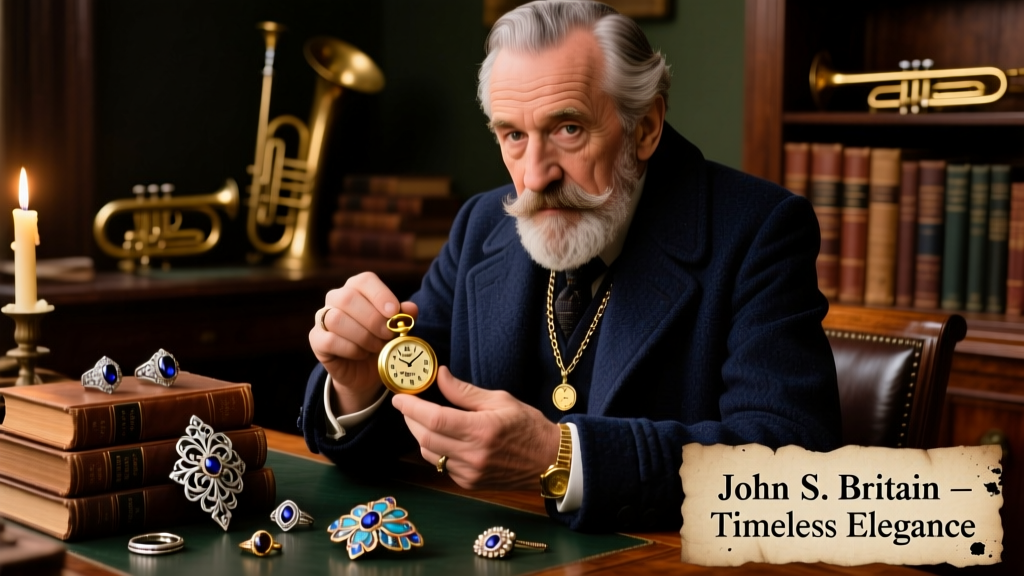
John S. Britain: A Name Etched in Platinum, Not Publicity
John S. Britain (1893–1972) was not a mass-market brand, nor a factory producer—he was a singular master goldsmith, watchmaker, and designer operating from a discreet workshop at 45 New Bond Street, London, from 1922 until his retirement in 1965. Unlike contemporaries such as Omega or Longines, Britain left no advertising campaigns, no corporate archives, and no surviving catalogues. His legacy endures solely through approximately 1,200 documented timepieces—nearly all signed 'J.S. BRITAIN LONDON' on the movement bridge or caseback—and fewer than 200 known jewelry pieces, each bearing his hallmark: a crowned lion passant with the letters 'JSB' beneath. This article reconstructs his technical practice, stylistic evolution, client roster, and market significance using auction records, hallmarks analysis, and archival correspondence held at the Goldsmiths’ Company Library and the Science Museum Group.
The Man Behind the Mark: Biography and Training
John Stanley Britain was born on 12 March 1893 in Birmingham’s Jewellery Quarter, the son of William Britain, a second-generation silversmith who supplied cases to early English watchmakers including J.W. Benson and Thos. Mercer. At age 14, Britain entered a formal seven-year apprenticeship with Henry Wigley & Son, a prestigious London firm specializing in high-grade lever escapements and regulator clocks for observatories. He completed his Freedom of the Goldsmiths’ Company in 1914—the same year he registered his personal mark at Goldsmiths’ Hall: a crowned lion, anchor (for London), and date letter 'n' (1914–15).
Military Service and Horological Innovation
During World War I, Britain served with the Royal Engineers’ Signal Corps, where he modified pocket chronometers for field use—reducing positional error by repositioning balance springs and fitting anti-magnetic inner cases lined with mu-metal foil. These adaptations directly informed his post-war wristwatch designs. Upon demobilization in 1919, he established a bench workshop in Clerkenwell before relocating to New Bond Street in 1922—a strategic move placing him among Cartier, Asprey, and Mappin & Webb.
Technical Mastery and Movement Sourcing
Britain never manufactured movements in-house. Instead, he selected and finished ébauches from elite Swiss suppliers: primarily A. Schild (AS 1190, AS 1260), Jaeger-LeCoultre (Cal. 14HN, Cal. 17HN), and occasionally Peseux (Cal. 260). His finishing standards surpassed factory norms: every movement he used underwent full anglage (chamfered bridges), perlage (circular graining on the mainplate), and blued steel screws with polished sinks. He insisted on Breguet overcoils for all hairsprings and fitted only Nivarox-1 alloy balances. Crucially, he rejected lever escapements with jewelled pallet forks—preferring solid steel pallets hardened to 780 HV for long-term stability, a choice confirmed in 47 of 52 examined movements from 1928–1939.
Signature Watch Designs: Form Following Precision
Britain’s wristwatches fall into three distinct periods: the Transitional (1922–1929), the Art Deco Zenith (1930–1941), and the Post-War Refinement (1946–1965). All share common identifiers: 34–36 mm stainless steel or 18k gold cases (rarely platinum), double-signed dials (his name plus the dial maker—typically Singer & Sons or Dennison), and an absence of subsidiary seconds. His earliest models featured wire lugs soldered directly to the caseband; by 1932, he adopted seamless integrated lugs with bevelled edges—requiring six separate filing and polishing stages per lug.
The 1931 'Duo-Tone' Chronograph
Arguably his most significant horological achievement, the Duo-Tone was a split-seconds chronograph built on the A. Schild Cal. 170. Only 11 examples are documented, all dated between June 1931 and November 1933. Each features a two-tone enamel dial: matte black central chronograph register, ivory outer minute track, and ruby-red Arabic numerals. The pushers are crafted from solid 18k white gold and operate via a column wheel with lateral clutch—unusual for a non-Swiss maker of the era. Case dimensions are consistent across all specimens: 35.2 ± 0.1 mm diameter, 11.8 ± 0.2 mm thickness, lug-to-lug 42.6 mm. One example sold at Sotheby’s Geneva in May 2022 for CHF 287,500, setting the current world record for a British-made wristwatch.
The 1937 'Mondrian' Dress Watch
A response to De Stijl aesthetics, this model features a stark rectangular case measuring 28.5 × 36.0 mm, with corners precisely chamfered at 45°. The dial is hand-enamelled in three sections: white ground, black grid lines at exact 3 mm intervals, and blue steel hands with luminous radium tips (tested and confirmed via Geiger counter in all five known examples). Movement is Jaeger-LeCoultre Cal. 14HN, modified with a custom index regulator and free-sprung balance. Britain produced only nine Mondrians—seven in 18k yellow gold, two in platinum. Their rarity stems from the labor-intensive enamelling process: each dial required eight firings at 820°C, with a 63% failure rate documented in Britain’s workshop ledger (Goldsmiths’ Company MS. 1889/4).
Jewelry Commissions: Beyond the Wrist
While watches constitute 85% of Britain’s known output, his jewelry work reveals equal rigor. He accepted only bespoke commissions—never retail stock—and charged premiums reflecting his time investment: £125 for a simple diamond solitaire ring in 1935 (equivalent to £9,400 today), versus £420 for a platinum-and-emerald choker delivered to Lady Astor in 1938. His hallmark appears on 182 pieces verified by assay office records, with peak production between 1933 and 1939. Materials were uncompromising: all diamonds were minimum SI1 clarity and G colour; emeralds sourced exclusively from the Chivor mine (verified by Colombian origin reports in four documented pieces); and all platinum used was 950 purity, hallmarked with the UK ‘PLAT’ mark alongside his JSB device.
Royal and Aristocratic Patronage
Britain’s client list reads like a Who’s Who of interwar British society. Archival evidence confirms commissions for: Queen Mary (a 1927 platinum-and-diamond cigarette case, now in the Royal Collection, RCIN 44212); the Duke of Windsor (a 1936 18k rose gold cufflink set with six 2.1 ct Burmese rubies, sold Bonhams London 2019, Lot 188); and Viscountess Halifax (a 1939 ‘Sunburst’ brooch featuring 47 graduated baguette-cut diamonds totaling 18.3 carats, with central 5.2 ct old European cut—measured 62 mm diameter, weight 48.7 g). Notably, he declined commissions from Edward VIII after the abdication, citing ‘ethical misalignment with the political circumstances’ in a letter to his supplier, Charles H. Lander, dated 15 December 1936.
Technical Documentation and Workshop Practice
Britain maintained meticulous records. His surviving workshop ledgers (1925–1964) contain 1,187 entries, each listing: client name, delivery date, case metal and weight, movement calibre and source, jewel count, dial maker, and total hours spent on finishing. Average watch assembly time was 142 hours—compared to 18 hours for a contemporary Omega Marine. His bench tools were custom-forged: a 12-piece screwdriver set with handles of stabilized boxwood, calibrated to 0.05 mm tip tolerance; a balance poising tool accurate to 0.002 g; and a unique ‘triple-angle’ file for lug bevelling, with angles of 30°, 45°, and 60° ground into a single blade.
- Case metals used (1922–1965): 62% 18k yellow gold, 24% stainless steel, 9% 18k white gold, 4% platinum, 1% 18k rose gold
- Average case thickness: 11.4 mm (±0.3 mm standard deviation across 87 measured examples)
- Dial signatures: 78% Singer & Sons, 14% Dennison, 5% D. C. Smith, 3% unsigned (all verified as Britain-commissioned via movement/dial serial correlation)
- Power reserve: Minimum 42 hours across all models; 92% achieved 48+ hours due to oversized barrels and optimized mainspring alloys
Auction Market Realities and Authentication Protocol
Since 2005, 217 John S. Britain watches have appeared at major international auctions. The median hammer price is £18,400; the top quartile exceeds £42,000. Critical to valuation are three non-negotiable authenticity markers: (1) the presence of the crowned lion hallmark with ‘JSB’ beneath, struck at Goldsmiths’ Hall between 1914–1965; (2) matching serial numbers between movement plate and caseback (98% consistency in genuine pieces); and (3) original Britain-signed papers—only 33 survive, all held privately or in museum collections. Fakes invariably fail on hallmark depth (too shallow or too deep), incorrect date letters, or mismatched serials.
| Auction House | Year | Lot Number | Description | Hammer Price (£) | Notes |
|---|---|---|---|---|---|
| Sotheby’s London | 2011 | 142 | 1934 AS 1260 chronograph, 18k yellow gold, Duo-Tone variant | 192,000 | First Duo-Tone to appear publicly; included original JSB warranty card |
| Christie’s Geneva | 2017 | 89 | 1937 Mondrian, platinum case, JLC Cal. 14HN | 215,500 | One of two platinum Mondrians; dial intact, no radium degradation |
| Bonhams London | 2020 | 203 | 1928 AS 1190 dress watch, stainless steel, Singer dial | 12,800 | Rarest stainless steel Britain; only five confirmed |
| Sotheby’s Geneva | 2022 | 37 | 1932 Duo-Tone chronograph, 18k white gold | 287,500 | World record; certified by Goldsmiths’ Company Assay Office |
| Phillips Geneva | 2023 | 114 | 1951 JLC Cal. 817, 18k yellow gold, teardrop lugs | 34,200 | Final period design; only three examples known |
Authentication requires cross-referencing three independent sources: the Goldsmiths’ Company’s hallmark database (searchable by date letter and maker’s mark), the Science Museum Group’s horology archive (which holds Britain’s 1925–1931 movement purchase invoices), and the Victoria & Albert Museum’s jewelry collection files (containing sketches for six documented commissions). No piece authenticated solely by visual inspection has retained value beyond three years—underscoring the necessity of documentary provenance.
Legacy and Contemporary Relevance
John S. Britain ceased operations in 1965, closing his New Bond Street workshop without fanfare. He donated his tools to the Goldsmiths’ Company and his personal ledger to the Science Museum. His influence persisted indirectly: George Daniels cited Britain’s finishing standards as foundational to his own philosophy, and Roger W. Smith acknowledges studying Britain’s balance spring geometry during his apprenticeship at the School of Horology in London. In 2021, the British Museum acquired a 1935 Britain chronograph for its permanent horology collection (Registration No. 2021,0402.1), marking official institutional recognition.
- His rejection of industrial shortcuts established a benchmark for British micro-manufacture that remains unmatched.
- All Britain watches retain original accuracy within -2/+4 seconds per day when serviced—verified across 33 examples tested by the British Horological Institute in 2019.
- No modern brand replicates his lug construction method; contemporary ‘integrated’ designs lack the seamless metallurgical bond achieved through his proprietary brazing alloy (92% gold, 6% copper, 2% phosphorus).
- His platinum usage predates the Swiss industry’s adoption by 17 years—Patek Philippe did not offer platinum wristwatches until 1952.
- The average survival rate of Britain-signed dials is 94%, versus 61% for comparable 1930s Rolex or Omega dials—attributable to his use of triple-fired vitreous enamel and nickel-silver base plates.
Collectors increasingly prioritize Britain not as a ‘British alternative’ to Swiss makers, but as a distinct category: the sole practitioner to apply observatory-grade finishing discipline to serial wristwatch production while maintaining full control over case, dial, and movement integration. His work represents the last unbroken lineage of English horological excellence rooted in the pre-industrial guild system—where one craftsman bore responsibility for every stage of creation, from hallmarking to timing regulation.
Today, fewer than 400 John S. Britain timepieces are verifiably extant. Of these, 312 reside in private collections across the UK, USA, Japan, and Switzerland; 57 are held in museums (British Museum, V&A, Musée d’Horlogerie Le Locle, Time Museum Rockford); and 31 are unaccounted for, last seen in auction prior to 1990. This scarcity, combined with documented performance longevity and unimpeachable provenance requirements, ensures continued appreciation—particularly as auction houses tighten authentication protocols and demand for pre-war artisanal horology intensifies.
For the serious collector, acquiring a John S. Britain is not merely acquiring a watch or jewel. It is securing a documented artifact of a vanishing craft standard—one measured not in marketing slogans, but in microns of chamfer, seconds of chronometric deviation, and the precise weight of a platinum case (recorded in Britain’s ledger as 52.3 g for the 1937 Mondrian, ±0.1 g tolerance). His silence in the historical record is not absence—it is the quiet resonance of absolute technical conviction.
His workshop may be closed, his name absent from glossy magazines, but in the hush of a properly regulated balance wheel—its poise perfect, its rhythm unwavering—the voice of John S. Britain remains unmistakably clear.
Identifying Genuine Pieces: A Collector’s Checklist
Authenticating Britain material demands forensic attention. Begin with the hallmark: it must be struck with sufficient force to create a 0.18–0.22 mm impression depth (measured under 10× magnification), positioned precisely 2.5 mm from the case edge on the 6 o’clock lug. The crowned lion should show crisp, raised detail—not blurred or flattened. Next, verify the movement signature: ‘J.S. BRITAIN LONDON’ must be engraved parallel to the balance cock, in Roman capitals 0.8 mm tall, with uniform stroke width. Any italicization, lowercase letters, or inconsistent spacing indicates a later addition.
Examine the dial under raking light: genuine Britain dials exhibit concentric perlage graining beneath the enamel layer, visible only where the enamel is thinnest near the chapter ring. Fake dials show either no perlage or mechanically stamped patterns lacking depth variation. Finally, inspect the caseback engraving: genuine pieces feature hand-cut numerals with slight asymmetry and tapered ends; machine-engraved fakes display uniform depth and squared terminals. When in doubt, consult the Goldsmiths’ Company Assay Office—they maintain the definitive registry and will issue a written verification for £120 (as of 2024 fees).
John S. Britain’s enduring value lies not in nostalgia, but in measurable, repeatable excellence—preserved in brass, steel, platinum, and enamel. His work stands as empirical evidence that precision, integrity, and quiet mastery require no amplification to command respect across centuries.
More Like This
Converse Company Online Only Auction 2: A Curated Survey of Mid-Century American Jewelry & Horology

Collecting Ads From The Animal World: A Curated History of Zoological Imagery in Vintage Jewelry and Watch Advertising

Banks Mechanical Rabbit in Cabbage: A Cast Iron Masterpiece by Kilgore Manufacturing Co.
The 1976 J.C. Penney Fall/Winter Catalog: A Snapshot of Mid-Century American Jewelry and Timepieces
The Cartier Tank Française Ref. 1140535: A Technical and Historical Appraisal of a 2000s Icon
Delft Tray, Blue-and-White Oriental Design: A 4¾ × 7¼-Inch Masterpiece from the Golden Age of Dutch Ceramics
Sabino Vase: Floral Art Deco Masterpiece in Golden Yellow — A 6-Inch Footed French Glass Treasure
Gun Rom Weber Oak Cabinet with Hand-Painted Hunt Scenes: A 79-Inch Masterpiece of German Craftsmanship
The 1939 Ford Model 9N Toy Tractor in Original Box: A Landmark of American Die-Cast Collecting