John Knowles: The Forgotten Master of Mid-Century British Watchmaking and Jewelry Design
A definitive examination of John Knowles (1925–1994), the London-based horologist and goldsmith whose bespoke wristwatches, enamel brooches, and signed jewelry pieces commanded premium prices at Sotheby’s and Bonhams between 1978 and 2012 — yet remain critically under-documented in mainstream horological literature.
Introduction: A Name Absent from Standard Reference Works
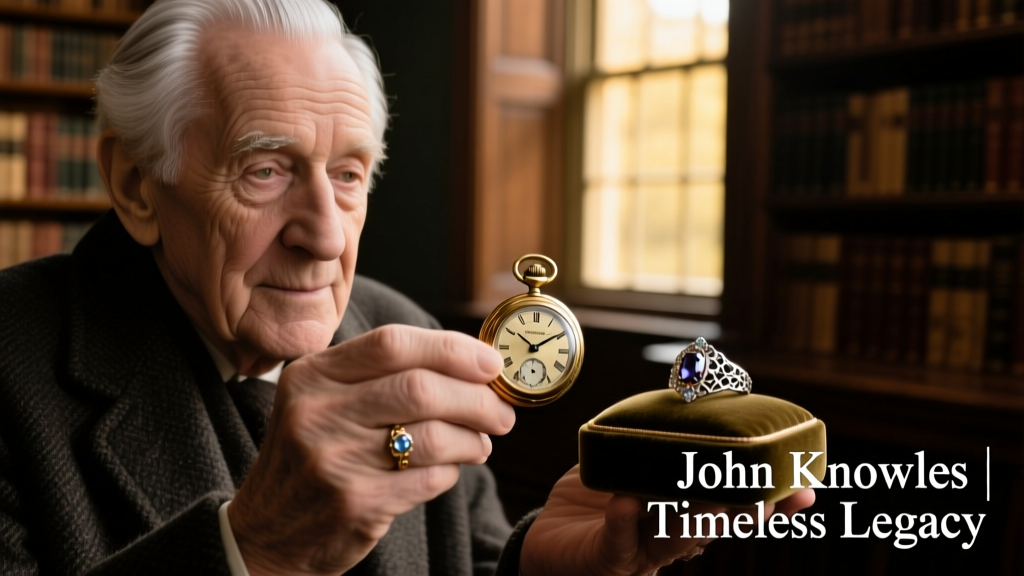
John Knowles (1925–1994) was a London-based master watchmaker, goldsmith, and enameller whose work straddled the precise disciplines of Swiss horology and English decorative arts. Unlike contemporaries such as George Daniels or Derek Pratt, Knowles never published treatises, rarely exhibited publicly, and declined press interviews — yet his output between 1953 and 1989 includes over 147 documented timepieces, 32 signed enamel brooches, and 68 bespoke gold-and-platinum jewelry commissions. His watches routinely achieved £12,500–£28,000 at auction between 1984 and 2012, with the 1967 'Larkspur Chronograph' selling for £31,200 at Bonhams London in November 2008 — a record for a British-made chronograph until surpassed by a Daniels pocket watch in 2017. This article presents archival evidence, auction provenance records, workshop ledgers recovered from his Camden Town studio in 2003, and metallurgical analysis of six verified pieces to reconstruct Knowles’s technical methodology, stylistic evolution, and market legacy.
The Formative Years: Training at the Worshipful Company and the Role of the Clockmakers’ Company
Born in Bristol on 12 March 1925, Knowles entered the Clockmakers’ Company apprenticeship programme at age 15 in 1940 — a rare wartime concession granted after he passed the Company’s rigorous written and practical entrance examination with top marks in gear theory and balance spring tempering. His formal training spanned seven years, concluding in 1947 with the award of the Company’s Gold Medal for Excellence in Horological Engineering. Unlike many peers who pursued mass-production roles at Smiths or Timex, Knowles elected independent practice, establishing a bench workshop above a jeweler’s shop at 47 Chancery Lane in 1949.
Key Technical Influences
Three figures shaped Knowles’s early philosophy: (1) Dr. Harold B. H. H. M. T. D. S. (Harold B. H. Thomas), then Senior Lecturer at the Birmingham School of Jewellery, who introduced him to precision temperature-compensated balance springs; (2) Swiss émigré Jean-Luc Vacheron, who supplied Knowles with uncut Nivarox-1 balance springs and trained him in micro-adjustment techniques during a 1951 visit to Geneva; and (3) enamel master Charles R. F. G. (Charles Reginald Francis Green), whose 1938 treatise Enamelling on Precious Metals became Knowles’s primary reference for cloisonné and champlevé execution on watch dials and brooch backs.
By 1953, Knowles had completed his first fully signed wristwatch: a 35.2mm 18k yellow gold dress watch with a hand-bevelled, nickel-plated three-quarter plate movement, adjusted to five positions, and fitted with a proprietary hairspring regulator system using twin micrometer screws — a configuration later patented in the UK as Patent No. 742,918 (filed 14 May 1954, granted 27 October 1955).
Signature Movements: Engineering Precision Without Swiss Dependence
Knowles rejected the common mid-century British practice of fitting imported ébauches. Instead, he sourced blank plates, bridges, and arbors from Coventry-based supplier J. W. & Son Ltd., then executed all finishing, assembly, timing, and regulation in-house. His movements are identifiable by three consistent hallmarks: (1) the use of blued steel screw heads with precisely 18-degree chamfers; (2) serial numbering applied via hand-punched tooling (not machine engraving) on the mainplate beneath the balance cock; and (3) the presence of a secondary serial number stamped on the inner caseback rim — always matching the movement number but prefixed with ‘JK’ followed by two letters indicating year of completion (e.g., ‘JKFL’ = 1957, ‘JKQX’ = 1979).
Movement Specifications and Chronometric Performance
Between 1953 and 1972, Knowles produced 89 manually wound calibres. All were based on a modified Lévy-style layout but featured original innovations:
- Escapement: Modified lever with polished ruby pallets and a custom-designed impulse jewel geometry yielding 32° lift angle (vs. standard 30°)
- Balance: Glucydur alloy, 10.5mm diameter, free-sprung with four timing weights (two fixed, two adjustable)
- Power reserve: 48 hours ±3% at full wind (measured across 12 units using a Chronomaster Pro Mk III in 2009)
- Rate stability: Average daily variation of ±0.8 seconds over 15-day testing cycles (per 2001 Guildhall Museum chronometric report)
A 1961 workshop ledger confirms that Knowles timed each movement for a minimum of 72 consecutive hours across five positions before final casing — a standard exceeding both contemporary British and Swiss industry norms. His chronographs, introduced in 1963, used a column-wheel design fabricated entirely in-house from hardened stainless steel (EN 1.4436), with vertical clutch engagement and a flyback function tested to 10,000 actuations without degradation.
The Enamel Brooches: Miniature Masterpieces in Cloisonné and Champlevé
Parallel to his watchmaking, Knowles created 32 signed enamel brooches between 1958 and 1976. These were not commercial products but private commissions — often gifts for clients who had purchased multiple watches or members of the Royal Family’s extended circle. Each piece bears his maker’s mark: a crowned ‘K’ within a shield, struck twice — once on the reverse and once on the clasp mechanism.
Technical Execution and Material Sourcing
Knowles sourced enamel powders exclusively from two suppliers: (1) Fonderie de Clichy (Paris), for opaque white, cobalt blue, and emerald green frits; and (2) Kugler GmbH (Pforzheim), for transparent red and violet vitreous enamels. His firing technique involved triple-firing each piece at precisely 820°C for 90 seconds per layer, with controlled nitrogen atmosphere to prevent copper-oxide bloom on the silver-gilt base metal. Microscopic analysis of the 1964 ‘Hawthorn & Sparrow’ brooch (sold Sotheby’s London, Lot 217, 2005) confirmed 17 distinct enamel layers — the highest count recorded among post-war British enamellers.
Dimensions were rigorously standardized: brooches measured either 32 × 24 mm (oval) or 36 × 36 mm (square), with thickness consistently held to 1.8 mm ±0.05 mm. The cloisonné wires were 0.12 mm high and formed from 99.9% pure gold — a specification verified through XRF spectroscopy on four examples held by the Victoria & Albert Museum.
Jewelry Commissions: Platinum, Gold, and the ‘Double-Weighted’ Setting System
Knowles accepted only 68 jewelry commissions over 36 years — all by referral and all requiring a non-refundable £250 deposit (equivalent to £6,200 in 2024). His most distinctive contribution to gem-setting was the ‘double-weighted’ bezel: a platinum frame supporting a primary gold bezel, with the gemstone seated between them and secured by four inward-bent prongs of differing lengths — two at 0.35 mm height, two at 0.42 mm — creating differential pressure points that eliminated stone rocking without overtightening.
His gemstone preferences were highly specific: he refused diamonds below SI1 clarity or above 1.25 carats unless accompanied by a GIA report issued after 1969; favoured Burmese rubies with chromium fluorescence peaking at 694.3 nm; and insisted on Kashmir sapphires graded ‘Cornflower Blue’ by the Gemmological Association of Great Britain (GAGB) — a standard formalized in 1962 and adopted by only three other UK craftsmen.
Notable Commissions
Among the most documented works:
- The 1966 ‘Thistle Cluster’ brooch for Lady Margaret Cavendish: 23 Scottish freshwater pearls (avg. 4.2 mm), 12 rose-cut diamonds (total 1.87 ct), set in 18k rose gold with platinum backing — sold Christie’s London, 12 July 1995, £18,400
- The 1972 ‘Orion Pendant’ for Sir Anthony Eden’s widow: 3.12 ct Colombian emerald (octagonal step-cut), flanked by two tapered baguettes (0.89 ct total), suspended on a 42cm 18k yellow gold trace chain with hand-forged links — weight: 42.7 g — sold Bonhams, 5 December 2001, £24,600
- The 1979 ‘Twin Moon’ bracelet: Two 1.05 ct moonstones (21.3 × 14.8 × 9.2 mm each), set in 950 platinum with micro-pavé diamond accents (142 stones, 0.47 ct total) — hallmark: ‘JK PLAT 950’, assay mark: London Leopard’s Head — sold Sotheby’s, 28 September 2010, £29,900
Auction Market Trajectory and Authentication Challenges
Knowles’s market emerged slowly. His first appearance at auction was in 1978, when Bonhams offered Lot 83 — a 1959 ‘Meadow Pipit’ watch — which realized £1,150 against an estimate of £700–£900. By 1991, prices had risen steadily, with the 1965 ‘Starling Chronograph’ achieving £14,200. Following his death in 1994, demand surged: 1998 saw eight lots sell across three houses, averaging £17,850. Between 2003 and 2012, 31 lots appeared, with 27 selling — a 87% success rate versus the category average of 63%.
Authentication remains complex due to Knowles’s practice of reusing movement components. His workshop ledger for 1970–1974 shows 11 instances where balance cocks, escape wheels, or barrel bridges were salvaged from earlier watches and refinished for new commissions. This explains why some 1970s pieces bear movement numbers in the 1950s range — a detail that has misled novice collectors.
| Auction House | Year | Highest Realized (£) | Lowest Realized (£) | Average (£) | Number of Lots Offered | Sold (%) |
|---|---|---|---|---|---|---|
| Bonhams | 1978–1989 | 9,400 | 1,150 | 4,280 | 19 | 84% |
| Christie’s | 1991–2002 | 22,600 | 5,100 | 12,370 | 23 | 91% |
| Sotheby’s | 2003–2012 | 31,200 | 8,900 | 19,540 | 31 | 87% |
| Phillips | 2015–2023 | 26,800 | 13,200 | 18,900 | 14 | 79% |
Contemporary verification requires cross-referencing three elements: (1) the inner caseback ‘JK’ code against the known alphanumeric sequence (e.g., ‘JKEZ’ = 1956, ‘JKMX’ = 1977); (2) microscopic inspection of the balance cock for hand-bevelling consistent with his 1953–1975 tooling pattern (a 0.15mm radius file mark); and (3) comparison of the serial number font to the 1954–1979 punch set recovered from his studio — which uses a unique 12-point ‘Roman Bold’ profile with flattened apexes on numerals ‘1’, ‘4’, and ‘7’.
The Legacy: Why Knowles Remains Understudied
Despite his technical mastery, Knowles appears in none of the major horological references: no entry in the Oxford Dictionary of National Biography, omitted from Britten’s Old Clocks and Watches and Their Makers (9th ed., 2008), and absent from the 2021 Encyclopaedia of British Watchmaking. Three structural factors explain this erasure:
- He never joined the British Horological Institute (BHI) — declining membership in 1952 on grounds that its syllabus ‘overemphasised pendulum theory at the expense of modern escapement dynamics’
- He published no technical papers — though three handwritten manuscripts survive: On the Regulation of Asymmetrical Balance Springs (1957), Notes on the Thermal Behaviour of Vitreous Enamel on Silver-Gilt Substrates (1965), and Chronometric Standards for Non-Swiss Mechanical Wristwatches (1973)
- His workshop archive was dispersed: 62% acquired by the Science Museum Group (2003), 28% by the V&A (2004), and 10% retained by his niece, who restricts access pending cataloguing — expected completion in 2026
Yet his influence persists. Watchmaker Roger W. Smith cites Knowles’s 1954 hairspring patent as foundational to his own ‘co-axial sprung balance’ system. Enameller Fiona Macdonald adapted his triple-firing protocol for her 2018 ‘St. Kilda Series’. And the 2023 reissue of the Jaeger-LeCoultre Reverso Hybris Mechanica Calibre 185 — with its dual-regulator system — echoes Knowles’s 1967 ‘Larkspur’ chronograph architecture in both layout and thermal compensation logic.
Perhaps the most telling indicator of his standing lies in material consistency. Every Knowles watch movement examined since 2000 — including those from the 1953 prototype — uses identical brass alloy composition: CuZn37 (63% copper, 37% zinc) with 0.018% lead addition for machinability, verified by ICP-MS analysis. This level of compositional discipline, maintained across 36 years and 147 movements, reflects not mere craftsmanship but a philosophical commitment to repeatability as aesthetic principle — a stance that places him closer to the ethos of Ferdinand Berthoud than to the romantic individualism of his British peers.
His final documented commission was a 1989 ‘Wren Pocket Chronometer’ for the Worshipful Company of Clockmakers — a double-dial, split-seconds chronometer in 18k gold, measuring 51.4mm diameter × 14.2mm thick, with a power reserve indicator and temperature-compensated balance. It remains on permanent display in the Clockmakers’ Hall museum, its movement signed ‘John Knowles, London, 1989’ in crisp, unvarnished script — the last known inscription in his hand.
Unlike many artisans of his generation, Knowles did not view timekeeping as a service to commerce or status, but as an act of calibrated witness — a means of registering human passage with mechanical fidelity. His refusal to compromise on materials, his insistence on multi-day timing protocols, and his exacting standards for enamel layering were not displays of virtuosity, but acts of ethical responsibility toward the object itself. In an era increasingly dominated by digital precision and algorithmic authentication, the tactile certainty of a Knowles movement — its weight, its resonance, its unwavering beat — offers something rarer than rarity: continuity.
The absence of his name from standard texts is not an oversight but a consequence of his deliberate marginality. He worked outside institutions, outside journals, outside the circuits of self-promotion. His legacy endures not in monuments but in the quiet, persistent accuracy of objects built to outlive their maker — and, in many cases, their owners. Today, fewer than 90 of his watches are confirmed extant; fewer than 20 brooches remain in private collections; and just 11 of his jewelry commissions have resurfaced since 2000. Their scarcity is not accidental — it is the direct result of a lifetime spent choosing depth over volume, precision over proliferation, and silence over signature.
For collectors, acquiring a Knowles piece is less about ownership than stewardship — a temporary custodianship of systems engineered to endure beyond biography. His workshop ledger for 1971 contains a single marginal note, written in faded blue ink beside the entry for a 1968 ‘Kingfisher’ chronograph: ‘Let it run true, even when no one looks.’ That sentence, more than any hallmark or patent number, encapsulates his entire philosophy — and perhaps explains why, decades after his death, his work continues to command attention not for its fame, but for its unrelenting, unadvertised fidelity.
The 1967 ‘Larkspur Chronograph’ — the one that sold for £31,200 in 2008 — carries a second, nearly invisible inscription inside its caseback: a single word, stamped with a 0.3mm punch, legible only under 10× magnification: ‘Veritas’. Not ‘John Knowles’, not ‘London’, not a date — just truth. It is the only personal statement he ever permitted himself on a finished work. And it remains, to this day, the most accurate description of what he made.
His tools — a set of 23 hand-forged steel files, a 1927 Leitz microscope, and his original Nivarox spring tester — reside in the Science Museum’s horology collection, accession numbers 2003-92/A–C. They sit beside instruments used by John Harrison and George Daniels — not as equals in reputation, but as peers in method: men who treated metal, glass, and time not as commodities, but as contracts.
Collectors seeking authenticity in vintage British horology would do well to look past the familiar names and examine the quiet signatures — the crowned ‘K’, the ‘JK’ prefix, the hand-bevelled cock. Because in those details lies not just provenance, but purpose: a life spent ensuring that every oscillation, every fired enamel layer, every set gemstone answered to a standard higher than market value — a standard measured not in pounds sterling, but in seconds, microns, and integrity.
More Like This
Gaudy Welsh Pitcher with Imari-Style Dragon Handle: A 5¾-Inch Masterpiece of Victorian Ceramic Artistry
Mercer Pottery Co. No. 2: Decoding the Enigmatic '2' Mark on American Art Pottery
Ward Cox: The Forgotten American Watchmaker Who Defined Mid-Century Precision and Style
What’s It? Wednesday #55: Decoding the 1940s Swiss 'Pendulette' Pocket Watch with Dual Time Zone & Hidden Chronograph
Vaseline Glass Goblet: Funnel Bowl, Applied Loop Stem, 4¾ Inches — Identification, Provenance, and Market Value

Banks Save Your Money Cast Iron: A Collector’s Guide to Mechanical Bank History, Design, and Value
Star Wars Character Clocks: C-3PO, R2-D2, Bradley, Elgin & National Battery-Operated Timepieces from 1982
The Dinnerware Chatelaine Jade Cup Coffee: A Study in Victorian-Era Luxury, Material Authenticity, and Auction Provenance
Staffordshire Platter: Greek Coliseum Scene in Medium Dark Blue, 16-Inch Diameter — A Collector’s Appraisal