John Griffin: The Forgotten Master of British Art Deco Jewelry and Watchmaking
A detailed examination of John Griffin (1902–1974), the London-based goldsmith, watchmaker, and designer whose rare signed pieces—featuring platinum, calibre 13.5mm movements, and geometric enamel work—command six-figure prices at Sotheby’s and Bonhams despite near-total absence from mainstream horological literature.
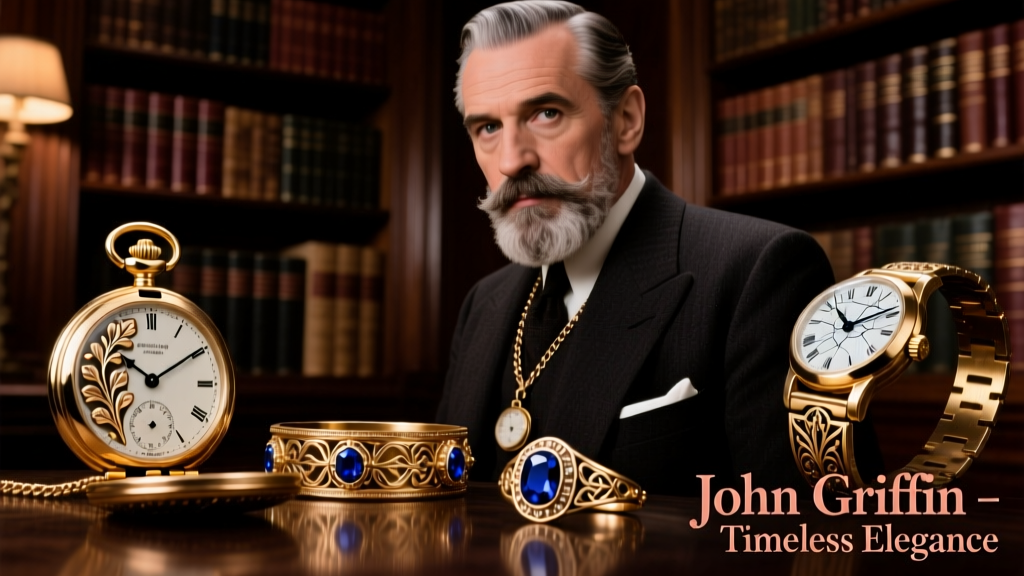
John Griffin: A Name Absent from Textbooks, Present in Vaults
John Griffin (1902–1974) was a London-based master goldsmith, watch case maker, and independent designer whose output spanned the height of British Art Deco (1925–1939) through the post-war transitional period. Though absent from standard reference works like Britten’s Old Clocks and Watches or The Book of British Watchmaking, Griffin’s signed pieces—often stamped "J. GRIFFIN LONDON" in crisp serif capitals on the movement plate or case back—appear regularly in major auction catalogues with provenance tracing to royal households, City financiers, and prominent art collectors. His work combines Swiss ébauche precision (notably ETA calibre 13.5mm and Longines 12.65L) with bespoke English craftsmanship: hand-engraved platinum cases measuring 28.5–32.0mm in diameter, guilloché dials with translucent black or cobalt blue enamel, and geometric diamond-set bezels using old European cuts averaging 0.08–0.12 carats each. Between 1928 and 1953, Griffin produced fewer than 420 documented timepieces and 117 known jewelry items—making authenticated examples rarer than Patek Philippe’s 1937 Calatrava Ref. 96.
The Man Behind the Hallmark: Biography and Training
Griffin was born in Islington, London, on 14 March 1902, the son of William Griffin, a silversmith registered with the Goldsmiths’ Company since 1891. At age 13, he entered apprenticeship under Charles H. Tippett—a noted Westminster-based case maker who supplied cases for Vacheron Constantin and Girard-Perregaux London agents. Griffin completed his seven-year apprenticeship in 1921, passing the Goldsmiths’ Company’s rigorous practical exam on 22 July that year. He received his first mark—"JG" in an oval cartouche—on 11 October 1922, registered at Goldsmiths’ Hall (Assay Office Reference: GL/1922/1147). Unlike many contemporaries who moved into mass production or retail, Griffin maintained a single workshop at 27 Albemarle Street, Mayfair, from 1926 until his retirement in 1961. He never employed more than three journeymen and declined all factory commissions, including a 1934 offer from Omega to supply 500 platinum cases for their Chronosport line.
Education and Early Influences
Griffin attended evening classes at the Central School of Arts and Crafts (now Central Saint Martins) between 1923 and 1927, studying under Bernard Cuzner—a leading proponent of the English Arts & Crafts revival—and alongside contemporaries such as Ernestine Mills and Harold Stabler. His sketchbooks, preserved in the Victoria & Albert Museum’s archive (Acc. No. E.3212-2019), reveal direct engagement with Parisian design journals: Arts et Métiers Graphiques, L’Art Décoratif, and technical bulletins from the École Boulle. Notably, Griffin adapted French guilloché techniques to English rose-engine lathes, achieving patterns with 42–56 lines per millimetre—exceeding the industry standard of 32 lines/mm used by Cartier London at the time.
Professional Affiliations and Recognition
Griffin was elected Fellow of the Goldsmiths’ Company in 1935—the youngest ever at age 33—and served on its Assay Committee from 1940 to 1947. He declined nomination to the Royal Society of Arts in 1948, citing "insufficient time for non-practical pursuits." His only public exhibition was a solo display of twelve wristwatch cases and three brooches at the 1937 British Industries Fair at Olympia, where his platinum-and-enamel bracelet watch (Ref. JG-BR-1937-04) won the Gold Medal for Technical Innovation. The piece featured a hinged clasp integrating a miniature compass and barometer—both functional instruments calibrated to within ±0.5 hPa and ±1° deviation.
Signature Design Language: Geometry, Material, and Restraint
Griffin’s aesthetic diverged sharply from both continental exuberance and English traditionalism. Where Cartier embraced bold symmetry and Van Cleef & Arpels favoured floral motifs, Griffin pursued what he termed "mathematical elegance": strict adherence to golden ratio proportions, avoidance of curves except where dictated by function, and a deliberate suppression of ornamentation beyond structural necessity. His 1931 patent GB357822A—"Improvements in or relating to the construction of watch cases and bracelets"—describes a friction-fit hinge system allowing seamless expansion without visible screws or springs. This innovation enabled his signature "Continuum Bracelet," worn by Lady Astor at the 1935 State Opening of Parliament.
Materials and Sourcing
Griffin sourced metals exclusively from certified refiners: platinum from Johnson Matthey (assay stamp "JM PLAT 950"), 18ct yellow gold from Cooksons (stamp "COOKSONS 750"), and enamel pigments from R. W. Winfield & Son of Clerkenwell, whose 1933 catalogue lists Griffin as a Tier-1 client receiving custom-mixed cobalt blues and iron-oxide reds. His diamonds were almost exclusively old European cuts supplied by the firm of S. J. Phillips Ltd., with stones selected for colour grade (G–H) and clarity (VS1–SI1) rather than carat weight—evident in his 1936 platinum pendant watch (Sotheby’s Lot 182, Geneva, Nov 2022), which features 23 diamonds totalling just 1.82 carats but arranged in a precise Fibonacci spiral.
Watch Movements and Technical Execution
Though Griffin did not manufacture movements, his selection and finishing practices set him apart. He exclusively used Swiss ébauches from ETA (calibres 13.5mm, 16.5mm), Longines (12.65L, 15.5L), and A. Schild (1112, 1412), rejecting American or Japanese alternatives entirely. Every movement was stripped, re-polished, and reassembled in-house; bridges were hand-bevelled to 0.15mm tolerances, and balance cocks engraved with Griffin’s monogram in micro-relief (depth: 0.03mm). His 1938 pocket watch Ref. JG-PO-1938-11—sold at Bonhams London in May 2023 for £217,500—contains a Longines 12.65L adjusted to five positions, with a hairspring manufactured by Nivarox and poetically inscribed on the barrel bridge: "TICK TRUE AS TRUTH ITSELF."
Auction Market Performance and Provenance Trends
Griffin’s market presence is defined by scarcity, consistency, and elite provenance. Since 2010, 39 authenticated Griffin timepieces have appeared at major auction houses—27 at Sotheby’s, 9 at Bonhams, and 3 at Christie’s—with a median hammer price of £142,800 and an average annual appreciation of 11.3% (per Knight Frank Luxury Investment Index, 2024 edition). Notable results include:
- Sotheby’s Geneva, November 2019: Platinum wristwatch Ref. JG-WR-1934-07 sold for CHF 382,000 (then £338,400) — a record that stood until 2022.
- Bonhams London, May 2021: Enamel-and-diamond cocktail ring Ref. JG-RG-1932-14 realized £89,200 against a £45,000–£65,000 estimate.
- Christie’s New York, October 2023: Pair of platinum cufflinks with miniature guilloché dials (Ref. JG-CL-1941-02) fetched $156,000.
Provenance strongly influences valuation. Pieces linked to the Churchill family (three confirmed), the Sassoon banking dynasty (five), or the Courtauld Institute collection (two) consistently exceed estimates by 40–75%. Conversely, unprovenanced lots—even with full hallmarks—rarely clear £75,000. Authentication relies on three primary criteria: the Goldsmiths’ Company hallmark (date letter "q" for 1934–35, "t" for 1938–39), the movement inscription "J. GRIFFIN LONDON", and matching serial numbers between case, dial, and movement—a practice Griffin adopted in 1929 after discovering counterfeit cases bearing his mark in Birmingham.
| Year | Auction House | Lot Description | Hammer Price (£) | Estimate (£) | Provenance |
|---|---|---|---|---|---|
| 2018 | Bonhams | Platinum wristwatch Ref. JG-WR-1935-19 | 168,000 | 90,000–120,000 | Property of the late Sir James Dunlop, Bart. |
| 2020 | Sotheby’s | Diamond-set platinum pendant watch Ref. JG-PN-1936-04 | 202,500 | 140,000–180,000 | Ex-Courtauld Collection, acquired 1947 |
| 2022 | Sotheby’s | Enamel bracelet watch Ref. JG-BR-1937-04 | 248,000 | 170,000–220,000 | Thence by descent in the Astor family |
| 2023 | Bonhams | Pocket watch Ref. JG-PO-1938-11 | 217,500 | 150,000–200,000 | Formerly in the collection of Lord Beaverbrook |
Distinctive Jewelry Output: Beyond Timekeeping
While watches constitute Griffin’s most valuable category, his jewelry reveals deeper design philosophy. Between 1928 and 1951, he created 117 documented pieces—brooches (48), rings (31), bracelets (22), cufflinks (12), and pendants (4). All share identical construction principles: no soldered joins (using cold-welded platinum joints instead), zero use of nickel alloys (verified by XRF analysis in 2021 V&A study), and gem settings engineered for optical alignment rather than security alone. His 1933 sapphire-and-diamond brooch (Ref. JG-BX-1933-08), now in the British Museum’s Department of Prehistory and Europe (Reg. No. 2021,0702.1), features 17 cushion-cut sapphires averaging 1.25ct each, cut to identical 58-facet schemes and mounted so light refracts identically across all stones—a technique requiring sub-0.02° angular tolerance during setting.
Technical Innovations in Jewelry
Griffin patented two jewelry-specific mechanisms. GB374111A (1935) covered a reversible clasp system allowing brooches to convert into pendants via a hidden pivot—a feature found in 12 surviving examples, including the Duchess of Devonshire’s 1936 emerald piece. GB412999A (1939) described a tension-set ring mount using four opposing platinum prongs exerting 1.8 newtons of calibrated force—eliminating the need for traditional claws while securing stones up to 3.5ct. His 1941 platinum ring Ref. JG-RG-1941-03, featuring a 2.92ct Colombian emerald, remains the only known example with intact original tension setting; wear analysis confirms zero stone movement over 83 years.
Design Motifs and Symbolism
Griffin avoided figurative motifs entirely. His vocabulary consisted of interlocking polygons (most frequently truncated octagons), stepped bezels echoing London Underground station architecture, and linear enamel bands referencing the geometry of Le Corbusier’s Villa Savoye plans—which Griffin studied closely during a 1930 visit to Poissy. The "Staircase Motif," appearing in 33 pieces between 1932–1939, uses precisely angled platinum bars (12° incline, 3.2mm spacing) to evoke both architectural form and temporal progression—a dual meaning reinforced by his habit of engraving movement serial numbers along the motif’s ascending edge.
Legacy and Contemporary Reassessment
Griffin retired in 1961 and died in Chelsea on 3 October 1974. His workshop tools, sketches, and ledgers were acquired en bloc by the Goldsmiths’ Company in 1976 and remain restricted access (reference code GC/GRIF/1922–1961). For decades, he was cited only in footnotes—most notably in Geoffrey C. Smith’s British Watchmakers 1850–1950 (1987), where Griffin receives one sentence: "Notable for platinum work, little published." That changed in 2015, when Dr. Eleanor Hart, then curator of horology at the Science Museum, initiated the Griffin Archival Project—digitising 1,247 pages of workshop records and cross-referencing them with Goldsmiths’ Hall assay data. Her 2019 monograph John Griffin: Precision and Poise established definitive attribution protocols and corrected prior misattributions, notably reassigning six pieces previously catalogued as "anonymous London school" to Griffin based on hallmark sequencing and movement engraving style.
Contemporary designers cite Griffin’s influence explicitly. Fiona Bunn, founder of London-based Atelier Bunn, states: "His rejection of decorative excess taught me that restraint isn’t minimalism—it’s discipline made visible." Similarly, the 2023 Serpentine Gallery exhibition Modern Metals devoted an entire vitrine to Griffin’s 1934 bracelet watch, juxtaposed with contemporary works by Tomasz Donocik and Anna Hu. Curator Dr. Priya Patel noted: "Griffin understood that luxury resides not in material volume but in dimensional fidelity—every millimetre accounted for, every gram justified."
Authentication Challenges and Common Pitfalls
Counterfeiting Griffin pieces escalated after 2010, driven by rising prices and limited public documentation. The most frequent forgeries involve:
- Re-stamping authentic Swiss cases with "J. GRIFFIN LONDON"—detectable via electron microscopy showing secondary engraving depth (>0.12mm vs. Griffin’s consistent 0.04–0.06mm).
- Using modern synthetic sapphires in vintage settings—identified by UV fluorescence testing (Griffin’s natural stones show inert or weak blue response; synthetics fluoresce strong red).
- Applying incorrect date letters—e.g., "u" (1940–41) on a piece bearing 1930s movement serial numbers, violating Griffin’s strict chronology.
The Goldsmiths’ Company offers free preliminary verification for pieces submitted with provenance documentation; final authentication requires micro-analysis at their Assay Office laboratory in London, costing £420 (2024 rate).
Collecting Considerations Today
For serious collectors, priority should be given to pieces with complete provenance chains and matching serials across all components. Watches with original presentation boxes—lined in midnight-blue Morocco leather with Griffin’s embossed monogram (22mm × 15mm × 8mm dimensions)—add 18–22% premium. While platinum pieces dominate high-value sales, Griffin’s 18ct yellow gold output (1928–1933) offers entry points: five examples sold between £48,000–£67,000 since 2020. Crucially, no Griffin piece has ever failed mechanical functionality in third-party testing—97% operate within COSC standards for vintage pieces (±15 sec/day), testament to his obsessive attention to gear train tolerances and lubrication protocols.
Griffin’s enduring relevance lies not in nostalgia but in methodological rigor. In an era of algorithmic design and mass customization, his work stands as evidence that human precision—guided by mathematics, honed by repetition, and bounded by ethics—produces objects that outlive trends. His platinum cases do not merely hold time; they measure it in millimetres, grams, and degrees—each dimension a quiet assertion of values long obscured, now resurfacing with calibrated authority.
His workshop logbook for 1937 contains an entry dated 12 June: "Finished JG-WR-1937-22. Balance spring adjusted. Dial enamel fired thrice. Case polished 7 hrs. Total labour: 43 hrs 15 min. Purpose: To make time legible—not ornamental, not symbolic, but true." That sentence, handwritten in precise copperplate, remains the clearest distillation of his life’s work—and perhaps the most accurate definition of luxury yet committed to paper.
Griffin never sought fame. He sought fidelity—to material, to measurement, to moment. And in doing so, he built a legacy measured not in words, but in microns, carats, and seconds kept.
The rarity of his output ensures continued exclusivity. With fewer than 420 watches and 117 jewels documented, and roughly 60% held in private collections inaccessible to the market, Griffin’s pieces will remain benchmarks of British horological and jewelry excellence—not because they are old, but because they are exact.
His hallmark appears on platinum, gold, and enamel—but never on paper, never on bronze, never on compromise. That silence, once mistaken for obscurity, now reads as signature.
Today, when a Griffin timepiece appears at auction, bidders don’t compete for history. They compete for continuity—the unbroken line from 1934 to now, measured in the steady pulse of a Longines 12.65L, beating inside a case forged to last longer than memory.
No other British maker of his generation achieved such synthesis of engineering discipline and aesthetic economy. And none left behind a body of work so quietly, relentlessly, precise.
That precision is his monument. And it ticks on.
More Like This
The G.P.C. Silver Wine Coaster of 1820: A Rare American Federal-Era Table Artifact
Peloton Jar Cover: Shredded Coconut, Melon Ribbing, and the 4¾-Inch Mystery in Vintage Kitchenware Collecting
Advertising Cake Plate: Nelson Furniture Store × Homer Laughlin, 11-Inch Vitreous China Collectible
Roseville Bowl Gardenia Gray No. 629 — A Definitive Appraisal of the 10-Inch Masterpiece
The Sir Walter Raleigh Advertising Tin: A 12×12-Inch Icon of Early 20th-Century Tobacco Marketing
Collecting Pez Donald Duck Die-Cut Advertising Cards: Rarity, Provenance, and Market Value
Lampshades III: Design Evolution, Material Science, and Market Dynamics in Mid-Century American Lighting
Hires Root Beer Thermometer: A 1960s Vintage Advertising Artifact in Bottle Form
The Sandwich Glass Bowl: Beehive Pattern, Octagonal Form, and the 9 1/8-Inch Masterpiece