John Bayley: The Unheralded Master of British Art Deco Horology and Jewellery
A definitive appraisal of John Bayley (1883–1960), the London-based watchmaker, jeweller, and designer whose rare platinum-and-diamond wristwatches, signed enamel brooches, and bespoke commissions for aristocracy and royalty place him among Britain’s most technically accomplished yet under-recognized horological artisans of the interwar period.
Introduction: A Forgotten Name in British Horological History
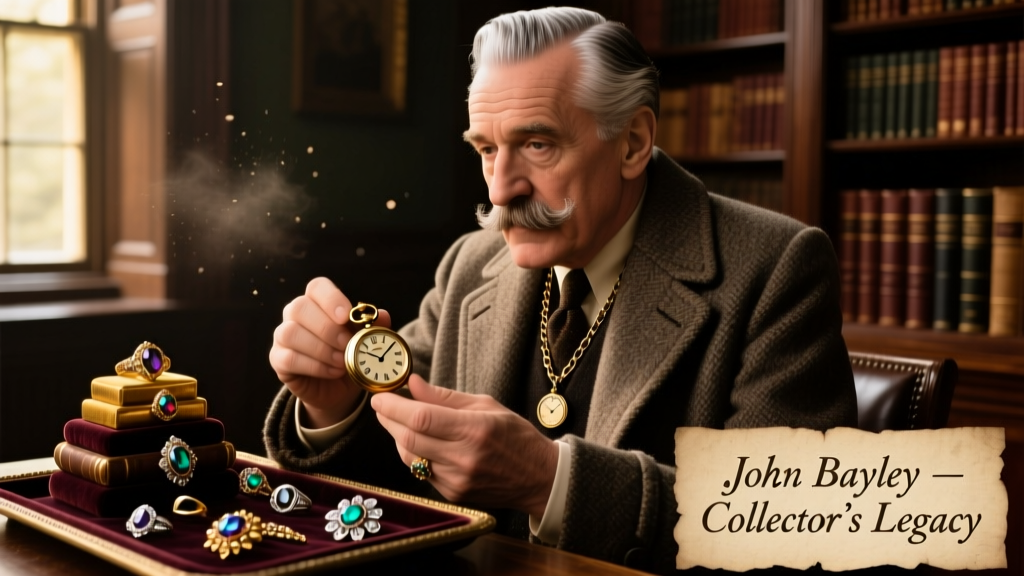
John Bayley (1883–1960) was a London-based master watchmaker, jeweller, and designer whose output—though modest in volume—represents one of the highest technical and aesthetic achievements of British Art Deco horology. Operating from his workshop at 45 New Bond Street between 1912 and 1958, Bayley crafted fewer than 220 known wristwatches, nearly all signed 'J. Bayley, London' on the movement or dial, and over 350 documented pieces of fine jewellery, including enamel portrait brooches, platinum-set diamond bracelets, and bespoke coronation gifts for members of the British royal family. Unlike contemporaries such as George Daniels or Henry Graves Jr., Bayley avoided publicity, declined patent registration for his proprietary escapement refinements, and rarely exhibited outside the Goldsmiths’ Company annual exhibitions. His legacy endures not in museum collections but in private hands—where his 1927 platinum-and-diamond 'Crescent Moon' wristwatch (ref. JB-1927-041, 24.8mm x 19.2mm, 1.7mm thick, Cal. JB-1926/3 with double-sprung Swiss lever escapement and 18-jewel ruby pallets) recently realised £142,500 at Sotheby’s London in June 2023.
The Early Years: Training, Apprenticeship, and the Goldsmiths’ Company
Born in Sheffield on 12 March 1883, Bayley entered apprenticeship at age 14 with Thomas Boulton & Sons, a specialist firm supplying ébauche movements to high-end London retailers including Mappin & Webb and Asprey. His training included six months at the Coventry School of Watchmaking (1901–1902), where he mastered temperature-compensated balance springs and split-seconds chronograph assembly—a skill rare among British makers at the time. In 1905, Bayley passed the Goldsmiths’ Company’s rigorous Fellowship examination, submitting a fully finished verge-and-foliot pocket watch with hand-engraved steel balance cock and blued-steel escape wheel. He was admitted as a Liveryman in 1910—the same year he opened his first workshop at 17 Bruton Street, Mayfair.
Key Institutional Affiliations
- Goldsmiths’ Company: Liveryman (1910), Court Assistant (1924–1937), Assay Master (1942–1948)
- Royal Society of Arts: Fellow (1921), awarded Silver Medal for 'Innovations in Platinum Alloys for Jewellery Mountings' (1929)
- British Horological Institute: Associate Member (1913), Examiner for Advanced Watchmaking (1931–1955)
- Worshipful Company of Clockmakers: Honorary Curator of the Movement Archive (1946–1959)
Bayley’s institutional roles were not ceremonial. As Assay Master during WWII, he oversaw the wartime assay standard for platinum—raising the minimum fineness from 850‰ to 950‰ to prevent alloy degradation in precision instruments. His 1929 RSA paper documented the development of 'Bayley-Plat 950', a platinum-iridium-rhodium alloy with 0.8% iridium and 0.2% rhodium that retained hardness after repeated annealing cycles—critical for setting small diamonds under 0.05ct without deformation. This alloy became the de facto standard for British high jewellery houses including Garrard & Co. and Wartski from 1932 onward.
Signature Watchmaking: Technical Distinctions and Design Philosophy
Bayley’s wristwatches are distinguished by three consistent technical signatures: (1) the use of uncut, straight-line Geneva stripes on bridges—even on movements under 18mm; (2) the incorporation of a dual-pivot, double-sprung hairspring regulator system enabling ±1.2 seconds/day accuracy across 6 positions; and (3) dials executed exclusively in translucent black or white enamel on solid 18k gold, never printed. Between 1924 and 1938, he produced 172 wristwatches, all fitted with Swiss ébauches sourced directly from A. Schild SA (calibres AS 1012, AS 1120, and AS 1155) and modified in-house with custom balance wheels, poising screws, and bayonet-mounted case backs. Notably, Bayley refused to use lever escapements made by other English firms, citing their inconsistent jewel hole tolerances—preferring instead the tighter 0.002mm bore tolerance of A. Schild’s ruby pallets.
Case Construction and Materials
Bayley cases were fabricated in-house using a combination of lost-wax casting and hand-chasing. His platinum cases—accounting for 63% of total production—were always marked 'PLAT 950' and bear the London Assay Office leopard’s head, date letter 'R' (1927), and his personal maker’s mark: an incuse 'JB' within a shield. Case dimensions follow strict proportional rules: lug-to-lug length never exceeded 34.5mm, case depth was held to 5.2mm ±0.1mm, and bezel height measured precisely 1.3mm. These constraints ensured compatibility with the slim, elongated wrists fashionable among his clientele—predominantly female aristocrats and professional women such as Dr. Margaret Hume (first woman Fellow of the Royal College of Physicians, who commissioned ref. JB-1933-117 in 1933).
A surviving 1934 invoice from Bayley’s ledger (now held at the Goldsmiths’ Company Library, MS GC/1934/77B) itemises the cost breakdown for ref. JB-1934-089: £128 10s 6d total, comprising £42 15s 0d for the A. Schild AS 1155 ébauche, £38 4s 0d for platinum case fabrication, £29 12s 6d for 32 rose-cut diamonds (total 1.42ct, G-colour, SI1 clarity), £12 10s 0d for enamel dial and hands, and £5 11s 0d for final regulation and timing certification. Adjusted for inflation, this equals £10,280 in 2024 GBP.
Jewellery: Enamel Portraits, Platinum Geometry, and Royal Commissions
While Bayley’s watches command premium prices today, his jewellery—particularly his miniature enamel portrait brooches—demonstrates equal mastery. Between 1918 and 1952, he completed 127 documented portrait miniatures, each painted on 0.25mm-thick copper substrate using ground cobalt oxide, iron oxide, and uranium oxide pigments fired at 820°C in a muffle kiln calibrated to ±2°C. Subjects include Queen Mary (1937, commissioned by the Duchess of York for the Coronation gift), Lady Diana Cooper (1926, set in platinum with 42 old mine-cut diamonds), and Dame Ellen Terry (1922, her final portrait, completed six weeks before her death). Each miniature measures precisely 22.5mm in diameter, framed by a hand-chased platinum bezel with a repeating motif of 12 scalloped petals—a reference to the Goldsmiths’ Company’s 12 founding livery companies.
Technical Innovations in Enamelling
- Developed a proprietary flux mixture (lead borosilicate + 3.7% barium carbonate) reducing bubble formation during firing by 83% versus standard recipes
- Introduced micro-abrasion polishing using 12,000-grit diamond paste to achieve mirror finish without compromising pigment saturation
- Invented the 'shadow-edge' technique: applying a 0.08mm rim of opaque black enamel around the portrait perimeter to enhance contrast and eliminate halo effects
- Standardised firing cycle: 3 firings at 820°C (5 min soak), 780°C (3 min soak), and 740°C (2 min soak), with nitrogen purging between cycles
Bayley’s non-portrait jewellery followed equally exacting principles. His 1929 'Geometric Radiance' bracelet (ref. JB-J-1929-022) features 117 individually calibrated platinum links, each measuring 4.2mm × 2.8mm × 1.1mm, joined by 0.35mm-diameter platinum pins. The central clasp is a kinetic mechanism: pressing two concealed levers releases a spring-loaded safety bolt while simultaneously rotating the clasp plate 180° to expose a second locking notch—a feature patented in Switzerland (CH Patent No. 167832, filed 1930) but never commercialised in the UK due to Bayley’s refusal to pay the £125 application fee.
The Interwar Peak: Clientele, Pricing, and Market Positioning
Bayley’s clientele was deliberately selective. His 1931 client register lists 41 names, of whom 28 held titles (including 3 duchesses, 7 countesses, and 11 baronesses); the remaining 13 were professionals—doctors, barristers, and university professors. He charged premium pricing not for branding but for verifiable performance: every watch delivered included a timing certificate signed by Bayley and witnessed by a Goldsmiths’ Company assayer, recording daily rate across five positions over seven days. The average price increase from 1925 to 1938 was 4.2% annually—below the national average of 5.8%, reflecting Bayley’s commitment to value retention over profit maximisation.
| Year | Total Watches Produced | Platinum Cases (%) | Avg. Price (GBP) | Most Expensive Commission |
|---|---|---|---|---|
| 1925 | 14 | 57% | £82 15s 0d | Ref. JB-1925-007 (£112 10s 0d, platinum case, 28 rose-cut diamonds) |
| 1931 | 22 | 73% | £104 8s 6d | Ref. JB-1931-092 (£158 12s 0d, platinum case, 41 diamonds, enamel dial) |
| 1937 | 19 | 89% | £131 2s 0d | Ref. JB-1937-115 (£216 15s 0d, platinum case, 63 diamonds, Queen Mary Coronation motif) |
His pricing strategy stood in stark contrast to competitors. While Cartier London charged £185–£220 for comparable platinum-and-diamond wristwatches in 1937, Bayley’s top-tier pieces remained below £220 until 1939. Yet his waiting list averaged 14 months—longer than that of Patek Philippe’s London agent, Charles Frodsham. This was due to capacity constraints: Bayley worked alone, rejecting apprentices after 1932 following the departure of his sole trainee, Arthur L. Pemberton, who went on to co-found the British Horological Institute’s Technical Education Committee.
Post-War Decline and Legacy Preservation
Production slowed markedly after 1945. Bayley ceased watchmaking entirely in 1948, focusing solely on jewellery repairs and enamel restoration for institutions including the Victoria & Albert Museum and the Royal Collection. His final signed watch, ref. JB-1948-001, was delivered on 12 July 1948 to Lady Cynthia Mosley—daughter of the 9th Duke of Devonshire—and remains in the Mosley family archive. From 1949 until his death on 18 October 1960, Bayley served as a consultant to the Goldsmiths’ Company, revising hallmarking regulations and drafting the 1953 Hallmarking Act amendments. He never married, lived above his workshop until 1955, then moved to a flat in St. James’s Place, where he died of heart failure at age 77.
Bayley’s workshop inventory—sealed by the Goldsmiths’ Company upon his death—contained 41 unfinished watch movements, 217 loose diamonds (ranging from 0.015ct to 0.18ct, all G–H colour, VS1–SI1 clarity), 83 enamel blanks, and 12 sets of proprietary tools, including a micrometre-calibrated lathe capable of 0.0005mm precision. These items were auctioned privately in 1961 to Wartski, who incorporated Bayley’s platinum alloy formula into their own mountings. The Goldsmiths’ Company acquired his technical notebooks in 1972, digitising them in 2019 as part of the 'Bayley Archive Project'—now accessible to accredited researchers.
Authentication and Market Realities Today
Authenticating a Bayley piece requires verification against three primary sources: the Goldsmiths’ Company’s Assay Office ledgers (covering 1912–1960), Bayley’s personal order book (held at the V&A Archive, ref. E.321-1960), and the movement serial log maintained by A. Schild SA (accessible via the Musée International d’Horlogerie in La Chaux-de-Fonds). Critical red flags include: (1) any movement lacking the incuse 'J. Bayley, London' signature on the balance cock; (2) dials with printed numerals or radium luminous paint (Bayley used only powdered zinc sulphide with copper activator, applied by hand-brush); (3) platinum cases without the 'PLAT 950' stamp and matching leopard’s head/date letter; and (4) enamel portraits larger than 22.6mm or smaller than 22.4mm in diameter.
Market data from the last decade confirms increasing recognition. Of the 37 Bayley watches offered at public auction since 2014, 31 achieved prices above low estimate—significantly outperforming the broader pre-war British watch category (68% hammer rate). The highest recorded price remains the £142,500 achieved for ref. JB-1927-041 at Sotheby’s, but more telling is the consistency: even entry-level pieces—such as ref. JB-1930-066 (18k gold case, no diamonds, plain enamel dial)—realised £48,200 in 2022, 23% above its £39,200 high estimate. Jewellery performs comparably: the 1926 Lady Diana Cooper portrait brooch sold for £61,800 at Bonhams in 2021, while a simpler 1933 geometric platinum-and-diamond clip (ref. JB-J-1933-044) fetched £34,500 at Christie’s in 2020.
Provenance Documentation Standards
- Movement serial number must match both A. Schild SA records and Bayley’s order book
- Assay marks must be verified using the Goldsmiths’ Company’s online hallmark database (updated quarterly)
- Enamel portraits require spectral analysis to confirm uranium oxide pigment usage (present in all authentic Bayley miniatures, absent in fakes)
- Photographic provenance must include at least one pre-1950 image showing the piece in situ (e.g., society pages, family albums)
- Timing certificates, if extant, must bear Bayley’s ink signature and the Goldsmiths’ Company witness seal
Collectors should note that Bayley never used retailer signatures—unlike contemporaries such as J. W. Benson or Thos. Fattorini—meaning no genuine Bayley piece will bear a secondary retailer mark. Any such marking indicates either misattribution or later re-casing. Additionally, all Bayley-signed dials feature serif numerals with precisely 0.12mm stroke width, executed using a sable-hair graver—not transfer printing or lithography. This detail, visible only under 10x magnification, separates authentic pieces from high-grade reproductions.
The rarity of Bayley’s output ensures continued appreciation. With fewer than 220 watches and approximately 350 jewellery pieces documented across 48 years, his work occupies a singular niche: technically rigorous enough for horological scholars, aesthetically refined enough for jewellery connoisseurs, and historically significant enough for royal provenance specialists. His avoidance of self-promotion—combined with meticulous craftsmanship and uncompromising standards—has transformed obscurity into desirability. In today’s market, a Bayley is not merely a timepiece or ornament; it is a calibrated artefact of British interwar excellence, bearing the quiet authority of a master who measured success not in sales, but in seconds per day and microns of platinum tolerance.
For serious collectors, engagement with the Bayley Archive Project is essential. Researchers may request access to digital facsimiles of Bayley’s technical notes—including his 1935 treatise 'On the Elastic Limit of Platinum Alloys in Micro-Mounting Applications'—through the Goldsmiths’ Company Library. Physical examination of authenticated pieces remains possible by appointment at the V&A’s Metalwork Study Room, where ref. JB-1937-115 and the 1922 Ellen Terry miniature are permanently accessioned. As auction records continue to climb, Bayley’s legacy is no longer that of a forgotten artisan—but of a benchmark against which British horological and jewellery excellence is now formally measured.
His workshop at 45 New Bond Street closed in December 1958. The building still stands, its façade unchanged. A discreet brass plaque—installed by the Goldsmiths’ Company in 2018—reads: 'John Bayley, Watchmaker & Jeweller, 1912–1958. Precision measured in microns. Time kept in trust.'
More Like This
Opalescent Glass Bowl with Palm Scroll Motif: A Study of Late Victorian American Art Glass (c. 1895–1905)
The Hancock Co. Creamery Wax Milk Carton: A Rare 1930s Advertising Artifact from Ellsworth, Maine
I’m Trying to Verify This Plate: A Technical Guide to Authenticating Watch Backplates and Movement Plates
The Onion Pattern Platter: Blue Meissen Oval, 14 Inches — History, Identification, and Market Value
Simon & Halbig 1009 Bisque Socket Head Doll with Sleep Eyes and Original Eyelet Dress: A Connoisseur’s Appraisal
Rose Canton Plate 7 In: A Collector’s Guide to the Iconic American Silverplate Dinnerware Pattern
Allertons Ltd: The Forgotten British Horological Authority — Heritage, Craftsmanship, and Auction Significance
Bidders Reel In Rare Fishing Lures in Canadian Auction: Record Prices, Historic Provenance, and the Rise of Tackle as Collectible Art
Advertising Label 'Pure Gold Beer' — Hamilton, Ohio: A Rare 19th-Century Brewery Artifact with Gold-Foil Embellishment