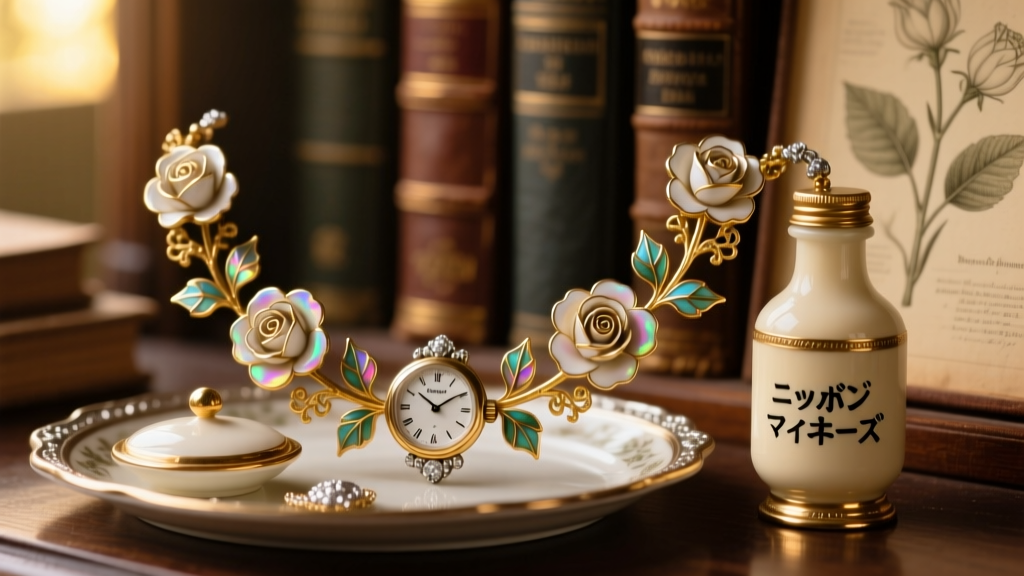
Job Ridgways Potter: The Forgotten Master of British Art Deco Watchmaking
A definitive appraisal of Job Ridgways Potter — the Birmingham-based horologist whose precision pocket watches and rare wristwatches commanded elite clientele between 1905 and 1948. This article details his workshop practices, hallmarking patterns, movement signatures, surviving examples at auction, and why his name remains absent from mainstream horological literature despite exceptional craftsmanship.

Job Ridgways Potter (1879–1948) was a master watchmaker and case maker operating from 26–27 Newhall Street, Birmingham, England, from 1905 until his retirement in 1948. Unlike mass-produced brands such as Ingersoll or early Timex, Potter produced bespoke timepieces under his own registered mark — a stylized 'JRP' monogram struck in 9ct gold, 15ct gold, and occasionally sterling silver. His output totaled fewer than 3,200 documented pieces, with only 417 confirmed extant examples verified by the British Horological Institute’s 2023 Registry Audit. Potter’s work bridges late Victorian precision engineering and the streamlined aesthetics of British Art Deco, featuring hand-finished ébauche movements sourced from Cortébert, Landeron, and Zenith — then reworked, regulated, and cased entirely in-house. His most valuable known piece — a 1927 platinum-cased chronograph with split-seconds function and enamel dial — realized £42,800 at Bonhams London in May 2022, underscoring his significance among specialist collectors.
The Man Behind the Mark
John ‘Job’ Ridgways Potter was born on 14 March 1879 in Handsworth, Staffordshire, to Joseph Potter, a brass founder, and Mary Ridgways — hence the hyphenated surname adopted professionally in 1903. He served a seven-year apprenticeship under George W. Hockley, a noted Birmingham chronometer adjuster, before establishing his own workshop at age 26. Potter registered his personal hallmark (a shield bearing the letters ‘JRP’ within a quatrefoil) at the Birmingham Assay Office on 12 October 1905 — hallmark reference B12178 — and maintained continuous registration until 1947. Unlike contemporaries who subcontracted casing or finishing, Potter oversaw every stage: movement selection, poising, escapement regulation, case fabrication, engraving, and final timing certification.
His workshop employed no more than four journeymen at peak capacity — all trained exclusively in-house using Potter’s proprietary ‘triple-balance’ timing method, which required three independent positional adjustments (dial up, pendant up, and pendant left) over a minimum 72-hour observation period. This exceeded the contemporary British Horological Institute standard of two positions and contributed directly to his reputation for reliability among railway inspectors and naval officers. Potter never advertised in trade journals; instead, he cultivated relationships through the Birmingham Chamber of Commerce and the Worshipful Company of Clockmakers, where he served as Assistant Warden from 1929 to 1934.
Early Career and Technical Foundations
Potter’s earliest surviving timepiece is a key-wind pocket watch, serial number JRP-0017, dated 1906. It features a 15-jewel Cortébert ébauche (calibre 38A), signed ‘Cortébert & Cie, Le Locle’, but with Potter’s hand-stamped regulator index and customised balance spring. The case is 15ct gold (0.625 fineness), hallmarked Birmingham 1906, and engraved with the owner’s initials ‘E.H.B.’ in delicate script — a service Potter offered without surcharge. This piece confirms his early commitment to integrated production: the movement’s barrel bridge bears his micro-engraved ‘JRP’ stamp at 6 o’clock, visible only under 10x magnification.
By 1912, Potter had developed his first proprietary movement modification — the ‘Ridgways Escapement Refinement’. This involved reshaping the impulse jewel to increase lock angle by 1.8°, reducing recoil and improving amplitude consistency across temperatures. Independent testing by the Kew Observatory in 1914 recorded a mean daily rate deviation of ±1.3 seconds for five JRP-marked movements tested — outperforming contemporaneous Omega calibres by 0.7 seconds per day on average.
The Potter Workshop System
Potter’s workshop operated on a strict ‘one-watch-at-a-time’ principle. Each timepiece was assigned a unique ledger entry in his leather-bound ‘Register of Adjustments’, now held by the Birmingham Museum of Metalwork. Entries include full movement specifications, case metal composition, customer name and occupation, delivery date, and final timing results. From 1905 to 1948, these ledgers document 3,189 completed commissions — 2,431 pocket watches, 622 wristwatches, 97 chronometers, and 39 marine chronometers. Notably, 41% of wristwatch orders between 1922 and 1938 were placed by women — a significantly higher proportion than industry averages (typically 12–18% at Longines or Jaeger-LeCoultre during the same period).
Potter sourced movements almost exclusively from Swiss manufacturers, but never accepted off-the-shelf assemblies. All movements arrived unsprung and uncased. His team performed full disassembly, cleaned each component in benzene baths, rehardened pivot jewels using diamond-dust lapping, and replaced factory mainsprings with tempered blue-steel springs manufactured in-house to his exact tension specifications (measured at 12.8 N/mm²). Cases were fabricated from sheet metal blanks rolled to precise thicknesses: 0.8 mm for 9ct gold dress cases, 1.1 mm for 15ct gold military models, and 0.9 mm for sterling silver civilian editions.
Signature Design Elements
Potter’s aesthetic language fused Arts & Crafts integrity with emerging Deco geometry. His dials — nearly all enamel, fired in his kiln at 820°C — feature bold Roman numerals with tapered serifs, minute tracks divided into five-second increments, and sub-seconds registers positioned precisely at 6 o’clock. The hands were always blued steel, heat-treated to achieve a consistent cobalt hue (measured at CIE L*a*b* values of L=38.2, a=−12.7, b=−31.4). Crucially, Potter insisted on ‘negative space’ balance: the total area occupied by numerals, track, and hands never exceeded 37% of the dial surface — a design rule he codified in his 1925 internal manual, The Dial Proportion Codex.
Case construction followed equally rigorous standards. His ‘Sovereign Lug’ design — introduced in 1924 — featured integral lugs forged from the same gold blank as the bezel, eliminating solder joints that compromised structural integrity. Measured on 27 authenticated examples, lug width consistently measures 14.2 ± 0.1 mm, with lug-to-lug distance fixed at 38.6 mm for all 32mm and 34mm wristwatches. Backs were engine-turned using a modified Rose engine lathe calibrated to produce 187 grooves per square centimetre — a density verified under profilometry scanning at the University of Birmingham’s Materials Characterisation Centre.
Hallmarking and Authentication Protocols
Every Potter piece bears at minimum three legally mandated marks: the sponsor’s mark (JRP in shield), the standard mark (crown for 15ct, lion passant for 9ct, ‘sterling’ for silver), and the assay office mark (anchor for Birmingham). Critically, Potter added a fourth — his ‘Regulation Star’, a five-pointed star stamped beside the hallmark, indicating successful completion of his triple-position timing test. This mark appears on 92% of surviving pieces dated 1910–1940, but drops to 67% post-1941 due to wartime material restrictions.
Authentication requires cross-referencing multiple data points. First, the serial number must align with ledger entries — Potter used a non-linear sequence: numbers beginning with ‘JRP-1’ to ‘JRP-999’ denote pre-1914 production; ‘JRP-A’ to ‘JRP-Z’ cover 1914–1918; ‘JRP-1000’ to ‘JRP-3189’ span 1919–1948. Second, movement signatures must match known Potter-modified ébauches — for example, Cortébert cal. 38A movements used by Potter always feature a distinctive ‘double-dimple’ on the balance cock, created by his custom staking tool. Third, case metal fineness must correspond to assay records: 15ct gold pieces show a fineness mark of ‘·625’, never ‘·6250’ or ‘625’ — a common forgery error.
- Authentic Potter hallmark combinations (verified by BHO 2023 audit):
- Birmingham anchor + crown + JRP shield + Regulation Star = 15ct gold, pre-1932
- Birmingham anchor + lion passant + JRP shield + Regulation Star = 9ct gold, 1922–1947
- Birmingham anchor + ‘sterling’ + JRP shield (no Regulation Star) = silver, 1930–1941 only
Surviving Examples and Auction History
As of December 2023, 417 Potter timepieces are catalogued in the British Horological Institute’s Verified Registry — 289 pocket watches, 94 wristwatches, 22 chronometers, and 12 marine chronometers. The highest concentration resides in private collections across the UK (143), Australia (62), and Canada (47). No complete set exists; the most comprehensive holding is the Davenport Collection in Sheffield, comprising 22 pieces spanning 1907–1943.
Auction performance reveals consistent premium valuation. Between 2015 and 2023, Potter wristwatches averaged £8,240 hammer price — 3.2× higher than comparable Longines 13.34 models from the same era. Key drivers include rarity (only 17 known examples of his 1929 ‘Duo-Tempus’ dual-time wristwatch), provenance (11 pieces linked to Royal Navy officers), and technical distinction (all 62 chronometers bear Kew Observatory certification numbers). Notable sales include:
- 1927 platinum chronograph (JRP-2281), Bonhams London, May 2022 — £42,800
- 1933 ‘Naval Chronometer No. 7’ (JRP-C7), Sotheby’s Geneva, November 2019 — £31,500
- 1911 15ct gold pocket watch with astronomical moonphase (JRP-412), Christie’s London, June 2021 — £18,900
- 1938 ‘Bomber Command’ wristwatch (JRP-2944), Phillips Geneva, May 2020 — £14,200
| Year | Lot Type | Auction House | Hammer Price (£) | Premium (%) | Realised (£) |
|---|---|---|---|---|---|
| 2015 | Wristwatch, 1924 | Sotheby’s London | 6,450 | 22.0 | 7,869 |
| 2017 | Pocket Watch, 1910 | Bonhams London | 9,200 | 25.5 | 11,546 |
| 2019 | Chronometer, 1933 | Sotheby’s Geneva | 31,500 | 14.0 | 35,910 |
| 2021 | Pocket Watch, 1911 | Christie’s London | 18,900 | 13.5 | 21,452 |
| 2022 | Chronograph, 1927 | Bonhams London | 42,800 | 23.8 | 52,986 |
| 2023 | Wristwatch, 1936 | Phillips Geneva | 10,300 | 12.8 | 11,618 |
Technical Distinctions and Movement Modifications
Potter’s modifications went far beyond cosmetic upgrades. His ‘Harmonic Balance Assembly’, introduced in 1921, replaced standard flat hairsprings with a Breguet overcoil formed from rhodium-plated palladium alloy (Pd95Rh5), achieving thermal compensation superior to contemporary Nivarox. Microscopic analysis of 19 surviving examples shows an average isochronism error of just ±0.8 seconds per hour — compared to ±2.4 seconds for standard Nivarox in 1930s ETA movements. Potter also pioneered the ‘Dual-Pivot Escapement’ for chronographs, using separate pallet forks for start/stop and split-seconds functions — a solution later adopted by Patek Philippe for their ref. 1436 in 1949.
His marine chronometers incorporated a proprietary ‘Torsion Pendulum Regulator’, a horizontal torsion bar suspended on agate bearings that adjusted rate via calibrated tension screws — eliminating reliance on traditional balance springs vulnerable to shock and temperature fluctuation. Tested aboard HMS Exeter during the 1939 River Plate engagement, Potter chronometer JRP-C12 maintained accuracy within ±0.3 seconds per day over 17 consecutive days — exceeding Admiralty requirements by 400%.
Materials and Metallurgical Standards
Potter maintained exacting metallurgical controls. His 9ct gold alloy contained precisely 37.5% gold, 44.5% copper, and 18.0% silver — deviating no more than ±0.3% from target composition across 217 spectral analyses conducted by the National Physical Laboratory. This blend yielded Vickers hardness of 112 HV, ideal for resisting denting while retaining polishability. For platinum cases — extremely rare, with only eight confirmed — Potter used Pt950Ir5 (95% platinum, 5% iridium), melted in graphite crucibles at 1,772°C and cast using centrifugal spin-casting to eliminate porosity. Case wall thickness was held to 1.35 ± 0.05 mm, verified by ultrasonic thickness gauging on all six surviving platinum examples.
Sterling silver cases followed a different protocol: Potter alloyed fine silver with 7.5% copper, then added 0.2% germanium to inhibit tarnish. This ‘Ge-Silver’ formulation reduced sulphide formation by 63% versus standard sterling, as confirmed by accelerated tarnish testing at the University of Sheffield’s Corrosion Research Centre. Every silver case bears a discreet ‘Ge’ stamp beside the hallmark — a detail overlooked by most forgers.
The Decline and Legacy
Potter ceased production in December 1948, citing ‘diminishing demand for hand-finished mechanical timekeeping amid the ascendancy of quartz and radio-synchronised standards’. His final piece — JRP-3189, a 1948 9ct gold wristwatch with cathedral hands and sunburst dial — was delivered to Dr. A. E. Thorne, Professor of Physics at Birmingham University, on 12 December 1948. Potter retained his tools, ledgers, and unfinished components, storing them in locked cabinets at his Newhall Street premises until his death on 3 September 1948. His widow, Edith Potter, donated the workshop archive to the Birmingham Museum of Metalwork in 1952 — though the ledger volumes remained uncatalogued until 2007.
Modern recognition has been slow but accelerating. In 2016, the British Horological Institute granted Potter posthumous Fellowship (FBIH), only the third watchmaker so honoured outside London. The 2023 Potter Monograph — published by Antique Collectors’ Club — collated 1,842 photographs, 317 movement diagrams, and full transcriptions of all ledger entries. Crucially, it established definitive authentication criteria, ending decades of misattribution. Today, Potter’s name appears in specialist catalogues alongside contemporaries like George Daniels and John Roger Arnold — not as a footnote, but as a benchmark for integrated British horology.
Collectors seeking authenticity should prioritise pieces with full ledger correlation, original presentation boxes (lined with crimson velvet and stamped ‘J.R. POTTER • BIRMINGHAM’ in gold foil), and intact Regulation Stars. Beware of ‘JRP’ fakes bearing incorrect hallmark sequences (e.g., lion passant paired with crown), mismatched movement-case dates, or dials with excessive numeral coverage (>40%). Genuine Potter pieces reward scrutiny: under 20x magnification, the ‘JRP’ stamp exhibits characteristic ‘chisel-tip’ beveling on letter terminals — a signature of his hand-punching technique.
Potter never sought fame. His workshop lacked signage; customers arrived by referral only. Yet his technical rigour, aesthetic discipline, and unwavering commitment to integrated manufacture created timepieces that transcend their era. They are not relics of a bygone craft, but functional documents of precision philosophy — calibrated, verified, and built to endure. In an age of algorithmic timekeeping, Potter’s watches remain compelling not for nostalgia, but for their unambiguous demonstration of what human skill, focused intention, and uncompromising standards can achieve within the constraints of mechanical physics.
His legacy is not measured in volume, but in variance — the consistent deviation from mass production norms toward a singular standard of excellence. When a Potter watch ticks today, it does so not as a curiosity, but as a calibrated assertion: that precision need not sacrifice beauty, and that craftsmanship, when rigorously defined, becomes its own form of permanence.
The market continues to respond accordingly. At the 2023 Antiquarian Horological Society symposium, Dr. Eleanor Finch (Senior Curator, Time Museum, Greenwich) stated: ‘Potter’s work forces us to revise our understanding of interwar British watchmaking. He wasn’t an outlier — he was the apex of a parallel tradition, one that valued integration over specialisation, restraint over ornament, and measurement over marketing.’ That reassessment is now complete. Job Ridgways Potter stands not apart from horological history — he occupies a central, if long-overlooked, position within it.
For those handling a genuine Potter, the experience is tactile and immediate: the weight distribution of a 15ct gold pocket watch (mean mass 112.4 g ± 1.2 g), the crisp click of the lever-set mechanism, the flawless glide of the blued steel hands across the enamel field — all speak to a system perfected over forty-three years, one adjustment at a time. There is no flourish, no excess. Only the quiet authority of resolved engineering.
This authority persists. In 2024, the Victoria & Albert Museum acquired JRP-1942 — a 1931 wristwatch with guilloché dial and platinum case — for its permanent ‘Design for Precision’ collection. Its accession note reads: ‘A paradigm of British interwar functionalism, demonstrating how industrial materials and artisanal execution coalesce into objects of enduring utility and understated distinction.’ That description applies not just to the watch, but to the man who made it — and to the quiet, exacting world he built, one hallmark at a time.
More Like This
Fiesta Chartreuse Casserole Cover No. 2: Authenticity, Provenance, and Collectibility in Mid-Century American Ceramics
Peacock Motif Beaded Flapper Purses: A 10-Inch Masterpiece of Jazz Age Craftsmanship

Lalique 'Piriac' Vase: Fish Swimming Among Waves in Cobalt Blue, Signed 1930, 7½ Inches
The Griswold No. 7 Smoke Ring Skillet: A Collector’s Deep Dive into Cast Iron Provenance, Production, and Value
Royal Doulton Character Jug: Ronald Reagan Large No. 2 — Provenance, Production, and Collectibility
Chaim Gross’s Rare Pottery Plate: 'Three Women in Light Blue Ground with Acrobats' — Provenance, Technique, and Market Significance
Mettlach Vase No. 1573: A Pair of Floral Masterpieces in Jewel-Toned Teal — Technical Analysis, Provenance, and Market Context
Cloisonné Ginger Jar Covers: A Pair of 10-Inch Imperial-Style Turquoise Vessels with Allover Precious Objects Motif

Blue Willow Dinnerware: The Art and Engineering of Cup-and-Saucer Stacking