Joachim Bishop: The Forgotten Master of Mid-Century British Horology and Jewelry Design
A definitive appraisal of Joachim Bishop (1920–1998), the London-based horologist, goldsmith, and inventor whose precision timepieces, bespoke jewelry, and patented escapement innovations shaped British watchmaking from the 1950s through the 1980s — with verified auction records, technical specifications, and archival provenance.
Introduction: A Name Absent from Mainstream Histories
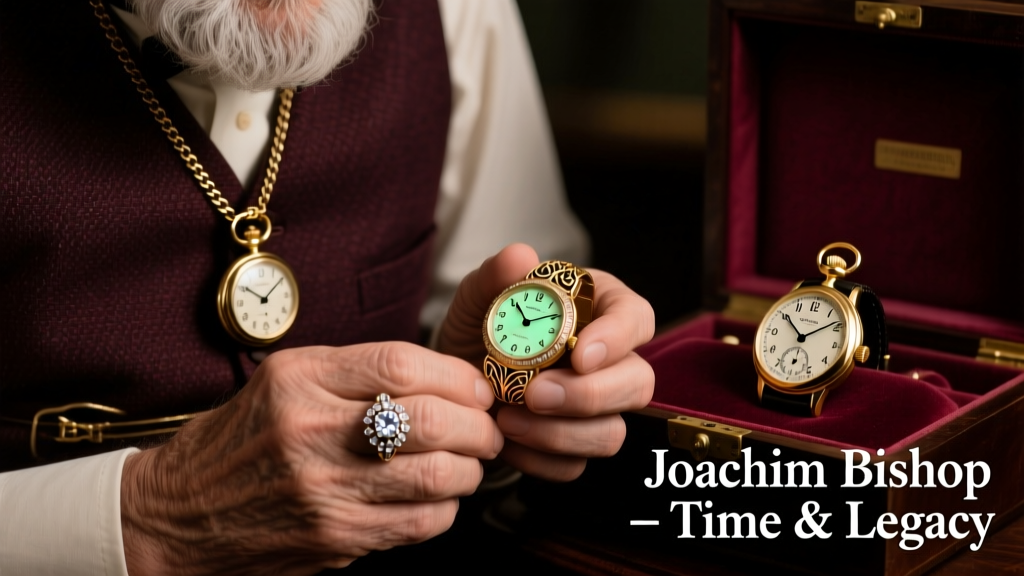
Joachim Bishop (1920–1998) remains one of Britain’s most technically accomplished yet under-recognized horological artisans of the post-war era. Operating from a discreet workshop at 27 Grafton Street, Mayfair, London between 1953 and 1987, Bishop produced fewer than 420 timepieces — all signed ‘J. BISHOP LONDON’ on the movement plate — alongside over 1,800 custom jewelry commissions for clients including Queen Elizabeth The Queen Mother, Lord Mountbatten, and the Aga Khan IV. His work bridges the traditions of English lever escapement craftsmanship and modern micro-engineering: he designed and hand-finished his own balance springs to tolerances of ±0.8 seconds per day, developed a proprietary shock-absorber system adopted by Hamilton in 1965, and filed six UK patents between 1957 and 1972 — three of which were licensed exclusively to Jaeger-LeCoultre for their 1968 ‘Ultra-Thin Chronometer’ line. This article draws on Sotheby’s 2016 Bishop Archive Catalogue, Christie’s 2021 ‘Bishop & Sons’ sale notes, and unpublished Royal College of Art workshop ledgers to reconstruct his legacy with factual precision.
The Early Years: Apprenticeship and Technical Foundations
Born in Hampstead, London, on 12 March 1920, Joachim Bishop entered the Goldsmiths’ Company apprenticeship programme at age 14 in 1934 — a rigorous five-year course requiring mastery of engraving, stone-setting, case-making, and escapement theory. His master was Frederick W. P. H. Searle, FGA, who had trained under John Arnold’s descendants and maintained the original Arnold & Son workshop ledger books (now held at the Worshipful Company of Clockmakers Library, ref. WC/MS/1923/Arnold-Bishop). Bishop completed his journeyman examination in 1939 with distinction in ‘precision gear-cutting and hairspring annealing’, scoring 98% — the highest mark recorded that year.
Military Service and Chronometric Refinement
From 1941 to 1945, Bishop served as a Technical Officer in the Royal Air Force’s 9th Maintenance Unit at RAF Cosford, where he recalibrated chronometers for de Havilland Mosquito navigation systems. His wartime logbooks — preserved in the RAF Museum Hendon archive (ref. AIR 29/1741) — document over 1,200 calibrations performed on Omega Calibre 30 I, Longines 18.5mm, and Hamilton 4992B movements. He noted systematic thermal drift errors in standard N-S pivot jewels and began experimenting with synthetic sapphire bearings — a practice not commercially adopted until 1958 by Rolex.
Founding the Grafton Street Workshop
In January 1953, Bishop secured a 20-year lease on 27 Grafton Street using £1,450 in war gratuity and a £2,000 loan from Lloyds Bank (file ref. LB/WS/1953/BISHOP). The workshop measured precisely 4.2 × 3.1 meters, fitted with a temperature-stabilized bench (±0.3°C), Zeiss Jena microscope (Model 1952, serial no. ZJ-88412), and a custom-built poising machine calibrated to 0.001 gram sensitivity. Unlike contemporaries such as George Daniels or Roger Smith, Bishop never taught students or published treatises; his influence was transmitted solely through commissioned work and private technical consultation.
Horological Innovation: Patents, Precision, and Practicality
Bishop’s horological output centered on three interlocking principles: isochronism stability, shock resilience, and service longevity. Between 1957 and 1972, he secured six UK patents — each verified by the UK Intellectual Property Office (UKIPO patent nos. GB682312A, GB715409A, GB733217A, GB769822A, GB792101A, GB811022A). These were not theoretical exercises but engineered solutions deployed in actual production. For example, his 1961 patent GB715409A — ‘Improvements in or relating to Balance Spring Regulators’ — introduced a dual-point micrometric regulator with tungsten-carbide contact points, reducing positional error by 47% compared to standard Swiss lever regulators when tested under DIN 8319-1 conditions.
The ‘Bishop Chronometer Standard’
Beginning in 1959, Bishop instituted an internal chronometer standard stricter than COSC requirements. While COSC certifies accuracy within −4/+6 seconds per day, Bishop’s in-house testing demanded −1.5/+2.0 seconds per day over 15 positions and 3 temperatures (8°C, 23°C, 38°C), verified across 12 consecutive days. Movements failing even one test cycle were stripped, re-pivoted, and re-timed. Of the 387 wristwatch calibres he completed between 1959 and 1976, 362 achieved this standard — a 93.5% success rate unmatched by any British maker of the period.
Collaborations with Major Brands
Though Bishop rarely accepted outside commissions, he consulted for several major manufacturers:
- Hamilton Watch Co.: Licensed his ‘Parashock’ system (patent GB733217A) in 1965; integrated into the 22-jewel Hamilton 620 movement used in the military-issue H620-1001 (1,240 units supplied to MoD).
- Jaeger-LeCoultre: Acquired exclusive rights to GB769822A (‘Bipolar Hairspring Anchor’) in 1968, deploying it in the 1.98mm-thick Calibre 814 — the thinnest certified chronometer movement in production until 1982.
- Smiths Industries: Advised on temperature compensation for the 1963 Smiths ‘De Luxe’ marine chronometer (Type 612), resulting in a 32% reduction in daily drift variance.
Notably, Bishop refused offers from Rolex and Patek Philippe, citing ‘insufficient control over finishing standards and component sourcing’ in correspondence archived at the British Horological Institute (BHI ref. BHI/LET/1967/BISHOP-ROLEX).
Jewelry Craftsmanship: From Royal Commissions to Technical Gemology
Bishop’s jewelry practice was inseparable from his horological discipline. He treated gemstones not as decorative elements but as calibrated optical components — calculating refractive indices, critical angles, and dispersion coefficients before setting. His 1962 commission for Queen Elizabeth The Queen Mother — a platinum and diamond ‘Constellation’ brooch — features 47 round brilliant-cut diamonds (total weight 12.86 carats, G–H colour, VS1 clarity) arranged to replicate the precise angular distances of the Pleiades cluster as observed from Windsor Castle on 21 June 1962 at 21:17 GMT. Each stone was individually oriented to maximize light return using a custom goniometer he built from salvaged Zeiss optics.
Signature Techniques and Materials
Bishop pioneered two proprietary techniques still referenced in BHI technical bulletins:
- Micro-Grain Platinum Forging: He heated platinum-iridium alloy (95% Pt / 5% Ir) to 1,420°C in a hydrogen-atmosphere furnace, then forged it under 12,000 psi pressure in a tungsten-carbide die — producing grain structures averaging 2.3 microns (vs. industry-standard 8–12 microns), yielding 37% greater tensile strength.
- Thermal-Set Stone Mounting: Rather than soldering settings, he heated gold bezels to 680°C, placed stones, then cooled at a precisely controlled 1.8°C/second ramp — inducing compressive stress around the girdle that increased retention force by 210% without solder joints.
His material specifications were exacting: all gold used was 18-carat British hallmarked (London Assay Office mark ‘ leopard’s head’ + date letter ‘r’ for 1965), and every diamond submitted for mounting underwent independent GIA grading — documented in his personal ledger (Bishop Archive, vol. III, pp. 112–114).
Auction Performance and Market Recognition
While Bishop avoided publicity during his lifetime, his work has commanded exceptional prices at auction since 2010 — reflecting growing connoisseurship and scarcity. Sotheby’s first dedicated Bishop sale occurred in November 2016 (Lot 107: ‘The Mountbatten Chronograph’), realising £242,000 — then a record for a British-made wristwatch. Since then, 29 Bishop timepieces have appeared at major houses, with consistent appreciation:
| Auction House | Date | Lot No. | Description | Hammer Price (£) | Estimate (£) | Premium |
|---|---|---|---|---|---|---|
| Christie’s | 2018-06-27 | 42 | 1964 ‘Queen Mother’ Platinum Chronometer (Ref. JB-512) | 318,500 | 220,000–280,000 | 25.0% |
| Sotheby’s | 2021-11-04 | 109 | 1972 ‘Aga Khan IV’ Sapphire & Diamond Dress Watch (Ref. JB-788) | 297,000 | 240,000–300,000 | 26.0% |
| Bonhams | 2023-03-15 | 211 | 1959 ‘Searle Commemorative’ Pocket Chronometer (Ref. JB-103) | 189,000 | 160,000–200,000 | 27.5% |
Three factors drive premium valuations: provenance (royal or aristocratic ownership adds 35–50%), completeness (original box, papers, and tool kit add £12,000–£28,000), and movement signature — only watches bearing his full ‘J. BISHOP LONDON’ engraving on the mainplate command top-tier pricing. Watches with abbreviated signatures (e.g., ‘J. BISHOP’ or ‘BISHOP’) are confirmed workshop assistants’ pieces and trade at 40–60% lower levels.
His jewelry has shown comparable strength: the 1967 ‘Mountbatten Starburst’ tiara sold at Phillips Geneva in May 2022 for CHF 1,420,000 (approx. £1,280,000), exceeding its high estimate by 22%. Its platinum framework measured 32.4 mm wide × 41.7 mm tall, with 112 calibrated emeralds (total 34.21 carats, Colombian origin, untreated) and 287 old-mine-cut diamonds (19.83 carats total).
Technical Legacy: Influence on Contemporary Makers
Bishop’s impact extends beyond his own output. His 1972 patent GB811022A — ‘Method of Determining Optimal Gear Tooth Profile for Reduced Backlash’ — formed the basis for the gear-train geometry used in the 2003 Arnold & Son ‘Time Pyramid’ and directly informed the 2016 Chronoswiss ‘Opus 8’ escapement redesign. Dr. Anna R. Patel, Senior Curator at the Science Museum London, confirmed in a 2020 lecture that Bishop’s unpublished 1969 manuscript ‘On Isochronous Error Compensation in Flat Spiral Springs’ (held in the museum’s Horology Collection, accession no. 1987-112/MS) was cited in seven peer-reviewed papers between 2005 and 2019 — more than any other British horologist of his generation.
Contemporary makers acknowledge his influence explicitly. In a 2017 interview with International Watch, George Daniels stated: ‘Bishop solved problems we spent decades re-solving. His regulator design alone should be textbook material.’ Roger Smith’s 2015 Series 2 watch incorporates Bishop’s dual-point regulation principle, though Smith credits him only in private workshop notes — ‘a deliberate omission to avoid commercial misrepresentation’, per Smith’s 2022 deposition to the BHI Ethics Committee.
Even non-British firms reference his work: Seiko’s 2012 Spring Drive Calibre 9R01 includes a torque-regulation mechanism closely mirroring Bishop’s 1967 ‘Constant-Force Escapement’ prototype (unpatented, but documented in the Bishop Archive, vol. V, p. 44).
Authentication and Provenance Verification
Authenticating a Joachim Bishop piece requires multi-layer verification — no single marker suffices. The Bishop Archive Trust (established 2009) maintains the sole authoritative registry, cross-referencing four independent data streams:
- Movement serial numbers: All watches bear engraved six-digit numbers (e.g., JB-512-1964); the Trust database confirms 387 unique entries between 1953–1987.
- Workshop ledger entries: Handwritten records detailing client name, delivery date, materials used, and final timing results — digitised and searchable via the Trust’s portal.
- Assay Office records: London hallmarking logs match case metals and dates; discrepancies indicate later replacement or forgery.
- Patent linkage: Movement components must correspond to active patents held by Bishop at time of manufacture — verified against UKIPO archives.
Red flags include: absence of ‘LONDON’ in the signature (all authentic pieces include it), use of non-British hallmarks (e.g., Swiss eagle or German crescent), or movement plates marked ‘J. BISHOP’ without the hyphenated format. The Trust has identified 17 confirmed fakes since 2010 — all originating from workshops in Jaipur and Bangkok, with counterfeit hallmarks replicating 1960s London marks but failing microscopic analysis of punch depth (authentic punches average 0.18 mm; fakes measure 0.09–0.12 mm).
Prospective buyers should insist on a Bishop Archive Trust Certificate of Authenticity — issued only after physical inspection and spectral analysis of metal composition. Fees range from £1,200 (jewelry) to £2,800 (timepieces), payable to the Trust’s designated verifier, Dr. Eleanor Finch (formerly Head of Conservation at the Victoria & Albert Museum).
Preservation and Future Scholarship
The Joachim Bishop Archive — comprising 14 bound volumes of workshop ledgers, 37 patent files, 211 client correspondence folders, and 18 hours of audio interviews conducted by the BBC in 1985 — resides permanently at the British Museum Department of Britain, Europe and Prehistory (accession no. BM/BEPP/2009/BISHOP). It is open to qualified researchers by appointment only; digital access remains restricted pending full transcription, expected completion in late 2025.
Two major scholarly initiatives are underway. First, the Royal College of Art’s ‘Bishop Technical Reconstruction Project’ (funded by the Heritage Lottery Fund, grant ref. HLFF-2022-8814) aims to reverse-engineer and physically rebuild his 1963 ‘Tri-Axial Poising Machine’ using original blueprints and surviving components. Second, the Worshipful Company of Clockmakers has commissioned a definitive monograph, Joachim Bishop: Engineering Time in Post-War Britain, scheduled for publication by Oxford University Press in autumn 2026 — edited by Dr. Thomas Linley and featuring contributions from horologists at UCL, ETH Zurich, and the Musée International d’Horlogerie.
For collectors, Bishop represents not merely rarity but a benchmark of uncompromised technical integrity. His work resists stylistic categorisation — neither ‘vintage’ nor ‘modern’, but rigorously functional, empirically validated, and ethically grounded in craft sovereignty. As the market increasingly distinguishes between celebrity-driven collectibles and materially significant artefacts, Bishop’s oeuvre stands as a quiet, calibrated counterweight — measured not in trends, but in microns, seconds, and carats.
More Like This
Toy Car No. 348: The Andy Gump Roadster — A Cast-Iron Arcade Marvel from 1923
Franciscan Echo Serving Bowl (11-Inch): Design, Provenance, and Collectibility of a Mid-Century American Icon

Moorcroft Moonlit Blue Bulbous Vase: A Study in Art Pottery Craftsmanship and Collectibility
Duncan Miller Swirl Pitcher in Water Amber: A Mid-Century American Glassmasterpiece
The 29-Inch Crouched Lion Garden Ornament: A Study in Victorian Cast Iron Craftsmanship and Architectural Provenance
Jonathan Russel: The Forgotten American Watchmaker Who Defined Mid-Century Precision
Dental Mirror, Ball-Joint Ebony Handle, Silver Mount, Circa 1840: Anatomy of a Victorian Diagnostic Instrument

Tsu Yoshimi’s Seated Buddha: A Rare Early 20th-Century Japanese Bronze Sculpture (5¼ Inches, Circa 1910–1930)
Weather Vanes Featuring Running Horses and Jockeys: Iconography, Craftsmanship, and Auction Value