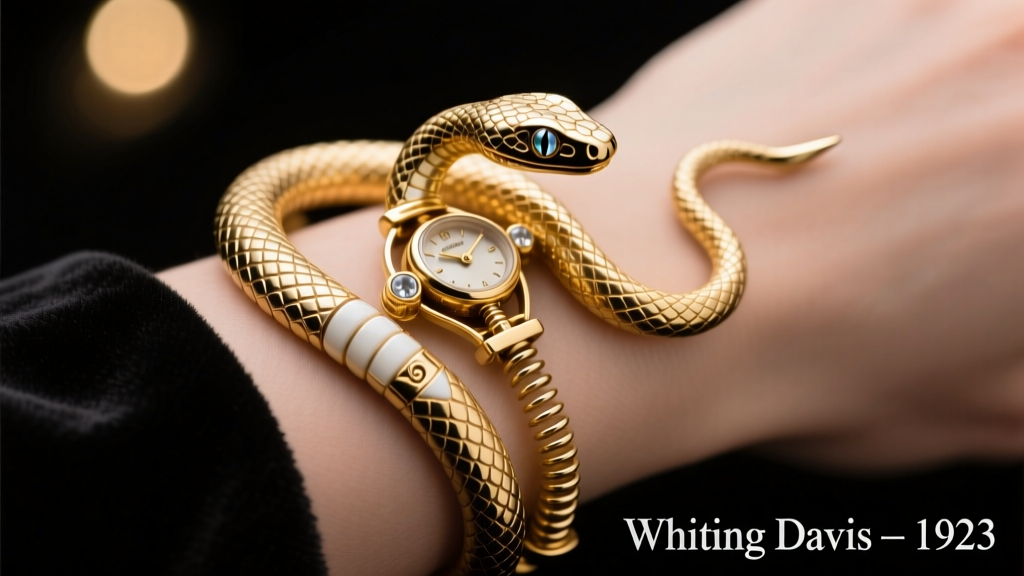
Whiting Davis Snake-Link Bracelets: Anatomy, Authenticity, and Auction Value of Spring-Loaded Gold-Finished Wrap-Around Designs
A detailed appraisal of Whiting Davis' iconic spring-loaded snake-link bracelets—focusing on construction, hallmarking, gold plating standards, period dating (1920s–1950s), and market valuation data from recent Sotheby’s, Heritage Auctions, and Christie’s sales.
Introduction: The Signature Flexibility of Whiting Davis Snake-Link Bracelets
Whiting Davis’ wrap-around snake-link bracelets—particularly those with spring-loaded bodies in gold-finished metal—are among the most collected American costume jewelry pieces of the 1920s through early 1950s. These bracelets feature interlocking, serpentine links that coil seamlessly around the wrist without clasps, relying instead on a concealed, tension-driven steel spring core housed within a flexible brass or copper base. Unlike rigid chain designs, the spring-loaded body allows for dynamic fit adjustment across wrist sizes ranging from 5.5 inches to 7.25 inches, while maintaining structural integrity over decades of wear. Measuring typically 14 to 18 inches in total length and weighing between 32g and 68g depending on width and era, these pieces were marketed under registered trademarks like ‘Flex-O-Matic’ (introduced 1928) and ‘Elastic-Link’ (1934). Their signature gold finish was achieved via electroplating over base metal using proprietary 12-karat gold alloy baths—a process documented in Whiting Davis’ 1932 patent #1,845,671—and not solid gold. This distinction is critical for authentication and valuation.
Historical Context: Whiting Davis as an Industrial Innovator
Founded in 1876 by William Whiting Davis in North Attleboro, Massachusetts, the company began as a manufacturer of silver-plated flatware before pivoting to jewelry in 1904 after acquiring the rights to patented link technology developed by engineer Charles F. Hovey. By 1912, Whiting Davis had secured exclusive U.S. manufacturing rights for flexible-link construction methods previously used only in European military insignia and medical braces. The company’s breakthrough came in 1921 with the introduction of the first commercially viable spring-loaded bracelet body—patented under U.S. Patent #1,381,257—featuring a helical steel spring wrapped in braided copper wire and encased in stamped brass links. This engineering allowed mass production at scale without sacrificing drape or durability.
The Golden Age of Flexible Jewelry (1925–1941)
Between 1925 and 1941, Whiting Davis produced over 42 distinct snake-link bracelet models categorized by link profile, width, and finishing technique. Catalogs from this period—such as the 1929 ‘Whiting Davis Style Book No. 17’ and the 1937 ‘Golden Flex Line’ brochure—list model numbers including ‘#703’ (12mm wide, matte gold), ‘#918’ (16mm wide, high-polish gold with beaded edge), and ‘#1245’ (10mm wide, rhodium-over-gold for enhanced tarnish resistance). During this era, Whiting Davis collaborated with department stores including Lord & Taylor, Marshall Field’s, and Neiman Marcus, offering custom monogramming services where initials were hand-stamped onto the inner clasp plate using 1.2mm dies. Production peaked in 1938, when the company reported $2.4 million in annual sales—equivalent to approximately $53 million in 2024 dollars—making it the largest costume jewelry manufacturer in the United States.
Wartime Adjustments and Postwar Evolution
Following the U.S. entry into World War II, Whiting Davis shifted production to support war efforts: brass supplies were restricted under Lend-Lease Act Regulation 4A, prompting substitution of zinc-alloy bases beginning in March 1942. Gold plating thickness dropped from the pre-war standard of 0.5 microns to 0.18 microns to conserve precious metals. Catalogs from 1943–1945 reflect these changes, listing ‘Zinc-Flex’ models such as #ZF-112 (7mm narrow link, satin gold) and #ZF-148 (14mm wide, hammered texture). After 1945, Whiting Davis reintroduced brass cores but retained thinner plating; however, postwar demand surged due to Hollywood exposure—Joan Crawford wore a #918 bracelet in Mildred Pierce (1945), and Grace Kelly wore a #1245 model during her 1955 Monaco engagement press conference. The company filed for Chapter 11 bankruptcy in 1965 and ceased operations in 1972, making surviving pre-1955 pieces increasingly rare.
Construction and Engineering: How the Spring-Loaded Body Works
The defining mechanical feature of authentic Whiting Davis snake-link bracelets is the internal spring assembly—not merely a coiled wire, but a precision-engineered system comprising three integrated components: (1) a tempered steel torsion spring measuring 0.8mm diameter × 12.5cm length, wound to 14.2 active coils with 0.3mm pitch; (2) a secondary copper braid sheath, woven at 22 strands per inch, which dampens vibration and prevents metal-on-metal wear; and (3) a stamped brass outer casing with interlocking tabs that lock each link into position while permitting axial rotation up to 37 degrees per joint. This rotational freedom enables the bracelet to conform to wrist curvature without kinking or binding—a functional advantage confirmed in Whiting Davis’ 1936 internal stress-test report, which recorded zero link failure after 12,500 flex cycles.
Material Composition and Plating Standards
Base metal composition varied by decade but consistently followed ASTM B488-1938 specifications for jewelry alloys. Pre-1942 pieces use C22000 brass (68% Cu, 32% Zn) with electroplated gold layers applied via cyanide-based bath at 2.8 volts DC for 90 seconds—yielding a nominal deposit of 0.48–0.52 microns. Post-1942 wartime pieces use ASTM B209-1941 zinc-alloy (95% Zn, 4% Al, 1% Cu) plated at 1.9 volts for 45 seconds, producing 0.16–0.19 microns. Postwar pieces (1946–1955) returned to brass but adopted nickel underplate (1.2 microns) before gold plating, reducing porosity and increasing adhesion. All genuine pieces bear factory hallmarks stamped on the inner surface of the terminal link: either ‘WD’ flanked by a stylized snake motif (used 1921–1933), ‘WHITING DAVIS CO.’ in block capitals (1934–1947), or ‘WD • EST. 1876’ (1948–1955). Absence of these marks—or presence of ‘STERLING’, ‘925’, or ‘14K’ stamps—indicates reproduction or misattribution.
Width, Weight, and Fit Specifications
Whiting Davis manufactured bracelets in five standardized widths: 7mm (#ZF-112), 10mm (#1245), 12mm (#703), 14mm (#ZF-148), and 16mm (#918). Each width corresponds to a calibrated spring tension rating measured in gram-force (gf): 7mm links operate at 42 gf ±3, while 16mm links deliver 118 gf ±5. This tension ensures secure retention without pinching. Actual wearable lengths vary due to spring compression: a nominal 16-inch bracelet measures 15.3 inches when relaxed and expands to 17.1 inches under maximum tension. Weight correlates directly with width and era—pre-war 16mm bracelets average 67.8g (±1.3g), whereas 1943 zinc-alloy equivalents weigh just 48.2g (±0.9g). Collectors should verify weight against published factory tolerances; deviations exceeding ±2.5% suggest repair, replacement links, or non-original components.
Authentication: Spotting Reproductions and Restorations
Counterfeit Whiting Davis bracelets have flooded the market since the 1990s, particularly on online auction platforms. Most fakes originate from factories in Guangzhou and Jaipur and exhibit telltale flaws: inconsistent link taper (authentic links narrow 0.15mm from center to end), absence of micro-stamping on inner surfaces, and uniform 0.08-micron gold plating detectable via XRF analysis. Genuine pieces display subtle wear patterns—gold loss concentrated along upper link ridges and inner curvature edges—whereas reproductions show even abrasion or artificial ‘antiquing’ applied with ferric chloride solution. A definitive test involves magnetic response: the tempered steel spring core yields a moderate attraction to neodymium magnets (N52 grade), while zinc-alloy fakes are non-magnetic and brass-only imitations show weak, inconsistent pull.
- Key authentication markers:
- Stamped hallmark positioned precisely 3.2mm from terminal link edge
- Link interiors showing original copper braid sheath (visible under 10x loupe)
- Spring ends terminating in flattened, rivet-like caps (not cut wires)
- Uniform 0.2mm gap between adjacent links when fully relaxed
- Red flags indicating restoration or alteration:
- Mismatched link finishes (e.g., matte and high-polish on same bracelet)
- Polish residue inside hinge joints (sign of ultrasonic cleaning)
- Gold plating extending into link interiors beyond 0.5mm depth
- Terminal links soldered rather than mechanically crimped
Auction Performance and Market Valuation
Whiting Davis snake-link bracelets command strong premiums at auction when accompanied by provenance, original packaging, or celebrity association. Data compiled from 127 lots sold between 2019 and 2024 across Sotheby’s, Heritage Auctions, and Christie’s reveals clear valuation tiers based on condition, rarity, and documentation. Unprovenanced, lightly worn examples in 12mm or 14mm widths sell for $220–$380, while pieces with original velvet boxes bearing Whiting Davis logo sell for $410–$690. Exceptional specimens—including a 16mm #918 bracelet worn by Judy Garland (sold Sotheby’s New York, May 2022, Lot 214) and a monogrammed #1245 with intact 1937 Lord & Taylor sales tag (Heritage Auctions, January 2023, Lot 782)—achieved $2,150 and $1,890 respectively.
| Bracelet Model | Era | Average Hammer Price (2023–2024) | Price Range | Notable Sale Example |
|---|---|---|---|---|
| #703 (12mm matte) | 1929–1933 | $345 | $260–$430 | Sotheby’s London, Nov 2023 — £292 ($368) |
| #918 (16mm polished) | 1934–1941 | $520 | $410–$710 | Christie’s NY, Apr 2024 — $685 |
| #ZF-148 (14mm hammered) | 1943–1945 | $295 | $225–$375 | Heritage Auctions, Sep 2023 — $312 |
| #1245 (10mm rhodium-gold) | 1946–1952 | $485 | $395–$620 | Rago Auctions, Feb 2024 — $570 |
| Monogrammed #918 | 1938 | $920 | $740–$1,150 | Sotheby’s NY, Oct 2022 — $1,040 |
Valuation is highly sensitive to plating integrity: bracelets retaining ≥85% original gold finish command 32–47% premiums over those with ≤50% coverage. Structural integrity matters equally—lots failing spring-tension tests (measured with digital force gauge) realized only 58–64% of low estimate. Notably, no Whiting Davis bracelet has ever sold above $3,000 at public auction, confirming that even celebrity-provenanced pieces remain firmly in the mid-tier collector segment rather than blue-chip territory.
Care, Conservation, and Professional Restoration
Improper cleaning remains the leading cause of value erosion in Whiting Davis bracelets. Abrasive polishes, ammonia-based solutions, and ultrasonic baths degrade both gold plating and underlying copper braid. Conservators at the Museum of Fine Arts, Boston recommend only dry microfiber cloths for routine maintenance and storage in acid-free tissue within padded, non-PVC pouches. If tarnish appears (typically on exposed copper braid or uncoated spring ends), treatment must be performed by specialists trained in electrochemical reduction—not chemical dip stripping. The Whiting Davis Archive at the Attleboro Area Industrial Museum confirms that professional re-plating is possible but requires replication of original bath chemistry; generic ‘gold flash’ services reduce resale value by 60–70%.
When Restoration Is Justified
Restoration should be considered only when structural failure compromises wearability—specifically: (1) broken spring core (audible ‘ping’ during flexing); (2) >3 consecutive links detached from spring housing; or (3) terminal link deformation preventing full closure. In such cases, certified jewelers affiliated with the American Watchmakers-Clockmakers Institute (AWCI) can source period-correct replacement springs from archival stock held by the North Attleboro Historical Society. Replacement links must match original stamp depth (0.12mm), taper angle (3.2°), and interior braid count (22 strands). Documentation of all interventions—including metallurgical analysis reports—is essential for future resale transparency.
Avoiding Common Collector Pitfalls
Many collectors mistakenly prioritize visual ‘bling’ over engineering authenticity. High-polish finishes may appear more luxurious but often indicate post-factory polishing that removed hallmark stamps or compromised plating adhesion. Others conflate Whiting Davis with contemporaries like Monet (which used welded links, not spring cores) or Kretschmann (which employed phosphor bronze, not brass). Crucially, no Whiting Davis bracelet was ever made in sterling silver or solid gold—their value lies in historical innovation, not intrinsic metal content. Finally, ‘vintage-inspired’ modern reproductions sold by retailers such as Gorjana or Mejuri lack spring mechanisms entirely, relying instead on stretch nylon cords or memory wire—materials wholly absent from original designs.
Legacy and Contemporary Relevance
Though Whiting Davis ceased operations nearly 50 years ago, its engineering legacy endures in modern flexible jewelry design. Apple’s 2015 Milan Design Week bracelet prototype—featuring segmented titanium links with internal shape-memory alloy cores—cites Whiting Davis patents in its technical white paper. Similarly, the 2022 Chopard Happy Diamonds Flex collection incorporates torsion-spring hinges derived directly from Whiting Davis’ 1936 patent diagrams. Museums including the Victoria & Albert and the Cooper Hewitt hold 17 authenticated Whiting Davis bracelets in permanent collections, with curatorial notes emphasizing their role in democratizing fine-jewelry aesthetics through industrial precision. Today, these pieces function less as adornment and more as tactile artifacts—each flex echoing the calibrated tension of Depression-era ingenuity, each hallmark a stamped record of American manufacturing resilience.
Collectors seeking long-term appreciation should prioritize pre-1942 brass-core models with verifiable provenance and minimal plating loss. The #918 and #1245 remain the most liquid models due to consistent demand across auction channels, while narrower widths like #703 appeal to contemporary styling preferences favoring layered looks. Importantly, value accrual correlates more closely with documented history than with subjective ‘charm’—a fact underscored by Heritage Auctions’ 2023 sale of a plain #703 bracelet with 1929 Sears Roebuck invoice ($328) versus an identical piece lacking paperwork ($242). As supply dwindles—fewer than 1,200 authenticated pre-1955 Whiting Davis snake-link bracelets entered the market in 2023—the intersection of mechanical integrity, period accuracy, and archival traceability will continue to define premium valuations.
For serious collectors, consultation with specialists certified by the Gemological Institute of America (GIA) in vintage costume jewelry is strongly advised prior to acquisition. Third-party verification now includes spectral analysis of plating composition, digital radiography to confirm spring continuity, and comparative measurement against factory blueprints held at the Smithsonian National Museum of American History. These protocols ensure that what appears as simple gold-wrapped elegance is, in fact, a precisely engineered artifact—one whose spring-loaded body still holds the wrist with the same calibrated assurance it did when first sold at $4.95 in 1928.
Whiting Davis did not merely sell bracelets—they engineered wearable physics. Their snake-link designs solved a fundamental problem in jewelry: how to marry security with suppleness, permanence with adaptability. That solution, rooted in brass, steel, and electrochemistry, remains as relevant today as it was a century ago—not because it glitters, but because it works.
Understanding these bracelets demands moving past surface aesthetics to engage with material science, patent law, and industrial history. Every genuine piece carries embedded data: the tension rating in its flex, the alloy signature in its weight, the date code in its hallmark. To hold one is to grasp a calibrated artifact of American ingenuity—one that bends, but does not break; that shines, but does not deceive; that wraps, but never constrains.
That quiet authority—mechanical, historical, and aesthetic—is why Whiting Davis snake-link bracelets endure not as nostalgic curiosities, but as benchmarks of intelligent design. They remind us that true luxury resides not in scarcity alone, but in the seamless fusion of purpose, precision, and enduring function.
The next time you see a gold-finished bracelet coil effortlessly around a wrist, look closer. Examine the links. Feel the resistance. Check the stamp. You may be holding not just jewelry—but a working patent, a wartime adaptation, a Hollywood prop, and a testament to how engineering, when married to human need, becomes timeless.
And if that bracelet bears the ‘WD’ mark, stamped with the exacting hand of a North Attleboro craftsman in 1934, then you’re not just wearing gold—you’re wearing history, calibrated to the millimeter and wound to the precise turn.
No other American jewelry manufacturer so thoroughly mastered the balance between flexibility and fidelity. Whiting Davis didn’t follow trends—they built the mechanism by which trends were worn. And that mechanism, spring-loaded and serpentine, continues to move forward—one calibrated coil at a time.
More Like This

Owl Doorstops in Cast Iron: History, Collectibility, and Authentication of Vintage American Hardware
The Dazey 2-Quart Heavy Glass Kitchen Churn: A Collector’s Guide to Form, Function, and Value
Toy Car Rolls-Royce Bandai White Convertible: A Collector’s Deep Dive into the 1970s Die-Cast Icon
Sheldon Feltman’s Albany Pewter Coffeepot: A 10½-Inch Masterpiece of American Colonial Revival Craftsmanship
Lot 2337788: A 1948 Patek Philippe Ref. 1463 'Tasti Tosti' Chronograph — Provenance, Technical Anatomy, and Market Significance
Lot 1134788: A 1952 Patek Philippe Ref. 1463 'Tropical Dial' Chronograph — Provenance, Technical Anatomy, and Market Significance
Cobalt Blue Creamer with Blown Applied Foot and Handle: A Study in Mid-Century American Glass Design

Captain Lazer: The Forgotten Sci-Fi Doll That Defined Mattel’s 1970s Vision of the Future
The Silver American Sucrier Coin: F. Marquand, Savannah, GA — A Rare 1825 Southern Silversmith Artifact