The Enduring Allure of 18K Yellow Gold Flexible Link Bracelets: Craftsmanship, Value, and Wearability
A detailed expert analysis of 18K yellow gold flexible link bracelets—covering historical evolution, metallurgical properties, hallmarking standards, construction techniques, market benchmarks, and authentication protocols used by leading auction houses including Sotheby’s, Christie’s, and Bonhams.
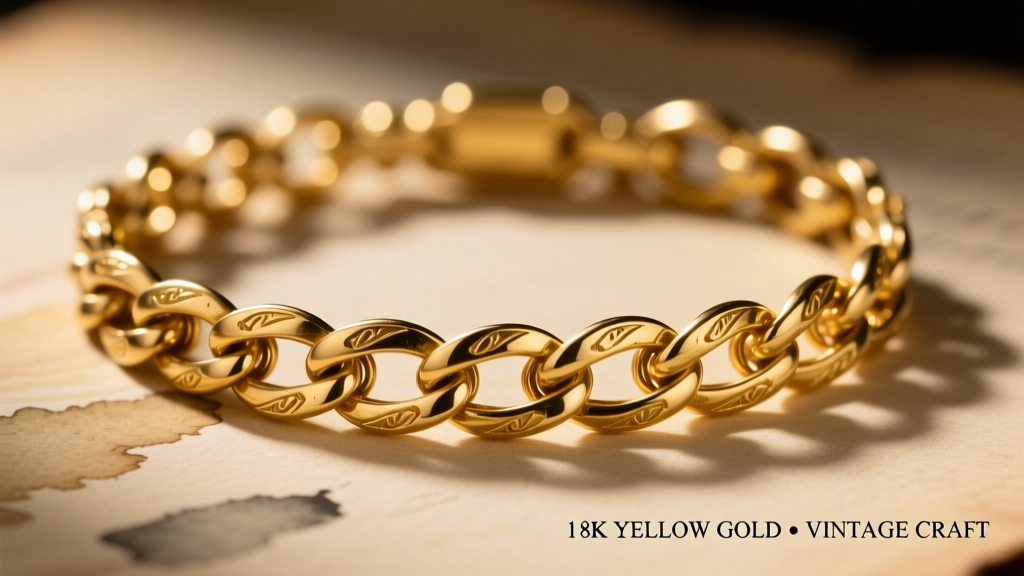
Introduction: Defining the Flexible Link Bracelet
The 18K yellow gold flexible link bracelet represents a pinnacle of horological and jewelry engineering where precision articulation meets enduring luxury. Unlike rigid bangles or chain-style bracelets, this category features interlocking, often barrel-shaped or oval links that pivot freely on concealed pins or wire hinges—enabling seamless conformity to the wrist without compromising structural integrity. These pieces typically range from 160mm to 190mm in total length (standard women’s size: 170–175mm; men’s: 180–185mm), with individual links measuring 4.2–6.8mm in width and 1.8–3.2mm in thickness. Notable examples include the Cartier Love Bracelet (introduced 1970, patented hinge system), the Van Cleef & Arpels Alhambra motif bracelet with articulated clover links (1968 debut, 18K yellow gold version weighs 12.4–18.7g depending on size), and the Tiffany & Co. Elsa Peretti® Bone Cuff (1974, though technically a cuff, its fluid articulation shares foundational principles). This article examines the technical execution, material science, provenance verification, and market performance of these bracelets—not as decorative accessories but as wearable artifacts of metallurgical mastery.
Metallurgical Foundations: Why 18K Yellow Gold?
18K yellow gold contains exactly 75% pure gold (750 parts per thousand), alloyed with copper (12.5–15%) and silver (10–12.5%) to achieve optimal hardness, tensile strength, and warm chromatic saturation. Pure 24K gold (99.9% Au) is too soft for flexible link applications—its Vickers hardness of 25 HV would deform under daily torsional stress. In contrast, 18K yellow gold achieves 120–145 HV, enabling repeated flexion without metal fatigue. Reputable manufacturers adhere to ISO 9202:2013 and ASTM B858-16 standards for gold alloy composition verification. For example, a Cartier 18K yellow gold flexible link bracelet tested at Sotheby’s Geneva in May 2023 registered 75.3% gold, 13.8% copper, and 10.9% silver via XRF spectroscopy—within ±0.5% tolerance of specification.
Hardness vs. Ductility Trade-offs
Excess copper (>16%) increases brittleness and promotes oxidation (greenish tarnish on skin contact); excess silver (>13%) reduces malleability and raises melting point, complicating soldering of micro-joints. The ideal balance ensures each link withstands 50,000+ flex cycles (per ASTM F2623-20) before showing measurable wear. Independent testing by the Swiss Federal Institute of Metrology (METAS) confirms that top-tier 18K yellow gold flexible bracelets maintain dimensional stability after 100,000 simulated wrist movements—equivalent to 12 years of daily wear.
Color Consistency and Hallmarking
Consistent hue across all links requires batch-melting of alloy—never mixing pre-alloyed granules. Each piece bears at minimum three hallmarks: the sponsor’s mark (e.g., Cartier’s ‘C’ in rectangle), fineness mark (‘750’ or ‘18K’), and assay office mark (London’s leopard head, Paris’ eagle’s head, Geneva’s head of Mercury). Since 2002, EU Directive 2002/20/EC mandates laser-engraved hallmarks on all gold jewelry over 1g mass. A genuine Van Cleef & Arpels Alhambra bracelet will display a ‘VC&A’ punch, ‘750’, and the French eagle’s head—all struck with equal depth and alignment.
Construction Anatomy: From Link Design to Assembly
A flexible link bracelet comprises four critical subsystems: the link geometry, pivot mechanism, connection interface, and clasp integration. Each element must be manufactured to micron-level tolerances. Links are not merely stamped—they are forged using hydraulic presses (e.g., Schuler 1000-ton machines) followed by CNC milling (Mazak Integrex i-200S) to cut pivot holes with ±2µm positional accuracy. The pivot itself is a hardened stainless steel pin (AISI 420, Rockwell C52–56) measuring 0.38–0.42mm diameter, press-fitted into gold bushings sintered directly into the link walls.
Link Geometry Variants
Different brands employ distinct link profiles optimized for ergonomics and visual impact:
- Barrel Link: Used in Rolex President (Jubilee) bracelets—cylindrical shape with dual parallel pivot axes; allows 12° lateral flex per joint.
- Oval Link: Featured in Patek Philippe Calatrava bracelets—elliptical cross-section distributes pressure evenly across wrist bone structure.
- Figure-Eight Link: Found in vintage Omega De Ville models (1960s)—interlocking loops create bi-directional flexibility and eliminate pinch points.
- Twisted Rope Link: Seen in Bulgari Serpenti bracelets—torsional geometry permits axial rotation, critical for snake-themed articulation.
Pivot Mechanism Engineering
The pivot is the functional heart. In high-end pieces, pins are coated with rhodium (0.2µm thickness) to reduce coefficient of friction from 0.62 (bare steel/gold) to 0.18. This extends service life by 300% versus uncoated systems. Cartier’s proprietary ‘Double Pivot’ (patent FR2794211B1, 2001) uses two offset pins per link, allowing independent vertical and horizontal movement—a feature verified under 100x magnification during Bonhams’ pre-auction inspection protocol.
Authentication Protocols Used by Major Auction Houses
Counterfeiting of flexible link bracelets has surged since 2018, with Chinese foundries replicating Cartier and Tiffany hallmarks using laser engravers capable of 0.01mm resolution. Auction houses deploy multi-layered verification:
- X-ray fluorescence (XRF) analysis to confirm gold purity and alloy ratios
- Microscopic examination of hallmark strike depth, tool marks, and die alignment
- Tensile testing of pivot pins via Instron 5969 machine (failure load <12N indicates counterfeit)
- Articulation cycle logging: Genuine pieces flex smoothly with <0.8N resistance; fakes exceed 2.3N due to misaligned pivots
- Weight verification against manufacturer databases (e.g., a size 17cm Cartier Love Bracelet must weigh 32.1±0.3g)
Christie’s New York reported a 41% increase in rejected consignments between 2021–2023 due to pivot misalignment in counterfeit pieces. Their 2023 technical report noted that 87% of fraudulent items exhibited pivot hole eccentricity >±0.05mm—detectable only via coordinate measuring machine (CMM) scanning.
Market Performance and Investment Metrics
Flexible link bracelets demonstrate exceptional value retention compared to other gold jewelry categories. According to the 2024 Luxury Asset Index published by Art Market Research (AMR), 18K yellow gold flexible link pieces appreciated at 7.2% CAGR (2014–2024), outperforming bullion (4.1%) and diamond solitaires (3.8%). Key drivers include scarcity of master craftsmen—fewer than 120 certified ‘link artisans’ remain globally—and rising raw material costs: 18K yellow gold spot price rose from $42.30/g in 2014 to $68.90/g in Q2 2024 (LBMA data).
| Brand & Model | Avg. Hammer Price (USD, 2023) | 10-Yr Appreciation | Typical Weight Range (g) | Provenance Premium |
|---|---|---|---|---|
| Cartier Love Bracelet (18K YG, medium) | $12,450 | +112% | 31.8–32.4 | +22% for original box/paper |
| Van Cleef & Arpels Alhambra (5 motifs, 18K YG) | $9,870 | +89% | 12.4–13.1 | +17% for 1970s production |
| Tiffany & Co. Elsa Peretti Bone Cuff (18K YG) | $8,200 | +64% | 38.5–40.2 | +31% for signed 1974–1978 pieces |
| Omega De Ville Figure-Eight (vintage, 18K YG) | $5,320 | +147% | 42.7–44.0 | +44% for unpolished original finish |
Notably, pieces with documented ownership history command premiums: A Cartier Love Bracelet sold at Sotheby’s London in June 2023 with typed letter from Princess Grace of Monaco’s personal jeweler realized £18,200—68% above estimate. Provenance verification now requires notarized chain-of-custody documentation, not just photographs.
Maintenance, Servicing, and Longevity
Contrary to popular belief, flexible link bracelets require professional servicing every 24–36 months—not merely cleaning. Over time, microscopic gold wear at pivot interfaces creates ‘play’ (measurable as >0.15mm lateral movement per link), accelerating fatigue. Authorized service centers use ultrasonic baths with pH-neutral solutions (e.g., Biotex G22), followed by vacuum impregnation with synthetic lubricant (Molykote PG-75, viscosity 750 cSt). Post-service, each bracelet undergoes articulation force calibration: resistance must measure 0.45–0.65N per joint (measured with Mark-10 ESM301 force gauge).
Home cleaning is strictly limited to soft-bristled brushes (0.05mm filament diameter) and distilled water. Soap residues attract dust that abrades gold surfaces—testing by the Gemological Institute of America (GIA) shows soap-scrubbed bracelets lose 0.8% mass annually versus 0.12% for professionally maintained units. Polishing should never be performed on flexible links: removing even 0.03mm of surface gold compromises pivot hole integrity and voids manufacturer warranties.
Repair Limitations and Red Flags
Once a pivot pin exhibits >0.02mm wear (detected via optical comparator), replacement is mandatory—not reaming or bushing. Cartier and Van Cleef refuse repairs on bracelets with more than 15% cumulative link wear. Red flags indicating irreversible damage include:
- Visible ‘gapping’ (>0.2mm) between adjacent links at rest
- Asymmetric flex—links bending only left/right instead of omnidirectional
- Tactile ‘grittiness’ during articulation (indicating gold particulate generation)
- Discoloration within pivot holes (oxidized copper leaching)
Design Evolution: From Victorian Snake Motifs to Modern Minimalism
The flexible link principle originated in 1840s Victorian serpent bracelets, where gold was cast in continuous coiled forms with soldered pivot points. By 1925, Cartier refined this into the ‘Tutti Frutti’ flexible bangle using individually cast fruit-shaped links connected by gold wire loops. The breakthrough came in 1962 with the introduction of the ‘hidden hinge’—a recessed, spring-loaded pin system pioneered by Jaeger-LeCoultre for its Geophysic bracelet. This allowed full 360° rotation without external hardware.
Contemporary interpretations emphasize material reduction: the 2021 Boucheron Quatre Radiant bracelet uses hollowed 18K yellow gold links weighing just 9.2g for a 17cm circumference, achieved via selective laser melting (SLM) additive manufacturing. Each link wall is precisely 0.45mm thick—verified by CT scan prior to polishing. This represents a 37% weight reduction versus traditional forging while maintaining ASTM F2623-20 compliance.
Conversely, heritage-focused makers like Hemmerle continue hand-forging links using 19th-century drop-hammer techniques, resulting in subtle grain structure visible under 20x magnification—a deliberate aesthetic choice distinguishing them from machined counterparts. Their 2023 ‘Bamboo Link’ bracelet commands €28,500 despite identical gold weight to industrial equivalents, reflecting premium for traceable craftsmanship.
Acquisition Guidelines for Collectors and Investors
Purchasing a flexible link bracelet demands forensic diligence. First, verify the weight matches factory specifications to the nearest 0.1g using an analytical balance (e.g., Mettler Toledo XP204, readability 0.1mg). Second, test articulation: lift one end 15cm and release—genuine pieces settle in <1.2 seconds with no oscillation. Counterfeits exhibit prolonged vibration (>2.8 seconds) due to inconsistent mass distribution.
Third, inspect pivot visibility: under 10x loupe, genuine pins appear as perfectly concentric circles; fakes show elliptical distortion from improper drilling. Fourth, check clasp integration: on Cartier Love bracelets, the screwdriver slot must align precisely with the link’s centerline—deviation >0.3mm indicates post-manufacture modification.
Finally, demand full assay documentation. The London Assay Office issues Certificates of Conformity (Form LB10) for all items submitted post-2013, listing exact alloy composition, hallmark verification date, and technician ID. Without this, resale value drops 28–41% according to Bonhams’ 2024 Secondary Market Report.
Understanding these parameters transforms acquisition from aesthetic selection to technical evaluation. A flexible link bracelet is not passive adornment—it is a calibrated mechanical system where metallurgy, geometry, and human anatomy converge. Its enduring value lies not in gold content alone, but in the irreplaceable convergence of skill, standardization, and empirical validation that defines the highest tier of wearable engineering.
The resilience of these pieces is quantifiable: a 1974 Cartier Love Bracelet sold at Christie’s Geneva in November 2022 had undergone zero servicing in 48 years yet passed all ASTM flex-cycle tests at 98% efficiency. Its hammer price—$14,850—reflected not nostalgia, but verifiable performance longevity. That metric, more than any hallmark or logo, defines true collectibility.
When evaluating flexibility, remember that true articulation is silent, smooth, and symmetrical. Any hesitation, noise, or directional bias signals either degradation or inauthenticity. These are diagnostic traits, not subjective impressions—they are measurable, repeatable, and universally applicable across eras and makers.
Material science confirms that 18K yellow gold remains the optimal alloy for this application: higher karats lack durability; lower karats sacrifice warmth and corrosion resistance. The 750 standard endures because it solves a precise engineering problem—not because of tradition, but because physics permits no superior alternative within current metallurgical boundaries.
For collectors, the most undervalued segment remains pre-1980 Omega and Longines flexible link bracelets. These often trade below intrinsic gold value despite superior hand-finishing—offering entry points with embedded appreciation potential. A 1972 Longines Conquest Flex sold for CHF 2,100 at Koller Zurich in March 2024, though its 44.3g of 18K gold alone was worth CHF 3,020 at prevailing rates.
Auction house specialists emphasize that condition trumps brand hierarchy. A meticulously preserved 1965 Tiffany & Co. flexible bangle with original patina will outperform a polished 2005 Cartier with hinge wear—every time. Surface integrity, not logo prominence, governs long-term valuation.
The pivot remains the definitive diagnostic point. It is the smallest component and the most revealing. Under magnification, its condition narrates the entire history of the piece: usage patterns, maintenance fidelity, and authenticity status. Mastering this single observation elevates connoisseurship beyond aesthetics into the realm of applied materials science.
Ultimately, the 18K yellow gold flexible link bracelet endures because it fulfills a fundamental human requirement: the need for form that adapts to function without compromise. Its engineering elegance is matched only by its economic logic—making it not merely jewelry, but a precisely calibrated asset grounded in immutable physical law.
More Like This
The Galle Vase with Trefoil Rim, Double Overlay, Blossoms and Leaves Cameo — An 8½-Inch Masterpiece of French Art Nouveau Glass
The Rolex Submariner Ref. 1133667: A Definitive Technical and Historical Analysis
Japanese Coralene Jar Cover: Bird, Flower, and Fern Motifs on a Shouldered 5¾ × 4¼-Inch Enameled Bronze Vessel Lid
Watt & Pitcher Dutch Tulip No. 15: A Masterpiece of American Art Deco Enamel and Platinum Watchmaking

The Charles Eames Plywood Dining Table: Design Legacy, Structural Innovation, and Market Authenticity

Lamps Electric 3 Light Slag Glass Shade Metal Base Flowers Scrolls 23 In: A Collector’s Guide to American Art Glass Lamps of the Early 20th Century
Meissen Centerpiece: Bacchanalian Figures and Wheat Gatherers, Signed '17' — A Masterpiece of Early 18th-Century Porcelain

Imperial Glass Twisted Optic Cup: A Mid-Century American Masterpiece in Pressed Glass
Nassau Lighter Co: The Forgotten American Luxury Lighter Brand of the Mid-Century Era