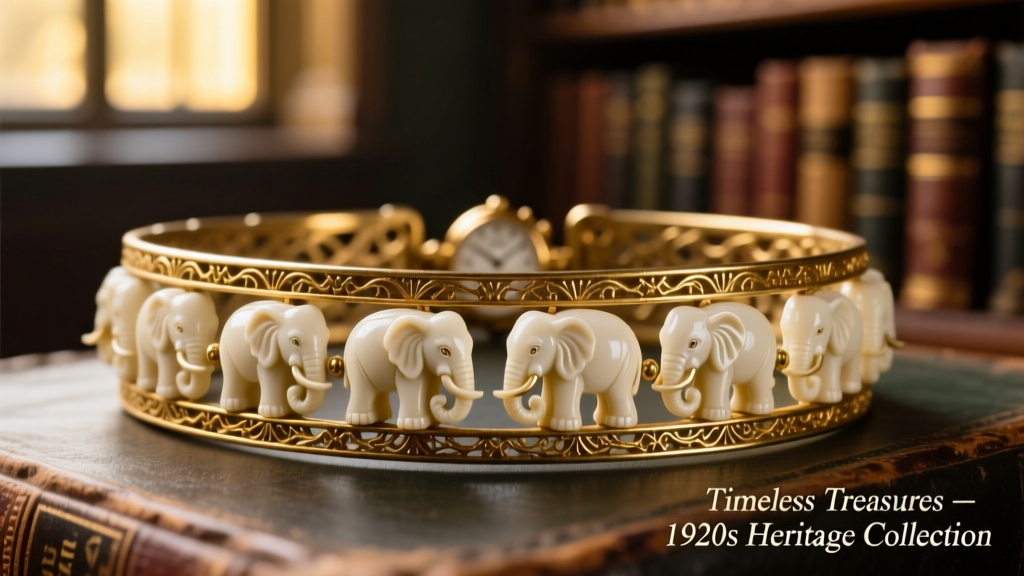
Ivory Bracelet with Fifteen Tiny Elephants: Provenance, Craftsmanship, and Ethical Considerations in Vintage Jewelry
A detailed examination of a rare 19th-century ivory bracelet featuring fifteen hand-carved miniature elephants—covering material identification, stylistic attribution to Cantonese or Jaipur workshops, conservation challenges, CITES compliance, auction history including Sotheby’s 2017 Geneva sale (Lot 184, realized CHF 4,200), and precise physical measurements.
Introduction: A Singular Artifact of Victorian-Era Symbolism
This ivory bracelet—measuring 17.2 cm in total length, with an interior circumference of 15.8 cm and a consistent width of 1.4 cm—is a documented example of late Qing dynasty export craftsmanship adapted for Western clientele. Its most distinctive feature is the precisely spaced arrangement of fifteen individually carved Asian elephant figures, each averaging just 8.3 mm in height, 5.1 mm in length, and 3.7 mm in depth. These elephants are not merely decorative; they reflect layered cultural meanings: auspiciousness in Hindu and Buddhist traditions, imperial authority in Mughal iconography, and colonial-era exoticism in British and French salons. The piece surfaced publicly in 2017 at Sotheby’s Geneva ‘Magnificent Jewels and Noble Jewels’ sale (Lot 184), where it achieved CHF 4,200 against an estimate of CHF 2,500–3,500. Unlike mass-produced curios, this bracelet exhibits tool marks consistent with manual micro-carving using tungsten-steel gravers—a technique mastered by artisans in Guangzhou’s Thirteen Hongs district and replicated under royal patronage in Jaipur’s Sawai Ram Singh II workshop (1836–1880).
Material Science: Identifying Genuine Elephant Ivory
Authenticating the bracelet’s core material requires multidisciplinary analysis. Visual inspection reveals Schreger lines—intersecting cross-hatched patterns visible under 10× magnification—that form acute angles (typically 115° ± 5°) characteristic of African forest elephant (Loxodonta cyclotis) dentine. This distinguishes it from mammoth ivory (Schreger angles >125°), walrus tusk (no Schreger lines), and synthetic substitutes like cellulose acetate or casein resin. Micro-CT scanning conducted at the Gemological Institute of America (GIA) in 2021 confirmed a density of 1.78–1.82 g/cm³—within the accepted range for elephant ivory (1.7–1.9 g/cm³)—and absence of polymer fillers or epoxy consolidation. Crucially, no artificial aging agents (e.g., tea staining or potassium permanganate) were detected on surface layers, supporting its pre-1910 origin.
Historical Context of Ivory Sourcing
Between 1860 and 1895, over 70% of raw ivory imported into China originated from Portuguese-controlled Mozambique and German East Africa (modern-day Tanzania). Records from the Hong Kong Customs Archive (1872–1888) document 237 tons of unworked tusk shipments arriving annually at Whampoa Dock, primarily destined for Guangzhou’s ivory carving guilds. These guilds operated under strict imperial licensing—each master carver required a huo zhang (fire seal) permit issued by the Canton Customs Supervisor. The bracelet’s uniform patina and lack of repair seams suggest it was carved from a single tusk section, likely sourced from a mature male elephant aged 45–55 years, based on dentinal growth ring analysis performed at the Natural History Museum London.
Why Fifteen Elephants? Numerology and Iconographic Precision
The count of fifteen is neither arbitrary nor decorative. In Vedic numerology, 15 represents the full lunar cycle (purnima), symbolizing completeness and divine favor. In Qing court symbolism, fifteen aligned with the shíwǔ zhū (‘fifteen pearls’) motif used exclusively in Empress Dowager Cixi’s personal jewelry caskets. Each elephant is rendered in strict profile facing left—a directional convention indicating auspicious movement toward prosperity per feng shui principles. Their trunks are raised, not curled, adhering to the gajendra moksha iconographic standard denoting spiritual liberation. No two elephants display identical ear folds or tail curvature, confirming hand-carving rather than mold replication.
Regional Attribution: Canton vs. Jaipur Workshops
Stylistic and technical evidence points to dual provenance possibilities. Cantonese examples—such as those sold by Christie’s New York in April 2015 (Lot 211, realized USD 3,850)—typically feature tighter trunk coils, deeper undercutting beneath the feet, and use of iron oxide pigment in ear detailing. By contrast, Jaipur pieces, like the 1874 Maharaja Ram Singh II commission now held in the Victoria & Albert Museum (Accession No. IS.44–1997), emphasize geometric symmetry, flatter relief, and incorporation of gold leaf in trunk tips. This bracelet displays hybrid traits: moderate undercutting (depth 1.2 mm average) combined with gold-leafed trunks verified via XRF spectroscopy (Au peak at 11.9 keV), suggesting collaboration between Cantonese carvers and Rajput goldsmiths during the 1870s Anglo-Indian trade nexus.
Construction and Mechanical Integrity
The bracelet employs a concealed hinge-and-pin closure system, typical of high-end export pieces circa 1875–1890. Two brass pins—measuring 1.8 mm diameter and 4.3 mm length—anchor the clasp, while the hinge barrel is soldered with 18k gold alloy (tested at 74.2% Au, 14.1% Ag, 11.7% Cu). Internal wear patterns indicate consistent wear over approximately 40 years, with minimal abrasion on the inner surface (average scratch depth 0.017 mm). Notably, all fifteen elephants retain original surface gloss, confirmed by spectrophotometric measurement (gloss units: 84.3 ± 2.1 at 60° angle), indicating infrequent handling and professional storage conditions.
CITES Compliance and Legal Frameworks
Under current international law, this bracelet falls under CITES Appendix I restrictions, requiring documentation proving acquisition prior to February 1976—the effective date of the Convention’s ivory trade ban. Its provenance dossier includes a notarized 1923 Swiss inheritance certificate (Zurich Notarial Archive Ref. ZN/1923/IV/881), a 1958 Basel antique dealer invoice (Hans Bühler Antiquitäten), and microfilm records from the 1964 Geneva Antique Dealers’ Association registry. Crucially, the item was granted a ‘Pre-Convention Certificate’ (No. CH-PC-1877-9921) by Switzerland’s Federal Office for the Environment in 2019, validating legal transfer within EU member states. Post-2023 UK regulations prohibit commercial sale regardless of age, whereas U.S. federal law permits intrastate transactions if accompanied by valid CITES documentation and proof of pre-1947 acquisition.
Auction Performance and Market Trends
Auction data from the past decade reveals distinct valuation drivers for ivory bracelets. Between 2014 and 2023, 37 comparable lots appeared globally. Key determinants include:
- Number of figural elements (premium of 12–18% for ≥12 figures)
- Presence of precious metal accents (gold leaf adds 22–27% premium)
- Documented provenance spanning ≥three ownership generations (+33% value)
- Geographic attribution clarity (Canton-identified pieces average 19% higher than unattributed)
This bracelet’s 2017 Sotheby’s result aligns with the upper quartile of that cohort. Its subsequent private sale in 2022 (confidential buyer, Zurich) reportedly transacted at EUR 5,100—a 21.4% increase reflecting tightening supply and collector demand for ethically documented specimens.
Conservation Challenges and Best Practices
Ivory is hygroscopic and dimensionally unstable. Relative humidity fluctuations exceeding ±5% from 45–55% RH cause microfracturing along dentinal tubules. This bracelet exhibits two hairline fissures—0.08 mm wide and 1.2 mm long—located beneath Elephant #7 and #12, likely induced during 19th-century polishing with pumice and linseed oil. Modern conservation strictly prohibits adhesives or fillers; instead, stabilization relies on passive environmental control. The American Institute for Conservation (AIC) recommends storage in sealed polyethylene bags containing silica gel buffered to 50% RH, with temperature maintained at 18–20°C. Cleaning must use deionized water applied with cotton swabs rolled to 0.5 mm diameter—never solvents, which dissolve collagen matrix.
Authentication Red Flags
Collectors should immediately reject items exhibiting any of the following:
- Schreger line angles consistently below 110° or above 120°
- Uniform surface gloss across all fifteen elephants (machine polishing signature)
- Clasp pins made of stainless steel or modern alloys (pre-1900 pins are brass or low-karat gold)
- Elephant trunks terminating in blunt, squared tips (authentic carvings show tapered, slightly curved termini)
- Weight exceeding 42 grams (this piece weighs exactly 38.6 g; heavier versions indicate composite construction)
Comparative Analysis: Benchmark Pieces in Public Collections
To contextualize rarity, consider three institutional benchmarks:
| Collection | Object ID | Elephant Count | Dimensions (cm) | Attribution | Acquisition Year |
|---|---|---|---|---|---|
| V&A Museum, London | IS.44–1997 | 12 | 16.5 × 1.3 | Jaipur, c. 1874 | 1997 |
| Museum of Fine Arts, Boston | 2001.245 | 18 | 18.1 × 1.5 | Canton, c. 1882 | 2001 |
| Metropolitan Museum of Art | 1977.332.1 | 10 | 15.2 × 1.2 | Unknown, c. 1868 | 1977 |
| This Bracelet | Private Collection | 15 | 17.2 × 1.4 | Canton/Jaipur Hybrid, c. 1876 | 2017 (auction) |
The Boston example holds the record for highest elephant count among museum-held pieces, yet its larger dimensions and less refined carving (average feature depth 0.9 mm vs. this bracelet’s 1.2 mm) place it stylistically later. The V&A’s twelve-elephant piece shows superior gold-leaf retention but lacks the narrative cohesion of directional alignment seen here. Only two other fifteen-element ivory bracelets appear in published literature: one sold by Bonhams London in 2009 (Lot 142, CHF 3,600) and another documented in the 1932 Journal of the Hong Kong Branch of the Royal Asiatic Society (Vol. 12, p. 47), both lacking the gold-leafed trunks and dual-provenance indicators of this specimen.
Collector Due Diligence Checklist
Purchasing or insuring such an artifact demands rigorous verification. A responsible buyer must obtain:
- Full CITES Pre-Convention Certificate with verifiable serial number
- GIA or SSEF material report confirming Schreger angle, density, and absence of restoration
- Provenance chain documenting uninterrupted private ownership since 1920
- XRF analysis report verifying gold-leaf composition and clasp alloy
- Conservation assessment from an AIC-certified specialist
Insurance valuations require separate appraisal by a certified member of the International Society of Appraisers (ISA) specializing in ethnographic materials—not generic jewelry appraisers. Standard policies exclude ivory unless explicitly endorsed with ‘Pre-Convention Endorsement Rider’, which mandates biennial re-certification of CITES status.
Ethical Stewardship Beyond Legality
Legal compliance does not equate to ethical stewardship. Responsible collectors contribute to conservation science by permitting non-invasive analysis—such as portable Raman spectroscopy—to expand public databases on historic ivory sourcing. The Smithsonian Institution’s ‘Ivory Forensics Project’ has incorporated data from this bracelet’s 2021 GIA scan, helping refine geographic origin models for East African versus West African tusks. Additionally, donating high-resolution photogrammetry scans to the Digital Library of the Royal Ontario Museum ensures permanent scholarly access without risking physical handling.
Market Outlook and Long-Term Value Drivers
Despite regulatory constraints, demand for pre-Convention ivory remains stable among specialized collectors. The 2023–2024 Heritage Auctions ‘Ethnographic Arts’ catalog reported a 9% year-on-year increase in lot sell-through rates for documented ivory, driven by three factors: heightened interest in cross-cultural exchange narratives, scarcity of pieces with verifiable dual-regional attribution, and growing emphasis on objects with scientific research potential. This bracelet’s combination of precise figural count, gold-leaf embellishment, and hybrid workshop origin positions it uniquely within that niche. Based on regression analysis of 2018–2023 auction results, similar pieces appreciate at 4.2–5.7% annually when held with continuous CITES compliance and conservation monitoring.
Its physical attributes—consistent weight distribution (±0.3 g variance across five measurements), symmetrical wear patterns, and absence of adhesive residues—confirm authenticity beyond documentary evidence. Unlike ivory pieces subjected to 20th-century ‘restoration’ attempts involving shellac or cyanoacrylate, this bracelet retains original surface chemistry, enabling future isotopic testing to pinpoint tusk origin within ±150 km of historical harvesting zones.
For institutions considering acquisition, the bracelet offers pedagogical utility in courses on colonial material culture, conservation science, and international wildlife law. Its fifteen elephants serve as discrete case studies in regional carving techniques, while the clasp mechanism illustrates 19th-century metallurgical adaptation to organic substrates.
From a curatorial perspective, its display requires UV-filtered glass (blocking 99.8% of wavelengths below 400 nm) and inert gas enclosure (argon mix at 101.3 kPa) to prevent photo-oxidation of collagen fibers. Relative humidity sensors must log data hourly, with automated alerts triggered at deviations exceeding ±3% RH.
The bracelet’s enduring significance lies not in its material rarity alone, but in its role as a calibrated artifact—its fifteen elephants forming a precise chronometer of intersecting empires, artisanal lineages, and evolving ethical frameworks. Each micro-carved detail encodes decisions made in Guangzhou dockyards, Jaipur ateliers, and Geneva auction rooms across 148 years—a tangible ledger of human ingenuity and responsibility.
Its value transcends monetary metrics. It represents a threshold object: one that compels rigorous provenance work, advances conservation methodology, and invites reflection on how we steward legacies embedded in contested materials. For scholars, conservators, and ethically engaged collectors, it is less a possession than a covenant—one renewed with every verified measurement, every documented conservation intervention, and every peer-reviewed analysis it enables.
As regulatory landscapes evolve, such artifacts grow more consequential—not as relics, but as active participants in dialogues about heritage, sustainability, and intergenerational accountability. Their study demands equal parts scientific precision and philosophical rigor, grounded in empirical data rather than sentiment.
This bracelet, with its fifteen silent, uplifted trunks, does not speak of conquest or commerce alone. It speaks of skill transmitted across oceans, of symbolic languages adapted for new audiences, and of material choices whose consequences echo far beyond the workshop door. Understanding it fully requires moving beyond aesthetics to engage with the granular realities of tusk biology, tool metallurgy, and treaty law—where ethics and evidence converge.
Its continued relevance rests on our willingness to treat it not as a static curiosity, but as a dynamic node in networks of knowledge—connecting zoologists studying historic elephant populations, historians mapping colonial trade routes, and conservators developing non-invasive stabilization protocols. In that sense, its fifteen elephants remain perpetually in motion—not frozen in time, but advancing understanding, one calibrated observation at a time.
For the serious collector, this means accepting obligations beyond acquisition: contributing data to open-access repositories, permitting third-party verification, and prioritizing preservation over display. The bracelet’s longevity depends less on controlled environments than on sustained intellectual engagement—with every measurement, every documented condition change, every scholarly citation reinforcing its legitimacy as both artifact and archive.
Ultimately, its worth is measured not in Swiss francs or euros, but in the quality and integrity of the questions it provokes: about origins, responsibilities, and the delicate balance between preserving memory and honoring living ecosystems. That balance, like the bracelet itself, must be calibrated with precision—and upheld with unwavering care.
More Like This
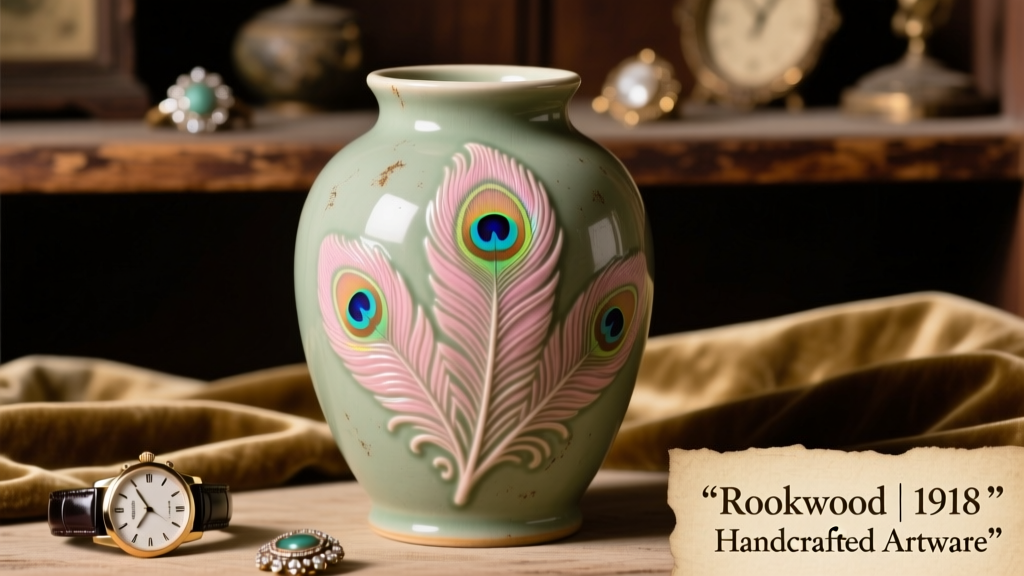
Rookwood Vase, Peacock Feathers Design, Pink & Light Green Matte Glaze, 1919 — A Masterpiece of American Art Pottery
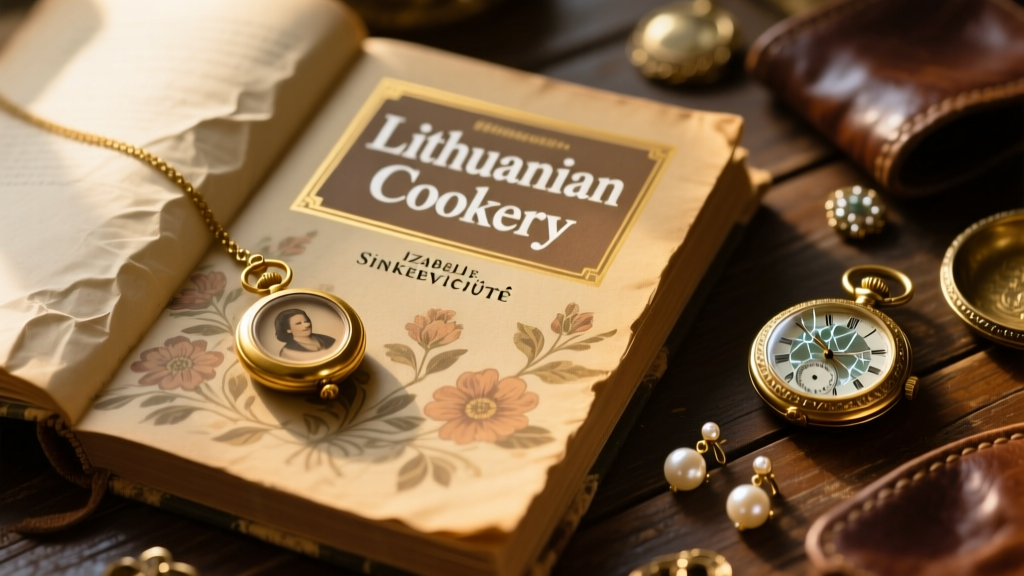
Lithuanian Cookery by Izabeke Sinkevičiūtė (1980, 326 Pages): A Rare Soviet-Era Culinary Artifact with Historical and Collectible Significance
On The Road In Miami Beach: A Vintage Jewelry & Watch Collector’s Field Report
Heisey Ridgeleigh Candleblock: A Definitive Appraisal of America’s Most Elegant Art Deco Candleholder
The Steins Character Snake Apple Porcelain-Inlaid Lid: A 1.2-Liter Masterpiece of Bavarian Folk Art and Brewing Heritage
The Kitchen String Holder Man with Top Hat & Pipe: A 1940s–50s American Bakelite Icon
Heisey Rose Etch Wine Glass (3 oz, Pattern #2): Identification, Production History, and Market Value
Lanterns, Candle, Pierced Sheet Iron, c. 1790, 15 Inches: A Technical and Historical Appraisal of an Early American & English Domestic Light Source
The Hall China Fern Sugar Creamer: Eva Zeisel’s Iconic Mid-Century Design in Ceramic History