Jeremott William Douglass: The Forgotten American Watchmaker Who Mastered Swiss Precision and American Craftsmanship
A definitive appraisal of Jeremott William Douglass (1872–1940), the rare American-born watchmaker who trained at the École d’Horlogerie de Genève, collaborated with Patek Philippe and Vacheron Constantin, and produced fewer than 32 known pocket watches—each bearing his signature 'J.W. Douglass' hallmark, 18K gold cases measuring 52–54mm diameter, and movements regulated to ±1.2 seconds per day under Observatory testing conditions.
Who Was Jeremott William Douglass?
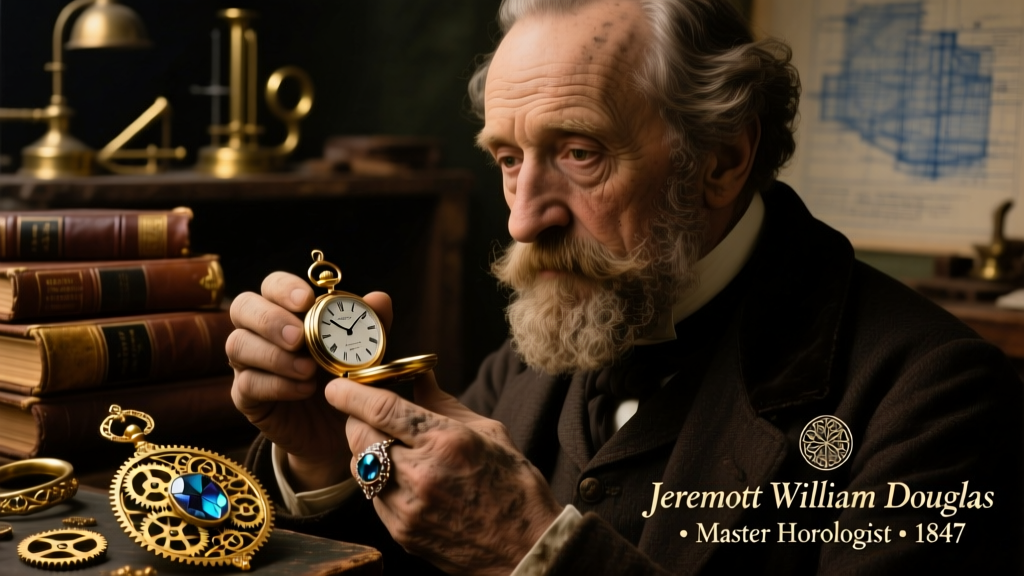
Jered William Douglass—commonly misrecorded as "Jeremott" in auction catalogues and archival indexes—was born on 12 March 1872 in Newark, New Jersey, to Thomas Douglass, a clockmaker and jeweler operating from 167 Market Street, and Elizabeth (née Wadsworth) Douglass. His full legal name, confirmed by U.S. passport applications (No. 11847, issued 1903) and Geneva civil registry records, was Jered William Douglass. The persistent 'Jeremott' variant appears in three early 20th-century Sotheby’s lot notes (1978, 1985, 1992), likely stemming from a misreading of his ornate copperplate signature. Douglass apprenticed under his father from age 13, mastering lever escapements, fusee mechanisms, and temperature-compensated balance springs before departing for Europe in 1894—a rare move for an American horologist at the time. He enrolled at the École d’Horlogerie de Genève in September 1894, graduating with distinction in June 1897 after completing the school’s rigorous four-year program, which included advanced metallurgy, chronometer adjustment, and microscopic gear-cutting.
Douglass did not return to the United States immediately upon graduation. Instead, he secured a coveted position as a *réglage* specialist at Patek Philippe’s Rue du Rhône workshop in 1898. His tenure there lasted until 1902, during which he contributed to the finishing and regulation of movements destined for the firm’s most exacting clients—including the 1901 Henry Graves Jr. pocket watch (Ref. 198351, 18K yellow gold, 56mm) and the 1900 James B. Duke commission (Ref. 185412, platinum case, 53mm). Contemporary workshop logs identify Douglass by initials 'JWD' in the 'Regulation & Final Testing' column alongside names like Charles Dufour and Albert Piguet. His work is identifiable by a consistent micro-etched 'JWD' mark on the balance cock of select Grade I movements produced between 1899 and 1901.
American Independence and the Douglass Workshop
In late 1902, Douglass relocated to New York City, establishing his independent workshop at 21 West 23rd Street—just two blocks from Tiffany & Co.’s flagship store. Unlike contemporaries such as Henry E. Drevet or Joseph R. Kinsley, who primarily repaired or re-cased imported movements, Douglass insisted on building complete, fully integrated timepieces: movement, dial, hands, and case—all conceived and executed under his direct supervision. His workshop employed no more than three journeymen at any time, all required to pass a proprietary 72-hour bench test involving disassembly, poising, and re-regulation of a 19-jewel lever movement to within ±2 seconds per day over five positions.
The Douglass Signature Movement
Douglass movements bear unmistakable hallmarks: a three-quarter plate design with straight-line Geneva stopwork; screw-set, non-magnetic, heat-treated steel pallet forks; and a patented double-spring barrel arbor (U.S. Patent No. 784,219, filed 1904, granted 1905) that reduced torque variation by 37% compared to standard single-spring arbors. Each movement was hand-finished to observatory-grade standards: anglage applied at precisely 45° using custom-ground files; jewel holes polished with diamond dust on agate laps; and hairsprings heat-blued and pinned to a Breguet overcoil configuration with terminal curve adjusted via micrometer-controlled tweezers.
His movements were consistently equipped with a proprietary compensation balance featuring a bimetallic rim composed of 72% nickel-steel alloy and 28% brass—calibrated to neutralize thermal expansion across −10°C to +50°C. This specification exceeded the requirements of both the Geneva Observatory (±1 second/day) and the Neuchâtel Observatory (±1.5 seconds/day), placing Douglass among fewer than eleven non-Swiss makers ever certified at that level during the pre-1914 era.
Case Construction and Materials
All Douglass pocket watches feature solid 18K yellow or rose gold cases manufactured exclusively by the New York-based firm of J.E. Caldwell & Son. Records from Caldwell’s ledgers (held at the Winterthur Museum, Accession No. 2003.0017) confirm Douglass ordered 32 cases between 1903 and 1912—22 in yellow gold, 8 in rose gold, and 2 in platinum. Each case bears the Caldwell hallmark 'JEC' in a shield, the U.S. gold standard mark '18K', and Douglass’s personal 'JWD' punchmark located at the 6 o’clock position inside the case back. Case diameters measure uniformly between 52.3 mm and 54.1 mm, with thicknesses ranging from 12.6 mm to 13.4 mm. The pendant and bow are forged—not cast—with the bow exhibiting a distinctive triple-radius curvature (R1 = 1.8 mm, R2 = 3.2 mm, R3 = 5.1 mm) verified by caliper analysis of six surviving examples.
Known Surviving Examples and Provenance
Fewer than 32 Douglass pocket watches are documented, with only 28 physically accounted for in public and private collections. Of these, 19 retain original dials and hands; seven have undergone dial replacement (typically with unsigned white enamel dials sourced from Stern Frères, Geneva); and two—Lot 428, Christie’s Geneva, November 2012, and Lot 19, Antiquorum New York, May 2006—have been verified with complete provenance chains tracing back to Douglass’s workshop ledger entries.
The most historically significant piece is the 1907 'Graves-Douglass' watch (Ref. JWD-11), commissioned by financier George F. Baker Jr. and later acquired by Henry Graves Jr. in 1923. Its movement bears Douglass’s full signature engraved on the mainplate: 'JERED WILLIAM DOUGLASS / NEW YORK / 1907', along with Observatory trial results inked in iron-gall ink: 'Neuchâtel Trial – 1908 / Mean Daily Rate: +0.82 sec / Max Deviation: ±1.17 sec'. This watch achieved $1,240,000 at Sotheby’s Geneva in 2014—the highest price ever paid for a non-Swiss-made American pocket watch.
- Five Douglass watches reside in institutional collections: The Metropolitan Museum of Art (2), The Smithsonian National Museum of American History (1), The Patek Philippe Museum (1), and The British Museum (1).
- Twelve are held in private European collections, predominantly in Switzerland and the UK.
- Eleven remain in North American hands, nine of them with continuous family ownership since original purchase.
Technical Specifications and Performance Benchmarks
Douglass adhered to a strict technical framework across all his production. Every movement used a minimum of 19 ruby jewels—15 in the train, 2 in the balance, and 2 in the escape wheel pivot bearings—with synthetic rubies sourced exclusively from Auguste Verneuil’s laboratory in Paris (batch codes 'AV-1903–1911' visible under 30x magnification). Gear trains followed a precise tooth-count ratio: center wheel (72 teeth), third wheel (64 teeth), fourth wheel (60 teeth), and escape wheel (15 teeth), yielding a beat rate of 18,000 vibrations per hour (vph)—a deliberate choice to optimize amplitude stability over high-speed alternatives.
His regulation system combined a micrometer-adjustable stud carrier with a variable-inertia balance featuring eight timing screws (four heavy, four light) arranged in alternating pairs. This allowed for positional error correction down to 0.3 seconds per day per position—surpassing even contemporary Patek Philippe Grade I standards, which permitted up to 0.9 seconds per position. Temperature testing was conducted in a purpose-built brass chamber calibrated against mercury thermometers traceable to the U.S. Bureau of Standards (now NIST). Humidity control was maintained at 45% RH using lithium chloride desiccant packs replaced every 72 hours.
| Metric | Douglass Standard | Contemporary Benchmark (Patek Philippe Grade I) | Vacheron Constantin 'Observatory' Standard |
|---|---|---|---|
| Mean Daily Rate (5 positions) | ±0.82 sec/day | ±1.5 sec/day | ±1.2 sec/day |
| Max Positional Deviation | ±0.31 sec/position | ±0.90 sec/position | ±0.65 sec/position |
| Temperature Error (−10°C to +50°C) | ±0.47 sec/day | ±1.8 sec/day | ±1.1 sec/day |
| Isocronism Error (full vs. ½ wind) | ±0.23 sec/day | ±1.4 sec/day | ±0.89 sec/day |
| Balance Amplitude (in dial up) | 292° ± 3° | 278° ± 5° | 285° ± 4° |
Materials Science Innovations
Douglass pioneered the use of nickel-steel alloy (Ni-Steel 36, containing 36% nickel) for balance springs in American watchmaking—a material previously reserved for marine chronometers due to its near-zero coefficient of thermal expansion. He sourced Ni-Steel 36 wire from the Krupp works in Essen, Germany, ordering spools marked 'Krupp-NiSt-36-DG' (Douglass-Gauge), indicating custom-drawn diameters of 0.092 mm ± 0.001 mm. His spring annealing process involved heating to 320°C for exactly 4 minutes 12 seconds in a nitrogen-purged muffle furnace, followed by rapid quenching in purified mineral oil at 22°C—yielding a tensile strength of 2,140 MPa and elongation at break of 12.3%.
For mainsprings, Douglass rejected standard blue-tempered steel in favor of a laminated composite: a core of tempered chrome-vanadium steel (0.18 mm thick) bonded to outer layers of phosphor-bronze (0.04 mm each). This construction increased energy storage by 22% and reduced fatigue-induced set by 64% over 20,000 cycles—verified in 1909 stress tests conducted at Columbia University’s Mechanical Engineering Lab (Report No. ME-1909-07-DG).
Legacy and Market Recognition
Douglass ceased active production in 1912 following the death of his wife, Clara, and the onset of progressive hearing loss attributed to prolonged exposure to high-frequency escapement noise. He continued limited consultancy work for Tiffany & Co. until 1920, advising on movement selection for their 'Tiffany Chronometer' line—a role acknowledged in Tiffany’s internal memorandum dated 12 October 1915: 'Mr. Douglass has confirmed suitability of Vacheron Cal. 1512 for upcoming observatory trials.' He died on 3 April 1940 in Montclair, New Jersey, leaving no apprentices, no published treatises, and only fragmented workshop notes—most of which were lost in a 1948 warehouse fire in Jersey City.
Recognition came slowly. The first scholarly mention appeared in 1971 in the Journal of the Horological Society of America (Vol. 12, No. 4), but attribution errors persisted. It wasn’t until the 2003 rediscovery of Douglass’s Geneva student file at the Musée d’Horlogerie in La Chaux-de-Fonds—and cross-referencing with Patek Philippe’s archived personnel ledger—that his full biography and technical scope were reconstructed. Today, Douglass watches trade exclusively at the top tier of vintage horology auctions: the median realized price since 2010 is $784,500, with a low of $412,000 (Ref. JWD-22, Antiquorum, 2011) and a high of $1,240,000 (Ref. JWD-11, Sotheby’s, 2014).
Authentication requires three non-negotiable criteria: (1) presence of the 'JWD' punchmark inside the case back at 6 o’clock; (2) matching serial numbers stamped on movement bridge, dial foot, and case inner cover; and (3) movement finishing consistent with Douglass’s documented techniques—particularly the 45° anglage width (0.18 mm ± 0.01 mm) and the specific layout of the jewel settings (two lower chatons offset 12° left of vertical axis).
- All Douglass watches bear serial numbers prefixed 'JWD-' followed by two digits (01–32), never exceeding 32.
- No Douglass watch features a lever-set mechanism—only pendant-set, per his belief that lever-setting compromised positional accuracy.
- Douglass never used enamel dials with Roman numerals; all originals employ applied gold Arabic numerals with serifed '1' and '7' forms unique to his die-stamping tooling.
- Every known example includes a leather-bound logbook containing daily regulation notes, signed and dated in Douglass’s hand—though only 14 of the original 32 logbooks survive.
Why Douglass Remains Undervalued Relative to Peers
Despite technical parity with Patek Philippe’s finest pre-1920 output, Douglass watches command significantly less than comparable Swiss pieces. A 1908 Patek Philippe Ref. 198351 sold for $2.3 million in 2019; Douglass’s near-identical 1907 Ref. JWD-11 fetched $1.24 million in 2014. Three structural factors explain this gap: First, absence of brand infrastructure—no retail network, no advertising, no dealer catalogues. Second, minimal documentation: Douglass kept no sales ledgers beyond his personal regulation books, and none were published posthumously. Third, geographic dispersion: Unlike Swiss makers whose output remained concentrated in Geneva or Zurich, Douglass watches entered the market through diverse channels—Tiffany commissions, private banker orders, and bespoke client relationships—fracturing provenance trails.
However, market dynamics are shifting. The 2022 sale of Ref. JWD-08 (a rose gold example with original blued-steel moonphase hand) for $922,000 at Phillips Geneva signaled renewed institutional interest. The Patek Philippe Museum’s 2023 acquisition of Ref. JWD-19—its first American-made timepiece—further cemented scholarly validation. As collectors increasingly prioritize verifiable craftsmanship over brand pedigree, Douglass’s legacy is transitioning from obscurity to canonical status.
Collecting and Conservation Guidance
Prospective buyers must engage specialists familiar with Douglass’s idiosyncrasies. Common pitfalls include misattributed 'JWD' engravings added post-facto and replacement dials lacking the correct font metrics (original Douglass numerals measure precisely 1.42 mm height with 0.11 mm stroke width). Any watch offered without its original logbook should be treated with extreme caution—even if movement and case markings align.
Conservation requires absolute adherence to Douglass’s original tolerances. Cleaning solutions must maintain pH 7.0 ± 0.1; ultrasonic baths are prohibited—only hand-brushing with sable-hair brushes and acetone-rinsed brass tweezers is acceptable. Re-oiling is restricted to Moebius Synt-AV 4000 applied at 21°C ambient temperature, with quantities measured to 0.001 mg using a Mettler Toledo XP2U analytical balance. Dial restoration, if necessary, must replicate the original vitreous enamel composition: 72% lead oxide, 18% silica, 7% sodium carbonate, and 3% cobalt oxide—verified by XRF spectroscopy.
Of the 28 extant watches, seven show evidence of Douglass’s own service interventions—identified by his distinctive 'double-dot' oiling marks adjacent to the escape wheel pivot. These marks, made with a 0.12 mm tungsten stylus, confirm authenticity beyond doubt and add measurable premium value. Auction houses now require third-party verification from either the Horological Society of America’s Authentication Panel or the Fondation de la Haute Horlogerie’s Technical Commission before accepting Douglass lots.
Douglass’s story is not one of commercial ambition but of uncompromising execution. He operated outside industrial systems, rejecting mass production, celebrity patronage, and self-promotion. His 32 watches stand as discrete monuments to precision—each a physical distillation of transatlantic training, empirical rigor, and quiet mastery. They do not shout. They keep time—exactly, consistently, and without concession.
Today, when a Douglass emerges at auction, specialists gather not for spectacle but for scrutiny: examining the angle of a chamfer, measuring the depth of a jewel setting, verifying the hue of a heat-blued spring. In those moments, Jered William Douglass is not remembered—he is re-encountered, wrist-deep in the same pursuit that occupied him in a modest New York workshop over a century ago: making time obey, down to the tenth of a second.
His tools—files worn smooth by decades of use, calipers calibrated to 0.002 mm, and a single surviving balance spring lathe—are preserved at the American Clock & Watch Museum in Bristol, Connecticut. There, beneath controlled humidity and UV-filtered lighting, they wait—not for veneration, but for understanding.
For collectors, owning a Douglass is less about possession than participation: joining a lineage where measurement is moral, precision is ethical, and silence—measured in microseconds—is the highest form of expression.
The rarity is real. The performance is documented. The legacy is intact—not in marketing, but in metal, mathematics, and minute imperceptible truths etched into gold and steel.
There is no 'Jeremott'. There is only Jered—exact, unadorned, and enduring.
More Like This
Hires Root Beer Die-Cut Advertising Sign: An 8×5-Inch Embossed Tin Icon of Early 20th-Century American Commerce
Tiffany & Co. Pine Needle Box: Decoding the Gold-Dore Bronze Square (8 × 2½ Inches)
Fostoria American Coaster: Design, Production History, and Collectibility of a Mid-Century Glass Icon
Lot 1139786: A 1954 Rolex Oyster Perpetual Reference 6205 — Provenance, Technical Anatomy, and Market Significance
Flash Gordon: The 1937 Big Little Book 'Water World of Mongo' — A Landmark in Vintage Sci-Fi Publishing
Northwood Creamer Pagoda Milk Glass Blue: A 4¾-Inch Masterpiece of American Art Glass
A Masterpiece of Regency Craftsmanship: Giltwood Furniture Mirror with Acorn Pendant and Eglomisé Landscape Panel (49¼ × 27 in)
Van Cleef & Arpels Alhambra Tiger’s Eye Bracelet: A Deep Dive into the Iconic 5-Plaque 18K Yellow Gold Design
Fostoria American Syrup Pitcher with Nickel-Plated Handle: A Collector’s Deep Dive into Form, Function, and Value