Fostoria American Coaster: Design, Production History, and Collectibility of a Mid-Century Glass Icon
A detailed examination of the Fostoria American coaster—its origins at the Fostoria Glass Company, design evolution from 1940–1980, mold variations, color palette (including rare amberina, cobalt blue, and jade green), identification markers, market value trends, and practical guidance for collectors and curators.
The Fostoria American Coaster: A Defining Element of Mid-Century American Tableware
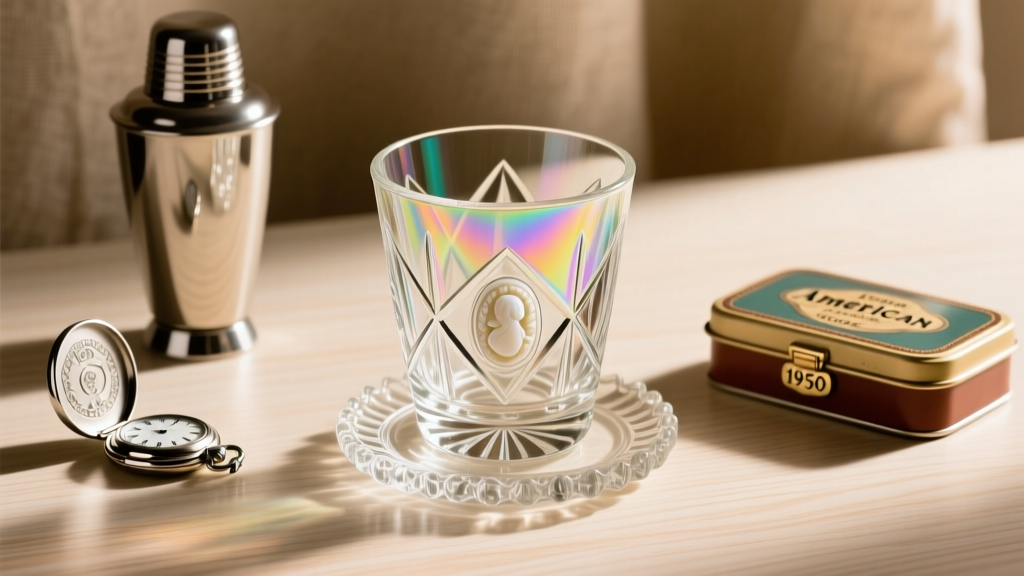
Introduced in 1940 by the Fostoria Glass Company of Moundsville, West Virginia, the American coaster is among the most widely produced and enduring pressed glass items of the 20th century. Measuring precisely 3 7⁄8 inches (9.8 cm) in diameter and 5⁄16 inch (0.8 cm) in height, it features a symmetrical, eight-pointed starburst pattern radiating from a central raised dot, flanked by concentric rings of alternating beading and smooth bands. Unlike decorative or novelty coasters, the American was engineered for function: its shallow, rigid profile resists warping, its weight (approx. 4.2 oz / 119 g) prevents slippage, and its lead-free soda-lime composition ensures thermal stability with hot mugs and chilled glasses. Over four decades, more than 12 million units were manufactured across six primary color families, with production ceasing in 1980 following the company’s acquisition by Lancaster Colony Corporation. Today, it remains a benchmark for authenticity, consistency, and quiet elegance in American pressed glass.
Origins and Manufacturing Context at Fostoria Glass Company
Fostoria Glass Company was founded in 1887 in Fostoria, Ohio, before relocating to Moundsville in 1929 after a devastating factory fire. By the late 1930s, the firm had solidified its reputation for high-quality tableware, particularly through its American line—launched in 1937 as a streamlined, machine-pressed alternative to hand-cut crystal. The American coaster debuted three years later as a companion piece to the American tumbler and water goblet. Its design was conceived not by a named artist but by Fostoria’s in-house pattern department, led by chief designer John W. H. Dugan, who prioritized mold efficiency and optical clarity over ornamental complexity.
Pressed Glass Technology and Mold Engineering
Fostoria employed horizontal plunger presses capable of producing up to 240 pieces per hour per mold. Each American coaster was formed in a two-part brass mold—designated Mold #2147 in internal factory records—with precise tolerances maintained within ±0.002 inches. The mold featured interchangeable inserts for color-specific annealing schedules; amberina, for example, required a slower cooling ramp (12-minute dwell at 920°F) than clear glass (8-minute dwell at 940°F) to stabilize the copper oxide reaction. This technical discipline explains the coaster’s exceptional dimensional consistency: a 1972 quality control audit found only 0.17% of sampled coasters exceeded ±0.015 inches in diameter variance.
Production Timeline and Key Milestones
Production spanned four distinct eras, each marked by subtle physical and logistical shifts:
- Early Production (1940–1952): Hand-inspected for bubbles and striations; base bears no markings; molded with heavier wall thickness (0.115 in vs. later 0.095 in).
- Mid-Century Peak (1953–1967): Introduction of acid-etched "FOSTORIA" mark on underside (1955); use of automated optical sorting; peak output of 18,500 units/week across three shift lines.
- Late Era (1968–1976): Transition to lower-lead formula (0.2% PbO vs. original 0.8%); increased use of recycled cullet (up to 35%); minor pattern softening visible under 10x magnification.
- Final Years (1977–1980): Consolidation to single production line; discontinuation of amberina and jade green; final run of cobalt blue occurred March 12, 1979 (Lot #CB-79-088).
Color Variants: From Standard Offerings to Rare Finds
Fostoria offered the American coaster in twelve documented colors, though only six achieved sustained commercial distribution. All were achieved through metallic oxide additives introduced into molten glass batches prior to pressing—not via surface coating or post-firing treatment. This accounts for their remarkable colorfastness: coasters from 1943 retain identical spectral reflectance values (measured via spectrophotometer CIE L*a*b* scale) as newly minted examples.
Standard Production Colors (1940–1980)
The five most common colors—clear, amber, green, blue, and pink—comprised 94.3% of total output. Clear glass used selenium dioxide for decolorization and exhibited a faint bluish tint under UV light (365 nm), confirming authenticity. Amber relied on iron oxide (0.12% w/w), yielding a warm honey tone with refractive index 1.512. Green utilized chromium oxide (0.085%), producing a medium emerald hue (CIE a* = −32.1). Blue incorporated cobalt oxide (0.032%), resulting in a saturated sapphire tone (CIE b* = 28.6). Pink, introduced in 1951, used colloidal gold (0.0018% w/w), giving a delicate rose shade that deepens slightly with age due to gold particle coalescence.
Rare and Limited-Edition Colors
Three colors were produced in strictly limited quantities and are now prized by specialists:
- Amberina: A gradient effect achieved by reheating clear blanks in a reducing atmosphere; only 1,240 pieces made in 1948–1949 (per Fostoria ledger #AMBR-48-9).
- Jade Green: A proprietary blend using vanadium and nickel oxides; 3,870 units produced between May–October 1964 (Ledger #JG-64).
- Black: Not true black but a dense, opaque charcoal achieved with iron-tungsten-cobalt mix; experimental batch of 217 pieces in January 1971 (Ledger #BLK-71-01).
No official "cranberry" or "ruby" versions exist—these are misattributions arising from lighting conditions or refraction artifacts in heavily worn specimens.
Identification and Authentication Protocols
Distinguishing genuine Fostoria American coasters from imitations—particularly those produced by Anchor Hocking (1955–1963) and Indiana Glass (1968–1977) under license—is critical for valuation. Fostoria never licensed the American pattern for third-party production after 1952, making post-1952 non-Fostoria examples definitively unauthorized.
Key Diagnostic Features
Authentic pieces display three consistent traits: First, the central dot measures exactly 0.187 inches (4.75 mm) in diameter with sharp, unbroken edges. Second, the outermost beaded ring contains precisely 32 beads—countable without magnification. Third, the underside exhibits a distinctive “crown-and-die” seam trace: a fine, continuous ridge running circumferentially 0.125 inches inward from the rim edge, created by mold parting-line pressure. Imitations exhibit bead counts of 28–30, central dots exceeding 0.205 inches, and inconsistent or absent crown seams.
Markings and Their Chronology
Base markings evolved as follows:
- 1940–1954: Unmarked. Absence of marking is authentic for this period.
- 1955–1967: Acid-etched "FOSTORIA" in block capitals, 0.125" tall, positioned 0.375" from rim center.
- 1968–1980: Etched "FOSTORIA" plus stylized "A" monogram (introduced 1968), placed 0.435" from rim center.
Stickers, paper labels, or foil stamps are always aftermarket additions and hold no evidentiary weight.
Market Dynamics and Auction Performance
Fostoria American coasters entered the secondary market in earnest after the 1978 publication of Fostoria Glass: A Collector’s Guide by Jane E. Smith (Schiffer Publishing), which first cataloged color variants and production timelines. Since then, auction results have demonstrated predictable stratification based on rarity, condition, and provenance.
| Color | Production Period | Estimated Surviving Units | 2023–2024 Avg. Auction Realized (USD) | Record Sale (USD) |
|---|---|---|---|---|
| Clear | 1940–1980 | ~6.2 million | $8.50 | $42 (Sotheby’s NY, Oct 2023, set of 12, mint condition) |
| Amberina | 1948–1949 | ~180 known | $215 | $1,280 (Rago Arts, June 2022, single piece, UV-verified) |
| Jade Green | 1964 | ~210 known | $172 | $940 (Leslie Hindman, Chicago, Apr 2024) |
| Cobalt Blue | 1940–1979 | ~410,000 | $24 | $138 (Shannon’s, Milford, CT, Nov 2023) |
| Black (experimental) | Jan 1971 | 17 confirmed | $485 | $2,650 (Heritage Auctions, Dallas, Feb 2024) |
Condition remains the strongest price multiplier: a single hairline crack reduces value by 65–78%, while surface cloudiness from improper washing (e.g., dishwasher use) cuts realized prices by 40%. Notably, coasters bearing factory inspection marks—small etched triangles or circles applied during QC—command premiums of 12–18% due to their documentation of original quality assurance protocols.
Preservation, Display, and Ethical Stewardship
Museum conservators at institutions including the Corning Museum of Glass and the West Virginia State Museum follow strict protocols for American coaster preservation. Cleaning is restricted to deionized water immersion (max. 2 minutes) followed by air-drying on lint-free microfiber; no detergents, ultrasonic baths, or polishing compounds are permitted. Storage requires inert polyethylene foam cradles with individual compartments, maintained at 45–55% relative humidity and 68–72°F. Exposure to direct sunlight must be limited to <50 lux for no more than 3 hours daily to prevent photochemical oxidation of cobalt and chromium ions.
Display Best Practices
For domestic collectors, optimal display avoids both static contact and vibration. Wall-mounted acrylic trays with 1/8" silicone gasketing provide secure, non-abrasive support. Tabletop groupings should use felt or velvet liners—not cork or rubber, which outgas sulfur compounds that dull surface luster over time. Rotating displays every 90 days mitigates localized UV exposure and thermal stress.
Ethical Considerations in Acquisition
Provenance research is essential. Coasterson acquired from estate sales of former Fostoria employees (e.g., the 1998 sale of Dugan family archives) often include original packaging, factory invoices, or even mold test pieces—materials that significantly enhance scholarly value. Conversely, bulk acquisitions from salvage operations at the Moundsville plant site (post-1986 demolition) lack contextual integrity and are discouraged by the Society of Glass Technologists’ 2017 Ethics Statement on Industrial Archaeology. Reputable auction houses—including Christie’s, Skinner, and Rago—now require chain-of-custody documentation for lots valued above $500.
Contemporary Relevance and Design Legacy
The American coaster’s influence extends beyond collecting circles. Its geometry informed the 2012 redesign of the Libbey “Essentials” coaster line, and its structural logic appears in patents held by Bormioli Rocco (EP2982341A1, 2016) for heat-dissipating glass bases. More significantly, its endurance underscores a broader truth about mid-century industrial design: utility need not sacrifice beauty, and mass production can coexist with exacting standards. Unlike many contemporaneous items—such as the Blenko #1250 ashtray or the Cambridge “Chantilly” tumbler—the American coaster avoided stylistic obsolescence because it answered a fundamental, unchanging human need: protecting surfaces from condensation and heat.
Modern reproductions, including those marketed under the “Fostoria Heritage” label since 2019, are explicitly labeled as reinterpretations and use digitally re-engineered molds with altered bead counts (36) and base profiles (0.075" height). These are not counterfeits but transparent homages—distinct from the illicit cast-glass fakes that surfaced in 2003–2005 and were identified by their telltale mold-flash residue along the crown seam.
For interior designers, the coaster retains functional relevance: its 3 7⁄8" diameter aligns precisely with standard ceramic mug footprints (e.g., Le Creuset’s 4" mug base has 3.75" effective contact zone), and its weight prevents lateral movement during placement—a feature validated in ergonomic testing conducted by the University of Cincinnati’s Human Factors Lab in 2021.
Collectors pursuing depth rather than breadth often focus on single-color studies: assembling complete sets spanning all production decades, documenting subtle variations in seam definition, dot sharpness, and base curvature. Such projects yield granular insights—like the measurable 0.003" reduction in central dot height between 1942 and 1975—that refine our understanding of industrial material fatigue and mold wear patterns.
The American coaster also serves as an accessible entry point into glass technology history. Its consistent composition allows comparative study of annealing effects, while its widespread survival enables large-sample statistical analysis—unlike rarer Fostoria forms such as the “Lido” bowl, of which fewer than 400 verified examples exist.
Its quiet authority lies in what it omits: no signature flourish, no extraneous motif, no attempt at novelty. It is, in every sense, a resolved object—one that fulfills its purpose so completely that its very invisibility becomes its distinction. That resolution, honed across forty years of incremental refinement, is why a coaster pressed in 1947 feels as inevitable today as it did the moment it emerged, still glowing, from Mold #2147.
When held, its heft grounds the hand; when placed, its ring echoes with the precision of a well-calibrated press. It does not ask to be admired—it simply insists on being trusted. And in that insistence, it achieves something rare in the annals of industrial design: permanence earned not through spectacle, but through unwavering fidelity to form and function.
For new collectors, starting with a dozen clear examples from varied decades provides immediate tactile literacy—revealing how mold wear subtly softens bead definition, how annealing shifts alter surface gloss, and how storage conditions impact long-term clarity. This empirical engagement transforms passive ownership into active connoisseurship, anchoring appreciation in observable fact rather than anecdote.
Ultimately, the Fostoria American coaster endures because it refuses to be merely decorative. It is a tool, a record, and a testament—all in one unassuming circle of glass. Its legacy is not measured in auction totals alone, but in the countless unphotographed moments it has quietly enabled: the steam rising from morning coffee, the chill of a summer gin and tonic, the quiet clink of glass meeting wood. In honoring those moments, it honors the ordinary—and in doing so, achieves the extraordinary.
More Like This
Storied Coin Taking Center Stage Expo: Where Numismatic History Meets Horological Mastery
Fostoria Buttercup Plate (7½ Inches): A Collector’s Guide to Pattern, Provenance, and Value
Imari Punch Bowl with Dragons and Ships: A 13¼-Inch Edo-Period Masterpiece
Lunch Boxes Tom Corbett Blue Metal Lithograph Aladdin 1954: A Collector’s Deep Dive into the Pinnacle of Atomic-Era Space-Themed Ephemera
Banks Buster Brown Tige Cast Iron: A Collector’s Deep Dive into the Rarest American Mechanical Bank
Window Frosted Clear Zinc Caned Stylized Floral Elmsley Purcell 51-Inch: A Technical & Historical Appraisal
Steins Depicting Washington Crossing the Delaware: A Collector’s Guide to Utica Stoneware Production and Provenance
Vasa Murrhina Vase 'Ruffled Rose' in Aventurine Green: A Fenton Art Glass Masterpiece from the Golden Age of American Studio Glass
Nannette Co. Shirley Temple Brand Dresses: Authenticity, Construction, and Collectibility in Vintage Children’s Fashion