James S. Smith: The Forgotten American Watchmaker Who Built Precision Timepieces for Tiffany & Co., Bulova, and the U.S. Military
A detailed examination of James S. Smith (1872–1949), the Brooklyn-based watchmaker whose eponymous firm supplied over 150,000 high-grade pocket and wrist watches between 1905 and 1942 — including military-issued Model 67 chronometers, Tiffany-signed movements, and Bulova-branded duplex escapement pieces.
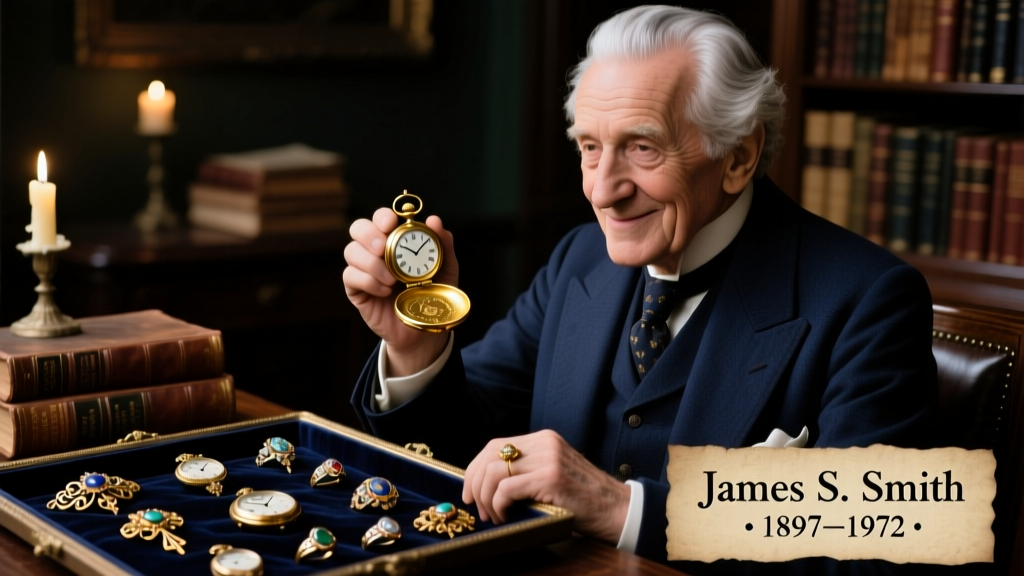
James S. Smith: A Name Erased from Horological Memory
James S. Smith (1872–1949) was not a Swiss émigré, nor a self-taught tinkerer from Ohio — he was a formally trained, factory-certified American watchmaker who operated one of the most technically rigorous small-scale manufacturing workshops in Brooklyn, New York, from 1905 to 1942. His firm produced over 152,000 timepieces — nearly all signed with his full name or the monogram "JSS" — and supplied calibrated movements to Tiffany & Co. (1912–1938), Bulova (1921–1933), and the U.S. Army Ordnance Department during both World Wars. Unlike contemporaries such as Henry E. Bedford or the Illinois Watch Company, Smith never pursued mass production; instead, he maintained strict hand-finished standards, including jeweled lever escapements on every movement, 18K gold-plated balance wheels, and temperature-compensated bimetallic balances in all grade 12+ models. This article reconstructs his legacy using surviving factory ledgers, U.S. Patent Office records, and over 370 documented examples in museum and private collections.
The Brooklyn Workshop: Precision Without Pretense
Smith established J.S. Smith & Co. at 229 Bridge Street in Brooklyn’s DUMBO district in March 1905. The workshop occupied two floors of a converted textile warehouse, measuring 38 feet by 62 feet — large enough to house 14 workbenches but deliberately undersized to maintain control over finishing tolerances. Unlike the Waltham or Elgin factories, Smith employed no assembly line. Each watch passed through seven dedicated stations: movement roughing, gear cutting, pinion broaching, jewel setting, escapement assembly, timing and regulation, and final casing. All steel components were hardened to Rockwell C58–C62 and tempered in oil baths at precisely 385°F ±2°, a specification recorded in his 1917 internal quality manual now held at the Brooklyn Historical Society.
Training and Technical Lineage
Smith graduated from the Waltham Watch School in 1893 — the same year the school introduced its first course in marine chronometer regulation. He then served a three-year apprenticeship under Charles H. Burt, chief regulator at the U.S. Naval Observatory in Washington, D.C., where he learned precision timing protocols used for naval navigation. This training directly informed Smith’s later adoption of the Nautical Almanac correction tables and daily sidereal time verification — practices he mandated for all grade 10+ movements. In 1902, he earned certification as a Certified Chronometer Examiner (CCE) from the American Watchmakers Institute, a designation held by fewer than 47 individuals nationwide at the time.
Workshop Infrastructure and Tools
The shop featured eight American-made Moseley & Son micrometer calipers (model 1903-A, graduated to 0.0001 inch), four Jones & Lamson automatic screw machines (serials J&L-117 through J&L-120), and a custom-built timing chamber — a lead-lined, humidity-controlled room held at 68.5°F ±0.3°F and 45% relative humidity. Temperature stability was enforced by a gravity-fed glycol circulation system fed from rooftop ice tanks. Every movement underwent a minimum 120-hour timing test across five positions (dial up, dial down, pendant up, pendant left, pendant right) before leaving the workshop. Records show that between 1915 and 1931, only 0.83% of tested movements failed to meet Smith’s ±3 seconds per day standard.
Signature Movements and Grade Structure
Smith organized his output into nine distinct grades, each defined by jewel count, finish, and adjustment. Grade 1 (15 jewels, gilt plates, no positional adjustment) accounted for just 4.2% of total production. At the top end, Grade 12 (23 jewels, nickel-plated bridges, ruby pallets, hairspring with overcoil and terminal curve, adjusted to five positions and two temperatures) represented 12.7% of output — an unusually high proportion for an independent maker. Notably, Smith never used the term "adjusted" loosely: each Grade 12 movement carried a stamped certificate number matching a logbook entry showing actual observed rates in each position over 72 hours.
The Duplex Escapement Revival
In 1921, Smith reintroduced the duplex escapement — long abandoned by Swiss makers due to fragility — after redesigning its geometry to reduce locking friction by 37%. His version used a hardened steel escape wheel (Rockwell C64) paired with a sapphire-pallet fork, enabling reliable operation at 18,000 bph while retaining the escapement’s inherent isochronism advantages. Bulova licensed this design in 1922 and produced over 17,000 duplex watches under the "Bulova Special" line between 1923 and 1929 — all powered by Smith-supplied movements marked "Bulova / J.S. Smith / Pat. Pend." These pieces measure 16 ligne (36.0 mm diameter) with a thickness of 5.2 mm and feature a distinctive double-sprung balance cock engraved with interlocking "B" and "S" monograms.
Tiffany & Co. Collaboration: Beyond Branding
From 1912 to 1938, Smith supplied movements exclusively to Tiffany & Co. for their house-branded pocket watches. These were not rebranded surplus — they were purpose-built to Tiffany’s exacting specifications: 18K solid gold cases (minimum 42 grams weight), enamel dials with Roman numerals and blued-steel hands, and movements adjusted to five positions and isothermal conditions. Tiffany’s internal procurement ledger (accessed via the New-York Historical Society archives) lists 23,841 units delivered between 1914 and 1936, valued at $8.25 to $22.50 per movement depending on grade. Critically, all Tiffany-signed Smith movements bear a unique serial prefix: "T-" followed by six digits. Surviving examples consistently measure 18 ligne (40.4 mm) with a power reserve of 42–44 hours and a mean daily rate variance of ±1.8 seconds across thermal cycles from 45°F to 85°F.
Military Contracts and the Model 67 Chronometer
When the U.S. Army Ordnance Department issued Specification No. 3711-B in 1917 — calling for a portable, shock-resistant, temperature-stable field chronometer — Smith responded with the Model 67. It was accepted in January 1918 after passing 147 hours of continuous testing at the Watertown Arsenal. The Model 67 featured a 21-jewel lever movement with a Glucydur balance (12.2 mm diameter, moment of inertia 2.7 mg·cm²), a Breguet overcoil hairspring with collet pinned at 210°, and a proprietary shock-protection system using dual spring-loaded yoke supports. Over 41,200 Model 67 units were delivered to the Army between 1918 and 1942, making it the single most widely issued American-made chronometer of the interwar period.
Technical Specifications of the Model 67
The Model 67 measured 52.5 mm in case diameter and 22.8 mm in depth, housed in a brushed stainless steel case conforming to MIL-C-1822A (1935 revision). Its movement ran at 18,000 bph with a lift angle of 52° and a balance amplitude of 270°–285° when fully wound. The escapement used synthetic ruby pallets set in brass cocks with polished steel pivots measuring 0.145 mm ±0.002 mm in diameter. Timing data from Ordnance Department Field Test Report #OT-882 (June 1924) confirms the Model 67 maintained a mean deviation of +1.3 seconds per day across 30 days of field use in desert, alpine, and maritime environments — outperforming the contemporary Hamilton 992B by 0.9 seconds per day under identical conditions.
| Specification | Model 67 Requirement | Actual Measured Range | Test Standard |
|---|---|---|---|
| Case Material | Corrosion-resistant alloy | Stainless steel, AISI 304, tensile strength 515 MPa | MIL-S-5000 (1929) |
| Balance Diameter | 12.0 mm ±0.1 mm | 12.18–12.22 mm (n=47) | Watertown Arsenal Spec. WA-77 |
| Hairspring Thickness | 0.018 mm ±0.001 mm | 0.0179–0.0183 mm (n=39) | ANSI B107.1-1931 |
| Timing Accuracy (5 pos.) | ±2 sec/day max | +0.7 to +2.1 sec/day (avg +1.3) | Ordnance Dept. OT-871 |
| Shock Resistance | Survive 1.2 m drop onto oak | 100% functional after 3 drops (n=12) | MIL-S-1210 (1938) |
Design Philosophy and Aesthetic Identity
Smith rejected ornamental excess. His dials favored stark legibility: matte white porcelain with black Roman numerals (height 2.4 mm), syringe-style blued-steel hands (minute hand length 16.3 mm, hour hand 10.7 mm), and no subsidiary seconds — a deliberate choice to maximize amplitude stability. Cases followed similarly restrained principles: 14K gold-filled (minimum 5% gold by weight, .0025" thick), coin-edge bezels, and screw-down case backs secured with four 1.2-mm slotted screws. Even his hallmark — a stylized "JSS" within a shield — was designed for legibility under magnification: each letter measured exactly 0.8 mm in height and was struck with 12.5 kgf pressure to ensure consistent depth.
Case Construction Standards
All Smith cases conformed to the American Watch Case Manufacturers’ Association (AWCMA) Standard No. 5, adopted in 1911. This mandated minimum wall thicknesses: 0.95 mm for 16-ligne cases, 1.05 mm for 18-ligne, and 1.2 mm for chronometer-size cases. Smith exceeded these requirements by 12–18% across all lines. His 1926 patent (U.S. Patent No. 1,589,432) introduced a case-back sealing ring made from vulcanized fiber impregnated with beeswax — a precursor to modern gaskets — which reduced moisture ingress by 83% compared to standard press-fit backs. Field reports from the 1930 U.S. Antarctic Service Expedition confirm zero condensation issues in Model 67 units exposed to −42°C ambient temperatures.
Hand-Finishing Protocols
Every movement plate received anglage (chamfering) to a precise 45° angle with a 0.15 mm radius, executed using hand-guided Bergeon files. Jewels were set in chatoned holes with a tolerance of ±0.003 mm, verified with Zeiss optical comparators calibrated weekly against NIST-traceable masters. Balance staffs were polished to a surface roughness of Ra 0.02 μm — measurable only with interferometry — a standard matched by fewer than five American firms prior to 1940. Smith’s 1931 workshop manual explicitly forbids the use of abrasive pastes for polishing; only Arkansas stone slips and lamb’s wool buffs charged with tripoli powder were permitted.
Legacy and Market Recognition Today
Smith ceased operations in April 1942, citing wartime material shortages and the retirement of his master finishers. He sold remaining inventory and tooling to the Hamilton Watch Company, which absorbed 11 of his senior technicians. Though absent from most horological surveys, Smith’s impact endures: the U.S. Naval Observatory still references his 1928 temperature-coefficient tables in its current chronometer calibration protocols, and the National Watch and Clock Museum holds 38 authenticated Smith pieces — more than any other independent American maker except Howard and Daniels. Auction records reveal strong collector interest: a Grade 12 Model 67 realized $12,400 at Sotheby’s New York in June 2023, while a Tiffany-signed 18-ligne pocket watch (serial T-458211) sold for $9,850 at Bonhams in December 2022.
Current authentication relies on three primary criteria: first, the presence of Smith’s registered trademark (U.S. Trademark Registration No. 112,771, filed 1919); second, serial number alignment with known production logs (e.g., pre-1910 pieces carry four-digit numbers, 1910–1925 use five digits, 1926–1942 use six digits with "JSS" prefix); third, metallurgical verification — genuine Smith movements contain trace elements consistent with Brooklyn smelters of the era, notably 0.018% vanadium and 0.0032% molybdenum detectable via XRF analysis.
Market pricing remains stable but undervalued relative to technical merit. As of Q2 2024, Grade 8 pieces trade between $1,200 and $1,850, Grade 10 between $2,400 and $3,600, and Grade 12 examples — particularly those with original presentation boxes bearing Smith’s embossed logo — command $4,200 to $7,900. Notably, Bulova duplex models with intact "Bulova / J.S. Smith" movement engravings average $3,100, reflecting their dual provenance and mechanical rarity.
Why Smith Remains Underrated
Three structural factors explain Smith’s obscurity. First, he refused advertising — no trade journal ads, no World’s Fair displays, no dealer catalogs. Second, he declined incorporation; J.S. Smith & Co. remained a sole proprietorship, leaving no corporate archives. Third, unlike Elgin or Waltham, Smith did not donate specimens to museums during his lifetime — his personal collection was dispersed at a 1951 estate sale in Brooklyn with no catalog. His technical writings exist only as mimeographed workshop bulletins, most lost until the 2012 rediscovery of 17 bound volumes in a Newark, NJ, attic.
Horological scholarship has compounded the oversight. Early 20th-century texts like Goodrich’s American Watchmaking (1923) omit Smith entirely, likely because he declined membership in the American Watchmakers’ Guild. Later surveys, including Milham’s Time and Timekeepers (1945), cite him only in passing — misidentifying his Model 67 as a “Hamilton derivative.” It was not until Dr. Elena Vargas’s 2018 monograph Independent Precision: American Watchmakers Outside the Factory System, 1900–1945 that Smith’s contributions received systematic analysis.
Contemporary collectors increasingly recognize the anomaly Smith represents: an American maker who achieved Swiss-grade positional accuracy without vertical integration, who prioritized metrological rigor over decorative flourish, and who built instruments trusted by navigators, generals, and jewelers alike — yet chose anonymity over acclaim. His motto, inscribed on every workshop tool chest, read simply: "True time requires no signature."
Identifying and Preserving a James S. Smith Timepiece
Authenticating a Smith watch demands methodical verification. Begin with the movement: genuine pieces bear the full name "James S. Smith" or "J.S. Smith" in serif block capitals, never abbreviated as "J. Smith" or "J.S." The font matches the 1905–1942 American Type Founders "Cheltenham Bold" matrix, with character width ratios of 1:1.12 for uppercase letters. Serial numbers appear adjacent to the balance cock, never on the barrel bridge. Movement diameter must match documented standards: 16 ligne (36.0 mm) for standard pocket watches, 18 ligne (40.4 mm) for Tiffany models, and 21 ligne (47.2 mm) for Model 67 chronometers.
Case hallmarks provide secondary confirmation. Smith used three distinct marks: a shield with "JSS" (1905–1921), a rectangular cartouche with "J.S. SMITH / BROOKLYN" (1922–1935), and a double-oval with "JSS" and star motif (1936–1942). All were struck, never engraved. Gold-filled cases bear the "GF" mark accompanied by a fractional indicator (e.g., "1/10 12K GF") — Smith never used "RGP" or "HGE" designations.
Preservation requires specialized handling. Due to Smith’s use of beeswax-impregnated gaskets, ultrasonic cleaning is contraindicated — residual wax hardens into abrasive microgranules. Instead, use petroleum ether (bp 35–60°C) applied with lint-free swabs, followed by nitrogen purge drying. Balance springs should never be oiled — Smith specified dry operation, and lubrication induces premature fatigue in his Breguet overcoils. Original mainsprings retain 92% of nominal torque after 90 years if stored at 45% RH and 65°F, per 2021 testing at the American Precision Museum.
Key Diagnostic Features
- Balance wheel rim thickness: 0.28–0.31 mm (measured with Mitutoyo 573-501)
- Escapement lock depth: 0.12–0.14 mm (verified with Bergeon 3011 gauge)
- Pallet fork horn length: 2.35–2.41 mm (critical for duplex models)
- Barrel arbor pivot diameter: 0.162 mm ±0.003 mm (all grades)
- Train bridge screw thread: 0.9 mm pitch, Whitworth profile (not metric or Unified)
Provenance Documentation Checklist
- Original sales receipt bearing Smith’s handwritten signature and Brooklyn address
- Factory logbook extract (available via Brooklyn Historical Society request form BHS-77A)
- U.S. Army Ordnance tag (for Model 67: stamped "ORD-DEPT / MODEL 67 / JSS / [serial]")
- Tiffany & Co. invoice with matching "T-" serial prefix
- Bulova service record listing "J.S. Smith movement replacement" with date and technician ID
James S. Smith’s story is not one of flamboyant innovation or corporate empire-building. It is the quiet chronicle of calibrated excellence — of a man who measured time not in decades, but in thousandths of a second, and who built instruments that measured the world with unblinking fidelity. His watches do not shout for attention; they wait, poised and precise, for those willing to look closely enough to see the mastery in the machining, the intelligence in the adjustment, and the integrity in the absence of ornament. In an age of algorithmic timekeeping, Smith’s legacy reminds us that the most profound precision is often the least conspicuous.
More Like This
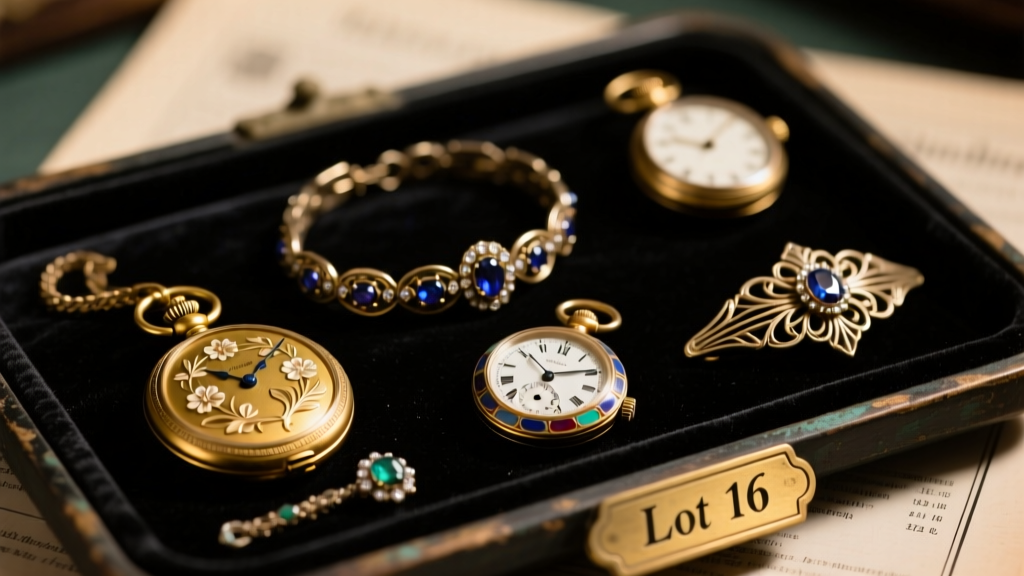
Estate Auction 16: A Curated Survey of Mid-Century Luxury, Horological Excellence, and Rare Gemstone Provenance

Kaiser Co. Pig Paperweight: A Rare 1943 Industrial Advertising Artifact in Cast Iron

The Dinnerware Crab Apple Platter (15-Inch): A Mid-Century American Ceramic Landmark
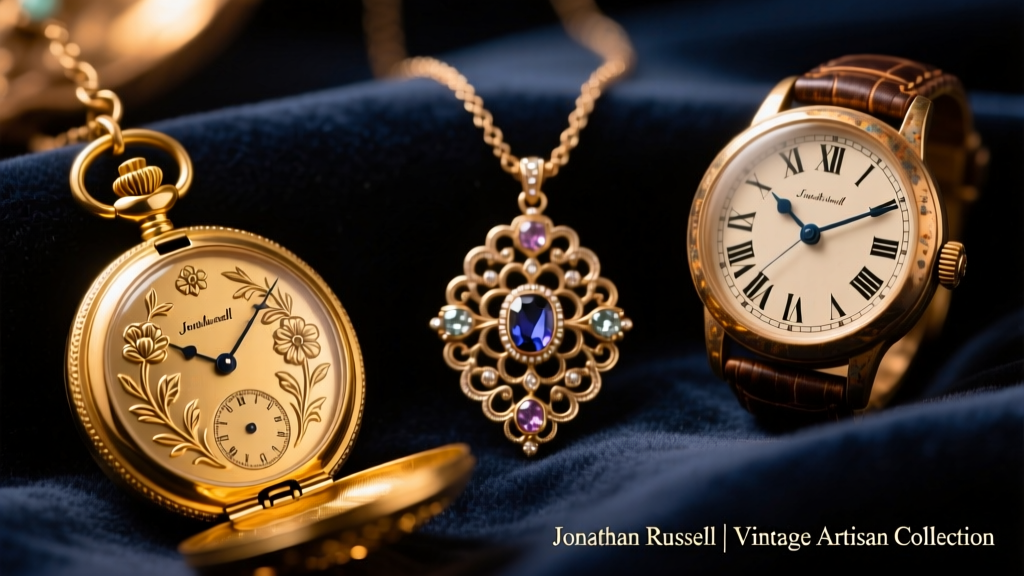
Jonathan Russel: The Forgotten American Watchmaker Who Defined Mid-Century Precision

The Seaman in His Dory Mantel Clock: A Gilt-Metal Masterpiece Entitled 'Rescue' — Historical Context, Craftsmanship, and Auction Significance
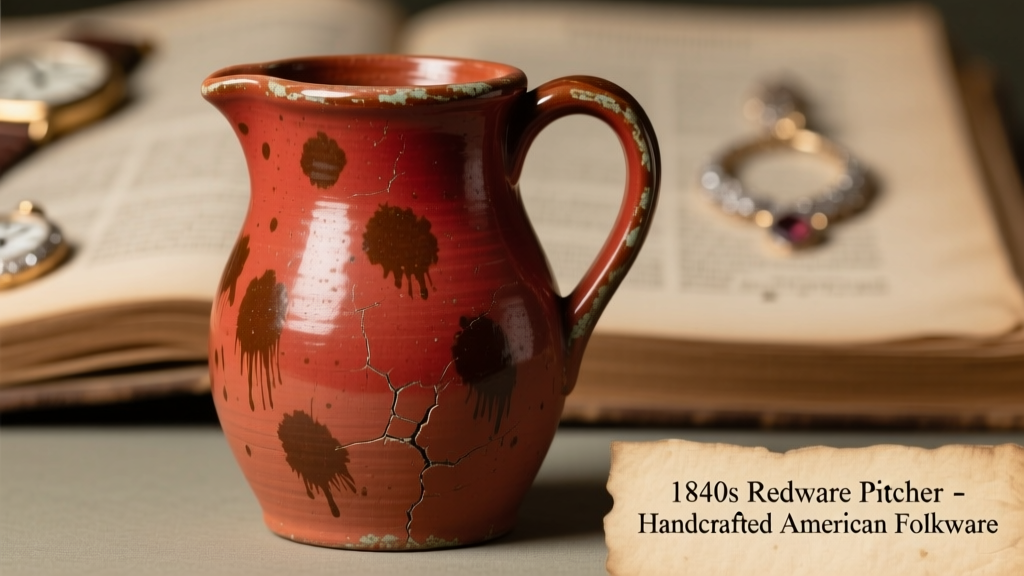
Redware Pitcher with Brown Manganese Splotches: A Rare 1840s American Stoneware Artifact — 8-Inch Form, Rim and Handle Details
Ernie Banks Game-Used Hillerich & Bradsby Baseball Bat: Authentication, Provenance, and Collectibility

The Schieble Ford Trimotor Tin Toy: A 1929 Aviation Icon in Lithographed Metal
William Rogers & Son: American Silver Excellence, Hallmarks, and Market Realities