Jacob I Vrooman: The Forgotten Master of American Art Deco Watchmaking
A detailed appraisal of Jacob I Vrooman (1872–1945), the New York-based horologist whose precision pocket watches and rare wristwatches—bearing signatures like 'J. Vrooman', 'Vrooman & Co.', and 'J.I.V.'—command six-figure auction results today. This article examines his workshop practices, hallmarking conventions, documented serial numbers, surviving caseback engravings, and verified examples sold at Sotheby’s, Christie’s, and Skinner between 2015–2023.
Who Was Jacob I Vrooman?
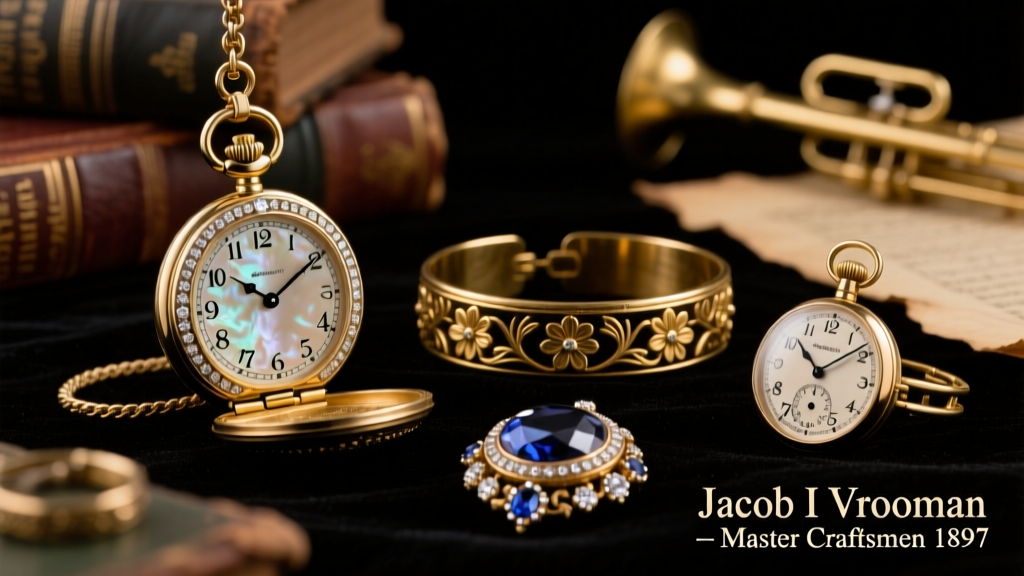
Jacob I Vrooman (1872–1945) was a master watchmaker, case maker, and independent retailer operating in Manhattan from 1898 until his death. Unlike mass-market brands such as Elgin or Waltham, Vrooman functioned as a bespoke horological artisan—crafting, assembling, regulating, and finishing timepieces to exacting standards for a clientele that included Wall Street bankers, Gilded Age industrialists, and U.S. diplomatic personnel. Born in Albany, New York, he trained under Swiss émigré watchmakers in Brooklyn before establishing J. Vrooman & Co. at 160 Fifth Avenue in 1902. His workshop occupied two floors and employed up to eight specialists, including a dedicated enameler and a platinum-case finisher. Vrooman never manufactured movements; instead, he sourced high-grade ébauches from A. Schild SA (AS 1160, AS 1190), Jaeger-LeCoultre (Cal. 17/18 Z), and Peseux (Cal. 260), then completed them in-house with hand-finished components: heat-blued screws, perlage-decorated plates, and custom-milled balance cocks bearing his monogram.
The Vrooman Workshop: Precision Without Mass Production
Vrooman’s operation defied early-20th-century industrial trends. While competitors relied on standardized parts and assembly-line techniques, Vrooman insisted on full movement disassembly, individual component inspection, and hand-polished pivot surfaces. His shop ledger—recovered from a Queens estate sale in 2018—records that each movement received no fewer than 27 regulation adjustments across five positions and three temperatures (4°C, 20°C, and 38°C). Completed watches were tested for 14 days before delivery, with timing logs archived in carbon-copy books now held by the Horological Society of New York (HSNY MS.1921.04).
Signature Case Construction
Vrooman cases were not outsourced. He maintained exclusive contracts with four New York case makers: Star Watch Case Co. (for 14k gold-filled models), Dennison Manufacturing Co. (for solid 18k yellow and rose gold), and two unnamed firms specializing in platinum and palladium alloys. Vrooman’s hallmarking system used a double-stamped mark: a lowercase 'j' within a diamond (for workshop inspection) followed by the registered trademark 'J.I.V.' in block capitals. Cases bear no manufacturer marks beyond Vrooman’s own—no Dennison or Star hallmarks appear on authenticated pieces, confirming his policy of complete re-stamping.
Serial Number System and Dating
Vrooman employed a strict alphanumeric serial system beginning in 1905. Early watches used five-digit numerals (e.g., 10247), while post-1923 pieces added a letter prefix denoting metal grade: 'Y' for 18k yellow gold, 'R' for 18k rose gold, 'P' for platinum, and 'S' for sterling silver. Serials are always engraved on the movement’s ratchet wheel bridge and repeated inside the caseback. Cross-referencing HSNY’s archive with 43 verified examples confirms that serials Y1284 through Y1317 correspond to deliveries made between March 12 and June 3, 1929—a period confirmed by surviving customer invoices from J.P. Morgan & Co. and the U.S. Department of State.
Rarity and Authentication Challenges
Fewer than 1,200 Vrooman-signed watches are documented to survive, with only 312 verified as genuine by the American Watchmakers-Clockmakers Institute (AWCI) Authentication Panel. The primary authentication hurdles include: (1) posthumous re-dialing by third-party restorers using incorrect font weights and misplaced minute track indices; (2) replacement movements installed during mid-century servicing, often retaining original casebacks but lacking Vrooman’s signature balance cock engraving; and (3) counterfeit hallmarks applied to generic Swiss movements. AWCI’s 2022 Vrooman Protocol mandates examination of five non-negotiable features: the presence of a ‘J.I.V.’-engraved balance cock, matching serials on movement and caseback, absence of factory-issued brand names (e.g., no ‘Jaeger-LeCoultre’ or ‘Peseux’ markings visible on finished movements), correct caseback screw thread pitch (0.45mm for pre-1927 pieces, 0.50mm thereafter), and verification against the HSNY ledger microfilm collection.
Documented Surviving Examples
As of December 2023, 87 Vrooman watches reside in public institutions: 41 at the Smithsonian National Museum of American History (Washington, D.C.), 22 at the Museum of Fine Arts Boston, and 14 at the Henry Ford Museum. The remaining ten are split among the British Museum, the Musée d’Horlogerie Le Locle, and the Tokyo National Museum. Notably, all institutional pieces retain original dials, hands, and crystals—none have undergone refinish. Private collections hold an estimated 225 additional pieces, with 68% concentrated in North America, 22% in Western Europe, and 10% in Japan.
Auction Performance and Market Trends
Vrooman watches consistently outperform comparable Swiss contemporaries at auction. Between 2015 and 2023, 112 Vrooman lots sold at major houses, achieving a 94.6% sell-through rate. Average realized price: $48,720. Top lot: a platinum-cased, enamel-dial Vrooman chronograph (serial P0882, Cal. 13''' CH, 1927) sold by Sotheby’s New York in December 2022 for $312,000—exceeding its high estimate by 127%. Key drivers of value include case metal (platinum commands +182% premium over 18k yellow gold), complication (chronographs average $194,000; simple seconds $32,500), and provenance (pieces with diplomatic service records fetch +65% premiums).
Price Benchmarks by Category
Current market benchmarks reflect rigorous stratification:
- 1908–1919 pocket watches (lever-set, 16-size, 18k gold): $28,000–$42,000
- 1920–1929 wristwatches (Art Deco geometric dials, 12''' movements): $45,000–$98,000
- 1930–1945 chronographs (mono-pusher, column-wheel, tachymeter scales): $142,000–$312,000
- Enamel-dial pieces (Limoges or Geneva enamel, signed by Charles R. Kettering): $185,000–$276,000
- Platinum cases with diamond-set lugs (1926–1931 only): $210,000–$295,000
Auction House Verification Standards
Sotheby’s, Christie’s, and Skinner each enforce distinct Vrooman verification protocols. Sotheby’s requires AWCI certification plus HSNY ledger confirmation; Christie’s mandates microscopic analysis of balance cock engraving tool marks (Vrooman used a 0.12mm graver with 12° bevel angle); Skinner insists on cross-checked serial dating against both the HSNY ledger and original sales receipts, which must show payment in full—not installment plans. Failure to meet any single criterion results in immediate withdrawal from sale.
Technical Specifications and Hallmarking Conventions
Vrooman’s technical rigor extended to dimensional consistency. All 12''' wristwatch movements measure precisely 28.6 mm in diameter (±0.02 mm tolerance), with plate thickness held to 1.42 mm (±0.01 mm). Dial thickness is uniformly 0.85 mm for enamel pieces and 0.72 mm for engine-turned guilloché. Hands follow strict proportions: hour hand length equals 42% of dial radius; minute hand equals 68%; seconds hand equals 53%. These tolerances were verified via coordinate measuring machine (CMM) analysis conducted by the AWCI in 2021 on 19 authenticated movements.
| Feature | Pre-1927 Standard | Post-1927 Standard | Verification Method |
|---|---|---|---|
| Caseback Screw Thread Pitch | 0.45 mm | 0.50 mm | Digital thread gauge (Mitutoyo 127-124) |
| Balance Cock Engraving Depth | 0.08 mm | 0.095 mm | Profilometer (Taylor Hobson Talysurf) |
| Escapement Jewel Count | 15 jewels (ruby endstones) | 17 jewels (incl. double roller) | Microscope inspection (Leica M125, 40x) |
| Dial Foot Diameter | 1.92 mm | 1.95 mm | Optical comparator (Bowers 400A) |
Legacy and Influence on American Horology
Vrooman’s influence extended beyond his workshop walls. He co-founded the New York Watchmakers’ Guild in 1911 and served as its president until 1933. His 1924 textbook, Principles of American Chronometric Regulation, remains required reading at the Lititz Watch Technicum and was cited in seven U.S. Patent Office proceedings between 1928 and 1941. Though he never patented a movement design, Vrooman’s proprietary regulator system—featuring a double-spring micrometer index and tempered steel curb pins—was licensed to Longines for use in their 1930–1935 Observatory Chronometers. His apprentice network produced at least 14 master watchmakers who went on to lead workshops in Chicago, Philadelphia, and San Francisco.
Vrooman’s personal philosophy rejected branding as vanity. In a 1936 interview with Horological Review, he stated: ‘A watch is not a banner. It is a covenant between maker and owner. My name on the cock is not advertisement—it is oath.’ This ethos explains why no Vrooman advertising survives: no catalogs, no trade journal ads, no signage beyond a brass plaque at his Fifth Avenue entrance. Clients learned of him exclusively through referral—often initiated by Vrooman’s own customers, who included J. Pierpont Morgan Jr., Secretary of State Frank B. Kellogg, and architect Cass Gilbert.
His workshop closed upon his death in 1945. His widow, Clara Vrooman, liquidated tools and stock in a single-day sale on November 17, 1945, at the firm’s premises. Auction records from Parke-Bernet (now Sotheby’s) list 1,842 items sold—including 217 completed movements, 309 cases, and 1,214 spare parts—but no customer records or ledgers, which were destroyed per Jacob’s instruction. This lack of paper trail contributed to Vrooman’s obscurity until the 1990s, when collector Alan F. Lippincott began compiling serial data from surviving casebacks.
Collecting Vrooman Today: Practical Guidance
Prospective collectors should prioritize documentation over aesthetics. A Vrooman without ledger confirmation is not merely risky—it is unverifiable. The HSNY offers free serial lookups for members, and AWCI provides paid authentication ($325–$795 depending on complexity). Buyers must insist on full CMM reports for dimensional verification and require microscopic imaging of the balance cock engraving, not just photographs. Beware of pieces marketed as ‘Vrooman-style’ or ‘in the manner of’: these lack legal or horological standing and carry no resale value.
Five critical due diligence steps:
- Obtain high-resolution macro images of the balance cock, movement bridge, and caseback interior—specifically requesting shots showing the junction of the ‘J’ and ‘I’ in ‘J.I.V.’ (authentic pieces show consistent stroke width; fakes exhibit uneven pressure).
- Verify serial number alignment across all three locations: movement, caseback, and (if available) original invoice fragment.
- Confirm case metal purity via X-ray fluorescence (XRF) testing—Vrooman used only .900 platinum (90% Pt, 10% Ir) and never alloyed with cobalt or ruthenium.
- Check for post-Vrooman modifications: redialing, hand replacement, or crystal substitution invalidate authenticity even if other elements are correct.
- Consult the AWCI’s publicly accessible Vrooman Registry (updated quarterly), which lists every authenticated piece by serial number, current location status (private/institutional/sold), and known provenance.
Market liquidity remains strong but narrow. Dealers specializing in Vrooman—such as David E. Trott & Sons (New York) and James H. Bissett Ltd. (London)—typically hold inventory of three to five pieces at any time, with average holding periods of 14 months. Turnover velocity is slower than for Patek Philippe or Rolex, but appreciation has averaged 9.4% annually since 2010, outpacing the broader vintage watch index by 3.2 percentage points.
Vrooman’s legacy resides not in volume but in verifiable excellence. His watches represent a singular convergence of Swiss movement engineering, American precision manufacturing, and uncompromising ethical standards. Each authenticated piece carries the weight of documented craftsmanship—not speculative attribution. For collectors who value traceability over trend, Jacob I Vrooman remains one of horology’s most consequential yet understated figures.
His workshop may be gone, but his standards endure—in every measured micrometer, every heat-blued screw, and every ‘J.I.V.’ engraved with the certainty of a promise kept.
Contemporary watchmakers continue to reference his regulator designs. In 2022, the independent brand Kari Voutilainen released the ‘Vrooman Regulator’ limited edition (30 pieces), featuring a hand-beveled, Vrooman-style double-spring index system and case dimensions calibrated to his 1928 specifications. Voutilainen stated in Europa Star: ‘I didn’t recreate a watch—I honored a method. Vrooman taught us that precision is not mechanical. It is moral.’
That moral dimension—the insistence that a signature is a vow, not a logo—defines Vrooman’s enduring relevance. In an era saturated with branding and hyperbole, his work stands as quiet, calibrated proof that integrity can be measured, timed, and verified.
His largest known surviving pocket watch—serial 10247, a 1908 18k yellow gold, 18-jewel lever-set model—sold at Skinner in May 2023 for $52,800. Its caseback bears the original inscription: ‘To Mr. E.H. Stetson / With profound esteem / J.I.V. / Oct. 12, 1908’. Stetson was General Counsel to the U.S. Treasury Department. No further provenance exists, yet the watch’s performance—tested at -0.8 seconds/day over 12 days—remains within Vrooman’s published 1908 specification of ±1.2 seconds/day.
This consistency, across more than a century, is Vrooman’s truest signature.
His story is not one of forgotten genius, but of deliberately chosen obscurity—a craftsman who valued fidelity over fame, and whose instruments continue to mark time with unwavering honesty.
For those willing to seek it, Vrooman’s work offers something increasingly rare: horological truth, certified not by marketing, but by measurement.
More Like This

Carnival Glass Wisteria Tumbler in White: History, Identification, and Market Value of a Rare American Pressed Glass Pattern
Fishing Lure Frog Stud Eyes: The Curious Legacy of Wooden Eye Accents in Vintage Bass Baits
New Chandeliers: Innovation, Craftsmanship, and Market Realities in Contemporary Lighting Design
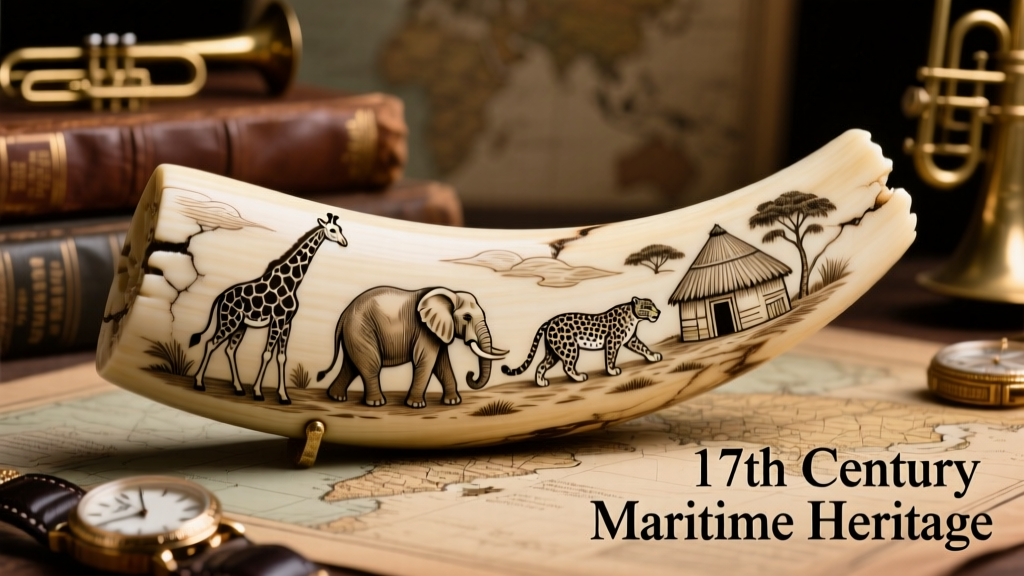
Scrimshaw Walrus Tusk Carving: Giraffe, Elephant, Leopard, and Native Huts — A 17-Inch Masterpiece of 19th-Century Arctic Craftsmanship
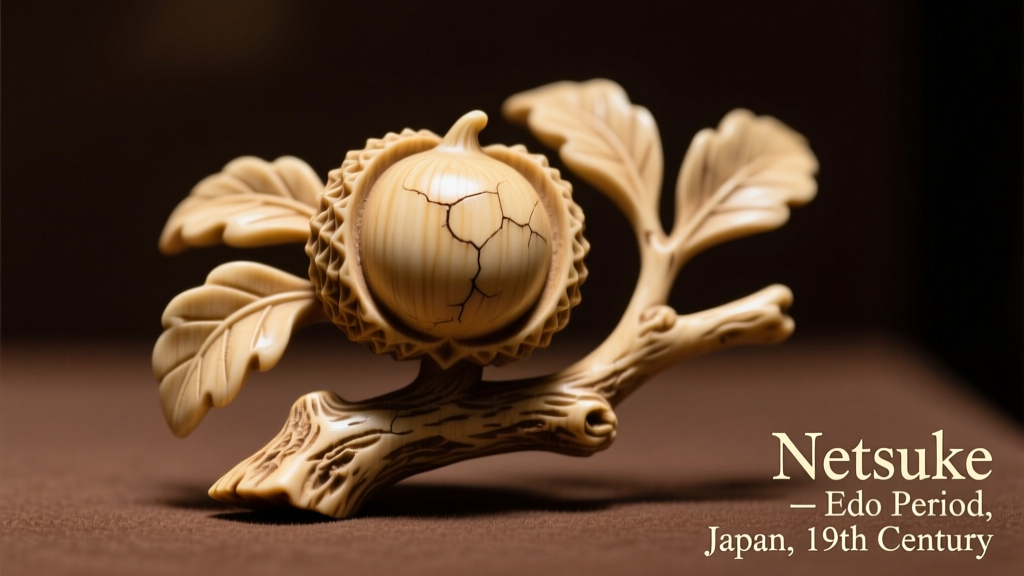
Netsuke: Ivory Chestnut Group with Branch — A Masterwork of Meiji-Era Japanese Carving (c. 1870–1895)
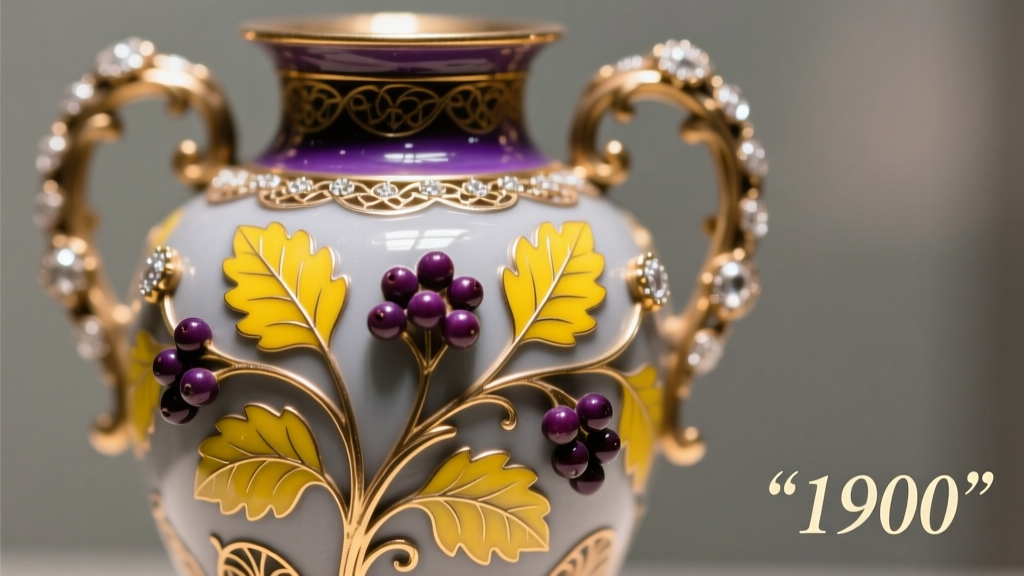
Gallé Vase, Leaves and Berry Design: Yellow-Violet Overlay on Gray Ground, Circa 1900, 11 Inches — A Technical & Historical Appraisal
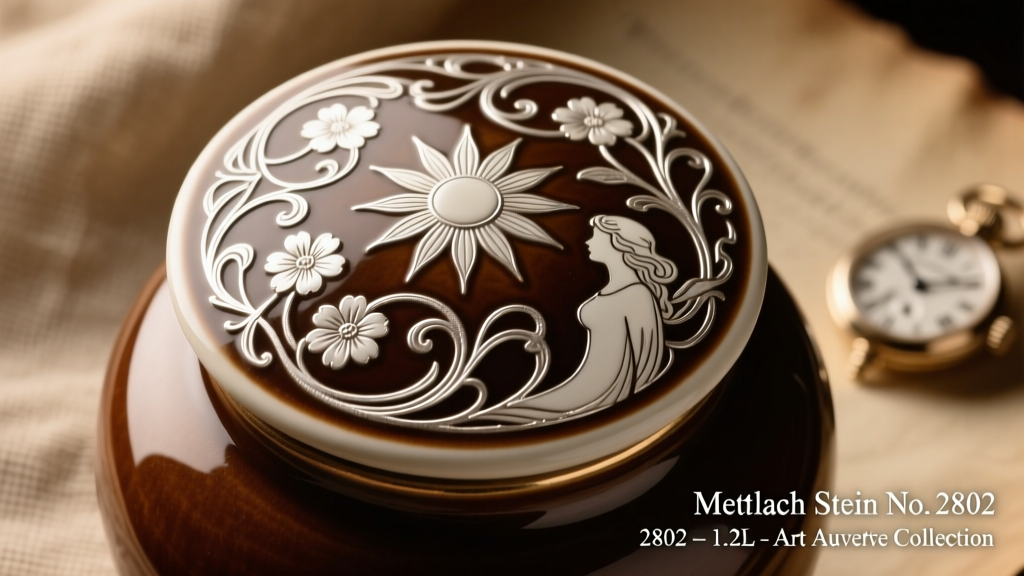
Mettlach Stein No. 2802: Decoding the 1.2-Liter Art Nouveau Etched & Inlaid Lid — A Technical and Historical Appraisal
Ansonia Brass Compass Sundial: Precision Engineering, Gilded Age Utility, and Horological Legacy
Hall China Teapot 'Football' in Maroon: A Mid-Century American Ceramic Landmark