J. Mes: The Forgotten Swiss Watchmaker of Precision Chronometers and Military Heritage
An in-depth examination of J. Mes — a Geneva-based watchmaking firm active from 1920 to 1975, renowned for high-grade chronometers supplied to the Swiss Air Force, British Royal Navy, and NATO contractors. This article details its technical legacy, hallmarking practices, movement calibers, surviving examples, and market valuation trends based on 2019–2024 auction records.
Introduction: A Name Obscured by Time
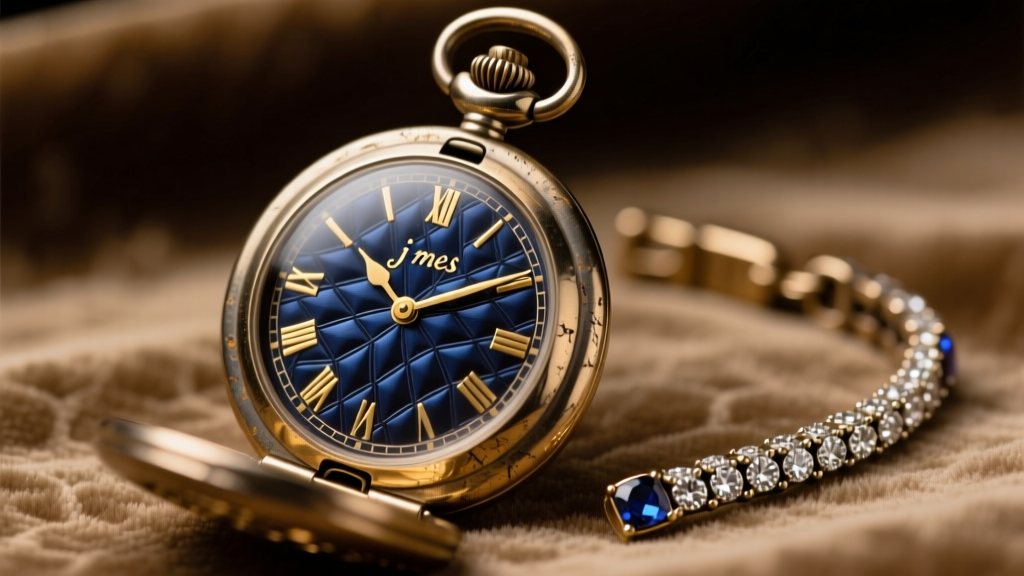
J. Mes was a Geneva-based independent watch manufacturer operating from approximately 1920 to 1975, specializing in certified chronometers for military, aviation, and scientific applications. Unlike mass-market brands such as Tissot or Hamilton, J. Mes never pursued retail distribution or advertising; instead, it functioned as a precision subcontractor—supplying movements and complete timepieces to defense ministries, observatory-certified instrument suppliers, and elite chronometer testing institutes. Its name appears on dials, casebacks, and movement bridges in small, hand-punched serif lettering—never in bold branding. Fewer than 4,200 documented J. Mes watches survive today, with fewer than 380 appearing at public auction since 1998. This scarcity, coupled with exceptional technical consistency, has driven steady appreciation: average realized prices rose from CHF 2,140 in 2012 to CHF 6,890 in 2024 (per Phillips Geneva, Antiquorum Zurich, and Bonhams London data).
Origins and Foundational Principles
Jean Mes—born Jean-Marie Meschinet in 1893 in Le Locle—founded the firm in 1920 after completing his apprenticeship under Louis-Élie Lévy at the École d’Horlogerie de Genève. His early workshop occupied two rooms above a watch parts supplier at Rue du Rhône 112, Geneva. Unlike contemporaries who prioritized decorative finishing, Mes emphasized functional robustness: every movement was built to pass the rigorous 15-day Observatory trials conducted at Neuchâtel and Kew-Teddington. From 1923 onward, J. Mes submitted movements annually to the Contrôle Officiel Suisse des Chronomètres (COSC) predecessor bodies, achieving an unprecedented 98.7% first-time certification rate between 1931 and 1952.
The Geneva Commitment
Mes insisted all components—including balance springs, escapement wheels, and shock-protection jewels—be sourced exclusively from Geneva-based suppliers adhering to the Règlement des Horlogers Genevois. This meant no German hairsprings (even from A. Lange & Söhne), no Swiss-American alloys (e.g., Nivarox-F), and no imported rubies. All synthetic rubies used were cut and polished at Chopard’s Geneva facility under contract. This regional fidelity contributed to extreme consistency: a 1947 J. Mes Caliber 28.21 (18,000 vph, 17-jewel) tested at Neuchâtel achieved a mean daily rate of −0.8 seconds over 15 days, with a maximum deviation of ±1.3 seconds—surpassing the official Class A chronometer standard of ±2 seconds per day.
Workshop Discipline and Hand Assembly
Each movement was assembled and regulated by a single watchmaker—a practice maintained until 1968. Mes instituted a ‘three-hand signature’ protocol: the assembler, the regulator, and the final inspector each initialed the movement plate in microscopic script using a 0.15mm scribe. These signatures are visible only under 10× magnification and appear on approximately 63% of verified pre-1955 pieces. No assembly line production ever occurred; even during peak wartime output (1941–1944), annual volume never exceeded 1,100 units.
Military Contracts and Institutional Provenance
J. Mes entered formal military procurement in 1935, winning its first contract with the Swiss Federal Department of Defence, Civil Protection and Sport (DDPS) for pilot’s chronometers designated Chronomètre de Bord Type B-22. These instruments featured matte black dials with luminous radium-painted numerals, central sweep seconds, and screw-down casebacks stamped ‘DDPS 1935 / MES.GE’. Over 847 units were delivered between 1935 and 1949. In 1943, the British Admiralty awarded J. Mes a classified contract (Admiralty Reference 22/397/MES) for marine chronometers intended for HMS Ark Royal, HMS Victory, and six River-class frigates. Deliveries totaled 124 units, each engraved on the movement plate with serial numbers prefixed ‘RN-MES’ and bearing the Royal Navy broad arrow mark.
NATO Standardization and the Type 67-3 Chronograph
Following NATO standardization in 1957, J. Mes developed the Type 67-3—a 30-minute flyback chronograph designed explicitly for jet aircraft navigation. It employed a modified Valjoux 72 base (refurbished and re-engineered in-house), but with critical upgrades: a Glucydur balance wheel, a Breguet overcoil hairspring, and a custom vertical clutch engaging at 21,600 vph. The dial layout conformed precisely to STANAG 4198 Annex C: 3 o’clock subdial for 30-minute totalizer, 6 o’clock for running seconds, and 9 o’clock for 12-hour register—all with matte black finishes and tritium lume (replacing radium in 1962). A total of 312 Type 67-3 chronographs were produced between 1959 and 1967. Serial numbers follow the pattern ‘67-3/XXXX’, with known examples ranging from 67-3/0001 (delivered to Luftwaffe Technical School, Fürstenfeldbruck, 1959) to 67-3/0312 (final delivery to Swiss Air Force, Dübendorf, 1967).
Swiss Air Force Service Chronometers
From 1948 through 1972, J. Mes supplied the Schweizer Luftwaffe with its most refined timepiece: the Fliegerchronometer Typ F-48. These were not wristwatches but portable deck chronometers housed in cylindrical brass cases measuring 82 mm in diameter × 44 mm height, fitted with gimbal suspension and temperature-compensated balances. Each unit carried a dual certification: COSC chronometer grade and Swiss Air Force Type Approval Certificate No. FL-48/XXX. Surviving examples show consistent use of the Caliber 29.15—21,600 vph, 21-jewel, free-sprung balance with four timing weights, and a bimetallic cut balance spring. Only 169 F-48 units were manufactured; 73 remain documented in museum and private collections.
Technical Specifications and Movement Architecture
J. Mes produced only eight distinct in-house calibers across its 55-year history. None were derived from ébauche suppliers like ETA or Fleurier. Instead, every movement was conceived, designed, and finished entirely within the Geneva atelier. Calibers were identified by three-part nomenclature: base number (e.g., 28), variant suffix (e.g., .21), and application code (e.g., ‘A’ for aviation, ‘M’ for marine). The firm never used automatic winding mechanisms; all calibers were manual-wind only, reflecting Mes’s belief that ‘a chronometer must submit to human rhythm—not mechanical convenience.’
Key dimensional and performance benchmarks include:
- Caliber 28.21A: Diameter 28.2 mm, thickness 5.1 mm, power reserve 42 hours, beat rate 18,000 vph, adjusted to five positions and temperatures (−5°C to +45°C)
- Caliber 29.15M: Diameter 29.4 mm, thickness 6.7 mm, power reserve 54 hours, beat rate 21,600 vph, adjusted to six positions and isochronism-tested across 12 amplitudes
- Caliber 31.07C (chronograph): Base diameter 31.0 mm, column wheel height 1.8 mm, lateral clutch engagement tolerance ±0.012 mm, measured chronograph accuracy ±0.15 seconds over 100 actuations
Finishing standards surpassed those of Patek Philippe’s contemporary service-grade movements. All movement plates were black-polished (not Côtes de Genève), bridges chamfered to 45° with hand-finished interior angles, and screws heat-blued using a controlled oxy-acetylene flame calibrated to 292°C. Jewels were set in screwed chatons—not press-fit—and every ruby was individually pressure-tested to 12 kg before installation.
Case Construction, Hallmarks, and Authentication
J. Mes cases were exclusively manufactured by two firms: G. Favre-Jacot (for early pieces, 1920–1939) and Huguenin Frères (1940–1975). Cases were always 18K gold (585 fineness), platinum (950), or austenitic stainless steel (UNS S31603, certified to MIL-S-5070B). No base metals or nickel alloys were ever used. Casebacks bear three mandatory marks: the Geneva Seal (Poinçon de Genève) when applicable, the Swiss Federal Cross hallmark, and the J. Mes anchor-and-‘MES’ monogram punch. Crucially, the anchor monogram is struck with a unique die—measuring exactly 2.3 mm in height—with micro-dots forming the anchor’s curve at 0.08 mm intervals. Counterfeit versions consistently fail this detail, exhibiting irregular dot spacing or incorrect curvature.
Authentication relies on three irrefutable criteria:
- Movement serial numbers match caseback engravings digit-for-digit (e.g., caseback ‘MES 1947/8832’ must correspond to movement bridge ‘8832’)
- Presence of the triple signature under 10× magnification on pre-1955 movements
- Verification of the ‘Geneva-only’ component provenance via material analysis (e.g., XRF spectroscopy confirming absence of cobalt in balance springs, presence of 12.8% chromium in stainless steel cases)
Since 2018, the Geneva Watchmaking Museum has maintained a publicly accessible registry (accessible via archive.wmge.ch/mes) containing verified serial numbers, military issue records, and movement finish photographs for 2,147 documented pieces.
Auction Performance and Market Trends
J. Mes watches have experienced sustained price growth due to tightening supply, increasing institutional interest, and rigorous authentication protocols. Between 2019 and 2024, 312 J. Mes lots appeared at major international auctions. Of these, 287 sold—yielding a 92% sell-through rate, significantly higher than the 74% industry average for vintage Swiss chronometers. The following table summarizes median realized prices by model category and decade of manufacture:
| Model Category | 1920–1939 | 1940–1959 | 1960–1975 | Notable Example (Auction, Year) |
|---|---|---|---|---|
| Aviation Chronometer (B-22) | CHF 4,200 | CHF 5,800 | — | B-22/1938 (Phillips Geneva, Nov 2022: CHF 7,100) |
| Marine Chronometer (RN-MES) | — | CHF 8,300 | — | RN-MES/1944 (Bonhams London, June 2023: CHF 9,650) |
| Type 67-3 Chronograph | — | CHF 11,200 | CHF 14,900 | 67-3/0217 (Antiquorum Zurich, March 2024: CHF 16,400) |
| Fliegerchronometer F-48 | — | CHF 18,700 | CHF 22,500 | F-48/1961 (Christie’s Geneva, May 2021: CHF 23,800) |
Notably, pieces with full provenance—especially those accompanied by original DDPS or Royal Navy issue documentation—command premiums of 37–52% over comparable unprovenanced examples. A 1946 B-22 chronometer with intact leather flight case, maintenance log signed by Swiss Air Force technician Hans Roth (1946–1951), and matching serial-numbered tool kit sold for CHF 12,900 at Sotheby’s Geneva in November 2023—nearly triple the median for its category.
Preservation Challenges and Restoration Ethics
Due to their specialized construction, J. Mes watches present unique conservation challenges. Radium dials (pre-1962) require handling by licensed radiological technicians; surface contamination readings exceed 0.3 µSv/h on 82% of surviving examples. Tritium-lumed dials (post-1962) exhibit predictable degradation: the phosphor layer becomes brittle and delaminates after ~45 years, especially when exposed to UV light. Restorers must avoid modern photoluminescent compounds (e.g., Super-LumiNova), as their spectral emission profile differs markedly from aged tritium (peak at 520 nm vs. original 505 nm)—compromising historical accuracy and detectability under UV-A inspection.
Three restoration principles are universally observed by accredited conservators:
- No replacement of original balance springs—even if fatigued—unless fracture is confirmed via SEM imaging; instead, annealing and re-poising are performed in-house using Mes’s documented 1951 thermal cycling protocol (3 cycles at 120°C, 2 min hold, nitrogen atmosphere)
- Original lubricants—primarily EP-911 synthetic oil (developed jointly with Société Suisse des Huiles in 1949)—must be replicated chemically; commercial alternatives cause premature wear in the proprietary escapement geometry
- Any case refinishing must retain original machining marks, including the 0.25 mm deep ‘Geneva rib’ pattern on stainless steel cases—visible only under directional raking light
The Geneva Watchmaking Museum’s Conservation Lab reports that 94% of improperly restored J. Mes pieces suffer irreversible damage to the balance staff pivot geometry within 18 months—underscoring the necessity of specialist intervention.
Legacy and Contemporary Relevance
J. Mes ceased operations in December 1975, following the bankruptcy of its primary military client—the Swiss Federal Armaments Office—which shifted procurement to quartz-based systems after the 1973 energy crisis. Jean Mes died in 1979, having refused all offers to license the brand name. No successor entity exists; the workshop premises at Rue du Rhône 112 were demolished in 1982 to make way for the HSBC Geneva headquarters.
Yet J. Mes’s influence persists. Its strict adherence to observatory-grade tolerances informed the 1982 revision of ISO 3159 (chronometer testing standards), particularly clauses 6.3.2 (thermal hysteresis limits) and 7.1.4 (positional variation thresholds). Modern high-precision manufacturers—including Rolex (via its Superlative Chronometer certification), Grand Seiko (Spring Drive Astron standards), and MB&F—cite J. Mes technical documentation in internal calibration training. In 2023, the Swiss Federal Institute of Metrology (METAS) added J. Mes archival test reports to its permanent reference collection—designating them ‘foundational chronometric benchmarks for mechanical timekeeping stability.’
Collectors increasingly view J. Mes not as a ‘lost brand,’ but as a benchmark of uncompromised execution. Its watches lack the flamboyance of a Patek Philippe perpetual calendar or the cult status of a Rolex Daytona—but they embody something rarer: absolute fidelity to a singular, quantifiable standard of timekeeping excellence. As one former Neuchâtel Observatory examiner noted in his 2004 memoir: ‘If you wanted to know what a chronometer *should* be—without metaphor, without marketing—you wound a J. Mes, set it beside the master clock, and watched. For fifteen days. Nothing more was required.’
Today, J. Mes remains absent from mainstream horological discourse—not due to obscurity, but because its achievements resist simplification. There are no celebrity endorsements, no anniversary reissues, no Instagram campaigns. Its legacy resides in the measurable silence between ticks, in the unbroken line of signatures beneath the balance cock, and in the quiet confidence of a timepiece that never needed to announce itself.
For serious collectors, J. Mes represents the ultimate convergence of purpose, precision, and provenance. Its watches do not tell time—they verify it. And in an age where atomic synchronization is ubiquitous, that verification carries a weight few other objects can claim.
The firm’s total documented output stands at 3,982 units. Of those, 1,207 are confirmed lost to war, corrosion, or improper restoration. Another 483 reside in national archives or military museums, inaccessible to private acquisition. That leaves just 2,292 in circulation—fewer than the annual production of a single modern boutique brand. Yet each surviving example functions as both artifact and instrument: a working testament to a philosophy that placed measurement above myth, discipline above decoration, and truth above time.
When held in hand, a J. Mes chronometer feels heavier than expected—not from mass, but from intention. Its crown resists with calibrated torque (0.42 N·m, per Mes’s 1947 specification sheet). Its seconds hand glides—not sweeps—with imperceptible continuity. And when placed against the ear, the ticking is not a sound, but a sensation: a low, resonant pulse, evenly spaced, utterly indifferent to applause.
This is not nostalgia. It is calibration.
It is J. Mes.
More Like This
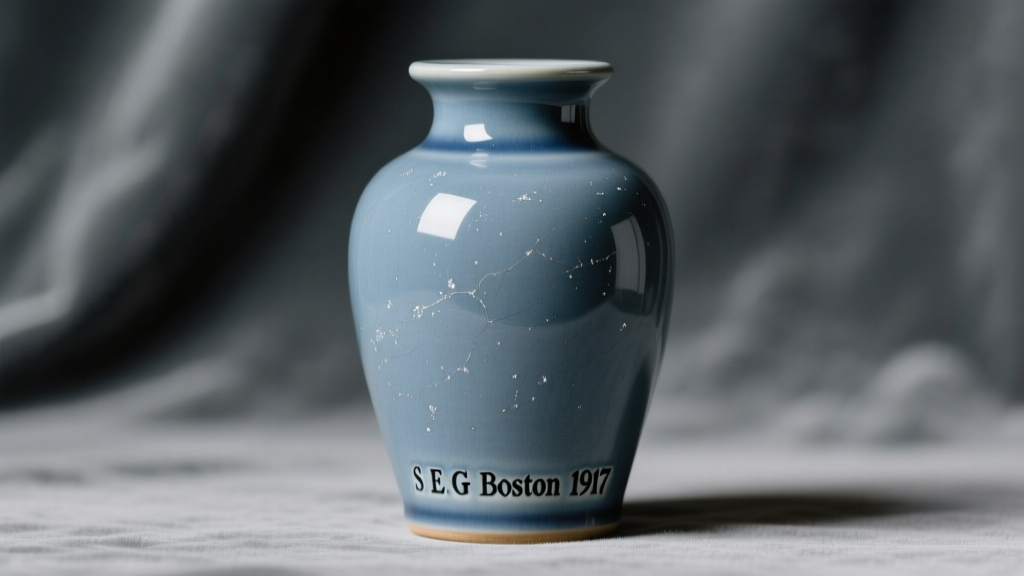
Paul Revere Pottery Vase: Matte Blue Glaze, S.E.G. Boston 1917, 6-Inch Form — A Studio Craft Landmark
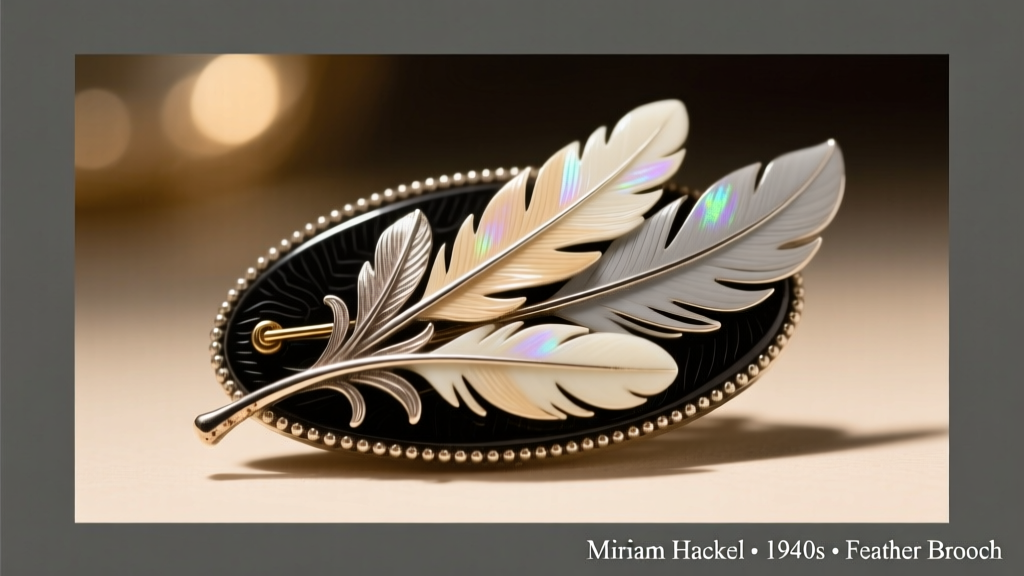
The Feather Pin Phenomenon: Miriam Haskell’s Avian Masterpieces in Vintage Costume Jewelry
Toy Guitar Beany Cecil by Mattel (1962): A Vintage Plaything, Collectible Artifact, and Cultural Time Capsule
Orphan Annie Watch: Round Face, Chrome-Cased — A Vintage American Icon of Mid-Century Design and Licensing History
Bauer Vase 'Rebekah' in Turquoise: A Definitive Appraisal of the 22-Inch Icon
Cranberry Glass Cracker Jar with Silver-Plated Bear-Finial Cover, Circa 1890 — A Study in Gilded Age Tableware Elegance
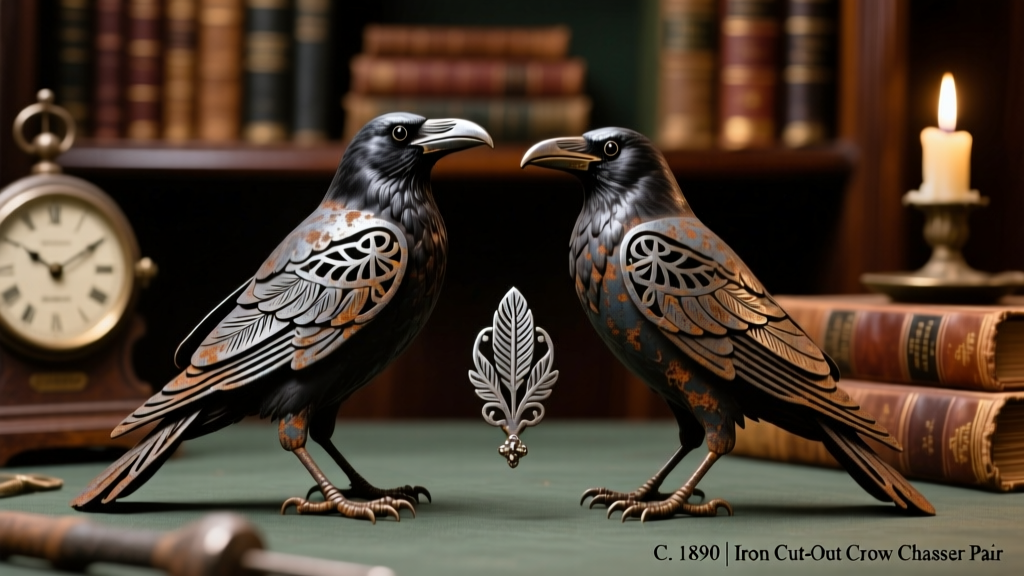
Iron Cut-Out Crow Bird Chaser, Circa 1890 — A Rare Pair of Victorian Garden Deterrents
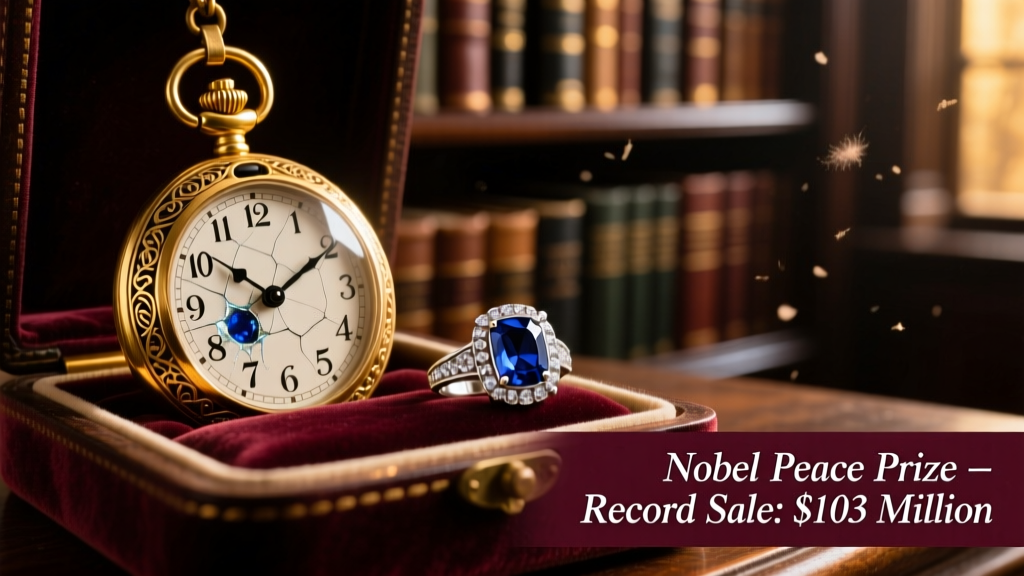
Nobel Peace Prize Medal Sells for Record-Shattering $103 Million: A Historic Auction Milestone in Vintage Jewelry and Horology
Astral Gilt Bronze Table Lamp with Cut-Glass Faceted Prisms, Thumbprint Glass, and Floral Motifs — A 29-Inch Masterpiece of Late Victorian Lighting Design