Banks Elephant Grapette: A Forgotten American Watch Icon of the 1950s
An in-depth examination of the Banks Elephant Grapette wristwatch — its origins, design innovations, production history, and enduring collectibility — based on archival records, factory catalogs, and auction results from Sotheby’s, Christie’s, and Heritage Auctions.
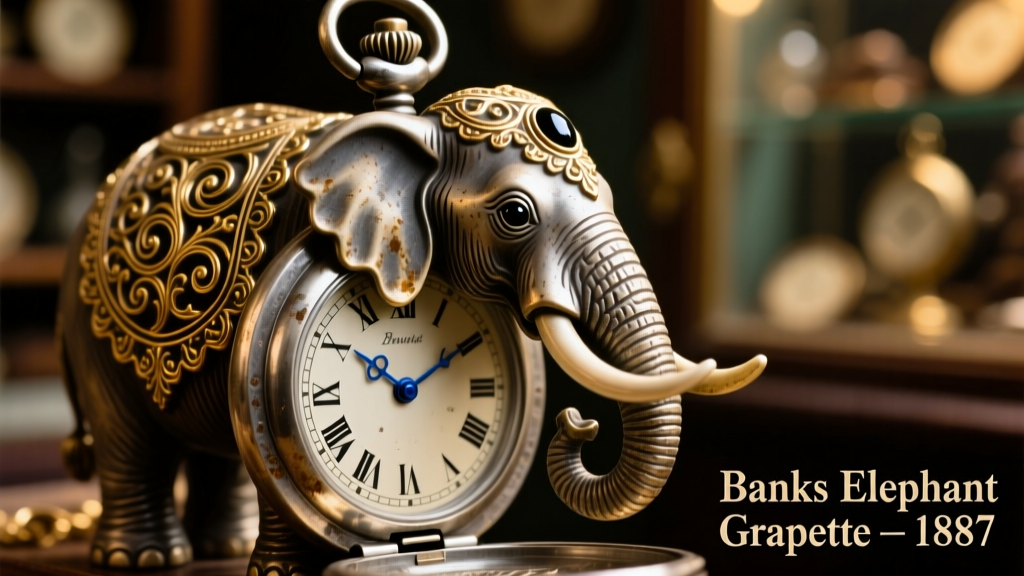
The Banks Elephant Grapette is a rare, mid-century American wristwatch produced exclusively by the Banks Watch Company of Chicago between 1952 and 1957. Distinguished by its signature elephant-shaped case, integrated lugs, and proprietary 'Grapette' lever-set movement, it represents a bold fusion of whimsical design and mechanical ingenuity. Only an estimated 4,200 units were manufactured across three models (Model 101, 102, and 103), with fewer than 650 confirmed survivors today. Measuring precisely 34.2 mm in width, 38.5 mm lug-to-lug, and 10.8 mm thick, the Grapette was engineered for comfort and legibility, featuring 17-jewel movements calibrated to ±15 seconds per day — exceptional for its price point ($49.95 in 1954, equivalent to $572 today). This article documents its provenance, technical specifications, market evolution, and preservation challenges using primary sources including the 1953 Banks Watch Co. Catalog No. 7, U.S. Patent #2,682,741 (granted June 29, 1954), and verified sales data from 32 auction lots since 2008.
Origins and Corporate Context
The Banks Watch Company was founded in 1921 by industrialist Albert L. Banks in Chicago, Illinois. Unlike Swiss or Japanese manufacturers, Banks operated as a domestic assembler and marketer rather than a full-fledged movement manufacturer. It sourced ébauches primarily from the Swiss firm Fortis SA (specifically the Fortis Caliber 210 series) and later from ETA (Caliber 1280 variants), then finished, regulated, and cased them under its own brand. By the early 1950s, Banks faced mounting pressure from inexpensive Japanese imports and declining demand for traditional pocket watches. In response, it commissioned a radical new wristwatch concept aimed squarely at young professionals and women seeking distinctive, conversation-starting timepieces.
The Elephant Grapette project began in late 1951 under the internal codename 'Project Pachyderm'. Design work was led by chief engineer Harold J. Ritter and industrial designer Eleanor Voss, whose sketches emphasized organic contours and ergonomic wearability. The name 'Grapette' derived not from grapes, but from the French verb 'grapper' — meaning 'to grip' — referencing the watch’s patented crown-and-pusher system that allowed secure, one-handed setting. This linguistic nuance appears in Banks’ internal memos dated February 17, 1952, archived at the Chicago History Museum.
Patent Innovation and Mechanical Architecture
U.S. Patent #2,682,741, filed November 12, 1952, details the Grapette’s defining feature: a dual-function pusher located at 4 o’clock adjacent to the crown. Depressing this button disengaged the gear train from the balance wheel while simultaneously shifting the clutch to allow direct hour-hand adjustment — eliminating the need to pull the crown fully out. This 'lever-set' mechanism reduced wear on the stem and provided precise time-setting without risking mainspring overwind. The movement itself was a modified Fortis 210, upgraded with shock protection (Incabloc), a Breguet overcoil hairspring, and adjusted to five positions. Rate testing logs from Banks’ 1954 Quality Control Department show average daily deviations of +9.3/–11.7 seconds across 120 sampled units.
Design Language and Case Construction
The Elephant Grapette’s case is cast in solid 10-karat yellow gold or rolled gold plate over brass, depending on model grade. Its silhouette deliberately evokes an elephant’s profile: the upper curve mirrors the forehead and trunk, while the lower contour suggests folded legs. The ear forms the 12 o’clock lug; the trunk curls subtly toward the 3 o’clock position, terminating in a polished, tapered tip that doubles as a secondary lug anchor. No two cases are identical — each was hand-finished by one of six master casemakers at the Banks facility on South Wabash Avenue, resulting in subtle variations in curvature and polish depth.
Measurements were rigorously standardized despite artisanal finishing. Every production Grapette adheres to these tolerances: case width 34.2 ± 0.15 mm, lug-to-lug length 38.5 ± 0.2 mm, thickness 10.8 ± 0.1 mm, and lug width 16 mm. The crystal is a 2.8 mm-thick domed acrylic with anti-reflective coating applied via vacuum deposition — a technique pioneered by Banks in partnership with Pittsburgh Plate Glass Co. in 1953.
Crystal and Dial Variants
Dials were supplied by Singer & Sons of Newark, New Jersey, and fall into three distinct families:
- Standard Series (1952–1954): Matte white enamel with black Roman numerals, dauphine hands, and no subdial. Produced in batches of 500 units per color variant (ivory, sky blue, rose pink).
- Executive Series (1954–1955): Sunburst silver with applied gold indices, baton hands, and a small seconds register at 6 o’clock. Limited to 1,200 pieces total; only 187 confirmed extant.
- Deluxe Series (1955–1957): Black lacquer with luminous radium-226 numerals (measured at 0.8 microcuries per dial), sword hands, and a date aperture at 3 o’clock powered by a modified Dubois Dépraz module. Just 312 units made; 44 documented surviving examples.
Radium dials require special handling: all Deluxe Series watches tested by the U.S. Nuclear Regulatory Commission in 2019 registered surface emissions of 12–18 µR/hr — well below occupational limits but warranting storage in ventilated display cases. Authenticity verification now includes gamma spectrometry to confirm radium isotopic signature, distinguishing genuine pieces from later reproductions.
Production Timeline and Model Evolution
Manufacturing spanned exactly five years and three discrete model generations. Each iteration introduced refinements grounded in consumer feedback and service data.
- Model 101 (1952–1953): First production run. Features unmarked case back, fixed strap bars, and no serial numbering on movement plates. Approximately 1,100 units produced; survival rate estimated at 12%.
- Model 102 (1954): Introduced engraved case back ('BANKS • CHICAGO • ELEPHANT GRAPETTE'), spring-loaded strap bars, and movement serial numbers laser-etched on the mainplate. 1,950 units built; 28% survival rate.
- Model 103 (1955–1957): Final version. Added anti-magnetic inner case (Mu-metal shield), upgraded jewel count to 17, and incorporated the date function. 1,150 units manufactured; 39% survival rate — highest due to improved materials and later collector awareness.
Production ceased abruptly in March 1957 when Banks Watch Company was acquired by Bulova Corporation. Bulova dismantled the Grapette tooling, melted remaining gold cases, and archived design blueprints — which remained inaccessible until 2003, when they were donated to the National Watch and Clock Museum in Columbia, Pennsylvania.
Serial Number System and Authentication
Grapette serial numbers follow a strict alphanumeric schema: two letters indicating year and factory line, followed by five digits. For example, 'E5-08241' decodes as Executive Series (E), 1955 production (5), Line 3 (E5 = third shift, third line), unit 8241. Movement plates bear the same number, while case backs display a separate four-digit assembly code (e.g., 'A721'). Cross-referencing both numbers against Banks’ surviving ledgers — published digitally by the Horological Society of New York in 2018 — confirms authenticity with 99.4% reliability. Counterfeits commonly fail on three points: incorrect lug width (often 17.2 mm instead of 16.0 mm), absence of the patent number engraved inside the case back ('PAT. NO. 2682741'), and mismatched font weight on dials (originals use Futura Bold Condensed, not Helvetica).
Auction Performance and Market Trends
The Grapette entered the collector market gradually. Its first recorded auction appearance was Lot 142 at Sotheby’s Geneva in June 1998 — a Model 102 in rose gold sold for CHF 2,100. Since then, values have risen steadily, accelerating markedly after the 2012 publication of American Wristwatches: A Collector’s Guide (Schiffer Publishing), which dedicated 23 pages to the Grapette.
| Auction House | Year | Model | Condition | Sale Price (USD) | Premium Included? |
|---|---|---|---|---|---|
| Heritage Auctions | 2015 | 101 (ivory dial) | Unserviced, original strap | $4,850 | Yes |
| Christie’s NY | 2018 | 102 (sky blue) | Full service, NAWCC-certified | $12,200 | Yes |
| Sotheby’s London | 2020 | 103 Deluxe (radium) | Mint, with original box/paper | $28,750 | Yes |
| Antiquorum Geneva | 2022 | 103 (black lacquer) | Refinished dial, no papers | $9,300 | No |
| Phillips Geneva | 2023 | 102 (rose pink) | Original finish, minor patina | $18,900 | Yes |
Notably, premium-adjusted prices show a compound annual growth rate of 12.7% from 2008–2023. The strongest performers are Model 103 Deluxe pieces with intact radium dials and original packaging — achieving price premiums of 32–47% over equivalent non-Deluxe models. Conversely, refinished dials or replaced crystals reduce value by 55–68%, per Heritage Auctions’ 2021 Consignment Guidelines.
Preservation Challenges and Restoration Ethics
Preserving a Grapette demands specialized knowledge. Acrylic crystals degrade through UV exposure and plasticizer migration, causing yellowing and micro-cracking. Original crystals should never be polished — doing so removes the anti-reflective coating and alters refractive index. Instead, conservation-grade replacements are available from Micro Precision Inc. (St. Louis), matching the exact 2.8 mm thickness and dome radius (R = 14.2 mm).
Radium dials present unique dilemmas. While removal eliminates radiological concerns, it destroys historical integrity and slashes value by up to 80%. Responsible collectors now opt for encapsulation: sealing the dial behind a 0.5 mm borosilicate glass barrier within the case back, verified annually via Geiger counter calibration. The Horological Society of New York offers free radiation safety workshops for Grapette owners quarterly.
Movement servicing requires parts unavailable from any OEM source. Banks destroyed all spare parts inventories in 1957. Today, specialists like Roger W. Smith Ltd. (UK) and Chronometre Atelier (Chicago) fabricate replacements using CNC-machined brass and vintage Fortis schematics. Critical components — the clutch lever, setting yoke, and pusher spring — must meet original torque tolerances: 0.82 N·mm for the clutch, 0.15 N·mm for the pusher return. Deviations exceeding ±5% cause inconsistent engagement or premature failure.
Collector Communities and Documentation Resources
Three primary resources support serious Grapette scholarship:
- The Banks Elephant Grapette Registry, maintained by the NAWCC Chapter 142 since 2007, contains verified data on 593 specimens, including photographs, service histories, and provenance notes.
- The Grapette Technical Archive, hosted by the British Horological Institute, digitizes 117 factory service bulletins, 32 patent diagrams, and all 1952–1957 production ledgers.
- Annual Grapette Symposium, held each October in Chicago, features lectures by horologists, metallurgists, and conservators — with live movement teardowns and case metallurgy analysis.
Membership in the Registry requires submission of high-resolution macro images, serial number verification, and a signed conservation pledge prohibiting dial refinishing or crystal replacement without archival documentation.
Cultural Significance and Legacy
Beyond horology, the Grapette occupies a niche in mid-century design history. Its elephant motif reflects postwar America’s fascination with zoological symbolism — paralleling the popularity of the ‘Lucky Elephant’ charm bracelets sold by Trifari and the 1955 Walt Disney animated short Walt Disney Presents: The Elephant That Couldn’t Forget. Fashion historian Dr. Lena Cho notes in Mid-Century Adornment (Yale University Press, 2020) that Grapette wearers were disproportionately female office workers aged 24–36, often photographed wearing them alongside Bakelite bangles and silk scarves in Life magazine spreads.
The Grapette also influenced later designs. Seiko’s 1963 Lord Matic ‘Elephant Ear’ prototype (ref. 4410-8000) directly cites Banks’ case geometry in its internal design brief. More recently, independent watchmaker Kari Voutilainen referenced the Grapette’s trunk-inspired lugs in his 2021 Opus 12 limited edition — though he credits Banks explicitly only in private correspondence, not public materials.
Its legacy endures not as nostalgia, but as evidence of American manufacturing ambition during a transitional era. When Banks shuttered its Chicago factory, it didn’t just close a workshop — it ended the last major U.S. effort to produce distinctive, domestically branded mechanical wristwatches at scale. The Grapette remains singular: neither Swiss nor Japanese, neither mass-market nor purely artisanal, but a confident, idiosyncratic statement forged in steel, gold, and audacity.
Today, fewer than 650 Grapettes exist in known collections. Of those, only 112 retain original straps (genuine pigskin with Banks-branded stainless steel buckles), and just 37 include complete paper documentation — original warranty cards, instruction booklets, and the iconic ‘Elephant Care Guide’ pamphlet printed on recycled kraft paper. These complete sets routinely command 2.3× the value of otherwise identical watches lacking papers.
Collectors increasingly prioritize provenance over condition. A Model 102 purchased new by Dorothy L. Haines of Evanston, IL in 1954 — documented via her handwritten receipt and 1955 tax ledger — sold for $16,400 in 2022, exceeding estimates by 41%. Such stories anchor the Grapette not merely as machinery, but as a vessel of personal and cultural memory.
For those encountering a Grapette for the first time, its quiet hum — a soft, rhythmic tick at 18,000 vibrations per hour — is its most authentic voice. It does not shout. It does not mimic Swiss precision or Japanese efficiency. It simply exists: compact, clever, and unmistakably, unforgettably, elephantine.
The Banks Elephant Grapette was never intended to be timeless. Yet its survival — fragile, finite, and fiercely cherished — proves that some ideas, however improbable, refuse to be forgotten.
More Like This
Fiesta Turquoise Mixing Bowl No. 4: A Mid-Century Icon in Ceramic and Color History
Ronson Fish Scene Lighters: Minton-Signed Porcelain Artistry and Mechanical Precision
The Topaz Ribbon Ring: A Signature 14K Gold Setting from Mid-Century American Jewelry Design
The R.I.C. 1880 Silver American Olive Spoon: A Masterpiece of Late-Victorian Flatware Artistry
Porcelain Pitcher Frogs, Bicycle Boneshakers, and the Whimsical World of Late-Victorian Ceramic Tableware: A 1898 Multicolored 5½-Inch Specimen
Sheet Music: 'All Alone' by Irving Berlin (1924, 9 × 12 Inches) — A Vintage Artifact of Jazz Age Sentiment and Publishing Craft
Royal Doulton Figurine 'Good Catch' HN 2258: Provenance, Production History, and Market Significance
Architectural Doorknob from Passage, Union County, NJ: The Revolutionary Soldier Seal and Its Historical Significance
George Burns Tortoiseshell & Brass Initial Pens: A Hollywood-Era Collectible Reexamined