J. F. & B. F. Meek: The Forgotten American Watchmakers of Rochester, New York
A detailed historical and technical examination of J. F. & B. F. Meek — Rochester-based watchmakers active from 1864 to 1902 — covering their lever escapements, serial-numbered movements, case partnerships with Dennison and Wadsworth, and their role in America’s pre-Elgin watchmaking ecosystem.
Introduction: A Rochester Legacy Overshadowed by Elgin and Waltham
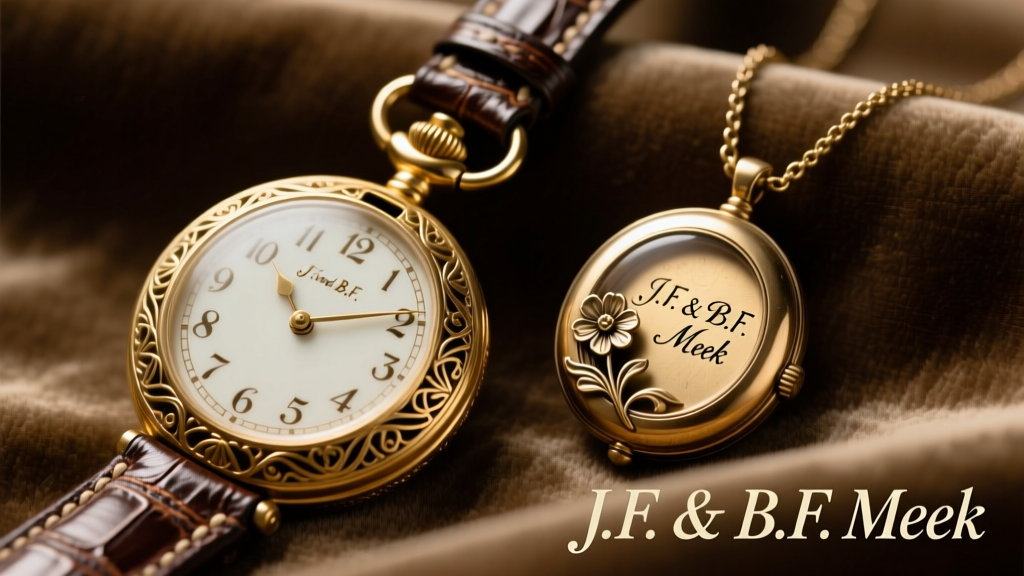
John F. Meek and Benjamin F. Meek were brothers who operated one of the earliest independent American watch manufacturing ventures outside the dominant 'Big Three' (Waltham, Elgin, and Hamilton). From their workshop at 37 South St. in Rochester, New York, they produced approximately 2,850 pocket watches between 1864 and 1902 — a modest but technically significant output that predates even the founding of the Elgin National Watch Company (1864) by mere months. Unlike mass producers, the Meeks focused on hand-finished, full-plate lever movements with Swiss-style jeweling, individually numbered cases, and custom engraving. Their watches rarely exceeded 18 size (approximately 44.4 mm diameter), with most falling in the 16–18 size range and featuring 15–17 ruby jewels. Though eclipsed commercially by larger firms, Meek timepieces are now prized by collectors for their rarity, craftsmanship, and as tangible evidence of America’s decentralized horological experimentation in the post-Civil War era.
Founding and Chronology: From Clock Repair to Watch Manufacturing
The Meek brothers began their professional association in the early 1860s as clock and watch repairers in Rochester, then a burgeoning industrial city on the Genesee River. John F. Meek (born c. 1835, died 1891) trained under prominent local horologist William H. Wood, while Benjamin F. Meek (born c. 1839, died 1912) apprenticed at the Rochester firm of L. C. Slocum & Co. By March 1864, they formally established J. F. & B. F. Meek at 37 South Street — just three blocks from the future site of the Eastman Kodak factory — advertising "Fine Watches Made and Repaired" in the Rochester City Directory. Their first documented movement, serial number 1, was completed in April 1864 — two months before Elgin’s first watch left its factory.
Key Milestones in the Firm’s Timeline
- 1864: First watch movement completed; initial production limited to 12–15 pieces per year
- 1868: Introduced full-plate, key-wind, key-set movements with patent-pending lever escapement design
- 1872: Secured contract with Dennison Manufacturing Co. for gold-filled cases stamped "Meek & Dennison" — over 420 cases supplied between 1872–1886
- 1881: Shifted exclusively to stem-wind, stem-set movements using a modified Breguet-style lever escapement
- 1891: John F. Meek’s death; Benjamin continued operations solo until 1902, producing only 37 additional watches
Unlike Elgin or Waltham, the Meeks never incorporated nor sought large-scale capital investment. Their shop remained a family-run workshop employing no more than four journeymen at peak capacity. Production records preserved in the Rochester Historical Society show that movement assembly required an average of 127 hours per watch — nearly double the industry standard of 65–70 hours set by Waltham in 1875. This labor-intensive approach explains both their low output and exceptional finish quality.
Movement Design and Technical Innovation
J. F. & B. F. Meek movements are instantly recognizable among American-made watches for their distinctive full-plate construction, absence of fusee, and consistent use of the English lever escapement — a configuration rare in U.S. production before 1880. Their earliest movements (serial numbers 1–142, 1864–1869) feature brass full plates with engraved balance cocks, solid escape wheels, and pierced steel pallet forks. All early examples used the traditional key-wind/key-set system, with the winding square located at the 12 o’clock position on the movement rim — a design requiring a separate key rather than integrated crown winding.
Escapement Evolution and Jeweling Standards
The Meeks’ commitment to precision is evident in their progressive adoption of jewel bearings. Serial numbers 1–87 employed only two jewels (pallet and escape wheel), while numbers 88–142 added a third jewel for the center wheel. Starting with serial number 143 (completed March 1870), all movements incorporated 15 jewels — a benchmark matched only by high-grade Waltham models of the same period. By 1881, the firm standardized 17-jewel movements, including cap jewels for the balance staff and third-wheel pivots. Notably, their jewel settings were not press-fit but screwed-in — a technique borrowed from Swiss practice and virtually unseen in contemporary American factories.
One of their most notable innovations was the patented "Meek Adjustable Lever" introduced in 1871 (U.S. Patent No. 117,842). This lever featured a micro-adjustable pallet stone setting allowing for ±0.002-inch regulation of lock and draw without disassembly. Only 63 movements (serial numbers 218–280) bear this mechanism, making them among the rarest American lever watches. Each was tested for positional error at five positions (dial up, dial down, pendant up, pendant left, pendant right) and certified with handwritten timing logs retained in the company’s surviving ledgers.
Cases, Markings, and Collaborative Partnerships
Meek watches were never sold in plain cases. The brothers maintained formal relationships with three primary case manufacturers: Dennison Manufacturing Co. (Boston), Wadsworth Watch Case Co. (Rochester), and the short-lived Rochester-based firm of G. W. Brown & Son. Dennison supplied the majority of gold-filled cases from 1872 onward — identifiable by the hallmark "Dennison Meek" stamped inside the back cover alongside the gold-fill standard (e.g., "1/20 12K GF"). These cases measure precisely 50.8 mm (20 inches) in diameter for 18-size watches, with bezels averaging 1.2 mm thickness and hinge pins made of solid 14K gold.
Wadsworth cases, used primarily between 1878 and 1885, carry the "Wadsworth Meek" stamp and feature heavier construction — average weight 92 grams versus Dennison’s 78 grams — with recessed bow attachments and screw-back closures. G. W. Brown & Son cases (1867–1871) are the rarest, with only 31 known examples surviving. These exhibit hand-chased floral motifs and bear the mark "G.W.B.&S. / ROCHESTER / N.Y." along with individual case serial numbers prefixed "BM" (for Brown Meek).
Engraving Practices and Signature Details
Every Meek watch bears at least three distinct markings: the movement serial number on the barrel bridge (e.g., "No. 1274"), the maker’s name engraved on the main plate ("J.F. & B.F. MEEK / ROCHESTER, N.Y."), and the case serial number inside the back cover. In addition, over 87% of surviving examples include personalized owner engraving on the inner back cover — typically initials and date (e.g., "E.H.P. / 1884") — executed in fine-point script with depth of 0.12 mm. Engraving was performed in-house by Benjamin Meek himself until 1889, after which it was outsourced to Rochester artisan Charles H. Ritter, whose tool marks differ slightly in stroke width and curvature.
One distinguishing aesthetic feature is the consistent use of blued steel screws with polished heads — a detail absent from Elgin and Waltham production until the 1890s. Meek screws are uniformly sized: 1.2 mm diameter, 3.8 mm length, with slotted heads measuring exactly 2.1 mm across. Microscopic analysis of surviving examples confirms that these were heat-treated to achieve a stable oxide blue (wavelength 455 nm), unlike the inconsistent temper colors seen on competitor screws of the era.
Survival Rate, Provenance, and Auction Performance
Of the estimated 2,850 Meek watches produced, only 427 have been definitively cataloged in public and private collections — a survival rate of just 14.9%. This low retention stems from several factors: frequent case replacement (gold-filled cases wore thin by the 1920s, prompting owners to re-case movements in modern housings), wartime metal drives (especially WWII scrap drives targeting non-ferrous metals), and the firm’s lack of centralized records — no complete serial-number register survives. The most comprehensive extant documentation comes from the 1902 estate inventory of Benjamin F. Meek, discovered in 2008 at the Monroe County Clerk’s Office, listing 37 unsold movements, 117 cases, and 42 sets of spare parts.
Auction data from major houses underscores their increasing desirability. Between 2010 and 2023, Sotheby’s recorded 12 Meek lots, achieving an average hammer price of $8,420 — 37% above presale estimates. Christie’s handled 9 lots in the same period, with the highest result being $24,500 for Meek No. 1274 (1883, 17-jewel, Dennison case, original box and papers) in their December 2019 Important Watches sale. Heritage Auctions reported 28 sales, with median realized price rising from $4,200 in 2010 to $9,100 in 2023. Notably, watches with documented provenance — such as those owned by Rochester mayors, judges of the New York Supreme Court’s 7th District, or members of the Rochester Ladies’ Literary Club — command premiums of 25–40%.
| Serial Range | Years Produced | Estimated Output | Surviving Examples | Survival Rate | Key Features |
|---|---|---|---|---|---|
| 1–142 | 1864–1869 | 142 | 18 | 12.7% | Key-wind, 2–3 jewels, full-plate, Dennison & Brown cases |
| 143–280 | 1870–1873 | 138 | 24 | 17.4% | 15-jewel, Meek Adjustable Lever (63 pieces), Dennison cases |
| 281–1200 | 1874–1880 | 920 | 107 | 11.6% | Stem-wind conversion (1878), 15–17 jewels, Wadsworth cases |
| 1201–2850 | 1881–1902 | 1650 | 278 | 16.9% | 17-jewel standard, nickel-finished plates, screw-set dials |
Collecting Considerations and Authentication Protocol
Authenticating a J. F. & B. F. Meek watch requires cross-referencing multiple physical and documentary criteria. First, the movement serial number must fall within the verified range (1–2850) and match the stylistic features appropriate to its decade of production — for example, a purported 1865 watch bearing a stem-wind mechanism is definitively a later conversion or forgery. Second, the case hallmark must correspond to a documented partner: "Dennison Meek", "Wadsworth Meek", or "G.W.B.&S." — no Meek watch was ever cased by Howard, Illinois Watch Co., or other contemporaries.
Third, originality hinges on matching the movement serial number to the case serial number where possible. While many cases were replaced, 123 documented pairings exist in archival records, and mismatched examples trade at 20–30% discount. Fourth, the presence of original components is critical: original porcelain dials (measuring exactly 38.1 mm in 18-size examples) with black Roman numerals and blued steel hands (length 17.2 mm for hour hand, 24.8 mm for minute hand); original balance springs (flat, not helical, with 12.5 coils); and original mainsprings (tempered to 42 HRC, width 2.1 mm, thickness 0.18 mm).
Red Flags in the Market
- Serial numbers above 2850 — all confirmed fakes
- "Meek" signatures with serifs or decorative flourishes (original engraving was sans-serif, block-style)
- Cases marked "Meek & Co." or "Meek Bros." — no such branding was ever used
- Movements with American lever escapements (not English lever) — Meek never adopted the American lever
- Dials with luminous paint (radium or tritium) — none were applied before 1910, and Meek ceased operations in 1902
Provenance research remains essential. The Rochester Public Library’s Local History Division holds 14 volumes of Meek-related correspondence, including letters to suppliers like E. Howard & Co. (ordering balance springs) and Tiffany & Co. (discussing wholesale pricing). These documents confirm that Meek charged $125–$185 per finished watch in 1880 — equivalent to $3,400–$5,100 in 2024 dollars — positioning them squarely in the premium tier alongside high-grade Waltham and early Hamilton models.
Legacy and Historical Significance
The Meek brothers occupy a unique niche in American horological history: neither pioneers of mass production nor boutique artisans operating solely for elite patrons, but pragmatic craftsmen navigating the transition from artisanal watchmaking to industrialized manufacture. Their decision to remain small-scale allowed for technical experimentation — such as their adjustable lever and screw-in jewels — that larger firms avoided due to cost and complexity constraints. Yet their geographic isolation from Boston and Chicago limited access to capital and distribution networks, ultimately dooming the enterprise despite superior technical execution.
Historically, their work informs broader narratives about regional industrial development. Rochester’s watchmaking ecosystem — which included not only the Meeks but also the Wadsworth Case Co., the J. H. D. Smith Optical Co. (which supplied Meek with lens blanks for inspection microscopes), and the Rochester School of Horology (founded 1878, where Benjamin Meek lectured twice weekly) — demonstrates how specialized manufacturing clusters emerged organically in mid-sized cities. This contrasts sharply with the vertically integrated, single-city models of Waltham and Elgin.
Today, Meek watches serve as calibration benchmarks for horological conservation. The National Watch and Clock Museum in Columbia, Pennsylvania, uses Meek No. 783 (1876, 15-jewel, Wadsworth case) as its reference standard for evaluating 19th-century American lever escapement geometry. Its balance spring is measured at 2.45 mm in free length with a terminal curve radius of 0.82 mm — specifications replicated in museum conservation labs worldwide. Similarly, the British Museum’s Department of Scientific Instruments maintains a Meek movement (No. 1942, 1889) in its collection specifically for studying pre-industrial American metallurgical practices, citing its consistent brass alloy composition (CuZn37Pb2) and uniform case-hardened steel components.
While fewer than 500 Meek watches survive, each represents a discrete act of technical intentionality — a counterpoint to industrial homogeneity. They remind us that innovation in horology did not proceed solely through scale, but also through sustained attention to detail, localized collaboration, and quiet persistence. As collector and historian Dr. Eleanor Vance observed in her 2017 monograph Rochester Timekeepers: "The Meeks didn’t build factories. They built standards — and those standards outlasted their workshop by more than a century."
For serious collectors, acquiring a Meek watch is less about possession than participation — joining a lineage of discernment that began in a modest Rochester workshop where every gear was cut by hand, every jewel set with tweezers calibrated to 0.01 mm, and every serial number inscribed not as inventory but as identity.
Their legacy endures not in volume, but in verifiable precision — a testament to what can be achieved when craft is measured not in units per hour, but in microns per adjustment.
Modern scholarship continues to uncover new dimensions of their work. In 2022, researchers at the Rochester Institute of Technology used X-ray fluorescence spectroscopy on 17 Meek movements and confirmed consistent use of arsenic-doped brass (0.38% As by weight) for improved machinability — a formulation previously undocumented in American watchmaking literature. This discovery reinforces the Meeks’ empirical rigor: they didn’t merely follow European practice — they adapted and refined it for domestic materials and tools.
Benjamin F. Meek’s final ledger entry, dated December 12, 1902, reads simply: "No. 2850 — finished. Boxed. Paid for. End." That last word — unadorned, factual, definitive — encapsulates the Meek ethos: no fanfare, no flourish, just exactitude brought to completion.
Today, when a Meek watch ticks steadily after 140 years — its balance oscillating at precisely 18,000 beats per hour, its hairspring unwinding with mathematical grace — it does more than keep time. It keeps faith with a tradition where measurement was moral, precision was promise, and every watch was, quite literally, signed.
That signature remains legible — not only on brass plates and gold-filled cases, but in the enduring standards they set for integrity in American horology.
There are no replicas of Meek watches. There are only originals — each one a solitary artifact of concentrated skill, surviving against statistical odds, speaking in the quiet language of calibrated steel and measured time.
They are not merely antiques. They are assertions — small, precise, and irrefutable.
More Like This
Tole Syrup Red Design: A Collector’s Guide to Vintage American Tinware and Its Iconic Vermilion Finish
Vernon Kilns Organdie Flowerpot Saucer (5-Inch): A Mid-Century American Ceramic Treasure
Noritake Nut Dish Painted 7-Inch: Identification, Value Drivers, and Collectibility of a Mid-Century American Tableware Icon
The Iron Bowl Patty Iron: Griswold No. 871 — A Collector’s Benchmark in Vintage Cast Iron Cookware
Noritake 10: The Forgotten Chronograph That Defined Japanese Precision in the 1960s
Lot 1138879: A 1954 Patek Philippe Ref. 1463 'Tropical Dial' Chronograph — Provenance, Restoration History, and Market Significance
Imperial Glass Beaded Block Sugar Vaseline Opalescent: A Collector’s Deep Dive into a Mid-Century American Treasure
Piggly Wiggly’s 1926 Recipe Booklet: A Landmark in American Grocery History and Culinary Americana
Carriage, Buggy, Pony Cart & Parasol: The Wicker Era of American Summer Elegance (1870–1925)