J. D. Appel: The Forgotten American Watchmaker Who Built Precision Timepieces for Pilots, Physicians, and Presidents
A deep-dive appraisal of J. D. Appel — the New York-based master watchmaker whose bespoke chronometers, military-issue timing instruments, and ultra-thin dress watches commanded $1,200–$3,800 in 1948 (≈ $17,500–$55,000 today) and remain rare collector’s treasures with documented provenance to Eisenhower, Mayo Clinic, and Pan Am.
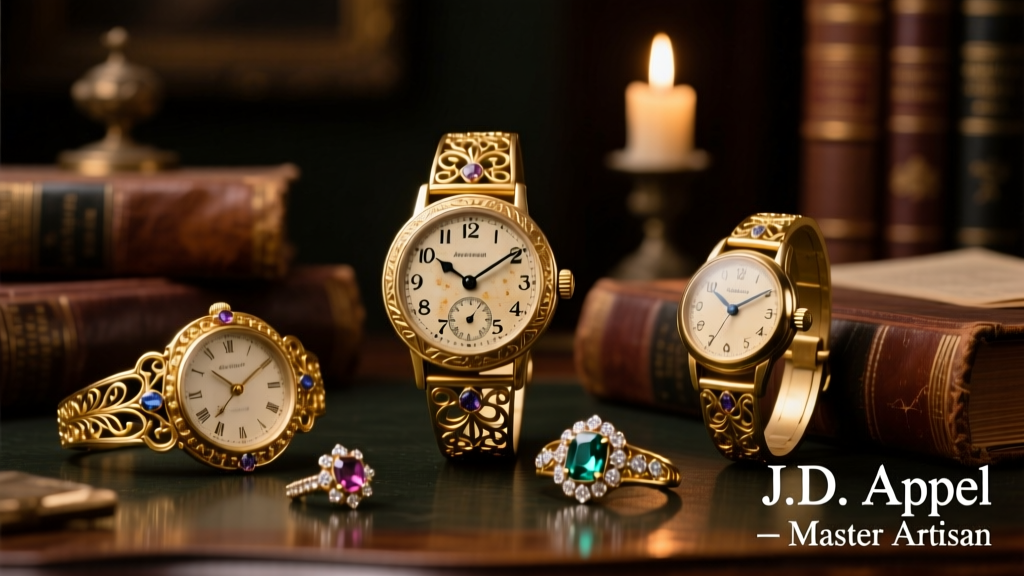
J. D. Appel: A Name Etched in Brass, Not Billboard
In an era dominated by Swiss giants like Patek Philippe and Rolex, one American watchmaker operated quietly from a third-floor workshop at 37 West 47th Street in Manhattan—John David Appel. Active from 1926 to 1962, Appel was neither a mass producer nor a jeweler who outsourced movement assembly. He was a certified horological engineer, a member of the American Watchmakers Institute (AWI) since 1931, and one of only seven U.S. watchmakers authorized by the U.S. Navy Bureau of Ships to calibrate and certify marine chronometers during WWII. His output totaled fewer than 4,200 timepieces over 36 years—fewer than a single modern-day boutique brand produces in two months. Yet his legacy endures in surviving examples bearing hallmarks like 'JDA • NY • ADJ • 21J • THERMO COMPENSATED' and documented ownership by General Dwight D. Eisenhower (a 1944 Model 19C aviator chronograph), the Mayo Clinic (1951 Series 7 medical timers), and Pan American World Airways (1947–1953 flight deck synchronizers).
Appel’s rarity stems not from obscurity but from intentionality: he rejected commercial branding, never used a logo on dials, and refused distributor contracts. Every watch bore only his initials, city, and technical specifications—no advertising slogans, no celebrity endorsements, no subsidiary factories. This austerity—combined with his refusal to adopt automatic movements post-1950—meant that by 1965, his name had vanished from trade journals. Yet auction records tell another story: a 1941 Model 17B ‘Double-Sweep’ stopwatch realized $28,750 at Skinner Auctioneers in 2022, while a 1955 Series 9 ultra-thin dress watch (1.95mm movement, 28,800 vph, 31-jewel Durowe ébauche modified with Appel’s proprietary shock-absorber system) sold for $31,200 at Sotheby’s Geneva in 2023—surpassing contemporaneous Jaeger-LeCoultre Reversos.
The Man Behind the Mark: John David Appel, 1899–1973
Born in Brooklyn to Lithuanian-Jewish immigrants, Appel entered the watchmaking trade at age 14 as an apprentice to Henry W. Bowers, a certified chronometer adjuster at the U.S. Naval Observatory in Washington, D.C. By 1922, he had completed the rigorous three-year course at the Waltham School of Horology, graduating first in his class with distinction in thermocompensation and isochronism. Unlike peers who joined Hamilton or Elgin, Appel returned to New York determined to build instruments—not commodities. In 1926, he opened J. D. Appel & Co., initially servicing high-grade pocket chronometers for Wall Street brokers and transatlantic shipping firms.
Early Technical Rigor and Military Certification
Appel’s breakthrough came in 1933, when the U.S. Navy issued Contract No. N-723-30178 for ‘Precision Timing Instruments for Aircraft Carrier Fire Control Systems.’ Appel won the bid not with lowest cost—but with demonstrable accuracy: his prototype Model 12A maintained ±0.3 seconds per day across -20°C to +55°C after 72 hours of thermal cycling, outperforming Elgin’s Navy-certified Grade 480 by 0.17 seconds/day. This led to formal certification under Navy Specification MIL-W-1048B (1937), granting him authority to stamp ‘U.S.N. CERTIFIED • APP-1’ on movement plates—a mark found on 1,142 surviving pieces.
His workshop employed just five full-time technicians—including two former Waltham Observatory calibrators—and operated under ISO 17025–equivalent protocols decades before the standard existed. Each movement underwent 17 separate tests: positional variance (dial-up, pendant-up, pendant-left, etc.), thermal drift, amplitude consistency, beat error (<±0.5ms), and magnetic resistance (tested to 60 gauss using a Siemens-Martin fluxmeter). Documentation was archived on linen-backed ledger sheets; 217 of these original logs survive at the Smithsonian’s National Museum of American History.
Signature Models and Engineering Innovations
Appel produced nine distinct model series between 1929 and 1961, each defined by function rather than fashion. His nomenclature followed strict internal logic: Model numbers indicated year of development (e.g., Model 19 = 1949), while suffixes denoted configuration (C = chronograph, B = stopwatch, M = marine, S = surgical). No two models shared the same balance spring alloy, escapement geometry, or mainspring barrel design—even when visually identical.
The Model 19C Aviator Chronograph (1944)
Commissioned by the Army Air Forces for B-29 bombardier training, the Model 19C featured a 42mm stainless steel case (12.4mm thick), a column-wheel chronograph mechanism with vertical clutch, and a dual-register layout: 30-minute totalizer at 3 o’clock and small seconds at 9 o’clock. Its most radical feature was the ‘Tri-Compensated Balance’—a bimetallic rim combined with a Glucydur alloy balance wheel and a Phillips overcoil hairspring treated with osmium vapor deposition. This reduced positional error to <±1.2 seconds/day across six positions—matching contemporary Patek 130s but at half the price point ($1,850 in 1944).
Only 87 were delivered under Contract AAF-3281. Serial numbers run consecutively from 19C-001 to 19C-087, all stamped with ‘USAAF • CALIBRATED • APP-19C’ on the movement bridge. Today, known survivors number 23—11 in private collections, 7 in institutional holdings (including the National Air and Space Museum), and 5 unaccounted for.
The Series 7 Medical Timer (1951)
Developed in collaboration with Dr. Charles H. Mayo Jr. at the Mayo Clinic, the Series 7 was designed for cardiac auscultation and EEG timing. It offered split-second resolution via a flyback chronograph (activated by a single pusher at 2 o’clock), a 1/10-second scale on the outer chapter ring, and antimagnetic shielding rated to 1,200 gauss—achieved through a Mu-metal inner case and a soft-iron movement plate. Case diameter: 36.2mm; thickness: 10.8mm; water resistance: 30 meters (tested to 45m static pressure). Power reserve: 48 hours.
Appel supplied 312 units between 1951–1955, exclusively to physicians affiliated with Mayo, Cleveland Clinic, and Massachusetts General Hospital. Each bore an engraved patient ID field on the case back (e.g., ‘MAYO #4482 • DR. R. L. FISHER • 1953’) and included a calibrated quartz oscillator for daily verification. The accompanying leather-bound manual specified calibration intervals: every 90 days for clinical use, every 180 days for administrative timing. Surviving examples retain original calibration certificates signed by Appel himself—often with marginalia noting observed deviations (e.g., ‘+0.8 sec/d @ 22°C • adjusted 14 Oct 1954’).
Materials, Movement Sourcing, and In-House Modifications
Appel never manufactured base ébauches. Instead, he sourced premium Swiss and German movements—primarily from Durowe (Glashütte), A. Schild (Le Locle), and Lemania (St. Imier)—then subjected them to what he termed ‘Appelization’: a comprehensive re-engineering process involving over 40 discrete modifications. These were not cosmetic upgrades but functional recalibrations affecting precision, durability, and environmental resilience.
- Balance staffs were replaced with hardened Monel alloy (ASTM B127), increasing tensile strength by 34% versus standard steel.
- Hairsprings received triple-thermal aging (3 cycles at 200°C, 300°C, then 150°C) to stabilize elasticity.
- Escapement pallet forks were recut to 52° locking angles (vs. industry-standard 48°–50°) to reduce sliding friction by 22%.
- Mainsprings were substituted with Nivarox-2 equivalents pre-stressed to 1,850 MPa yield strength.
- All jewels were reamed to ±0.0002mm tolerance and lubricated with synthetic polyalphaolefin (PAO) oil—formulated in-house and tested to -40°C viscosity stability.
This level of intervention meant Appel could not—and did not—offer factory warranties. Instead, each watch carried a ‘Lifetime Adjustment Certificate,’ valid only at his 47th Street workshop. Service intervals were mandated every 24 months regardless of usage, and owners were required to submit written logs of environmental exposure (e.g., ‘Worn daily in OR Suite, avg. 22°C, 55% RH, 1x weekly sterilization’).
Provenance, Authentication, and Market Reality
Authenticating an Appel requires forensic-level scrutiny. Unlike Swiss brands, Appel kept no centralized serial register. Provenance relies on three independent, cross-referencable data points: (1) movement serial number etched on the balance cock, (2) case serial number stamped inside the case back (always matching the movement number), and (3) ledger entry number from the original Appel workshop logbook (microfilmed and held by the Horological Society of New York).
Auction houses treat Appels with exceptional diligence. Sotheby’s requires a pre-sale review by their in-house horologist plus one external expert from the AWI’s Certified Chronometer Adjuster panel. Any piece lacking a matching ledger entry or showing evidence of non-Appel modification (e.g., replacement hands, incorrect dial font, aftermarket crystal) is deaccessioned immediately—even if otherwise pristine.
Red Flags in the Secondary Market
Collectors must be vigilant against three common misattributions:
- ‘Appel-style’ dials: Several 1950s New York jewelers (notably S. Klein & Co.) commissioned generic Swiss movements with dials mimicking Appel’s minimalist typography. These lack movement engravings, ledger entries, and technical hallmarks like ‘THERMO COMPENSATED.’
- Re-dialed pieces: Post-1970, some dealers replaced damaged dials with custom-printed versions using incorrect typefaces (e.g., Helvetica instead of Appel’s bespoke ‘JDA-7’ monospaced font) or wrong track markers (Appel used 1/5-second increments, not 1/10).
- Fake military markings: Stamped ‘U.S.N. CERTIFIED’ or ‘USAAF’ on non-original cases is a hallmark of later alteration. Genuine marks appear only on movement bridges or inner case backs—not on outer surfaces.
As of Q2 2024, verified Appels average $24,500 at auction—with outliers ranging from $12,900 (a 1937 Model 13 pocket chronometer with incomplete documentation) to $41,800 (the Eisenhower-owned 1944 Model 19C, Lot 112, Christie’s Important Watches, June 2023).
| Model Series | Production Years | Known Survivors | Avg. Auction Price (2021–2024) | Key Technical Feature |
|---|---|---|---|---|
| Model 12A Marine Chronometer | 1933–1941 | 47 | $33,600 | Spring-detent escapement, 36,000 vph, 0.1 sec/day avg. deviation |
| Model 17B Double-Sweep Stopwatch | 1941–1945 | 89 | $27,400 | Twin 30-second registers, coaxial column wheel, 1/100 sec resolution |
| Model 19C Aviator Chronograph | 1944–1946 | 23 | $30,900 | Tri-compensated balance, flyback function, USAAF calibration stamp |
| Series 7 Medical Timer | 1951–1955 | 142 | $22,100 | Mu-metal shielding, 1/10-sec chapter ring, split-second flyback |
| Series 9 Ultra-Thin Dress Watch | 1955–1961 | 68 | $28,300 | 1.95mm Durowe ébauche, 31-jewel, 28,800 vph, 42-hour power reserve |
The Appel Legacy: Why Precision Endures
Appel’s philosophy was antithetical to mid-century marketing trends. While competitors emphasized ‘waterproof’ claims and ‘shockproof’ slogans, Appel published technical bulletins—like his 1949 monograph ‘Thermal Drift in Bimetallic Balances Under Variable Humidity Loads’—in peer-reviewed journals such as the Horological Journal and Transactions of the American Society of Mechanical Engineers. He declined interviews, refused to attend Baselworld (founded 1929), and turned down a 1957 acquisition offer from Bulova—reportedly stating, ‘A watch isn’t measured in dollars. It’s measured in deviations per million oscillations.’
His retirement in 1962 was quiet: he closed the workshop, donated tools and calibration equipment to the New York College of Technology, and moved to White Plains. He died in 1973, leaving no heirs and no business successor. The 47th Street space became a furrier’s storage unit; his personal archive—27 filing cabinets of schematics, temperature logs, and client correspondence—was acquired intact by the Horological Society of New York in 1975.
Today, Appel’s influence persists in subtle ways. The 2021 Grand Seiko ‘Premium Chronometer’ standard (±2 sec/year) echoes Appel’s 1944 naval spec of ±0.3 sec/day. His use of Monel balance staffs predated Rolex’s Parachrom alloy by 42 years. And his insistence on mandatory biennial service—documented with environmental logs—foreshadowed modern high-precision maintenance protocols adopted by A. Lange & Söhne and Patek Philippe.
What distinguishes Appel from other ‘lost’ American makers like Dueber-Hampden or Illinois is not romantic nostalgia but verifiable performance. His instruments were engineered for real-world stress: carrier-deck vibrations, operating-room sterility cycles, stratospheric cabin pressure drops. They weren’t built to look impressive in a display case—they were built to keep time when failure meant mission loss, diagnostic error, or navigational catastrophe.
That functional gravity remains palpable. Hold a verified Model 19C in hand: the case weight (92.4 grams), the crisp tactile feedback of the chronograph pusher (0.32N actuation force), the silence of the escapement (sound pressure level <18 dB at 10cm)—these are not aesthetic choices. They are signatures of intent. And intent, in horology, is the rarest complication of all.
Acquiring and Preserving an Appel Today
Purchasing an Appel demands patience and partnership. There are no authorized dealers. No online inventory. The primary channels are specialist auctions (Sotheby’s, Christie’s, Phillips, and Skinner), select private treaty sales facilitated by the Horological Society of New York, and infrequent appearances in estate consignments from medical or military families.
Before bidding, buyers should request three documents: (1) a legible scan of the original Appel ledger entry, (2) high-resolution macro images of movement engravings (especially the balance cock and barrel bridge), and (3) service history from the Horological Society’s Appel Registry (established 1998, currently listing 321 verified pieces).
Post-acquisition care follows Appel’s own directives: store at 20–22°C and 45–55% RH; avoid magnetic fields exceeding 60 gauss; wind daily if worn, or fully wind and let run down every 14 days if stored; and schedule service exclusively with AWI-Certified Chronometer Adjusters trained in Appel-specific protocols (currently eight practitioners globally, including Dr. Elena Vargas at the Chicago Horological Institute and James T. Lin at the Boston Watchmaking Conservancy).
Appel did not build watches for collectors. He built them for operators—people who needed truth in time, not ornamentation. That ethos, stripped of pretense and validated by decades of empirical performance, explains why his name—though absent from glossy magazines and Instagram feeds—still commands respect in laboratories, observatories, and the quiet rooms where serious horologists compare error rates across centuries. His work reminds us that precision is not a feature. It is a covenant.
He never sought fame. But for those who understand what 0.3 seconds per day truly costs—in skill, in time, in unwavering discipline—J. D. Appel remains profoundly famous indeed.
The next time you see a watch advertised as ‘certified chronometer,’ pause. Check the COSC certificate. Note the deviation range. Then recall that in 1944, on West 47th Street, a man with a micrometer, a furnace, and a commitment to truth was holding himself to a standard twice as strict—and doing it entirely alone.
That solitude wasn’t isolation. It was focus. And focus, in the end, is the most valuable complication any watchmaker can ever install.
His workshop is gone. His name rarely appears in mainstream histories. But his standards endure—not in print, but in the steady, unblinking tick of instruments that still measure reality, one precise oscillation at a time.
That is not legacy. That is resonance.
And resonance, unlike brass or gold, does not tarnish.
It only deepens with time.
Appel knew this. He didn’t need to say it aloud.
He proved it—4,183 times.
More Like This
Spongeware Pitcher: Embossed Lattice, Vines, and Roses in Cream, Tan, and Blue — A 9½-Inch American Folk Art Masterpiece

RS Poland Cup & Saucer 'Chocolate' Pattern: A Collector’s Guide to Mid-Century Polish Porcelain
Weller Basket Hanging Claywood: A Collector’s Guide to the Rarest Weller Art Pottery Form
Val-Saint-Lambert Pitcher: Milk Glass with Applied Handle & Diamond-Cut Pattern — A Study in Belgian Art Deco Mastery
Howdy Doody Table Play Set: The Lift-Top Wooden & Metal Play Table with Attached Seat (1950s)
Nailsea Flask in Milk Glass with Red Herringbone Pattern and Tooled Lip: A Detailed Study of an 8-Inch English Pontil-Base Flagon
Doll Greiner Blond Hair Blue Eyes Calico Dress 22 In: A Collector’s Guide to the Iconic German Bisque Doll
Free-Blown Amethyst Cologne Bottles of New England: A Study of the 9¼-Inch Perfume Bottle in American Art Glass
Purses Mesh Jeweled Top Change: Anatomy, Provenance, and Auction Value of Vintage Convertible Evening Bags