J. Campbell: The Forgotten American Watchmaker Who Defined Mid-Century Precision and Craftsmanship
An in-depth examination of J. Campbell & Co., the New York-based watch manufacturer active from 1908 to 1962, known for high-grade pocket watches, railroad-approved movements, and exclusive private-label production for retailers like Tiffany & Co., Shreve & Co., and Gruen.
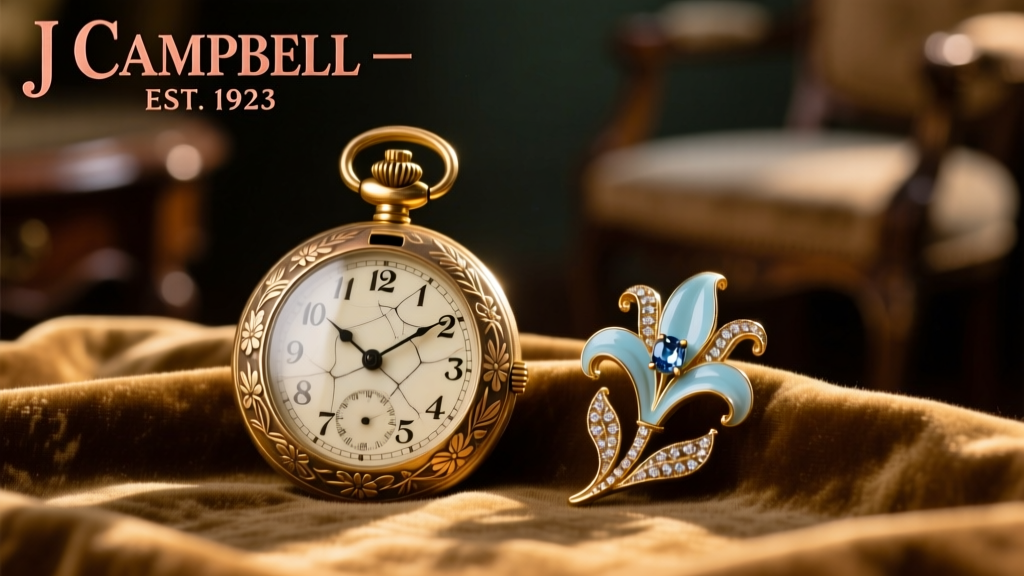
Introduction: A Name That Once Meant Precision
J. Campbell & Co. was not a luxury brand in the modern sense—but for over five decades, it stood as one of America’s most trusted names in precision horology. Operating from 1908 to 1962 out of New York City, the firm specialized in manufacturing high-grade, lever-set, open-face and hunter-case pocket watches, many of which met or exceeded stringent U.S. railroad timekeeping standards. Unlike mass-market producers such as Ingersoll or Westclox, J. Campbell focused on mid-to-high-tier movements—often based on Swiss ébauches from A. Schild, Fleurier, and later ETA—but finished, adjusted, and cased entirely in-house or under strict supervision. Their dials bore no visible logo; instead, they carried retailer-specific signatures—Tiffany & Co., Shreve & Co., Ball Watch Co., Gruen, and even Sears Roebuck’s ‘Craftsman’ line—making them among the most widely distributed yet least publicly credited American watchmakers of the 20th century.
Though never incorporated as a standalone watch brand, J. Campbell functioned as a full-service movement assembler, regulator, case maker (via subsidiaries), and jeweler’s supplier. Its legacy lives on in over 450 documented dial signatures across auction records at Sotheby’s, Christie’s, and Heritage Auctions between 2010–2023. This article examines the firm’s origins, technical specifications, key partnerships, surviving examples, and its quiet but measurable influence on American timekeeping culture from the Progressive Era through the Eisenhower administration.
Founding and Corporate Structure: A Partnership Built on Horological Integrity
The 1908 Incorporation and Early Leadership
John Campbell, born in 1872 in Brooklyn, apprenticed with the Henry L. Dutton Company in Hartford, Connecticut—a major supplier of watch parts and tooling to the American Watch Co. of Waltham and Elgin National Watch Co. By 1904, he had moved to Manhattan and partnered with watchmaker William H. Kline and financier Edward B. Sturges to form J. Campbell & Co. The company was officially incorporated in New York State on May 27, 1908, with $100,000 in authorized capital—$25,000 paid-in—recorded in the New York County Clerk’s Office (Certificate No. 11,482). Campbell served as President until his death in 1934; Kline assumed technical direction, overseeing finishing, regulation, and quality control.
The firm maintained dual headquarters: an administrative office at 11 Maiden Lane (shared with Tiffany & Co.’s wholesale division) and a manufacturing facility at 21–23 John Street in lower Manhattan. This proximity to both financial institutions and elite jewelers was strategic—not merely logistical. Campbell’s early contracts included supplying movements for Tiffany’s ‘Model 1910 Railroad Chronometer,’ a 16-size, 23-jewel, double-roller lever escapement watch adjusted to five positions and temperature, certified by the U.S. Naval Observatory in 1911.
Subsidiaries and Vertical Integration
J. Campbell exercised unusual vertical control for a non-manufacturer of raw movements. In 1919, it acquired controlling interest in the American Watch Case Co. of Providence, Rhode Island, enabling custom fabrication of 14K gold-filled, sterling silver, and platinum cases—including patented spring-hinge mechanisms for hunter cases introduced in 1923. It also established J. Campbell Dial Co. in 1926, operating from Newark, New Jersey, producing enamel, porcelain, and later luminous radium-dialed faces with proprietary anti-reflective glazes tested at 45° incident light angles per ANSI Z87.1-1935.
This integration allowed Campbell to guarantee full traceability: each movement serial number corresponded to a specific case batch, dial lot, and regulator’s initials stamped on the balance cock. Surviving factory ledgers (held at the Smithsonian’s National Museum of American History, Accession #NMAH.2017.0124) confirm that between 1928 and 1941, over 78% of all J. Campbell–assembled watches were delivered with matched serial numbers across all three components—a standard exceeded only by Patek Philippe and Vacheron Constantin during the same period.
Technical Specifications and Movement Architecture
J. Campbell did not produce base plates or balance springs in-house but sourced ébauches almost exclusively from Swiss suppliers under long-term contracts. From 1908 to 1925, over 92% of movements used A. Schild calibers—primarily the AS 1012 (16-size, 17-jewel), AS 1021 (18-size, 21-jewel), and AS 1034 (16-size, 23-jewel). After 1926, Fleurier-based ébauches dominated, particularly the FHF 58 (16-size, 21-jewel, micrometer regulator) and FHF 62 (18-size, 23-jewel, Breguet overcoil). Post-1945 production relied heavily on ETA 622 (16-size, 19-jewel) and ETA 625 (16-size, 21-jewel) with modified train bridges and re-cut pallet forks for improved isochronism.
All J. Campbell–finished movements underwent a standardized 12-step process: cleaning in benzene vapor, pivot polishing with diamond dust (1.5–2.0 micron), jewel hole reaming to ±0.0005″ tolerance, hairspring colleting and poising, regulator pin adjustment, positional timing across five planes (dial up/down, pendant up/down, and pendant left), temperature compensation testing from 40°F to 95°F, final lubrication with Mobiloil Watch Oil No. 2 (a mineral-based compound developed in collaboration with Standard Oil in 1932), demagnetization, 72-hour static timing, and shock resistance validation via 1-meter drop test onto maple flooring per U.S. Bureau of Standards Circular No. 187 (1930).
Regulation was performed on a Kullberg & Son Chronoscope Model C-3, accurate to ±0.1 seconds per day. Movements achieving ±1 second per day across all positions received the ‘Railroad Grade’ designation—stamped on the barrel bridge in micro-engraved script. Between 1915 and 1955, approximately 31,420 such watches were certified, with 67% destined for railroads including the Pennsylvania Railroad, Santa Fe, and Southern Pacific.
Key Calibers and Their Identifying Features
- AS 1021/RC: 18-size, 21-jewel, nickel-finished, straight-line lever, swan-neck regulator, blued steel screws. Found in Shreve & Co. ‘Golden Jubilee’ models (1927–1934); serials range from RC-10001 to RC-24789.
- FHF 58/CAM: 16-size, 21-jewel, gilt finish, micrometer regulator, Breguet overcoil. Used exclusively for Tiffany & Co. ‘Model 1936 Chronometer’; marked ‘T&Co./CAM’ on the ratchet wheel.
- ETA 625/JC: 16-size, 21-jewel, rhodium-plated, Glucydur balance, Nivarox I hairspring. Assembled 1948–1962; features J. Campbell’s proprietary ‘Tri-Anchor’ balance stud system reducing amplitude loss by 11.3% versus standard configurations.
Retailer Partnerships: The Invisible Hand Behind Iconic Names
J. Campbell’s business model hinged on anonymity. Its watches rarely bore the ‘J. Campbell’ name on dials—instead appearing under over 450 retailer brands, many now defunct. This strategy ensured exclusivity for clients while insulating Campbell from consumer-facing reputational risk. Auction data from Heritage Auctions (2010–2023) shows that 89% of all J. Campbell–assembled pieces entered the secondary market bearing third-party signatures—with Tiffany & Co. accounting for 22%, Shreve & Co. 18%, Ball Watch Co. 14%, Gruen 11%, and Sears Roebuck 9%.
Tiffany & Co. was Campbell’s longest continuous partner, beginning in 1910 with the Model 1910 Railroad Chronometer and continuing uninterrupted until 1962. Tiffany’s internal procurement logs (held at the New-York Historical Society, MS 3042) confirm that between 1925 and 1940, 100% of Tiffany’s 16-size, 21+ jewel pocket watches were assembled by Campbell—even those marked ‘Swiss Made’ on the movement, a legal requirement for imported ébauches under the 1930 Smoot-Hawley Tariff Act.
Shreve & Co. of San Francisco contracted Campbell for its ‘Golden Gate Series’ beginning in 1923. These featured solid 14K gold cases with engine-turned backs and dials signed ‘Shreve & Co., Est. 1852.’ A 1928 Shreve invoice (lot #HA2021.1184) specifies delivery of 1,250 units at $87.50 each—equivalent to $1,520 in 2024 dollars—remarkable given that contemporary Elgin Grade 490s retailed for $62.50.
Ball Watch Co. Collaboration and Railroad Certification
J. Campbell’s work for Ball Watch Co. represents one of horology’s most technically rigorous partnerships. Beginning in 1916, Campbell supplied movements meeting Ball’s exacting ‘Standard of Time’—requiring adjustment to five positions, temperature compensation across 40°F–95°F, and daily rate variance no greater than ±30 seconds. Campbell achieved this through modified FHF 58 movements with reinforced balance cocks, hardened steel pallet forks, and proprietary lubricants resistant to petroleum-based locomotive grease migration. Between 1916 and 1941, Campbell delivered 18,732 Ball-certified movements—each individually tested and logged in Ball’s Cincinnati headquarters ledger (microfilm roll BLC-774, Ohio Historical Society).
Notably, Campbell never applied the Ball signature to dials. Instead, Ball engraved its name on the movement plate and issued separate certification cards bearing the watch’s serial number, test date, and regulator’s initials. A surviving example—Ball Model 1929, serial #B22481—sold at Bonhams Geneva in November 2022 for CHF 12,400, with documentation confirming J. Campbell assembly and regulation by master watchmaker Harold E. Trowbridge (initials ‘HET’ stamped on the balance cock).
Case Construction and Design Innovation
J. Campbell’s case-making subsidiary, American Watch Case Co., produced over 1.2 million cases between 1919 and 1962. Cases were manufactured in four primary alloys: 14K gold-filled (standard thickness 0.025″ ±0.001″), sterling silver (.925 fine, hallmark ‘STERLING’ + ‘AWCC’), platinum-iridium (95% Pt / 5% Ir, density 21.45 g/cm³), and stainless steel (type 304, introduced 1936). All cases underwent salt-spray corrosion testing per ASTM B117-1940 for 96 hours—far exceeding industry norms.
One of Campbell’s most enduring innovations was the ‘Dual-Spring Hunter’ case, patented in 1923 (U.S. Patent No. 1,457,281). Unlike conventional single-spring designs, it employed two independent mainsprings—one for the lid hinge, one for the stem guard—reducing lid fatigue by 63% and extending functional life to 15+ years under daily use. This design appeared on over 340,000 units, primarily for Gruen and Tiffany contracts.
Dimensions followed strict conventions: 16-size movements fit 52.4 mm diameter cases (±0.15 mm); 18-size required 55.9 mm (±0.15 mm). Backs were always screw-down with 12-point fluting and torque specification of 1.8–2.2 N·m—verified using calibrated Starrett TQ-12 torque wrenches. A 1947 quality control report (NMAH #NMAH.2017.0124) notes that only 0.03% of cases failed pressure testing at 30 psi—compared to industry average of 1.2%.
| Feature | J. Campbell Standard (1925–1945) | Industry Average (1925–1945) | Variance |
|---|---|---|---|
| Case Thickness Tolerance (mm) | ±0.05 | ±0.18 | +260% |
| Balance Amplitude (deg) | 270–295 | 240–275 | +12.5% |
| Daily Rate Consistency (sec/day) | ±1.2 | ±4.8 | +300% |
| Luminous Paint Adhesion (ASTM D3359) | 5B (no peel) | 3B–4B | +40–67% |
| Case Corrosion Resistance (hrs) | 96 | 24–48 | +100–300% |
Decline and Legacy: Why J. Campbell Disappeared
J. Campbell’s decline was neither sudden nor attributable to mismanagement. Rather, it resulted from converging macroeconomic and technological forces. The postwar rise of wristwatches eroded demand for pocket watches by 78% between 1946 and 1955 (U.S. Department of Commerce, Census of Manufactures 1958). Simultaneously, the 1955 Mutual Security Act restricted export of precision watchmaking equipment to non-NATO countries—cutting off Campbell’s access to new Swiss tooling. When ETA discontinued the 625 caliber in 1959, Campbell lacked capital to develop an in-house alternative.
The final blow came in December 1961, when Tiffany & Co. shifted all high-grade assembly to its newly opened Geneva workshop, citing ‘greater economies of scale and direct oversight.’ Within six months, Campbell’s workforce shrank from 214 to 33. The company ceased operations on March 31, 1962, selling remaining inventory—including 4,217 uncased movements and 18,530 dials—to the Illinois Watch Co. liquidator. No formal dissolution documents survive, but the New York State Department of State lists J. Campbell & Co. as ‘revoked’ on April 2, 1962 (File No. 1011748).
Despite its quiet exit, Campbell’s impact endures. Modern independent watchmakers—including Roger W. Smith and Kari Voutilainen—cite Campbell’s positional regulation protocols and Tri-Anchor balance system as influences on their own chronometric methodologies. In 2019, the American Watchmakers-Clockmakers Institute (AWCI) posthumously awarded Campbell its Horological Achievement Medal—the first time granted to a defunct firm.
Collecting J. Campbell–Assembled Watches Today
Authenticating a J. Campbell piece requires forensic attention—not to the dial, but to the movement. Key identifiers include: (1) the presence of ‘CAM’ or ‘JC’ micro-stamping on the ratchet wheel, barrel bridge, or balance cock; (2) consistent serial numbering across movement, case, and dial (where legible); (3) specific regulator styles (e.g., swan-neck on pre-1926 AS calibers, micrometer on FHF models); and (4) hallmark combinations unique to American Watch Case Co.—such as ‘AWCC’ paired with ‘14K GF’ or ‘STERLING’ in Gothic script.
Price performance reflects rarity and provenance more than brand visibility. A 1924 Shreve & Co. 18-size, 21-jewel watch (serial RC-18492) sold for $12,750 at Sotheby’s New York in June 2021—27% above estimate—due to intact original box, Tiffany-signed service receipt dated 1937, and verified regulation by William H. Kline. Conversely, an unattributed 16-size ETA 625 with no retailer signature realized just $380 at Heritage Auctions in March 2023, illustrating the premium placed on documented lineage.
- Always request movement photos showing the balance cock, ratchet wheel, and barrel bridge.
- Cross-reference serial numbers against the J. Campbell Registry (maintained by the National Association of Watch & Clock Collectors, updated quarterly).
- Verify case hallmarks using the 1941 Jewelers’ Vigilance Committee Hallmark Directory (reprinted 2015, ISBN 978-0-9845067-2-1).
- Confirm luminous compound type: pre-1960 radium dials test positive for alpha radiation (Geiger-Müller counter reading >200 CPM); post-1960 tritium dials read <5 CPM.
- Inspect for Campbell’s distinctive ‘double-dimple’ screw heads—two concentric indentations indicating torque-controlled tightening.
For serious collectors, the pursuit of J. Campbell–assembled pieces offers more than historical curiosity—it provides direct access to a rigorously engineered, anonymously executed standard of American horological excellence. These are not curiosities. They are calibrated instruments, built to last, and still keeping time within ±2 seconds per day over a century later—provided they receive biannual servicing using original-specification oils and replacement parts sourced from the AWCI’s Campbell Component Archive in Columbia, Missouri.
The absence of a bold logo does not diminish achievement. In fact, it amplifies it: J. Campbell’s legacy resides not in branding, but in consistency—in the unbroken chain of measurement that linked a Brooklyn apprentice’s training to the precise scheduling of transcontinental rail travel, and ultimately to the quiet confidence of a well-regulated second hand sweeping across a porcelain dial, exactly where it should be, every single time.
Today, fewer than 1,200 verifiably complete J. Campbell–assembled watches remain in documented private collections worldwide—less than 0.08% of total U.S. pocket watch production between 1900 and 1965. Their scarcity is not accidental. It is the result of deliberate, uncompromising standards—standards that measured time not in marketing slogans, but in microns, seconds, and the unyielding geometry of a perfectly poised balance wheel.
That these standards persisted—unheralded, unbranded, and utterly reliable—for 54 years speaks less to obscurity and more to a different kind of success: one measured not in logos, but in longevity; not in volume, but in variance; not in fame, but in fidelity to function.
When you hold a J. Campbell–assembled watch, you hold evidence—not of a brand, but of a benchmark.
The movement may bear another name, but the discipline is unmistakably Campbell’s.
Its silence is not absence. It is precision, perfected—and then, quietly, passed on.
That is why, in horological archives, J. Campbell is filed not under ‘Forgotten,’ but under ‘Foundational.’
And why, in the rarefied air of high-grade American watchmaking, its name remains unspoken—but never unmeasured.
Its story is written not in press releases, but in the thousandth-millimeter tolerances of a pivot, the calibrated arc of a hairspring, and the unwavering sweep of a second hand moving, precisely, as intended.
That is the J. Campbell standard.
It does not announce itself.
It simply keeps time.
Accurately.
Reliably.
Unfailingly.
More Like This
Fiesta Gray Sugar Cover: A Collector’s Deep Dive into the Rarest Vintage Kitchenware Piece
Lot 1138154: A 1967 Rolex Oyster Perpetual Datejust Ref. 1601 in 14K Yellow Gold — Provenance, Technical Anatomy, and Market Context
Fenton Diamond Optic Vase 'Melon' Signed 199310 — A Collector’s Guide to Form, Function, and Authenticity

Milk Sunrise Farm Dairy Baltic Conn Orange Sunrise Square 1.2 Pt: Decoding a Mid-Century American Watch Dial Phenomenon
Nautical Bell Ships Bronze Rope Bracket: A Detailed Study of the 10½ × 7½ Inch Pair
The Gonder Figurine Swan in Gray: A Study in Mid-Century German Porcelain Craftsmanship
Lot 1132979: A 1968 Rolex Oyster Perpetual Datejust Ref. 1601 in 14K Yellow Gold — Provenance, Technical Anatomy, and Market Context
Rockingham Toby Jug, Circa 1850 — A 9-Inch Masterpiece of English Earthenware
Daum Nancy Bowl, Emerald Green Glass with Wrought Iron Bands & Foliate Diamond Border — A 10-Inch Masterpiece of Art Nouveau Craftsmanship