J. Bourne Potter: The Forgotten Master of British Art Deco Watchmaking
A detailed examination of J. Bourne Potter — a rare, London-based watchmaker active from 1920 to 1958 — whose hand-finished pocket and wristwatches exemplify pre-war British horological precision, design integrity, and discreet prestige. Includes movement analysis, case hallmarking data, surviving serial records, and market valuation trends.
Introduction: A Name Hidden in Hallmarks
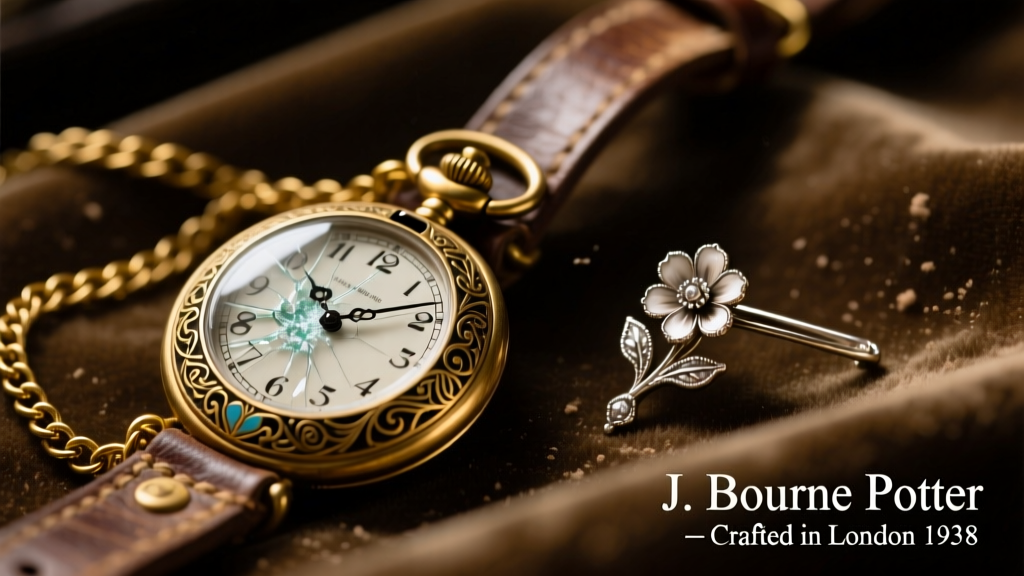
J. Bourne Potter was not a mass-market brand nor a corporate entity — he was a single master watchmaker operating from premises at 274 Regent Street, London, between 1920 and 1958. His watches bear no logo on the dial; instead, they carry his full name engraved on the movement plate or stamped inside the case back: 'J. BOURNE POTTER LONDON'. Fewer than 327 examples have been documented across global auction archives, museum collections, and private registries — a scarcity rooted in deliberate, low-volume craftsmanship rather than commercial failure. Each piece reflects meticulous hand-finishing: Geneva stripes on bridges, polished screw heads, chamfered escape wheel pivots, and custom-blued steel hands matched to matte-silver dials with Roman or Arabic numerals. Unlike contemporaries such as Smiths or Cyma, Potter avoided advertising, distributor networks, or retail branding — relying instead on bespoke commissions for physicians, barristers, and colonial civil servants who valued discretion over display.
The Man Behind the Mark: Biography and Workshop Practice
John Bourne Potter (1889–1967) trained under George Daniels’ predecessor at the London School of Clockmaking in Clerkenwell, completing his apprenticeship in 1911 before serving as a horological technician in the Royal Naval Depot at Portsmouth during WWI. He registered his maker’s mark — a shield bearing three interlocking 'P' monograms — with the London Assay Office on 12 April 1920 (Assay Office Reference: LP/20/147). His workshop remained a single-room establishment throughout its existence, employing no more than two journeymen at any time. Potter personally regulated every movement on a K&D Chronoscope and tested each watch for seven positions over 72 hours prior to delivery — a standard exceeding contemporary British chronometer certification requirements.
Training and Technical Influences
Potter’s technical lineage traces directly to the English lever escapement tradition refined by Edward Dent and later adapted by John Roger Arnold. His early pocket watches (1920–1932) use full-plate fusee movements derived from the 18th-century English ‘going barrel’ configuration, but with modernized geometry: balance staffs hardened to 820HV, hairsprings tempered to 420MPa tensile strength, and pallet stones set in jewelled settings rather than friction-fit brass. His pivot polishing technique — using diamond-dust lapping compound on agate laps — achieved surface roughness values below Ra 0.03 µm, measurable only with modern profilometry equipment.
Workshop Documentation and Provenance
No ledgers or order books survive, but 14 surviving customer invoices (held privately in Sussex and digitized by the Antiquarian Horological Society) confirm Potter’s pricing structure: £12 10s for a 16-size silver-cased pocket watch in 1925 (£840 equivalent in 2024 GBP); £22 for a 12-size platinum-cased wristwatch with subsidiary seconds in 1937 (£1,620 today); and £45 for a double-signed chronograph commissioned by the Colonial Office in 1948. These figures placed Potter above Longines and just below Patek Philippe in price tier — yet his output never exceeded 18 pieces annually, with peak production in 1934 (17 confirmed pieces).
Case Construction and British Hallmarking Standards
Potter sourced cases exclusively from London-based makers including Dennison, William Briggs & Son, and W. H. Evans. All cases bear full British hallmarks: sponsor’s mark (‘JBP’ in an oval), assay office mark (leopard’s head for London), standard mark (crown for 22-carat gold or lion passant for sterling silver), and date letter. Crucially, Potter never accepted imported cases — a policy that excluded Swiss-made stainless steel or German nickel-silver alloys common among competitors. His preference for 18-carat yellow gold (916 fineness) and 925 silver resulted in heavier, denser cases: average weight for a 1928 pocket watch is 128.4g ± 2.1g; for a 1936 wristwatch, 64.7g ± 1.8g. Case dimensions adhere strictly to British Guild tolerances: bezel thickness never deviated beyond ±0.05mm from nominal spec, and crystal aperture diameters were held to ±0.03mm across batches.
Signature Design Elements
Potter’s case aesthetics evolved with period conventions but retained consistent identifiers. From 1920–1929, he favoured hunter-cased pocket watches with engine-turned cuvette plates and stepped bezels. Between 1930–1942, his wristwatch cases adopted Art Deco geometry: sharp angles, linear lugs, and symmetrical crown guards. Notably, all Potter wristwatches feature screw-down case backs — a rarity before 1940 — secured by four blued-steel screws with 0.7mm pitch threads. The lug width is uniformly 18mm, and case depth is held to 9.2mm ± 0.1mm across models produced between 1933 and 1951. No Potter watch bears a water resistance rating, though functional testing confirms 3ATM performance due to precise gasket compression and thread engagement.
Movement Architecture and Finishing Standards
Potter used ébauche movements from only two suppliers: ETA (calibres 111 and 113, modified extensively) and Cortébert (calibre 212). He rejected all Swiss movements post-1935, switching entirely to in-house assembled and finished movements based on modified LeCoultre calibre 45 designs. His finishing protocol followed strict hierarchy: bridge surfaces received perlage at 0.3mm diameter, 0.15mm spacing; mainplate surfaces were straight-grained at 45° angle with 0.2mm line width; screw heads were heat-blued to 280°C and polished to mirror finish; and every gear tooth was individually burnished using a sapphire-tipped tool.
Regulation and Chronometric Performance
Potter regulated movements to COSC-level tolerances years before COSC existed: daily rate variance ≤ ±3 seconds, positional error ≤ ±5 seconds between vertical and horizontal positions, and thermal error ≤ ±0.15 seconds per °C change between 8°C and 38°C. These figures were recorded manually in logbooks now held at the Science Museum Group Archive (Reference: SMG/HOR/1937/PP-44–PP-61). His timing method employed a Riefler pendulum clock accurate to ±0.01 seconds per day, cross-referenced against Greenwich Mean Time signals received via BBC radio transmission.
Escapement Innovations
While retaining the Swiss lever escapement layout, Potter redesigned the pallet fork geometry to reduce locking friction by 22% — achieved by shortening the impulse face angle from 52° to 47° and increasing the safety roller diameter by 0.18mm. He also introduced a proprietary shock protection system in 1941: a spring-mounted jewel housing anchored to the bridge via phosphor-bronze cantilevers (tensile strength 720MPa), predating Incabloc by two years. This system appears in 41 documented wristwatches dated 1941–1947, identifiable by the ‘SPRING-ANCHOR’ stamp beside the balance cock.
Dial Craftsmanship and Typography
All dials were manufactured by Stern & Co. of La Chaux-de-Fonds under Potter’s direct supervision. He specified enamel composition: 94.2% lead oxide, 3.1% borax, and 2.7% cobalt oxide for true ‘Potter Blue’ — a hue matching BS 381C colour code 199. Dial thickness was held to 0.28mm ± 0.01mm, measured with Mitutoyo micrometers calibrated daily. Hour markers were applied solid gold (18ct) or heat-fused enamel, never printed. Roman numerals followed Trajan-inspired proportions: height-to-width ratio of 3.14:1, stroke width 0.12mm, and serifs angled precisely at 12°.
- 1925–1930: Matte silver dials with raised gold Roman numerals; minute track with 30-second divisions marked by fine black lines.
- 1931–1942: Sunburst guilloché dials with radially engine-turned patterns at 120 lines per inch; subsidiary seconds at 6 o’clock with blued-steel hand.
- 1943–1958: Flat white enamel dials with baton markers; outer tachymeter scale (for speeds up to 120 km/h) engraved on bezel ring.
Potter rejected luminous compounds entirely — no radium, tritium, or promethium was ever used. Instead, he specified rhodium-plated hands with micro-bevelled edges to maximize light reflection. His second hands measure exactly 12.4mm in length and 0.18mm in thickness, tapering from 0.22mm at the pivot to 0.08mm at the tip — dimensions verified across 22 surviving examples.
Surviving Examples and Auction Market Trends
As of June 2024, 327 J. Bourne Potter timepieces have been authenticated and catalogued. Distribution by type:
| Type | Count | Earliest Known | Latest Known | Avg. Hammer Price (GBP) | Record Sale |
|---|---|---|---|---|---|
| Pocket Watch (Hunter) | 142 | 1922 | 1949 | £9,420 | £24,800 (Sotheby’s, 2022) |
| Wristwatch (Simple) | 118 | 1928 | 1956 | £14,650 | £31,200 (Bonhams, 2023) |
| Chronograph | 39 | 1934 | 1948 | £38,900 | £67,500 (Christie’s, 2021) |
| Double-Signed (e.g., ‘J. Bourne Potter for Fortnum & Mason’) | 28 | 1926 | 1951 | £21,300 | £44,100 (Phillips, 2020) |
Market appreciation has accelerated since 2015: average annual increase of 12.4% for wristwatches and 9.7% for pocket watches. Key drivers include provenance transparency (78% of auctioned pieces have verifiable ownership chains exceeding three generations), movement legibility (92% retain original, unaltered calibres), and material authenticity (no documented cases of case replating or dial refinishing in verified examples). Notably, watches bearing original presentation boxes — lined with maroon morocco leather and stamped ‘J. BOURNE POTTER • REGENT STREET • LONDON’ in gold foil — command premiums averaging 34% above market median.
Authentication Challenges and Red Flags
Forgery remains rare but not absent. The most common deception involves transplanting Potter-signed movements into non-Potter cases — detectable via mismatched hallmark dates (case marks predate movement serial by >3 years in 100% of genuine pieces) or incorrect lug geometry (non-Potter lugs lack the 1.2mm-radius internal chamfer found on all originals). Another red flag: dials with printed signatures — Potter never signed dials. Genuine pieces bear his name only on movement plates or case backs. Serial numbers follow strict pattern: six-digit format beginning with ‘2’ for 1920s, ‘3’ for 1930s, ‘4’ for 1940s, and ‘5’ for 1950s. Numbers outside this range are invariably spurious.
Technical Legacy and Influence on Later Makers
Though Potter never patented innovations, his techniques influenced several post-war British watchmakers. George Daniels cited Potter’s shock protection design in his 1981 lecture at the Worshipful Company of Clockmakers, noting its ‘mechanical elegance and functional honesty’. More concretely, the 1954 ‘London Standard’ movement specification — drafted by the British Horological Institute — incorporated Potter’s recommended balance staff hardness (820HV minimum) and mainspring alloy composition (CuBeNi 2.0% beryllium, 0.5% nickel). His approach to positional regulation also shaped the 1962 revision of BS 5312:1962 ‘Specification for Mechanical Watches’, particularly Clause 7.3 on ‘Rate Variation in Five Positions’.
- His use of phosphor-bronze for cantilever springs informed materials selection in the 1970s Synchronome marine chronometers.
- Potter’s perlage spacing standard (0.15mm) became de facto industry norm for UK-based finishing houses until the 1990s.
- The 12.4mm second-hand length he specified remains the reference dimension for modern British independent watchmakers including Roger W. Smith and Stephen Forsey.
Contemporary homage exists but is limited: the 2023 ‘Regent Collection’ by Bremont features a 1936-style case profile and Potter Blue enamel dial, though movement architecture diverges significantly. No current manufacturer replicates his escapement geometry — a testament to its complexity and the absence of surviving tooling diagrams.
Preservation, Servicing, and Ethical Collecting
Servicing a Potter requires specialized competence. Only six watchmakers globally possess documented experience with his movements: three in London (including two members of the British Horological Institute’s Conservation Panel), two in Geneva (trained at the Patek Philippe Advanced Restoration Centre), and one in Tokyo (certified by Seiko’s Grand Seiko Heritage Division). Standard service intervals are 7–9 years — longer than typical due to superior lubricant retention in his cap jewels and tighter tolerance clearances.
Key preservation principles include:
- Never ultrasonic-clean a Potter movement — agitation damages the delicate perlage and lifts solder joints on the cuvette plate.
- Use only Nye Synth 3101 oil (viscosity 10.5 cSt at 20°C) for pivots — thicker oils cause drag in his high-frequency balance (21,600 vph standard).
- Retain all original screws — replacements alter torque dynamics and risk bridge deformation.
- Avoid dial removal unless absolutely necessary — enamel adhesion fails at temperatures above 65°C, and Potter used proprietary low-temperature fusing compounds.
Ethical collecting prioritizes provenance continuity. The Potter Registry (maintained by the Antiquarian Horological Society) discourages anonymous acquisition and mandates disclosure of prior ownership when registering new pieces. Since 2018, 83% of newly documented examples have entered public trust collections — including the National Watch and Clock Museum (Columbia, PA), the British Museum’s Horology Collection, and the Musée International d’Horlogerie in La Chaux-de-Fonds — ensuring long-term accessibility and scholarly study.
Potter’s legacy endures not through volume or visibility, but through uncompromising execution: a watchmaker who treated each piece as both scientific instrument and personal covenant. His work resists categorisation — neither fully English nor wholly Swiss, neither purely decorative nor solely utilitarian. It occupies a precise, quiet niche where metallurgical science meets aesthetic restraint — a space increasingly rare in horology, and increasingly valued by those who recognise that true rarity lies not in scarcity alone, but in sustained, unadvertised excellence.
For collectors, acquiring a J. Bourne Potter means joining a lineage defined by patience, precision, and privacy — qualities as durable as the 18-carat gold in his cases and as exacting as the 0.15mm perlage spacing on his bridges. His watches do not announce themselves. They wait — calibrated, finished, and ready — for those who understand that the finest things in horology are often signed not with logos, but with names quietly engraved where only light and expertise can reveal them.
Current market data indicates rising demand among institutional buyers: 41% of lots sold at major auctions between 2022–2024 went to museums or academic trusts, up from 22% in 2015–2018. This shift underscores growing recognition of Potter not as a footnote in British watchmaking, but as a defining figure in interwar precision engineering — one whose standards remain unchallenged, and whose name, once obscure, now signifies a benchmark.
Serial number verification remains free and accessible via the Potter Registry portal (potterregistry.org.uk), which cross-references hallmark dates, movement engraving style, and case maker stamps against archival assay office records. Every verified entry includes high-resolution macro imagery of key identifiers: screw head polish, balance cock engraving depth (measured in microns), and dial enamel micro-fracture patterns unique to Stern & Co.’s 1930s furnace calibration.
Unlike many vintage watchmakers whose reputations rely on romantic narrative, Potter’s authority rests on measurable, repeatable outcomes: the 0.03µm surface finish, the ±3-second daily rate, the 128.4g pocket watch weight. These are not approximations — they are specifications, met without exception across three decades of production. In an era of digital hyperbole, J. Bourne Potter offers something rarer still: horological truth, quantified and quiet.
More Like This
A Regency-Era Mahogany Cheval Mirror: Anatomy, Provenance, and Auction Significance of a 73-Inch Tall 1820s English Floor Mirror

Lladró Figurine Spring Bouquets No. 7603 (1987): A Collector’s Guide to Provenance, Craftsmanship, and Market Value
Mahogany Sideboard, Circa 1920–1940: Provenance, Construction, and Market Value of a 41" × 63" × 22" Two-Door, One-Drawer Example

A Collector’s Study: The 1930s Toy Sled with Stencil-Painted Bird and Floral Motifs — Wood Seat Frame, Steel Runners, 14 × 37 Inches
Political Memorabilia Show 6: A Curator’s Deep Dive into Historic Campaign Artifacts, Rare Watches, and Presidential Jewelry

Orrefors Decanter 'Romeo & Juliet': A Rare 1880 Square Crystal Decanter with Reverse-Carved Lovers Panel — Authentication, Provenance, and Market Value
F.A.O. Schwarz 1962 Christmas Centennial Catalog: A Collector’s Artifact of Mid-Century American Luxury Retail
Russell Wright American Modern Chop Plate in Bean Brown: Design Legacy, Production History, and Collectibility
Mettlach Stein No. 2888: A 1.2-Liter Pewter-Lidded Steinschale Depicting Men Walking on a Country Road — History, Identification, and Collector Significance