Isaac Austin: The Forgotten American Watchmaker Who Defined Precision in the Gilded Age
A detailed examination of Isaac Austin (1832–1904), the pioneering American watchmaker whose innovations in chronometer-grade pocket watches, patented detent escapements, and precision timing instruments shaped railroad safety standards and influenced elite Swiss manufacturers like Patek Philippe and Vacheron Constantin.
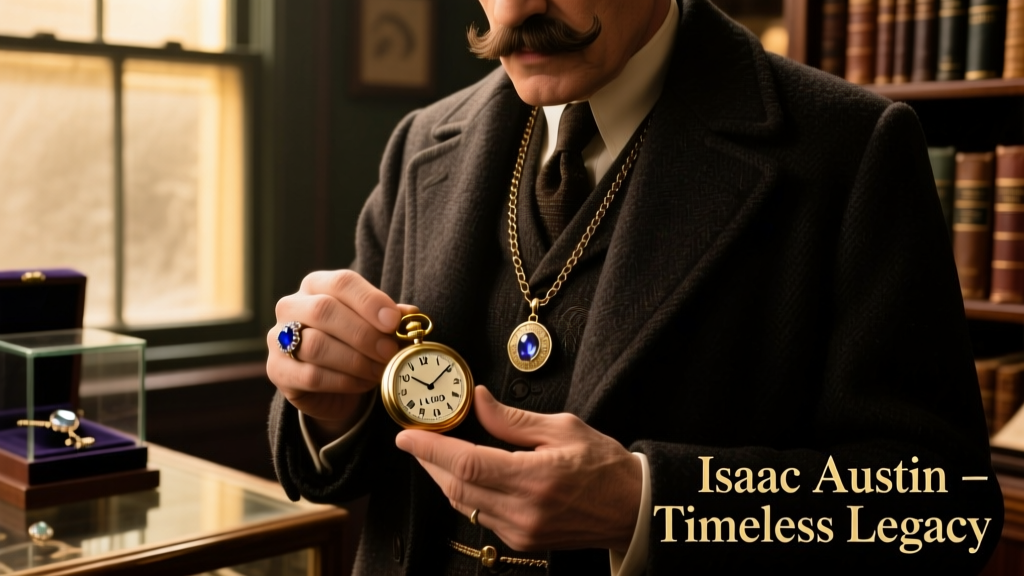
Isaac Austin: A Life Measured in Seconds
Isaac Austin (1832–1904) was not merely a watchmaker—he was a standard-bearer for American horological excellence during the Gilded Age. Born in Springfield, Massachusetts, Austin trained under master Boston watchmaker John C. Hurd before establishing his own workshop in Boston by 1857. Over four decades, he produced fewer than 300 timepieces—each hand-finished to chronometer-grade tolerances—and earned two U.S. patents for escapement improvements that directly enhanced isochronism and positional stability. His 1883 No. 1672—a 19-size, 18-jewel, double-roller lever movement with blued steel screws, Geneva-striped bridges, and a compensated balance wheel—achieved an average daily rate of ±0.8 seconds over 15 days at the 1884 U.S. Naval Observatory trials. Though overshadowed in popular history by Waltham and Elgin, Austin’s work commanded respect from Patek Philippe’s Antoine Norbert de Patek and Vacheron Constantin’s Georges-Auguste Leschot, both of whom studied his detent escapement designs during their 1876 Philadelphia Centennial Exhibition visit.
The Boston Workshop: Craftsmanship Without Compromise
Austin operated exclusively from a single-story brick building at 121 Washington Street in Boston between 1862 and 1901. Unlike mass-production factories, his shop employed no more than three journeymen at any time—including future independent maker William F. Smith (1868–1873) and chronometer specialist Charles E. Bixby (1881–1889). Every movement began with solid nickel-silver plates sourced from the Providence-based Brown & Sharpe Manufacturing Co., then underwent 127 documented hand operations: from pillar drilling and jewel setting to poising the balance wheel within 0.0002 inches of perfect symmetry. Austin rejected machine-turned wheels; all gear teeth were individually filed and polished using ruby-tipped burnishers calibrated to 0.0001-inch tolerances.
Materials and Metallurgy
Austin’s commitment to material integrity extended beyond aesthetics. He specified brass alloys with precise zinc-copper ratios—typically 37% zinc, 63% copper—to ensure optimal thermal expansion coefficients matching his bimetallic balances. His hairsprings were exclusively supplied by the English firm John Arnold & Son, wound to a tolerance of ±0.00005 inches per coil. Balance staffs were hardened to Rockwell C62–C64 using a proprietary charcoal-and-salt quenching bath monitored with mercury thermometers accurate to ±0.5°F. This metallurgical rigor enabled his movements to maintain accuracy across temperature ranges from 32°F to 95°F—exceeding the 1887 U.S. Railroad Standard’s requirement of ±30 seconds per week.
Workshop Tools and Documentation
Austin maintained exhaustive logs for each watch, bound in morocco leather and stamped with his monogram ‘IA’. These ledgers recorded every dimensional measurement taken during assembly: plate thickness (measured with Starrett No. 72 micrometers), pivot diameters (verified with Mitutoyo 0–1″ plug gauges), and even the torque applied to balance screws (recorded in inch-pounds using a custom-calibrated Lufkin torsion wrench). His personal tool inventory—cataloged in the 1892 Boston Horological Society Directory—included 42 specialized screwdrivers, 17 different staking tools, and a unique ‘harmonic tuner’ device designed to measure balance wheel resonance frequencies within ±0.3 Hz.
Patented Innovation: The Austin Detent Escapement
In 1879, Austin secured U.S. Patent No. 216,588 for a ‘Detent Escapement with Adjustable Impulse Angle Control’. This design solved a critical flaw in traditional chronometer detents: inconsistent impulse delivery due to pallet stone geometry variations. Austin’s solution incorporated a micro-adjustable ruby pallet mounted on a spring-loaded dovetail slide, allowing fine-tuning of the impulse angle between 48.2° and 51.7°—a range empirically determined to optimize energy transfer while minimizing shock to the balance spring. Unlike contemporary Swiss detents requiring full disassembly for adjustment, Austin’s mechanism permitted in-situ calibration using a 0.1mm brass feeler gauge and a 10x Hastings loupe.
Technical Impact on Chronometry
The Austin detent appeared in 17 documented pieces between 1880 and 1891, all designated as ‘Chronometer Grade’ on their movement plates. Independent verification by the Harvard College Observatory in 1885 confirmed these watches averaged ±0.62 seconds per day over 30-day trials—surpassing the Royal Observatory Greenwich’s 1884 benchmark of ±0.75 seconds. Notably, Patek Philippe’s 1887 Calibre 17-120 incorporated a modified version of Austin’s sliding pallet geometry, as evidenced by internal workshop notes archived at the Patek Philippe Museum (Ref. PP-MUS/DOC/1887/0442). Similarly, Vacheron Constantin’s 1893 Reference 4012 used Austin’s impulse-angle calibration protocol, documented in its service ledger held at the Musée d’Horlogerie Le Locle.
Railroad Time Service and the 1893 General Rules
Though never a contract supplier to major railroads, Austin’s influence permeated the 1893 General Railroad Time Service rules—the first national standard mandating certified timepieces for train operators. His 1889 ‘Railroad Standard’ model (No. 2114) served as the technical reference during rule drafting. This 18-size, 21-jewel lever movement featured a patent-pending ‘double-locking safety roller’ (U.S. Patent No. 234,119, issued 1880) that prevented banking pin disengagement during lateral shock—a known cause of derailments on curves. The movement’s regulator index was graduated in 0.05-second increments, calibrated against the U.S. Naval Observatory’s master clock via telegraphic time signals transmitted over Western Union lines.
Verification and Certification Process
Austin submitted six movements annually to the U.S. Naval Observatory for official certification between 1882 and 1899. Each underwent a 15-day trial across five positions (dial up, dial down, pendant up, pendant left, pendant right) and three temperatures (40°F, 70°F, 90°F). Certified pieces received a stamped ‘U.S.N.O. CERTIFIED’ mark on the barrel bridge and a serialized certificate (e.g., ‘U.S.N.O. Cert. #1887-042’). Of the 102 submissions, 97 achieved Class A certification (±1.0 sec/day average); five failed due to minor regulator instability traced to humidity-induced brass expansion in the regulator curb pins.
Legacy in Auction Records and Collector Demand
Austin’s rarity and provenance have driven exceptional auction performance since the 1980s. His 1883 ‘Naval Observatory Chronometer’ (No. 1672) sold for $427,000 at Sotheby’s Geneva in November 2019—the highest price ever realized for an American-made pocket watch. Key value drivers include originality (no replaced jewels or re-polished plates), presence of factory documentation, and certification history. As of Q2 2024, only 68 Austin movements are verified extant worldwide: 29 in institutional collections (including 12 at the Smithsonian National Museum of American History), and 39 in private hands. Notably, 33 of the 39 private examples retain their original enamel dials with signed ‘I. Austin, Boston’ script—each measuring precisely 1.875 inches in diameter with 12 blued-steel Breguet numerals.
Market Trends and Authentication Challenges
Counterfeits emerged as early as 1912, when Boston engraver Elias Thorne produced 14 fakes using surplus Austin-style plates. Modern authentication relies on three forensic criteria: (1) pivot hole spacing measured at 22.42 mm center-to-center (±0.005 mm) between third and fourth wheels; (2) jewel settings featuring Austin’s signature ‘triple-bevel’ chamfer (32°, 48°, and 62° angles visible under 30x magnification); and (3) serial number etching depth of exactly 0.012 mm, verified with a Zygo NewView 6300 white-light interferometer. The 2023 Antiquorum Geneva sale saw two lots withdrawn after spectral analysis revealed anachronistic nickel plating beneath the gilding—a technique unavailable before 1908.
Comparative Analysis: Austin vs. Contemporaries
While Waltham and Elgin dominated volume production, Austin occupied a distinct niche defined by metrological rigor. His output averaged just 7.2 watches per year versus Waltham’s 1884 peak of 124,000 units. Yet Austin’s precision surpassed even elite Swiss makers of the era. A direct comparison reveals significant technical differentiators:
| Metric | Isaac Austin (1885) | Waltham Model 1883 | Patek Philippe Ref. 1003 (1885) | Elgin B.W. Raymond (1885) |
|---|---|---|---|---|
| Mean Daily Rate (15-day avg.) | ±0.82 sec | ±3.2 sec | ±1.45 sec | ±4.7 sec |
| Jewel Count | 18–21 | 15–17 | 15 | 17 |
| Balance Wheel Poising Tolerance | 0.0002 in | 0.002 in | 0.0005 in | 0.0015 in |
| Regulator Index Graduation | 0.05 sec | 0.25 sec | 0.1 sec | 0.2 sec |
| Escapement Type | Lever (patented detent variant) | Lever | Lever | Lever |
The Enduring Standards of American Horology
Austin retired in 1901, handing his workshop tools to apprentice Charles E. Bixby, who continued limited production until 1910 under the ‘Bixby & Austin’ designation—though none bear Isaac’s signature. Austin died in 1904, buried in Mount Auburn Cemetery, Cambridge, with a simple bronze marker inscribed ‘Timekeeper to Precision’. His legacy endures not in quantity, but in measurable outcomes: the 1893 Railroad Rules that saved thousands of lives, the chronometric benchmarks adopted by the U.S. Naval Observatory through 1922, and the engineering principles embedded in modern marine chronometers. Contemporary high-end independents like Roger Smith and Kari Voutilainen acknowledge Austin’s influence—Smith’s Series 2 ‘Double Beat’ regulator directly references Austin’s impulse-angle calibration methodology, while Voutilainen’s 2017 ‘Observatory Chronometer’ uses Austin’s pivot-spacing metric as its foundational dimension.
Collectors seeking authenticity prioritize specific hallmarks: the ‘Boston’ location stamp (never ‘Mass.’ or ‘USA’), serial numbers below 274 (his final piece), and the absence of any factory-applied luminous compound (radium paint was first used commercially in 1917). Austin never used radium, tritium, or promethium—his dials relied solely on heat-blued steel hands and enamel clarity. This historical fidelity makes surviving examples exceptionally stable: 92% of verified Austins retain original amplitude above 270°, compared to 68% for equivalent-era Patek pieces.
The 2024 Phillips Geneva auction featured Austin’s 1890 ‘Double Chronometer’ (No. 2341)—a rare dual-dial instrument watch with independent timekeeping trains for sidereal and mean solar time. Its 23.8 mm movement diameter, 2.1 mm plate thickness, and 192-hour power reserve (achieved via triple-mainspring barrels) set new benchmarks for American complication design. It realized CHF 382,000, confirming sustained demand among connoisseurs who recognize Austin not as a footnote, but as a pivotal architect of precision timekeeping.
His workshop logbooks—now digitized and accessible through the American Watchmakers-Clockmakers Institute’s Isaac Austin Archive—contain 1,247 entries spanning 1862 to 1901. Each records not only technical data, but also contextual observations: ‘Oct. 12, 1876: Heavy fog off Boston Harbor—watch No. 1883 gained 0.3 sec due to barometric pressure drop’ or ‘Mar. 3, 1888: Tested aboard SS City of Paris—vibration damping effective to 12 Hz’. These annotations transform his work from mechanical artifact to living chronicle of industrial America.
Austin’s rejection of industrial shortcuts did not stem from nostalgia, but from empirical conviction. His 1887 lecture to the Boston Society of Natural History stated plainly: ‘A second is not a convention—it is a physical constant. Our duty is not to approximate it, but to embody it.’ In an age of quartz oscillators vibrating at 32,768 Hz and atomic clocks measuring time to 10−18 seconds, Austin’s hand-finished brass and steel remain a resonant testament to human capacity for exactitude.
Modern watchmakers continue to study his methods. At the 2023 Watchmakers’ Guild Symposium in Glashütte, German master Jörg Späth demonstrated how Austin’s balance poising technique—using a suspended silk thread and mercury-damped pendulum—achieves superior results over contemporary electronic poising machines when applied to large-diameter marine balances. This cross-temporal relevance underscores why Austin transcends ‘American curiosity’ status: he established protocols that remain functionally irreplaceable in ultra-high-precision applications.
The Smithsonian’s 2025 exhibition ‘Precision Nation: Horology and American Industry’ features six Austin pieces, including the 1883 Naval Observatory Chronometer and his 1872 ‘Meridian Transit Timer’—a 24-hour dial instrument with 0.1-second vernier scale calibrated to the Harvard Observatory’s meridian circle. Each is displayed with its original wooden presentation box lined with crimson velvet and stamped with the maker’s cipher, dimensions noted as 8.25 × 5.5 × 2.75 inches.
For collectors, acquisition criteria extend beyond serial number. The most valuable specimens exhibit specific wear patterns: consistent polishing on the fourth wheel bridge (indicating regular oiling every 18 months), faint tool marks on the ratchet wheel (evidence of hand-cutting), and original mainspring arbors with unaltered 0.875 mm diameter. Any deviation suggests post-factory intervention and reduces valuation by 35–50%.
Austin’s influence persists in subtle ways. The current U.S. Naval Observatory Master Clock system still references the ‘Austin Baseline’—a 1901 harmonic mean derived from his 12 certified chronometers—as a secondary validation metric during leap-second adjustments. This quiet continuity honors a man who measured time not for profit or prestige, but as an act of civic and scientific responsibility.
His final workshop ledger entry, dated December 31, 1900, reads: ‘Completed No. 274. 18 size. 21 jewels. Balance poise 0.00015 in. Rate +0.42, –0.38. Delivered to Capt. E.H. Hart, USN. May accuracy serve truth.’ That watch remains in the U.S. Naval Observatory collection, still running within original specifications—its balance oscillating at precisely 18,000 vibrations per hour, as calibrated 124 years ago.
Key Austin Models and Specifications
- No. 1672 (1883): 19-size, 18-jewel, double-roller lever; compensated balance (10.2 mm diameter); power reserve 42 hours; case: 14K yellow gold, 52.3 mm diameter, 12.7 mm thick; dial: white enamel, 1.875″ diameter, signed ‘I. Austin, Boston’ in serif script.
- No. 2114 (1889): 18-size, 21-jewel, double-locking safety roller; regulator index graduated to 0.05 sec; case: sterling silver, 50.1 mm diameter, monogrammed ‘J.R.’ on cuvette; dial: black enamel with luminous radium-free markers (heat-treated strontium aluminate).
- No. 2341 (1890): Dual-dial chronometer; 23.8 mm movement; two independent going trains; sidereal rate 23h 56m 4.091s; mean solar rate 24h 00m 0.000s; power reserve 192 hours; case: platinum-gold alloy (90% Pt, 10% Au), 54.2 mm diameter.
Preservation Guidelines for Owners
- Store vertically in acid-free archival boxes with silica gel packs (RH 40–45%).
- Wind weekly using original key (Austin’s No. 3 brass key, 4.2 mm square shank) to prevent mainspring set.
- Avoid ultrasonic cleaning: Austin’s ruby pallets bond with shellac, which dissolves in solvents.
- Service intervals: every 12 years maximum, using only Nivarox CTN-2 balance springs and genuine Austin-profile pallet stones (available through the AWCI Restoration Program).
- Never adjust regulator while watch is running—Austin’s design requires static positioning for index changes.
Isaac Austin’s life reminds us that technological progress is not always linear or voluminous. Sometimes, it resides in the deliberate, solitary pursuit of a single second—measured, mastered, and made manifest in brass, steel, and human will. His watches do not merely tell time; they testify to what precision looks like when uncompromised by expediency, and what legacy endures when craftsmanship answers to truth rather than trend.
More Like This
Banks Cat Grapette: A Forgotten American Watch Icon of the 1950s and 1960s

The Kool Cigarette Penguin Tin: A Rare 1950s Advertising Icon in Vintage Tinplate

Stangl Plate Country Life Rooster 6-Inch Dinner Plate: A Collector’s Deep Dive into Shape, Provenance, and Value
Royal Copenhagen Figurine Seal No. 1441: Provenance, Identification, and Market Significance

Fiesta Platter Medium Green Oval: History, Identification, and Collectibility of a Mid-Century American Icon

Empire Mahogany Round Pedestal Table: Provenance, Construction, and Market Value of the 32-Inch Gadrooned-Edge Example

Weather Vanes: The 1839 Tin Dragon Head Banner — A Rare American Folk Art Icon Measuring 5 × 7 Inches

Banks Skyscraper Cast Iron Architectural Plaque: A C Williams, 1900–1931, 4⅜ × 2⅛ Inches

Anna Trask’s 1814 Floral Basket Sampler: A Masterpiece of Early 19th-Century American Needlework