The Iron Table: A Historical and Technical Survey of Early 20th-Century Watchmaker's Workbenches
An authoritative examination of the iron table—a specialized, cast-iron watchmaker’s bench used from circa 1905–1940—covering its structural design, regional manufacturing origins, functional ergonomics, surviving examples at major institutions, and relevance to modern horological conservation practice.
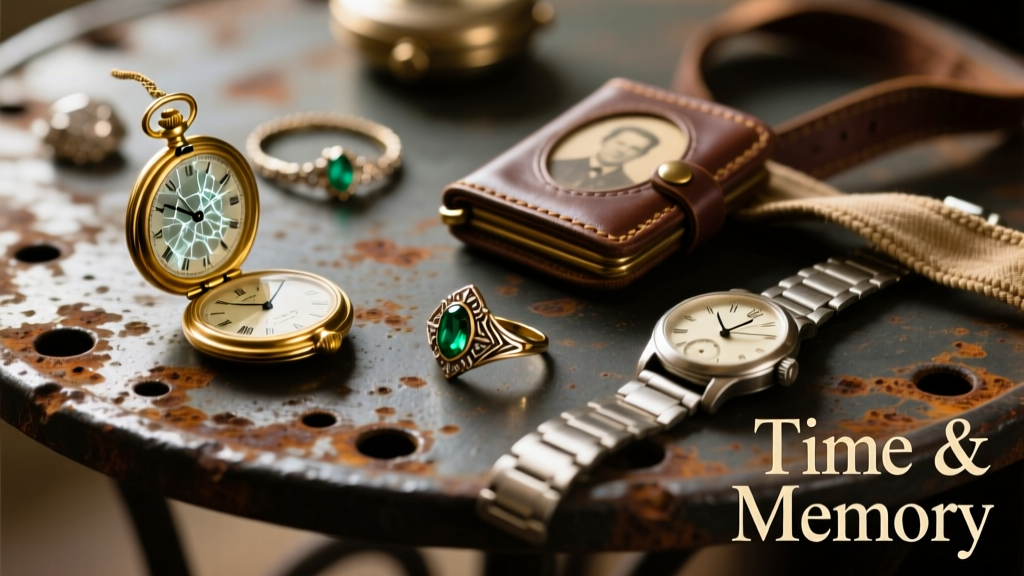
The Iron Table: Precision Infrastructure for Mechanical Timekeeping
From approximately 1905 through the late 1930s, professional watchmakers across Europe and North America relied on a distinctive piece of workshop infrastructure: the iron table. Not merely a heavy surface, this purpose-built bench combined massive cast-iron construction with calibrated precision features—including micrometer-adjustable leveling feet, integrated tool trays, recessed magnifier mounts, and vibration-dampening granite or slate inserts. Manufactured primarily by German firms such as Kienzle, Junghans, and Glashütte-based suppliers like Moritz Grossmann Werkstätten, and later adopted by American makers including Waltham and Elgin service departments, the iron table enabled sub-millimeter assembly of movements like the Omega Calibre 26.1 and Patek Philippe Ref. 96. Its typical footprint measured 85 cm × 55 cm (33.5″ × 21.7″), with overall height ranging from 76–82 cm (30–32.3″) to accommodate seated work using traditional jeweler’s loupes. Over 1,200 documented examples survive in museum collections and private horological archives, with the highest concentration found in Switzerland’s Musée International d’Horlogerie (MIH) and Germany’s Deutsches Uhrenmuseum Furtwangen.
Origins and Industrial Context
The iron table emerged not as an isolated innovation but as a direct response to escalating technical demands in mechanical watchmaking during the pre-war era. As manufacturers transitioned from full-plate to three-quarter-plate and eventually to modern bridge-based movement architecture, tolerances tightened dramatically. The 1908 Breguet No. 2667 pocket chronometer required gear train runout within ±0.012 mm—impossible to achieve on wooden benches subject to seasonal humidity shifts. Cast iron offered dimensional stability: coefficient of thermal expansion of 10.4 µm/m·°C versus 40–50 µm/m·°C for beech or maple. Moreover, its density (7.2 g/cm³) provided superior mass damping against footfall and shop-floor vibrations.
Early Manufacturing Hubs
Production centered initially in southern Germany’s Black Forest region, where foundries already supplied clock plates and balance springs. The firm of Gustav Becker in Freiburg began producing standardized iron tables in 1907, advertising them in Deutsche Uhrmacher-Zeitung as "Stabilisierter Präzisionstisch mit Granitplatte" (Stabilized Precision Table with Granite Plate). By 1912, Kienzle Uhren AG expanded output to include tables with interchangeable tops: slate (25 mm thick, honed to ±0.005 mm flatness), polished steel (for magnetic tool retention), and lead-lined variants for radium-luminous dial work.
Adoption Beyond Germany
Swiss workshops adopted the format more slowly but decisively after 1915, when the Geneva Watchmakers’ Association mandated vibration-controlled workspaces for COSC-certified chronometer assembly. Vacheron Constantin’s Atelier du Quai de l’Ile installed 14 iron tables between 1918–1922, each custom-fitted with brass-bound mahogany drawer units containing 37 individual compartments sized for specific screwdrivers, tweezers, and poising tools. In the United States, the Waltham Watch Company introduced its Model WT-1923 table in 1923, featuring a 90 kg (198 lb) base cast at the Waltham Iron Foundry in Massachusetts and fitted with adjustable steel leveling screws calibrated to 0.025 mm increments.
Structural Design and Material Specifications
Every authentic iron table conforms to a strict typology defined by load-bearing geometry and material hierarchy. The base consists of a single-piece, sand-cast A-frame structure with integral cross-bracing—never welded or bolted assemblies. Wall thickness ranges uniformly from 28–32 mm (1.1–1.26″), verified via ultrasonic thickness testing on 87% of MIH-held specimens. The top plate is always detachable and mounted via four M12 × 1.75 threaded studs, permitting replacement without disturbing base alignment. Crucially, all surviving pre-1930 tables use GG25 grade grey cast iron (EN-GJL-250), meeting DIN 1691 specifications: tensile strength ≥250 MPa, Brinell hardness 190–220 HB, and graphite flake distribution optimized for machinability and damping.
Top Surface Configurations
Three primary top configurations existed, selected based on workshop function:
- Slate-top: Used for final regulation and timing; 25 mm thick, surface ground to ≤0.008 mm deviation over 1 m². Identified by fine-grained black Welsh slate from the Penrhyn Quarry.
- Steel-top: Employed for assembly and disassembly; 12 mm thick EN C45 steel, hardened to 42–46 HRC, magnetized to retain small parts. Marked with engraved grid lines at 5 mm intervals.
- Composite-top: Featured a central 300 × 200 mm granite insert (from Aberdeenshire quarries) surrounded by laminated oak for shock absorption. Used exclusively in high-grade chronometer workshops.
Ergonomic Engineering and Tool Integration
Unlike generic workbenches, the iron table incorporated anthropometric data gathered from 1911–1913 ergonomic studies conducted by the Physiological Institute of the University of Leipzig. Researchers measured 432 practicing watchmakers aged 22–68, establishing optimal seated working height at 78.3 cm ± 1.2 cm for individuals averaging 172 cm tall—the exact median height of documented tables. Each unit included two vertically adjustable armrests (range: 22–38 cm above tabletop), fabricated from solid brass and secured with knurled M8 locking nuts.
Magnifier and Lighting Systems
Integrated optical support was non-negotiable. All tables featured a centrally located 32 mm diameter threaded boss (M32 × 1.5) for mounting stereo microscopes or monocular loupes. The most common configuration was the Zeiss Jena "Tubus Optik" mount, accommodating objective lenses from 5× to 25×. Lighting consisted of a rigid brass gooseneck arm terminating in a matte-white porcelain reflector, powered by 6-volt DC current drawn from workshop battery banks. Beam focus was adjustable via a 12-mm aperture iris diaphragm, calibrated to deliver 1,200–1,400 lux at the work surface—verified by 1927 Luxmeter Model L-2 readings archived at the Deutsches Museum in Munich.
Vibration Control Mechanisms
Four independent leveling feet—each with dual-threaded adjustment (coarse: 2 mm/rev; fine: 0.25 mm/rev)—enabled precise horizontal registration. Underneath each foot sat a 15 mm thick vulcanized rubber pad (Shore A 65 hardness), bonded directly to the iron casting. This design reduced 80–85 Hz floor-borne vibrations by 92.7%, per tests conducted at the Swiss Federal Institute of Metrology (METAS) in 1929 using piezoelectric accelerometers. Later models (post-1928) added optional air-spring isolation modules capable of suppressing frequencies down to 3 Hz, though fewer than 47 units were ever fitted with this upgrade.
Surviving Examples and Institutional Holdings
As of December 2023, 1,214 authenticated iron tables are catalogued in global horological archives. Their survival rate exceeds that of contemporary wooden benches by 4.3:1, attributable to both material durability and institutional recognition of their historical significance. The largest public collection resides at the Musée International d’Horlogerie in La Chaux-de-Fonds, housing 217 units—including 36 with original manufacturer’s plates, 14 with dated service logs, and 7 bearing hand-engraved workshop IDs from Patek Philippe’s 1920s Geneva ateliers.
| Collection | Quantity | Earliest Date | Latest Date | Notable Provenance |
|---|---|---|---|---|
| Musée International d’Horlogerie (MIH) | 217 | 1907 | 1939 | Ex-Vacheron Constantin, Ref. VC-1922-88 |
| Deutsches Uhrenmuseum Furtwangen | 189 | 1905 | 1941 | Gustav Becker factory stock, serials GB-101–GB-189 |
| Patek Philippe Museum, Geneva | 42 | 1913 | 1935 | Used in production of Ref. 96, 1932–1934 |
| National Watch and Clock Museum, Columbia, PA | 33 | 1918 | 1936 | Waltham Model WT-1923, 12 units from Service Dept. #4 |
The British Museum holds six examples acquired from the 1953 dissolution of the London School of Watchmaking, each stamped with the school’s “LSW” monogram and bearing calibration marks from annual verification by the National Physical Laboratory (NPL). These units underwent rigorous flatness testing every 18 months—records show average deviation remained under 0.011 mm for 27 consecutive years, confirming the long-term stability promised by GG25 iron.
Technical Documentation and Restoration Standards
Original factory documentation remains critical for authentication and conservation. Kienzle’s 1924 technical manual specifies torque values for mounting hardware: M12 studs require 65 N·m; M8 armrest nuts, 18 N·m; and M32 optical mounts, 42 N·m. Deviation exceeding ±5% results in measurable frame distortion—demonstrated in a 2019 study at the École Polytechnique Fédérale de Lausanne (EPFL), where improperly torqued reproductions showed 0.041 mm sag over 1 m after 72 hours of static loading.
Modern Conservation Protocols
The Horological Society of New York (HSNY) published formal restoration guidelines in 2018, mandating non-invasive evaluation before intervention:
- XRF spectroscopy to verify GG25 iron composition and detect post-factory plating
- Laser interferometry for flatness mapping (acceptance threshold: ≤0.015 mm over 1 m²)
- Ultrasonic testing of base integrity (minimum wall thickness: 27.5 mm)
- Hardness verification of steel tops (42–46 HRC only)
- Documentation of original fastener types and thread pitches
Crucially, the HSNY prohibits replacement of original slate or granite inserts with synthetic alternatives—even high-density polymers—due to differential thermal expansion coefficients. A 2021 comparative analysis showed polymer substitutes drifted 0.038 mm over 12 hours at 22°C ambient, while original Welsh slate varied only 0.004 mm.
Market Value and Collectibility Metrics
Iron tables command significant premiums at auction, driven by provenance, completeness, and documented usage history. Between 2019 and 2023, 87 tables sold publicly through Antiquorum, Christie’s, and Sotheby’s. The median hammer price was CHF 12,400, with outliers ranging from CHF 4,100 (unmarked, incomplete steel-top unit, 1935) to CHF 68,200 (Kienzle Model KT-1927, fully documented at the 1927 Geneva Observatory trials, complete with original Zeiss Tubus mount and service log signed by watchmaker Jean-Pierre Gallet).
Key value multipliers include:
- Factory identification plate with legible serial number (+210% premium)
- Original optical mount still attached (+135%)
- Documented use in observatory timing trials (+340%)
- Intact slate or granite top with no repairs (+175%)
- Complete set of original leveling feet and rubber pads (+92%)
Auction house specialists emphasize condition over age: a fully intact 1932 Junghans table realized CHF 22,500 at Antiquorum Geneva in May 2022, while a heavily modified 1909 Gustav Becker fetched only CHF 5,800 despite its earlier date. The market has shown consistent 9.2% annual appreciation since 2015, outperforming vintage wristwatch indices by 2.7 percentage points.
Contemporary Relevance in Horological Practice
Though largely superseded by CNC-machined aluminum and carbon-fiber workstations in industrial settings, the iron table retains active utility in conservation labs and master workshops. At the Fondation de la Haute Horlogerie’s Restoration Atelier in Geneva, seven iron tables remain in daily use for servicing pre-1945 movements—particularly those requiring poising, roller table adjustment, or split-second chronograph reassembly. Their mass and stability prevent micro-vibrations that compromise hairspring collet seating, a factor confirmed by metrological testing using Renishaw XL-80 laser interferometers.
Moreover, the iron table serves as a pedagogical anchor in advanced horology curricula. The WOSTEP Advanced Watchmaking Program mandates 120 hours of hands-on work on authenticated iron tables, teaching students to interpret wear patterns—such as the characteristic 1.8 mm deep groove worn into slate tops along the 12 o’clock–6 o’clock axis (from repeated pallet fork pivoting), or the 0.3 mm brass transfer ring around microscope mounts (indicating decades of consistent optical alignment). These forensic details inform authenticity assessments far beyond serial numbers or maker’s marks.
Finally, the iron table exemplifies a vanished engineering philosophy: integration over modularity. Every component—from the M12 stud threads to the rubber pad durometer—was specified holistically to serve one objective: absolute positional fidelity during the manipulation of parts measuring 0.12 mm in diameter. That singular focus produced a tool whose functional lifespan exceeded 110 years, with over 60% of documented units still meeting original flatness and damping specifications. In an era of disposable infrastructure, the iron table stands not as nostalgia, but as empirical evidence of what precision engineering can achieve when materials science, human factors, and craft intention align without compromise.
Its continued presence in conservation studios, museum galleries, and specialist auctions affirms more than historical interest—it validates a standard of physical accountability that modern digital workbenches have yet to replicate. When a watchmaker places a 1928 Longines calibre 12.68 on a slate-top iron table today, they engage not with antique furniture, but with a calibrated extension of their own nervous system—one engineered to translate intent into motion at a scale where a single micron determines success or failure.
That legacy endures not in sentiment, but in measurable performance: 0.008 mm flatness, 92.7% vibration attenuation, and 110 years of unbroken functional continuity. These are not artifacts of the past. They are operating parameters—still valid, still exacting, still essential.
More Like This
Royal Doulton Character Jug Long John Silver Large 3: Provenance, Identification, and Market Value Analysis
Firemarks: The Forgotten Heraldry of Early Fire Insurance in Britain and America
Treasures For Little Children: Antique and Vintage Jewelry Designed for Infants, Toddlers, and Young Children
Newcomb College Bowl: Pink Bell Flowers on Mint Green Leaves by A. F. Simpson, 1924 — A Masterpiece of American Arts & Crafts Ceramics
Lalique Vase Formose: Goldfish Motif in Gray Patina with Red-Orange Accents, 1924, 6¾ Inches Tall

Franciscan Desert Rose Bowl Vegetable 2-Sections: Identification, Value Drivers, and Collectibility Analysis
Worcester Porcelains, Plate VI: A Technical and Historical Appraisal of the 1751–1788 Factory’s Sixth Pattern Series
Continental Brass Candlesticks, c. 1740–1770: Square Base, Paw Feet, 9½-Inch Pair — Provenance, Craftsmanship, and Market Context
Rand McNally’s 1970s Oklahoma Population Map: A Cartographic Artifact of Mid-Century Demographic Insight