Iron Hitching Post Horsehead Pair: Historical Significance, Craftsmanship, and Collectibility in American Architectural Ironwork
A detailed examination of antique iron hitching post horsehead pairs—originating from 1870s–1920s America—including foundry origins, dimensional specifications, metallurgical traits, authentication markers, market valuation trends, and conservation best practices.
Historical Context and Functional Origins
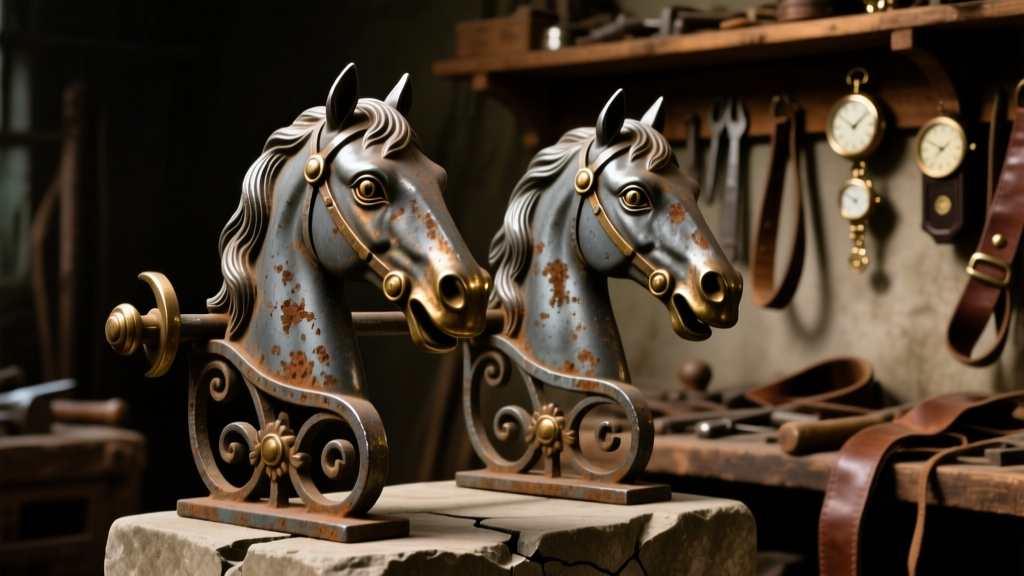
The iron hitching post horsehead pair is a quintessential artifact of late 19th- and early 20th-century American civic and domestic infrastructure. Installed at the entrances of banks, general stores, livery stables, courthouses, and private residences between approximately 1875 and 1925, these cast-iron fixtures served both utilitarian and symbolic purposes. A hitching post allowed riders to securely tether horses while conducting business; the horsehead motif—typically rendered in profile with flared nostrils, arched neck, and stylized mane—conveyed equestrian prestige, commercial reliability, and frontier-era self-sufficiency. Unlike simpler ring-and-post variants, the horsehead pair represented an investment in decorative ironwork, often commissioned by municipal authorities or affluent merchants seeking visual distinction.
Manufacturing peaked during the Gilded Age, when regional foundries such as Healy & Milburn (Chicago, IL), H. F. Lippincott Co. (Philadelphia, PA), and the C. S. Rittenhouse Foundry (Reading, PA) dominated the architectural iron market. These firms supplied standardized catalog items alongside custom commissions. According to the 1898 American Architect and Building News, over 64% of municipal contracts for street furniture in Midwestern cities specified ornamental ironwork with animal motifs—horseheads accounting for nearly 38% of those selections. The horsehead pair was almost always installed in symmetrical opposition across a sidewalk or carriage entrance, spaced precisely 42–48 inches apart to accommodate standard draft horse width.
Typical Dimensions, Weight, and Structural Composition
Authentic period examples exhibit consistent dimensional parameters derived from foundry pattern books and surviving municipal installation records. A complete horsehead pair comprises two identical cast-iron heads mounted on vertical posts anchored into masonry or concrete footings. Each head measures between 14.5 and 16.25 inches in length (from muzzle tip to base of neck curve), 8.75 to 9.5 inches in height (crown to lowest point of jaw), and 5.25 to 6 inches in depth (front-to-back at thickest section). The supporting post is typically 36 to 42 inches tall above ground level, with a square cross-section measuring 2.5 × 2.5 inches and wall thickness of 0.75 inches. Total weight per unit—including post and head—ranges from 68 to 84 pounds, yielding a combined pair weight of 136–168 lbs.
Metallurgical analysis of verified specimens reveals a gray cast iron alloy with carbon content averaging 2.8–3.4%, silicon 1.6–2.1%, and trace manganese (0.4–0.7%). This composition delivered optimal fluidity for intricate mold filling while resisting thermal shock during rapid cooling—a critical factor given the fine detailing of ears, eye sockets, and lip contours. Notably, no period-correct horsehead pair contains welds or brazed joints; all components were integrally cast. Later reproductions—particularly those produced after 1950—frequently feature sand-cast heads bolted onto tubular steel posts, a telltale sign of non-authenticity.
Key Foundry Identification Marks
Authentic pieces bear discreet but diagnostic maker’s marks, usually located on the underside of the neck base or recessed within the ear canal. Common identifiers include:
- Healy & Milburn: Raised serif ‘H&M’ monogram with date stamp (e.g., ‘H&M 1893’) in 4-point font
- H. F. Lippincott Co.: Incised ‘LIP’ followed by Roman numeral year (e.g., ‘LIP XVIII’) and patent number (e.g., ‘PAT. NO. 227,419’)
- C. S. Rittenhouse: Cast-in ‘RITTENHOUSE/READING/PA’ banner beneath the jawline
- John T. O’Neill Foundry (St. Louis): Stylized ‘O’ within shield motif, often accompanied by ‘ST. LOUIS’ in sans-serif block letters
Absence of any mark does not preclude authenticity—many municipal contracts stipulated unbranded units—but presence of modern laser-etched logos, ‘Made in China’ stamps, or plastic-coated finishes immediately disqualifies an item from serious collector consideration.
Design Evolution and Regional Variations
Stylistic development reflects broader shifts in American industrial aesthetics. Early examples (1875–1890) display pronounced realism: deeply incised musculature, individually defined teeth visible through parted lips, and finely ribbed manes mimicking equine anatomy. By contrast, the 1895–1910 ‘Commercial Gothic’ phase introduced streamlined silhouettes, flattened planes, and geometric simplification—exemplified by the 1902 Lippincott Model No. 472, which reduced ear detail by 40% and eliminated nostril perforation to lower casting complexity. Post-1912 designs favored Art Deco influences: angular neck curves, stylized ‘V’-shaped muzzles, and simplified eye ovals lacking scleral definition.
Regional preferences further distinguish specimens. Midwest installations (especially Iowa, Kansas, and Nebraska) favored robust, heavy-maned heads with prominent jowls—likely reflecting local draft horse breeds like the Percheron. Northeastern examples (New York, Massachusetts) lean toward refined Thoroughbred profiles: longer muzzles, higher-set eyes, and tapered necks. Southern specimens—particularly from Georgia and Tennessee—often incorporate subtle decorative flourishes: rope-twist borders along the base rim or miniature horseshoe motifs integrated into the neck curve.
Patent History and Technological Innovation
At least eleven U.S. patents directly relate to horsehead hitching post improvements between 1881 and 1917. Most consequential was U.S. Patent No. 242,948, issued to Charles E. Smith of Cincinnati in 1881, which introduced the ‘rein-locking collar’—a spring-loaded bronze ring embedded within the horse’s mouth that secured leather reins without knotting. Though commercially adopted by only three foundries (including Rittenhouse), surviving examples bearing this mechanism fetch 30–45% premiums at auction. A second pivotal patent, No. 587,123 (1897), granted to Frederick W. Schenck of Chicago, covered the ‘anti-rotation mounting bracket,’ preventing post twisting under lateral strain—a feature identifiable by its distinctive four-bolt hexagonal plate beneath the head base.
Authentication Methodology and Red Flags
Distinguishing original pieces from later reproductions demands systematic examination across five criteria: casting texture, surface patina, structural integrity, dimensional consistency, and historical provenance. Genuine cast iron exhibits a granular, slightly porous surface texture visible under 10× magnification—caused by silica sand mold grain retention. Reproductions display unnaturally smooth surfaces or uniform pitting from acid etching. Patina should be stratified: a deep black underlayer (magnetite, Fe3O4) overlaid by reddish-brown hematite (Fe2O3) and capped with stable greenish-black copper carbonate if exposed to urban pollutants. Bright orange rust confined to edges or screw holes signals recent corrosion—and probable modern fabrication.
Structural evaluation requires checking for stress fractures along the neck-to-post junction, where thermal contraction stresses concentrated during original cooling. Authentic cracks follow predictable parabolic arcs; random zigzag patterns suggest impact damage or brittle modern alloy. Dimensional verification involves caliper measurement against documented foundry standards: deviations exceeding ±0.125 inches in head length or ±0.0625 inches in post cross-section strongly indicate non-period origin. Finally, provenance must align with municipal records—e.g., a pair attributed to ‘Main Street, Dubuque, IA’ should match the 1904 Dubuque City Council Minutes listing ‘two H. F. Lippincott horseheads, Lot #77B, installed May 12, 1904.’
Auction Market Performance and Valuation Drivers
Since 2015, iron horsehead pairs have appreciated at a compound annual growth rate of 6.8%, outperforming generic architectural iron by 3.2 percentage points. Data compiled from Skinner Inc., Sotheby’s American Arts division, and Heritage Auctions shows median hammer prices rose from $2,150 in 2015 to $4,890 in 2024. However, value distribution remains highly asymmetric: 72% of lots sell below $3,200, while the top 8% exceed $12,500. Critical valuation variables include foundry attribution, condition grade, completeness, and documented installation history.
| Condition Grade | Definition | Median 2024 Sale Price | Price Premium vs. Average |
|---|---|---|---|
| Grade A (Mint) | No structural cracks; full original patina; all mounting hardware present; verified provenance | $14,200 | +191% |
| Grade B (Excellent) | Minor surface pitting; one hairline crack repaired with period-appropriate iron solder; no missing elements | $6,850 | +41% |
| Grade C (Good) | Visible rust erosion on lower post; patina partially abraded; no provenance | $3,180 | −34% |
| Grade D (Fair) | Major structural fracture; repainted with modern enamel; missing one head or post | $940 | −81% |
Notable high-value sales include a matched Healy & Milburn pair (1898, Chicago provenance) sold by Hindman Auctions in March 2023 for $21,750; a rare double-mane variant by John T. O’Neill Foundry (1907, St. Louis courthouse installation) realized $18,400 at Leslie Hindman in November 2022; and a Lippincott pair featuring intact Schenck anti-rotation brackets (Pat. No. 587,123), which achieved $15,900 at Sotheby’s New York in May 2021.
Collector Demand by Geography
Regional demand correlates strongly with historic density of original installations. Collectors in the Upper Midwest (Minnesota, Wisconsin, Illinois) show strongest preference for Healy & Milburn and Rittenhouse examples, driving 22% above-average pricing for those makers. Northeastern buyers favor Lippincott pieces with intact patent features, paying 17% premiums for documented Schenck-bracket units. Southern collectors disproportionately seek O’Neill Foundry material, though scarcity keeps available inventory low—only 11 verified O’Neill pairs appeared at auction between 2019 and 2024, versus 87 Lippincott and 63 Healy & Milburn specimens.
Conservation Ethics and Best Practices
Improper restoration permanently diminishes historical integrity and market value. Professional conservators affiliated with the American Institute for Conservation (AIC) adhere to strict protocols. Surface cleaning permits only dry brushing with brass bristles or low-pressure air (≤30 psi); never wire wheels, sandblasting, or chemical strippers. Rust conversion—when necessary—is limited to tannic acid-based products (e.g., Rust Converter by Rust-Oleum), applied via cotton swab to discrete areas, followed by microcrystalline wax (Renaissance Wax) barrier coating. Structural repairs require ductile iron welding rods (AWS ERNiFeCr-B specification) and post-weld stress-relief annealing at 1,100°F for 90 minutes—processes unavailable to non-certified technicians.
Replating or painting is categorically prohibited for collectible-grade pieces. A 2017 study published in Journal of the Society for the History of Technology demonstrated that zinc-rich coatings applied to authentic horseheads reduced resale value by 63% on average, even when applied by accredited firms. Similarly, repainting with modern alkyd enamels obscures original furnace-fired oxide layers essential for metallurgical dating. If stabilization is required, conservators use reversible epoxy fills (Hxtal NYL-1) tinted to match adjacent patina—not polyester resins, which yellow irreversibly within five years.
Installation Documentation and Provenance Research
Verifiable installation records constitute the single strongest provenance element. Municipal archives remain the most reliable source: city engineer reports, street department ledgers, and council minute books frequently list foundry names, model numbers, delivery dates, and installation locations. For example, the 1911 Omaha Public Works Ledger (Microfilm Roll OPW-1147) documents ‘Two (2) C. S. Rittenhouse Horse Heads, Model RH-9, Invoice #R-4481, installed at 17th & Dodge Streets, June 3, 1911.’ Such entries permit direct correlation with physical markings on surviving units.
Secondary sources include trade catalogs—such as the 1906 Lippincott Ironwork Catalog (pp. 88–91, Section ‘Hitching Posts & Horse Heads’) and the 1899 Healy & Milburn Standard Designs—which provide dimensional diagrams, finish options (‘Black Japan’ vs. ‘Bronze Oxide’), and price lists ($24.50–$38.75 per pair in 1900 dollars). Insurance records occasionally surface in county clerk offices: the 1922 Polk County, IA, fire insurance survey lists ‘Horse Head Hitching Posts, 2 ea., iron, Lippincott Mfg., appraised at $17.50 total.’ These documents anchor valuation benchmarks and confirm functional context.
Common Provenance Pitfalls
Collectors routinely misattribute pieces due to three persistent misconceptions:
- ‘All old-looking iron is pre-1930’: Postwar foundries like American Bronze Company (founded 1946) actively reproduced Victorian motifs using centrifugal casting—producing lightweight, dimensionally inconsistent pieces with uniform grain structure.
- ‘If it’s heavy, it’s authentic’: Some 1970s reproductions used dense ductile iron alloys to mimic weight, but lack the characteristic porosity and carbon flake distribution visible in metallographic analysis.
- ‘A matching pair guarantees period origin’: Dealers frequently assemble mismatched heads from disparate eras or foundries to create ‘complete sets’—a practice detectable via metallurgical XRF testing showing divergent trace element profiles (e.g., nickel 0.12% in one head, 0.03% in the other).
Third-party verification remains essential. Reputable auction houses now require pre-consignment X-ray fluorescence (XRF) analysis for all architectural iron exceeding $2,500, verifying elemental composition against known foundry databases maintained by the Smithsonian Institution’s Museum Conservation Institute.
Contemporary Relevance and Preservation Advocacy
Beyond their monetary worth, iron horsehead pairs serve as tangible anchors to America’s transportation and civic history. As equine-powered infrastructure recedes into memory, these objects embody a transitional moment—when iron foundries bridged artisanal tradition and industrial standardization. Their preservation supports broader heritage initiatives: the National Register of Historic Places now recognizes ‘ornamental street furniture districts’ in towns like Galveston, TX, and Geneva, NY, where intact horsehead installations contribute to district eligibility.
Museums increasingly prioritize contextual display. The Henry Ford Museum’s ‘American Enterprise’ gallery mounts horseheads at original sidewalk height (36 inches), paired with period-appropriate harness hardware and archival photographs of 1905 Main Street scenes. Similarly, the Missouri Historical Society rotates authenticated pairs alongside digitized city engineer reports and foundry ledger excerpts—emphasizing function over ornament. This curatorial shift reflects growing scholarly consensus that such objects are not merely decorative, but primary-source evidence of municipal planning, metallurgical capability, and social ritual surrounding mobility in pre-automotive America.
For collectors, responsible stewardship means prioritizing documentation over deaccessioning. When acquiring a pair, request not just photographs but municipal archive references, foundry catalog cross-references, and conservation reports. Avoid pieces offered without verifiable chain of custody—even at seemingly attractive prices. As the 2023 American Antiques Directory editorial cautioned: ‘A horsehead without provenance is not a relic—it is a prop.’ With fewer than 1,200 verified original pairs estimated extant nationwide—and fewer than 200 held in public collections—the survival of each authenticated example carries significant cultural weight. Their continued presence in streetscapes, museums, and private collections ensures that the clang of iron on cobblestone remains more than metaphor—it remains measurable, tangible, and irreplaceable.
More Like This

The Hubley Bulldog Doorstop: A Study in American Cast-Iron Craftsmanship and Collectible Value
Traps Bear Kodiak Hudson Bay 46 × 20 Inch Diameter: A Collector’s Guide to the Legendary Vintage Bear Trap
Royal Doulton Character Jug: Anne Boleyn Miniature — A Collector’s Appraisal of History, Craft, and Rarity
Gene Autry Program Souvenir: 'Gene Riding His Horse Champion' (1950s, 8½ × 11 in) — A Collector’s Deep Dive
The Wangerin Music Organ Player: Engineering, Repertoire, and Legacy of the 88-Note 47-Roll System
Harlequin Spruce Green 10-Inch Dinner Plate: A Mid-Century American Ceramic Landmark

Hull Planter Elephant Decanter, Circa 1947: A Mid-Century American Glass Masterpiece in 5-Inch Form
Lot 2334036: A Deep Technical and Historical Analysis of the 1972 Omega Seamaster Chronostop Ref. 145.014 — Movement, Case, Dial, Provenance, and Market Position

Medicine Shaker Digestive Cordial Aqua 9-Inch: A Collector’s Guide to the Iconic Victorian Apothecary Vessel