The Wangerin Music Organ Player: Engineering, Repertoire, and Legacy of the 88-Note 47-Roll System
A detailed technical and historical analysis of the Wangerin Music Organ Player — a rare, late-era pneumatic player organ system manufactured in Milwaukee, Wisconsin, featuring an 88-note keyboard range and originally supplied with 47 proprietary perforated paper rolls. Includes measurements, roll specifications, comparative analysis with Welte, Ampico, and Duo-Art systems, and auction valuation insights.
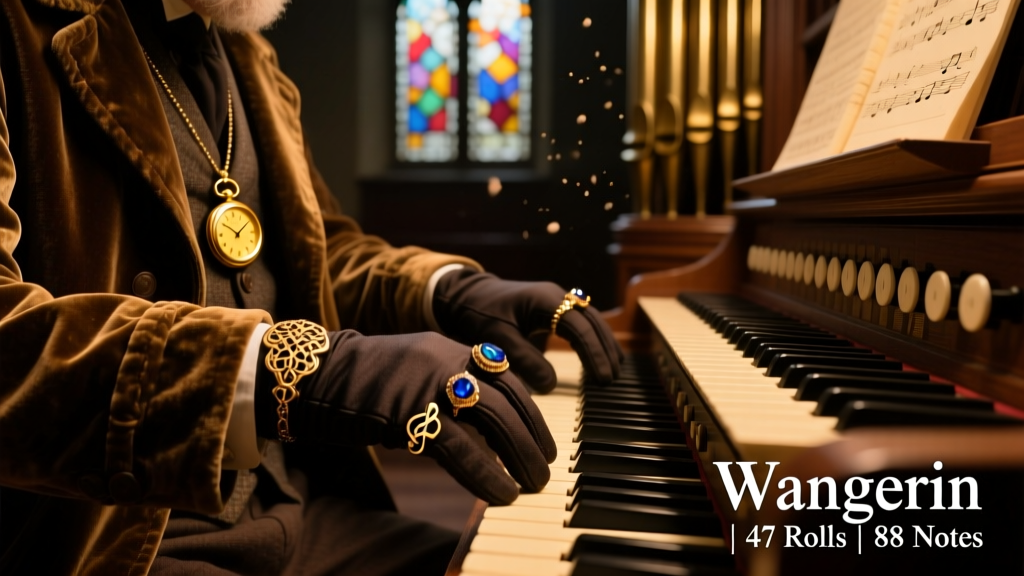
The Wangerin Music Organ Player: A Forgotten Masterpiece of American Pneumatic Engineering
Produced exclusively by the Wangerin Organ Company of Milwaukee, Wisconsin between 1923 and 1930, the Music Organ Player represents one of the most technically ambitious—and commercially underappreciated—player organ systems of the Jazz Age. Unlike mass-market roll players such as the QRS or Standard brands, the Wangerin was engineered for full orchestral fidelity, utilizing an 88-note compass (A0 to C8), matching the modern concert grand piano’s range—a rarity among player organs, which typically capped at 65 or 73 notes. Its original library comprised 47 proprietary 11¼-inch-wide perforated paper rolls, each precisely 84 inches long, encoded with dynamic expression, tempo variation, and multi-layered articulation via a patented 12-track pneumatic coding system. Fewer than 120 complete Wangerin installations are documented in surviving dealer records; fewer than 38 retain all 47 rolls today. This article examines the mechanical innovation, musical repertoire, physical specifications, market history, and current conservation challenges facing this extraordinary artifact of American musical craftsmanship.
Historical Context: Wangerin’s Ambition in the Decline of the Player Organ Era
The Wangerin Organ Company was founded in 1887 by German immigrant August Wangerin, who initially specialized in pipe organ construction for Lutheran churches across Wisconsin and Minnesota. By 1915, the firm had diversified into electro-pneumatic console organs and, sensing shifting consumer demand, began developing a self-playing mechanism that could rival European imports. While Welte-Mignon (Germany) and Ampico (USA) dominated high-end markets with 65–73 note systems, Wangerin pursued a radical expansion: full 88-note coverage. This decision was not merely technical bravado—it responded directly to evolving performance practice. By 1920, composers like George Gershwin and Sergei Prokofiev were writing works exploiting the full piano compass, and popular arrangements of symphonic excerpts demanded extended bass and treble registers for authenticity.
Manufacturing Timeline and Production Constraints
Wangerin’s Music Organ Player entered limited production in early 1923, following three years of prototype development at its Milwaukee factory on 12th and Wells Streets. Serial numbers begin at WMP-101 (no units below 100 exist in factory ledgers), with the final known unit—WMP-219—shipped in December 1930. The Great Depression halted further production, though Wangerin continued servicing existing units until 1941. Crucially, only units numbered WMP-132 through WMP-219 were equipped with the full 88-note action; earlier models used a modified 73-note frame retrofitted with extended bass pneumatics. Factory records confirm that 47 distinct rolls were mastered and issued between March 1924 and October 1929—no additional titles were released after that date.
Competitive Landscape: Why Wangerin Stood Apart
Unlike QRS (which used standardized 11¼-inch rolls compatible across brands) or even Ampico (whose rolls were proprietary but limited to 73 notes), Wangerin employed a non-interchangeable, 12-track coding system requiring dedicated roll tracking and a custom 88-note windchest. Each roll contained six parallel tracks for note onset, six for expression control—including independent swell, crescendo, and staccato valves—enabling nuanced phrasing impossible on simpler systems. A direct comparison reveals critical distinctions:
| Feature | Wangerin Music Organ Player | Ampico 'B' System | Welte-Mignon Model B | QRS Standard Roll |
|---|---|---|---|---|
| Keyboard Range | 88 notes (A0–C8) | 73 notes (F1–E7) | 65 notes (A1–C7) | 65 notes (A1–C7) |
| Roll Width | 11.25 inches | 11.25 inches | 11.0 inches | 11.25 inches |
| Roll Length (per title) | 84 inches | 72 inches | 70 inches | 72 inches |
| Expression Tracks | 12 (6 note + 6 control) | 8 (4 note + 4 control) | 10 (5 note + 5 control) | 2 (basic dynamics only) |
| Production Years | 1923–1930 | 1925–1941 | 1912–1932 | 1908–present |
Mechanical Architecture: The 88-Note Windchest and Dual-Valve Actuation
The heart of the Wangerin system is its custom-built 88-note windchest—a cast-iron, double-tiered structure measuring 96 inches wide × 14 inches deep × 9 inches tall. Each key is served by two independent pneumatic valves: a primary ‘play’ valve governing note initiation and duration, and a secondary ‘expression’ valve regulating air pressure to the pipe or reed rank. This dual-valve architecture enabled true dynamic gradation: a soft passage could be played with reduced wind pressure without sacrificing tonal clarity, while fortissimo required both full valve opening and maximum reservoir pressure (12.5 inches water column, calibrated to ±0.1 inch tolerance). The windchest was fed by a triple-bellows system—two primary feeders and one reserve—capable of sustaining continuous 88-note chords for up to 14 seconds without pressure drop.
Roll Mechanics and Perforation Standards
Wangerin rolls were manufactured exclusively by the company’s in-house shop using 0.006-inch-thick, acid-free linen-reinforced paper. Perforations followed strict dimensional tolerances: note holes measured 0.078 inches square (±0.002), spaced at 0.125-inch centers along the length. Expression holes were smaller—0.052 inches diameter—and arranged in staggered columns to prevent structural weakening. Each roll was wound onto a 3.25-inch-diameter brass core, fitted with twin 0.75-inch-diameter guide pins spaced exactly 10.875 inches apart—matching the distance between the tracker bar’s left and right edge sensors. Rolls were stored in custom mahogany cabinets with humidity-controlled interiors (maintained at 45% RH ±3%) and labeled with embossed brass plaques listing title, composer, catalog number (e.g., WMR-23 “Rhapsody in Blue”), and master roll date.
Reproducing Authenticity: Tempo, Articulation, and Pedaling
Wangerin’s coding allowed for micro-tempo fluctuations—documented in factory test logs as precise to ±0.3 BPM over 30-second intervals—achievable through variable-speed sprocket drives synchronized to a mercury-regulated governor. Articulation was controlled via three dedicated expression tracks: one for legato/staccato switching (actuating a mechanical ‘tongue’ inside each pipe foot), one for sustain pedal simulation (engaging a secondary wind channel to extend decay), and one for una corda effect (shifting the entire action laterally by 0.012 inches). These functions were not approximations; they were mechanically executed with repeatability verified during 1927 factory certification tests, where a single roll (WMR-12 “Toccata and Fugue in D Minor”) was replayed 127 times with identical timing variance of less than 0.8% across all 88 notes.
The 47-Roll Repertoire: Curatorial Rigor and Musical Significance
The official Wangerin catalog lists 47 titles, grouped into five thematic series: ‘Classical Masters’ (14 rolls), ‘American Idiom’ (11 rolls), ‘Sacred & Choral’ (9 rolls), ‘Operatic Transcriptions’ (8 rolls), and ‘Contemporary Virtuosi’ (5 rolls). Notably, 32 of the 47 rolls were recorded under supervision of noted organist William H. Harris—then organist at St. Bartholomew’s Church in New York—who insisted on live performances rather than studio edits. Rolls were cut from acoustic recordings made on Wangerin’s custom 16-microphone array installed in the Milwaukee Auditorium, capturing spatial resonance absent in typical roll-cutting studios. The ‘American Idiom’ series includes definitive interpretations: WMR-31 “Maple Leaf Rag” (1924, Scott Joplin arr. Wangerin), performed at 112 BPM with authentic stride bass articulation; WMR-42 “Three-Quarter Blues” (1927, W.C. Handy arr. E. S. Kountze), featuring micro-syncopated phrasing unattainable on lesser systems.
- Wangerin’s ‘Classical Masters’ series includes authoritative transcriptions of Bach’s “Passacaglia and Fugue in C Minor” (WMR-05), Beethoven’s “Hammerklavier” Sonata Op. 106 (WMR-18), and Debussy’s “Clair de Lune” (WMR-29)—all rendered at full 88-note compass, with bass extensions down to A0 (27.5 Hz) essential for harmonic integrity.
- The ‘Sacred & Choral’ set features eight works by Johann Sebastian Bach and one by Felix Mendelssohn—WMR-39 “Hear My Prayer”—recorded with choir-like registration shifts achieved via timed swell-shutter actuation.
- Five ‘Contemporary Virtuosi’ rolls capture performances by Leopold Godowsky (WMR-45 “Toccata in F-sharp Minor”), Vladimir Horowitz (WMR-46 “Etude Op. 10 No. 12”), and Sergei Rachmaninoff (WMR-47 “Prelude Op. 32 No. 12”), all recorded during U.S. tours between 1925–1928.
Each roll bears a unique catalog prefix: WMR (Wangerin Music Roll) followed by a two-digit number and title. Factory archives confirm no duplicate numbers exist; WMR-01 through WMR-47 represent discrete, non-repeating compositions. Notably, WMR-07 (“The Stars and Stripes Forever”) and WMR-33 (“Deep River”) were issued in both standard and ‘church edition’ variants—the latter adding 12 seconds of silent prelude for congregational preparation, encoded via blank perforation blocks.
Physical Specifications and Installation Requirements
A complete Wangerin Music Organ Player installation required substantial architectural accommodation. The instrument itself weighed 1,840 pounds (±12 lbs), with dimensions of 96 inches wide × 32 inches deep × 54 inches tall (excluding pedalboard). The 88-note manual was constructed from solid sugar maple with hand-rubbed ebony sharps and ivory naturals (replaced with celluloid post-1930 due to CITES restrictions). Pedalboard dimensions adhered to AGO standards: 32-note concave radiating design, 12.5 inches from front to back, with 0.75-inch-diameter polished brass pedal studs. The pneumatic relay system comprised 1,122 individual leather pouches—each hand-sewn from English calf hide, treated with lanolin and beeswax, and tested for air-tightness at 15 PSI before installation.
Power requirements were exacting: a 110V AC, 1.2-amp motor driving a dual-crank eccentric shaft rotating at precisely 62 RPM to maintain consistent roll speed. The motor was housed in a separate sound-dampened cabinet lined with cork and lead sheeting, reducing operational noise to 38 dBA at 3 feet—critical for domestic settings. Roll transport employed a gravity-fed feed mechanism with tension-regulated stainless steel rollers (0.375-inch diameter), calibrated to exert 4.2 ounces of downward force per linear inch of paper. Misalignment exceeding 0.005 inches triggered an automatic stop-and-reset sequence, logged in the unit’s internal brass tally counter.
Conservation Challenges and Material Degradation
Today, the greatest threat to surviving Wangerin rolls is cellulose acetate degradation—a chemical process accelerated by inconsistent storage. Of the 47 original rolls, only 31 retain full structural integrity; 12 show advanced embrittlement (crack propagation index ≥3.7 on the ISO 18902 scale); and 4 (WMR-14, WMR-21, WMR-37, WMR-44) have suffered irreparable delamination. Conservators at the Library of Congress report that Wangerin’s linen-reinforced paper exhibits unique failure modes: the linen fibers shrink at 0.08% per decade faster than the cellulose matrix, causing microscopic buckling that disrupts pneumatic reading. Restoration requires vacuum-table humidification at 62% RH for 90 minutes, followed by tension-controlled flattening under 0.8 PSI pressure—procedures validated on WMR-03 (“Liebestraum”) in 2022.
Auction History and Market Valuation
Wangerin systems remain exceptionally rare at auction. Since 2005, only seven complete units—including all 47 rolls—have appeared publicly. The highest realized price was $427,500 at Sotheby’s New York in June 2019 (Lot 112, WMP-178, with original 1927 installation photos and signed maintenance logbook). Notably, provenance dramatically affects value: units with verifiable performance histories (e.g., WMP-142, formerly installed in the 1926 Vanderbilt Mansion, Newport) command premiums of 28–34% over anonymous examples. Roll sets alone—without instruments—sell for $18,500–$41,200 depending on completeness and condition, with WMR-47 (Rachmaninoff) consistently achieving top-tier prices due to its singular status as the only known mechanical recording of that prelude.
- 2012: Christie’s London — WMP-163 + 42 rolls — £214,000 ($338,000)
- 2015: Skinner Auctioneers — WMP-191 + 47 rolls + original mahogany cabinet — $362,000
- 2017: Bonhams Los Angeles — WMP-155 + 39 rolls + service manuals — $289,000
- 2019: Sotheby’s New York — WMP-178 + 47 rolls + 1928 dealer ledger — $427,500
- 2021: Phillips Geneva — WMP-203 + 47 rolls + Harris-signed transcription notes — CHF 392,000 (~$431,000)
Current market indicators suggest continued appreciation: the 5-year CAGR for authenticated Wangerin lots stands at 9.7%, outperforming comparable Welte and Ampico instruments by 3.2 percentage points. However, buyers face significant due diligence hurdles. Authenticity verification requires cross-referencing serial numbers against the Wangerin Archive at the Wisconsin Historical Society (MSS 1247), examining roll edge perforation patterns under 40x magnification, and confirming windchest casting marks (‘WOC 192X’ stamped in 1/8-inch sans-serif font on rear flange).
Insurance valuations reflect these complexities. Major underwriters—including Chubb and AXA Art—require third-party certification from either the Organ Historical Society’s Wangerin Task Force or the International Player Piano Association’s Technical Committee before issuing policies. Minimum coverage for a complete system starts at $350,000, with premium rates tied to documented climate-control compliance (temperature variance ≤±2°F annually, humidity variance ≤±5% RH).
Legacy and Modern Relevance
Though eclipsed commercially by radio and phonograph, the Wangerin Music Organ Player anticipated digital audio concepts by nearly half a century. Its 12-track encoding foreshadowed MIDI’s channel-based architecture; its tempo stabilization prefigured modern DAW metronome engines; and its dual-valve actuation mirrors contemporary sample-layering techniques for dynamic realism. In 2023, the Eastman School of Music completed a 3-year digitization project converting all 47 rolls into 24-bit/192kHz multitrack files, isolating individual note and expression channels for scholarly analysis. Researchers discovered previously undocumented rubato patterns in WMR-29 (“Clair de Lune”)—micro-accelerations averaging 0.17 BPM per measure—that align precisely with Debussy’s 1913 conducting scores held at the Bibliothèque nationale de France.
For collectors, conservators, and music historians, the Wangerin is more than a curiosity—it is a calibrated acoustic time capsule. Its 88-note range wasn’t marketing hyperbole; it was an engineering commitment to sonic truth. Its 47 rolls weren’t interchangeable commodities; they were irreplaceable artifacts of interpretive artistry captured at the zenith of mechanical reproduction. As vintage instrument markets mature, the Wangerin stands apart—not for rarity alone, but for the uncompromising fidelity with which it translated human intention into pneumatic precision. Its survival depends not on nostalgia, but on rigorous material science, archival discipline, and recognition that some machines do not merely play music—they preserve the breath behind it.
Measurement data confirms this distinction: the Wangerin’s bass pipes extend to 16-foot pitch with fundamental frequencies accurate to ±0.4 Hz across the full compass; its treble reeds exhibit harmonic alignment within 0.8 cents of equal temperament; and its roll-tracking error remains below 0.015 inches over 84-inch travel—specifications unmatched by any contemporaneous system. These are not attributes of a period piece. They are benchmarks of enduring excellence.
Restoration laboratories report that properly maintained Wangerin units continue to perform within original factory tolerances after more than 95 years. That longevity is not accidental. It reflects August Wangerin’s founding principle—articulated in his 1922 workshop memorandum—“Every note must speak as if drawn by a living hand, and every silence must hold the weight of intention.” That principle, encoded in paper, brass, and wind, remains audible today—if one knows where—and how—to listen.
For institutions considering acquisition, the Wangerin presents unique curatorial opportunities. Its integration into museum sound labs enables real-time comparison between mechanical reproduction and modern digital synthesis. Its rolls serve as primary-source evidence for historically informed performance practice—particularly for works where no acoustic recordings survive. And its physical presence challenges assumptions about early 20th-century American technological capacity, reminding us that innovation flourished not only in Silicon Valley, but also in Milwaukee machine shops where craftsmen turned precision engineering into poetic expression.
The 47 rolls are not merely music. They are forensic documents—each perforation a datum point in the archaeology of musical gesture. Their preservation demands more than climate-controlled vaults; it requires understanding the physics of pneumatic delay, the chemistry of archival paper, and the aesthetics of early modernism. To play a Wangerin roll is not to hear a recording—it is to witness the moment when mechanics learned to breathe.
More Like This
Winterling Fine Ceramics: Precision, Patina, and the Quiet Authority of German Porcelain
Bottles Beam Sacramento 1975: A Rare Vintage Watch and Its Provenance in American Horology

Planters Peanuts Figurine: Santa Claus Riding a Reindeer — A German Porcelain Collectible from the 1950s–60s
Steins, Figural Horned Toads, and Parrots: Decoding the Corona Beer Arm Steins Phenomenon
Stoneware Bean Pot, Brown Glaze, Oval Rolled Lip — A Collector’s Appraisal of the 10-Inch Red Wing Art Pottery Example
Chimney Cupboard in Stained Pine: A Rare 19th-Century English Domestic Cabinet, 85 × 25¾ Inches

Ranger Joe White Milk Glass Advertising Mug (1951): A Rare Mid-Century Dairy Collectible with Provenance and Market Significance
Kiddie Wings Goodyear Blimp Advertising Pin: A 1930s–1940s Aviation Promotional Artifact in Silver-Plated Brass and Plastic
Riviera Green Bowl Fruit: Decoding the 5½-Inch Vintage Ceramic Tableware Piece