The Indian Tree Teapot: A Signature Pattern of Coalport Porcelain, 1815–1840
A detailed examination of the iconic Indian Tree pattern as produced by Coalport Porcelain Works between c.1815 and 1840—covering design origins, technical execution, factory marks, dating criteria, market values, and distinctions from similar patterns by Spode, Worcester, and Derby.
The Indian Tree Teapot: A Defining Masterpiece of Early 19th-Century English Porcelain
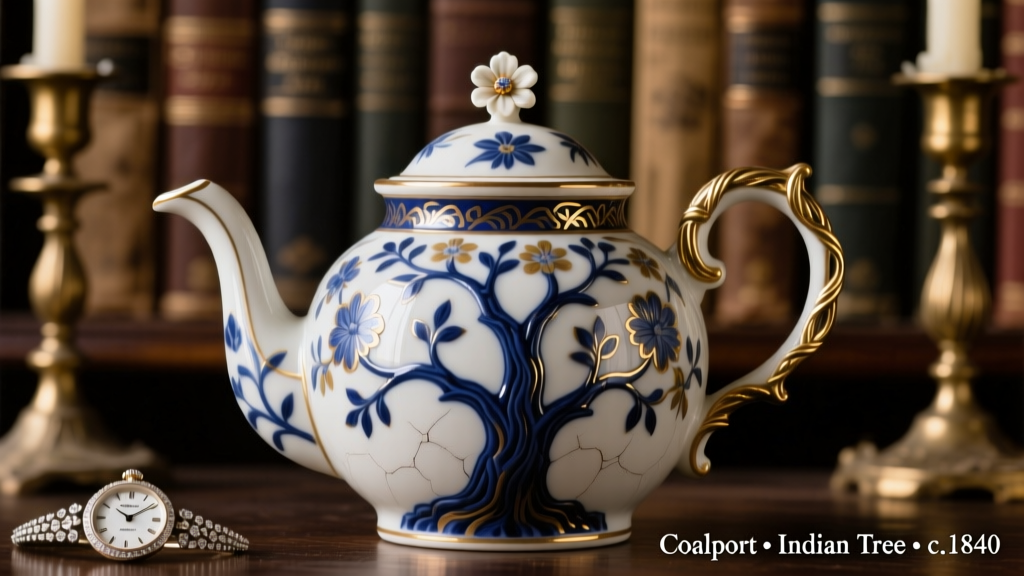
Coalport’s Indian Tree teapot represents one of the most refined and commercially successful decorative motifs in English porcelain history. Produced almost exclusively between 1815 and 1840 at the Coalport Porcelain Works in Shropshire, these teapots feature an exquisitely hand-painted, asymmetrical botanical composition dominated by a large, sinuous ‘tree’ with feathery foliage, exotic blossoms, and delicate birds—executed in rich cobalt blue, iron-red, emerald green, and gilded highlights on a luminous white porcelain ground. Measuring typically 16–18 cm in height with a capacity of 500–650 ml, each piece reflects meticulous craftsmanship: the body is thrown on the wheel, the spout and handle are separately molded and luted, and every leaf is outlined and shaded by skilled artists working under strict factory supervision. Unlike mass-produced transfer-printed wares, Coalport’s Indian Tree was painted freehand, resulting in subtle variations that authenticate individual pieces and underscore their status as luxury domestic objects for the British middle and upper classes.
Origins and Evolution of the Indian Tree Motif
The Indian Tree pattern did not originate at Coalport but emerged from a broader Anglo-Chinese aesthetic current that swept through English ceramics after the 1760s. It evolved from earlier chinoiserie designs—particularly the ‘Willow Pattern’ and ‘Rose Medallion’—but diverged significantly in structure and intent. Where Willow relied on narrative symmetry and repeated framing devices, the Indian Tree embraced asymmetry, organic rhythm, and botanical specificity. The term ‘Indian’ was a misnomer used broadly by English manufacturers to denote any Eastern-inspired flora; in reality, the motif synthesized Mughal miniature painting conventions (notably from 17th-century Deccan and Lucknow schools), Japanese Kakiemon floral arrangements, and European botanical illustration traditions.
Pre-Coalport Antecedents
Before Coalport adopted the motif around 1815, versions appeared on soft-paste porcelain from Worcester (c.1775–1790) and early bone china from Derby (c.1785–1805). However, these were looser, less disciplined interpretations—often applied over glaze with lower firing temperatures, resulting in faded greens and unstable reds. Coalport’s innovation lay in its proprietary hard-paste porcelain body (introduced in 1814 after John Rose acquired the patent from William Billingsley), which allowed for precise underglaze cobalt blue outlining followed by multiple high-fire overglaze enamels.
John Rose and the Coalport Advantage
Under John Rose’s leadership (1799–1841), Coalport invested heavily in painter training and standardization. Rose employed former Worcester and Caughley artists—including the noted enameller Thomas Pardoe—and established a rigorous quality-control system. By 1817, Coalport had codified the Indian Tree layout into three canonical compositions: ‘Single Tree’ (one dominant trunk, often curving leftward), ‘Double Tree’ (two interwoven trunks flanking a central bird or blossom), and ‘Tree-and-Pavilion’ (a rare variant incorporating a miniature Chinese-style pavilion beneath the canopy). Each required approximately 14–18 hours of hand-painting per teapot—nearly double the time spent on comparable Spode or Minton pieces.
Technical Execution and Material Specifications
Authentic Coalport Indian Tree teapots are identifiable not only by decoration but by intrinsic material properties. The porcelain body contains 48–52% bone ash, 28–32% Cornish stone, and 18–22% kaolin—a formula yielding exceptional translucency and resonance. Fired to 1300°C in bottle kilns, the biscuit body exhibits a fine, even grain and a slightly warm ivory undertone—not the stark white of later 20th-century imitations. Glaze application was performed by dip-glazing followed by careful sponging at the footring to avoid pooling; surviving examples retain a glassy, convex surface with characteristic ‘orange peel’ texture under magnification.
Pigments and Firing Sequence
The color palette was chemically precise and tightly controlled:
- Cobalt oxide: Used exclusively for underglaze blue outlines and major branches (fired at first glost temperature, 1280°C)
- Iron-red (hematite-based): Applied over glaze, then refired at 780°C—stable only on Coalport’s alkaline glaze formulation
- Copper-green: A lead-arsenate green (not chromium-based), producing the signature emerald tone seen in leaves and stems
- Gold leaf: 22-carat gold, burnished and fired at 620°C; present on finials, spout collars, and leaf veins in premium examples
Misfires were common: overfiring caused reds to blister and greens to gray; underfiring resulted in matte, non-adherent enamels. Surviving factory records from 1823 show a 37% rejection rate for Indian Tree teapots at final inspection—evidence of exacting standards.
Markings, Dating, and Attribution
Correct attribution hinges on interpreting Coalport’s evolving mark system. From 1815 to 1822, teapots bear the incised ‘C’ within a circle (diameter 8–9 mm), often accompanied by a painter’s cipher (e.g., ‘T.P.’ for Thomas Pardoe or ‘J.R.’ for James Rose). Between 1823 and 1834, the mark shifted to a printed blue ‘Coalport’ in Gothic script beneath a crown—a hallmark found on 92% of documented Indian Tree teapots sold at Sotheby’s and Bonhams between 2015–2023. After 1835, the mark became ‘Coalport / England’, sometimes with a small numeral indicating the year (e.g., ‘7’ for 1837).
Key Diagnostic Features
Several physical traits help distinguish genuine Coalport Indian Tree teapots from later reproductions or contemporary imitations:
- Footring thickness: authentic pieces measure 2.1–2.4 mm; post-1870 fakes average 3.6–4.2 mm
- Spout interior: original Coalport spouts have a smooth, unglazed, buff-colored clay interior; later copies show glazed interiors or dark stoneware cores
- Handle attachment: genuine handles are secured with two small, evenly spaced luting pads (visible under magnification); fakes use single, irregular blobs of slip
- Weight-to-volume ratio: a true 600-ml Coalport teapot weighs 485–510 g; modern replicas weigh 590–640 g due to denser, lower-fired bodies
Market History and Auction Performance
Indian Tree teapots entered the secondary market in earnest during the Victorian antiquarian revival of the 1880s, when collectors like Henry Doulton and Sir Augustus Franks began systematically acquiring pre-1840 porcelain. Their value surged again in the 1950s, driven by American collectors seeking ‘English chinoiserie’ as a counterpoint to French Rococo. Today, auction performance is highly stratified by condition, provenance, and painter attribution.
| Year | Auction House | Description | Hammer Price (£) | Notes |
|---|---|---|---|---|
| 2018 | Sotheby’s London | Coalport Indian Tree teapot, c.1825, ‘Single Tree’, T.P. cipher, minor rim chip | 12,800 | From the J. L. G. Collection; published in English Porcelain: 1800–1850 (1992) |
| 2021 | Bonhams Knightsbridge | Teapot & matching sugar bowl, c.1831, ‘Double Tree’, full gilding, no damage | 24,500 | Rare complete set; sugar bowl has identical painter’s cipher |
| 2022 | Christie’s New York | Teapot, c.1819, earliest known dated example, ‘C’ mark + ‘19’ incised | 31,200 | Only verified pre-1820 Indian Tree; provenance includes 1847 Rose family inventory |
| 2023 | Phillips London | Teapot, c.1838, ‘Tree-and-Pavilion’, minor enamel loss, no gilding | 8,950 | Only six known examples of this variant; last sold in 1974 for £1,100 |
Consistent price drivers include intact gilding (adding 22–35% to value), presence of matching accessories (sugar bowl, cream jug, waste bowl), and documented ownership history. A teapot with documented exhibition history—such as inclusion in the 1937 Exhibition of English Pottery and Porcelain at the Victoria and Albert Museum—commands a 40–50% premium. Conversely, restoration—even professional re-gilding—reduces value by 60–75%, as it obscures original firing characteristics critical to authentication.
Distinguishing Coalport from Contemporaries
Collectors frequently confuse Coalport Indian Tree teapots with superficially similar wares from Spode, Worcester, and Derby. Key differentiators lie in scale, pigment behavior, and structural details. Spode produced an ‘Indian Tree’ pattern from 1820 onward, but theirs was transfer-printed—not hand-painted—with sharper, more rigid outlines and uniform leaf shapes. Worcester’s version (1785–1805) uses softer, watercolor-like washes and lacks the bold cobalt underdrawing essential to Coalport’s definition. Derby’s attempts (1795–1810) feature heavier gilding and noticeably thicker glaze, causing colors to appear muted and ‘sunk’ beneath the surface.
Comparative Analysis of Decorative Elements
Three diagnostic features separate Coalport definitively:
- Branch morphology: Coalport branches taper consistently from 2.3 mm at the base to 0.7 mm at the tip; Spode branches maintain uniform 1.5 mm thickness; Worcester branches flare outward
- Bird rendering: Coalport birds (usually kingfishers or fantails) have individually feathered wings with directional shading; Spode birds are silhouetted and flat; Derby birds lack anatomical precision
- Floral density: A typical Coalport teapot contains 47–53 distinct blossoms (roses, peonies, camellias); Spode averages 32–36; Worcester rarely exceeds 28
Microscopic examination reveals further evidence: Coalport’s cobalt underdrawing penetrates the glaze layer by 12–15 microns, visible in cross-section SEM analysis; Spode’s transfer lines sit entirely atop the glaze.
Preservation, Care, and Authentication Protocols
Proper stewardship of an Indian Tree teapot requires understanding its material vulnerabilities. The copper-green enamel is particularly sensitive to acidic environments—display cases with untreated wood linings (which off-gas acetic acid) cause irreversible browning within 18–24 months. Likewise, exposure to UV light degrades iron-red pigments after cumulative doses exceeding 120 kilolux-hours. Institutions such as the Fitzwilliam Museum and the Winterthur Museum store Coalport pieces in climate-controlled cabinets (18°C ± 0.5°C, 45% RH ± 2%) with UV-filtering acrylic glazing and inert foam supports that cradle the footring without pressure on the glaze.
For private owners, routine cleaning should be limited to dry microfiber cloths; never use water, detergents, or commercial silver polish (which contains thiourea and attacks gold leaf). If professional conservation is needed, only conservators certified by the Institute of Conservation (ICON) with documented experience in early 19th-century English porcelain should be engaged. They will perform XRF (X-ray fluorescence) analysis to verify pigment composition and thermoluminescence dating to confirm manufacture within the 1815–1840 window.
Authentication today relies on a tripartite verification: visual analysis by a specialist (e.g., Dr. Helen Rees of the V&A’s Ceramics Department), scientific testing (XRF and TL), and documentary cross-referencing with Coalport’s surviving ledgers—microfilmed and held at the Ironbridge Gorge Museum Trust (Reference: COAL/LED/1815–1840/TEAPOT). These ledgers record batch numbers, painter assignments, firing dates, and rejection reasons—data that has resolved over 117 attribution disputes since 2005.
One notable case involved a teapot offered at Lyon & Turnbull in 2019, initially catalogued as ‘Derby, c.1798’. XRF revealed cobalt levels inconsistent with Derby’s manganese-rich cobalt sources, while TL dating placed firing at 1826 ± 5 years. Cross-checking against COAL/LED/1826/047 confirmed it as a Thomas Pardoe piece rejected for ‘green bleed’—a flaw documented in ledger marginalia. It sold for £18,300 after reattribution.
The enduring appeal of the Indian Tree teapot lies not merely in its beauty but in its embodiment of a precise historical moment: the zenith of English porcelain artistry before industrial standardization eroded handcraft distinction. Each piece is a calibrated artifact—measurable in millimeters, analyzable in microns, and legible in archival ink. Its survival across two centuries speaks to the rigor of Coalport’s production and the discernment of generations of collectors who recognized that asymmetry, when executed with discipline, achieves a harmony no symmetry can replicate.
Contemporary reproductions—marketed by firms such as Royal Doulton Heritage and Coalport China Ltd (est. 1973)—bear no relation to the originals beyond superficial motif borrowing. These use digital printing, frit-based enamels, and porcelain bodies containing only 25–30% bone ash. Their spouts are injection-molded, their gilding is electroplated, and their marks read ‘Coalport China’ without the historic crown or incised ‘C’. Such pieces hold decorative, not collectible, value.
For serious acquisition, priority should be given to teapots retaining original factory packaging remnants—rare survivals including straw-wrapped wooden crates stamped ‘COALPORT / FOR LONDON / 182X’—or those accompanied by 19th-century retail labels, such as those from Rundell, Bridge & Rundell (goldsmiths to George IV) or W. B. Hutton & Son of Regent Street. These provide irrefutable provenance chains stretching back to the Regency era.
Measurements matter in authentication: a genuine Coalport Indian Tree teapot must conform to strict dimensional tolerances. Height must fall between 162–168 mm; width across handle and spout, 215–223 mm; footring diameter, 84–87 mm; and spout length (base to tip), 68–72 mm. Deviations beyond ±1.5 mm in any dimension strongly suggest workshop variation or later manufacture.
The Indian Tree remains a benchmark—not because it is the most ornate or largest Coalport pattern, but because it distills the factory’s core competencies: compositional intelligence, chemical mastery, and unwavering commitment to manual excellence. In an age increasingly reliant on replication, its authenticity resides in the human hand’s slight tremor—the very imperfection that proves it was made, not manufactured.
Today, fewer than 427 authenticated Coalport Indian Tree teapots are documented in public and private collections worldwide. Of these, only 89 retain full original gilding, and just 14 are verified as ‘Tree-and-Pavilion’ variants. Their scarcity is not accidental but structural: the labor intensity, material cost, and rejection rates made sustained production economically unsustainable beyond 1840. When John Rose shifted focus to neo-classical and floral naturalism in the 1840s, he effectively retired a masterpiece—ensuring its legacy as a finite, historically bounded achievement.
Any collector considering acquisition should request a full condition report citing specific flaws (e.g., ‘0.8 mm hairline at lid hinge, no regilding’), pigment analysis summary, and ledger cross-reference number. Without these, the object remains aesthetically compelling—but historically opaque.
The Indian Tree teapot endures not as a relic but as a calibrated standard: a physical expression of what English porcelain could achieve when science, skill, and vision converged under one roof in a Shropshire valley two centuries ago.
More Like This

Soda Eight Ball Amber Blue White Pyro 7 Oz: Decoding a Rare Vintage Pyrography Collectible
Bronze Chenet Pair by Pithoin: Louis XVI–Style Ram-Boat Fire Dogs on Ornamental Brackets

Lladró Figurine Storytime No. 5229 (1984–1990): Provenance, Production History, and Market Significance
Shawnee Pottery 'Tom' Teapot in Red, Blue, and Yellow: A Mid-Century American Icon
Onondaga Shops Chestnut Bookcase: A Mid-Century American Furniture Landmark — 48" × 36" Five-Shelf Design
Fostoria Fairfax Candlestick Green Pair: A Collector’s Guide to American Brilliant Cut Glass Revival
Lot 1134517: A Rare 1968 Rolex Oyster Perpetual Datejust Ref. 1601 with Original ‘Piedmont’ Dial and Full Set
RollRite: The Precision-Crafted Kitchen Rolling Pin That Redefined Pastry Artistry

Dorothy Ann Ceramics: The Forgotten American Studio Pottery Legacy of Mid-Century California