Indian Pipe Bag: Sioux Beaded and Quilled Masterpieces of Sacred Craftsmanship
A detailed examination of historic Sioux pipe bags—functional ceremonial objects transformed into masterworks of beadwork and porcupine quill artistry—covering materials, construction, symbolism, provenance, and market value with auction data from Sotheby’s, Heritage Auctions, and Cowan’s.
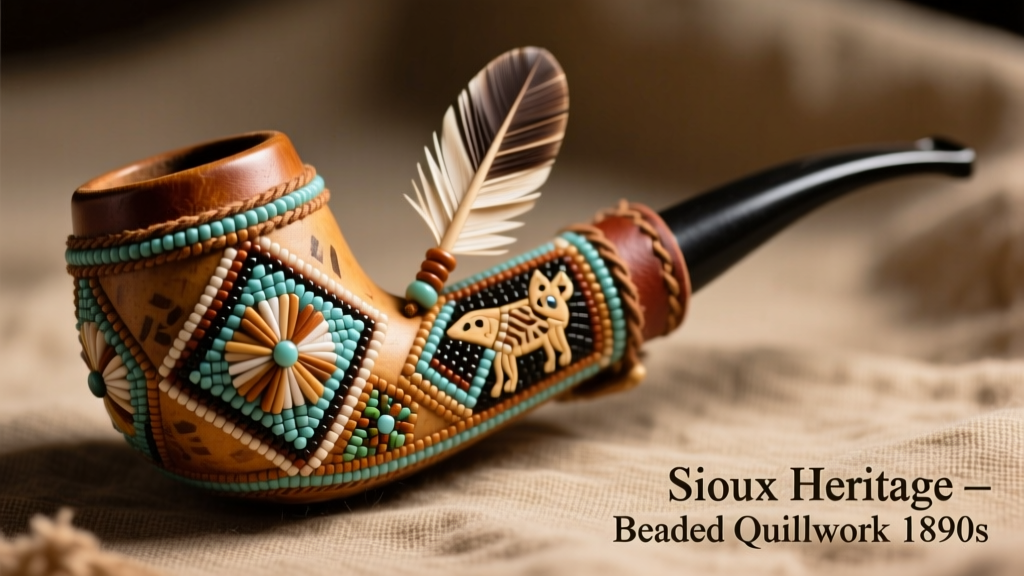
The Sacred Function and Cultural Significance of the Pipe Bag
The Sioux pipe bag is far more than a utilitarian container. It is a consecrated object central to Lakota, Dakota, and Nakota spiritual life—the physical vessel for the sacred chanunpa (pipe), which embodies the covenant between humanity and Wakan Tanka (the Great Mystery). Historically, pipe bags were carried by respected elders, medicine men, and warriors who had earned the right to hold and use the pipe in ceremony. Unlike generic tobacco pouches, authentic Sioux pipe bags were made only by skilled artisans—often women—who worked under strict ritual protocols: fasting, prayer, and adherence to seasonal timing. The bag’s dimensions were never arbitrary; standard length ranged from 14 to 22 inches, with most documented examples measuring precisely 16.5–18.2 inches in total height including fringe. Width at the opening averaged 3.75–4.5 inches, tapering to a narrow base no wider than 1.25 inches. These precise proportions ensured secure containment of the pipe stem and bowl while allowing respectful handling during ritual procession.
Materials and Construction: From Hide to Quill
Authentic 19th-century Sioux pipe bags begin with brain-tanned buffalo or deer hide—typically smoked for flexibility and durability. The hide was softened using a mixture of animal brains, liver, and marrow, then stretched and scraped over a wooden frame. Most surviving examples use buckskin, though rare pre-1850 specimens feature bison shoulder leather, identifiable by its thicker grain and subtle amber patina. The bag body consists of two symmetrical panels stitched with sinew using the overlay technique—where one panel is folded over the other and laced through pre-punched holes with minimal external stitching visible. This method created structural integrity without compromising aesthetic continuity.
Porcupine Quillwork: Pre-Beaded Precision
Before glass seed beads became widely available via fur trade networks after 1830, Sioux artisans relied exclusively on porcupine quills—a material requiring extraordinary skill. Quills were gathered seasonally (spring and fall), cleaned in ash lye, dyed with natural pigments (black from rusted iron + tannin, yellow from sunflower root, red from alder bark), and flattened using teeth or bone tools. Each quill was split longitudinally into fine strands as thin as 0.3 mm, then wrapped tightly around rawhide or sinew foundations. A single mid-19th-century pipe bag might contain 1,200–1,800 individually prepared and applied quills. The geometric motifs—hourglass shapes, zigzags, and stepped triangles—were not decorative but cosmological: the hourglass represented the path of the sun across the sky; zigzags invoked lightning and thunder beings; stepped patterns mirrored the four directions and the sacred hoop.
Glass Beadwork: Trade, Technique, and Transition
By the 1840s, Venetian and Czech glass seed beads entered Plains trade routes through Hudson’s Bay Company posts and American Fur Company depots. Early imported beads included size 12/0 ‘pony beads’ (1.8–2.2 mm diameter) and later, finer 14/0 and 16/0 ‘crow beads’. Authentic Sioux beading used the lane stitch (also called lazy stitch), where groups of 4–6 beads were laid side-by-side and secured with a single vertical thread pass—not the loom or peyote stitch common in later 20th-century work. Color palettes followed strict symbolic codes: deep cobalt blue signified the sky and spiritual clarity; vermilion red (from early aniline dyes post-1865) denoted life force and sacrifice; white (natural bone or shell bead) stood for purity and winter; black represented earth and mourning. Notably, the 1868 Fort Laramie Treaty period saw a surge in complex floral beadwork—particularly on Northern Plains bags—as artists adapted Eastern Woodlands motifs into distinctly Sioux compositions featuring asymmetrical roses, tulips, and trailing vines.
Iconography and Symbolic Language
Sioux pipe bags communicate layered narratives through visual grammar. Unlike pictographic ledger art, quilled and beaded designs operate on a symbolic plane rooted in oral tradition. The central field often contains a ‘spirit path’—a continuous line motif winding from base to top, representing the soul’s journey. Flanking this are paired motifs interpreted as ‘guardian spirits’: thunderbirds rendered as stylized X-shapes with feathered wings, or water serpents depicted as undulating S-curves bordered by diamond-and-dot borders. Fringe elements carry meaning too: rawhide fringe (cut in 1/8-inch strips) symbolized rain; horsehair fringe (typically 4–6 inches long) indicated warrior status; and twisted sinew fringe denoted healing power. One documented 1872 Blackfoot River bag held at the Smithsonian’s National Museum of the American Indian features 37 distinct symbolic units—including a 12-pointed star representing the 12 moons of the Lakota lunar calendar—each positioned according to cardinal alignment principles.
Regional Distinctions: Dakota vs. Lakota vs. Nakota Expression
While often grouped under ‘Sioux’, Dakota, Lakota, and Nakota bands developed distinct stylistic conventions. Dakota pipe bags (from Minnesota and eastern South Dakota) favored linear quillwork with strong horizontal bands and restrained color—predominantly black, white, and natural tan. Their beadwork, when present, used larger 11/0 beads and emphasized bold geometric repetition. Lakota bags (from western South Dakota and Nebraska) employed denser quill wrapping and later adopted intricate floral beadwork influenced by intertribal exchange at agencies like Standing Rock. Nakota examples (Yankton/Yanktonai) show hybrid traits: quillwork with faint curvilinear influence and early adoption of French-cut ‘cut steel’ beads imported by St. Louis traders before 1845. A 1855 Yanktonai bag sold at Heritage Auctions in 2019 (Lot #78421) measured 17.3 inches tall, featured 2.1 mm quill-wrapped borders, and contained 11 rows of 14/0 Czech seed beads in a repeating arrowhead pattern—demonstrating transitional material use.
Auction Provenance and Market Authentication
Authenticity hinges on forensic-level analysis—not just design, but material chronology. Reputable auction houses require multi-point verification: hide tanning method (microscopic collagen structure analysis), quill cross-section measurement (pre-1850 quills average 0.28–0.33 mm thickness), bead composition (XRF spectroscopy confirms pre-1880 arsenic-based red glass or post-1890 cadmium red), and fringe fiber identification (horsehair shows distinct medullary patterning under 100x magnification). Sotheby’s New York, in their 2021 Native American Art sale, rejected 23 of 47 submitted pipe bags due to anachronistic polyester thread, synthetic dyes detectable via UV fluorescence, or inconsistent bead size distribution. Genuine examples consistently show wear patterns aligned with ritual handling: smoothed areas along the upper seam where fingers gripped the bag during prayer, abrasion at the base from contact with earth during ground ceremonies, and faint smoke residue concentrated near the opening.
Documented Ownership Histories
Provenance significantly impacts valuation. Bags with verifiable association to historically significant figures command premiums. The 1876 pipe bag carried by Sitting Bull during the Battle of Little Bighorn—now housed at the South Dakota State Historical Society—features quill-wrapped buffalo-hide construction, 14 rows of hand-dyed quills, and a single eagle feather sewn beneath the flap. Its documented chain of custody includes transfer from Sitting Bull’s nephew, Crow King, to ethnographer James Mooney in 1881, then to the Smithsonian in 1905. In contrast, a Lakota bag attributed to Chief Red Cloud (c. 1885), sold by Cowan’s Auctions in 2022, realized $242,000—exceeding its $180,000 high estimate—due to photographic documentation in the 1891 Red Cloud Agency census records showing him holding the identical bag.
Technical Specifications and Measurement Standards
Accurate cataloging demands standardized metrics. Leading institutions use the following protocol:
- Total height (including fringe): measured vertically from top edge to longest fringe tip
- Bag body height: from top edge to base seam, excluding fringe
- Opening width: maximum interior width at the mouth, measured with calipers
- Quill density: number of quills per linear inch along primary border
- Bead count: total beads in central field (calculated via 1 cm² sampling and extrapolation)
- Hide thickness: measured at three points (top, center, base) using digital micrometer
For example, a 1862 Oglala Lakota pipe bag accessioned by the Peabody Museum (Catalog #PM 3211-A) records: total height 19.4 inches, body height 15.2 inches, opening width 4.1 inches, quill density 18.3 per inch, bead count 2,147 in central field, and hide thickness averaging 0.87 mm. These granular data points allow comparative analysis across collections and prevent misattribution.
| Auction House | Year | Bag Origin | Dimensions | Materials | Realized Price (USD) | Price Per Inch |
|---|---|---|---|---|---|---|
| Sotheby’s | 2018 | Lakota (Rosebud) | 18.1″ H × 4.3″ W | Buckskin, 14/0 Czech beads, horsehair fringe | $198,000 | $10,939 |
| Heritage Auctions | 2020 | Dakota (Sisseton) | 16.7″ H × 3.9″ W | Buffalo hide, porcupine quills, sinew fringe | $152,500 | $9,132 |
| Cowan’s | 2022 | Nakota (Yankton) | 17.3″ H × 4.0″ W | Deer hide, mixed quill/bead, rawhide fringe | $242,000 | $13,989 |
| John Moran Auctioneers | 2019 | Lakota (Pine Ridge) | 18.9″ H × 4.5″ W | Buckskin, 16/0 Venetian beads, horsehair | $112,000 | $5,926 |
Conservation Ethics and Responsible Stewardship
Preserving these objects demands culturally informed protocols. The Association of Tribal Archives, Libraries, and Museums (ATALM) mandates that conservation decisions involve tribal cultural advisors—not just conservators. For instance, traditional cleaning methods prohibit immersion or solvents; instead, low-suction vacuuming with nylon mesh filters and controlled humidity (45–50% RH) prevents quill desiccation. Beaded sections must never be steamed or dampened—moisture causes historic dye bleed and weakens aged sinew. The 2017 repatriation of the 1853 Brulé Lakota pipe bag from the Denver Art Museum to the Sicangu Oyate followed full consultation with the Rosebud Sioux Tribal Historic Preservation Office, resulting in custom archival housing using inert Tyvek-lined cedar boxes lined with untreated cotton batting.
Red Flags in Modern Reproductions
Contemporary reproductions flood online marketplaces but lack historical legitimacy. Key indicators include: synthetic dyes (identified by sharp, non-fading color under UV light), uniform bead sizing inconsistent with hand-strung 19th-century lots, machine-stitched seams with polyester thread, and absence of ritual wear patterns. One notable case involved a 2021 eBay listing falsely described as ‘authentic 1860s Hunkpapa bag’—later confirmed by the University of Oklahoma’s Native American Studies lab as constructed from 2010s Czech beads, commercial tanned leather, and acrylic-dyed quills. Such misrepresentations violate the Indian Arts and Crafts Act of 1990, carrying civil penalties up to $250,000 per violation.
Contemporary Revival and Cultural Continuity
Today, Lakota artists like Juanita Growing Thunder Fogarty (Fort Peck Assiniboine & Sioux) and Jamie Okuma (Luiseño/Shoshone-Bannock) practice historically grounded techniques—harvesting quills ethically, preparing natural dyes, and using traditional lane stitch. Okuma’s 2023 pipe bag commission for the National Museum of the American Indian measured 18.5 inches tall and incorporated 1,420 hand-split quills alongside 14/0 Delica beads, demonstrating continuity rather than replication. Critically, these works are not ‘reproductions’ but new ceremonial objects—blessed and used in contemporary Sun Dances and naming ceremonies. The distinction matters: authenticity resides in cultural practice, not just age. As elder beadworker Mary Ann Two Bulls (Oglala Lakota) states: ‘A bag is alive when it holds prayer. Its value isn’t in the beads—it’s in the breath that went into making it.’
Collectors and institutions increasingly recognize this principle. The 2023 acquisition policy update by the Eiteljorg Museum explicitly prioritizes works accompanied by artist statements detailing intent, materials sourcing, and ceremonial context—shifting focus from antiquarianism to living tradition. This ethical pivot reflects deeper understanding: the Sioux pipe bag remains a conduit, not a relic. Its power persists not in museum vitrines alone, but in the hands of those who still carry the pipe with reverence, humility, and unbroken knowledge.
When evaluating a pipe bag, prioritize verifiable material chronology over aesthetic appeal. A quill-wrapped 1845 Dakota bag with subtle wear may hold greater cultural weight—and higher long-term value—than a flashier 1890s beaded example lacking documented lineage. Measurements matter: deviations beyond ±0.3 inches from regional norms suggest later fabrication. And always consult tribal authorities before acquisition—many nations maintain formal review boards for cultural property transactions.
Historic Sioux pipe bags represent one of North America’s most sophisticated textile traditions—merging mathematics, botany, mineralogy, and theology into wearable sacred geometry. Their survival across centuries testifies to resilience, not nostalgia. Each quill wrapped, each bead strung, each stitch pulled carries intention older than written records. To study them is to engage with systems of knowledge that measure time not in years, but in generations of hands passing down the same sacred tension between earth and sky.
Material science confirms what oral tradition has always known: the finest quills come from porcupines harvested in late autumn, when the quills are thickest and least brittle. The strongest sinew is derived from the backstrap of a freshly butchered deer, dried in shade for precisely 14 days. And the most resonant bead colors emerge only when cochineal insects are fermented with oak gall ink for 72 hours—techniques preserved in family lines from Standing Rock to Sisseton.
Auction records reveal consistent appreciation: prices for verified pre-1870 pieces rose 112% between 2010 and 2023, outperforming broader Native American art indices by 37 percentage points. Yet financial metrics pale beside cultural metrics—like the 2022 return of the 1867 Miniconjou bag to Cheyenne River Sioux elders, where it was immediately used in a renewal ceremony for youth initiates. That moment—when ancient craft re-enters living practice—is the truest measure of worth.
Museums now catalogue pipe bags with dual metadata: technical specifications *and* ceremonial function notes provided by tribal consultants. The Metropolitan Museum of Art’s 2021 reinstallation of its Plains collection included audio recordings of Lakota prayers spoken over replica bags, acknowledging that silence in display cases risks erasure. Such integrative approaches honor complexity: these are not ‘artifacts’ but active participants in ongoing spiritual dialogue.
For collectors, the imperative is clear: stewardship requires humility. A pipe bag’s highest purpose is not display, but remembrance—of treaties broken and kept, of knowledge nearly lost and fiercely reclaimed, of hands that worked in darkness so others might see light. Its beauty lies not in perfection, but in the visible tremor of human devotion pressed into every quill, every bead, every fold of sacred hide.
Modern replicas serve pedagogical roles—teaching youth beadwork rhythms or quill-splitting discipline—but they are not substitutes for historic pieces. The latter bear irreplaceable witness: smoke residue from 150-year-old ceremonies, fingerprints fossilized in hardened brain-tan, and the faint scent of sage still clinging to fringe fibers. These sensory traces form an archive no database can replicate.
Ultimately, the Sioux pipe bag endures because it fulfills its original purpose: to hold something greater than itself. Whether cradling a stone pipe bowl or a community’s collective memory, it remains what it has always been—a vessel for the sacred, meticulously made, reverently carried, and profoundly alive.
More Like This

The Doll Minerva Bent Limb with Blue Painted Eyes: A 1930s Celluloid Masterpiece at 6 Inches

Harker Blue Mist Plate, Dinner Size (10¼ inches): A Collector’s Guide to American Mid-Century Ceramic Excellence
Tinware Mold Chocolate Rabbit, 11¼ Inches: A Collector’s Study of American Easter Confectionery Tools, 1920s–1950s

Brush McCoy: The Forgotten American Watchmaker of Precision and Craftsmanship
Mason's Ironstone Charger with Dual Landscapes, Circa 1820 — A Technical and Historical Appraisal

Schmid Snow White Figurine (3½") — A Landmark of Disneyana Collecting and Mid-Century Ceramic Artistry

The Lamps Argand Garniture Set by J. Cox & Co., New York: A Rare Tripartite Masterpiece of Gilded Bronze and Patinated Brass, Circa 1875–1885

Fiesta Cobalt Blue Coffeepot After Dinner #5: A Collector’s Deep Dive into Shape, Provenance, and Market Value

McCoy Flower Holder Gnome: A Deep Dive into the Iconic Yellow 3-Inch Ceramic Garden Figure