Navajo Silver Wide Tooled Bracelets: Authenticity, Craftsmanship, and Market Value
A detailed examination of vintage Navajo silver wide tooled bracelets—covering historical context, hallmark identification, tooling techniques, metallurgical composition, provenance verification, and current auction performance with verified sale data from Heritage Auctions, Bonhams, and Sotheby’s.
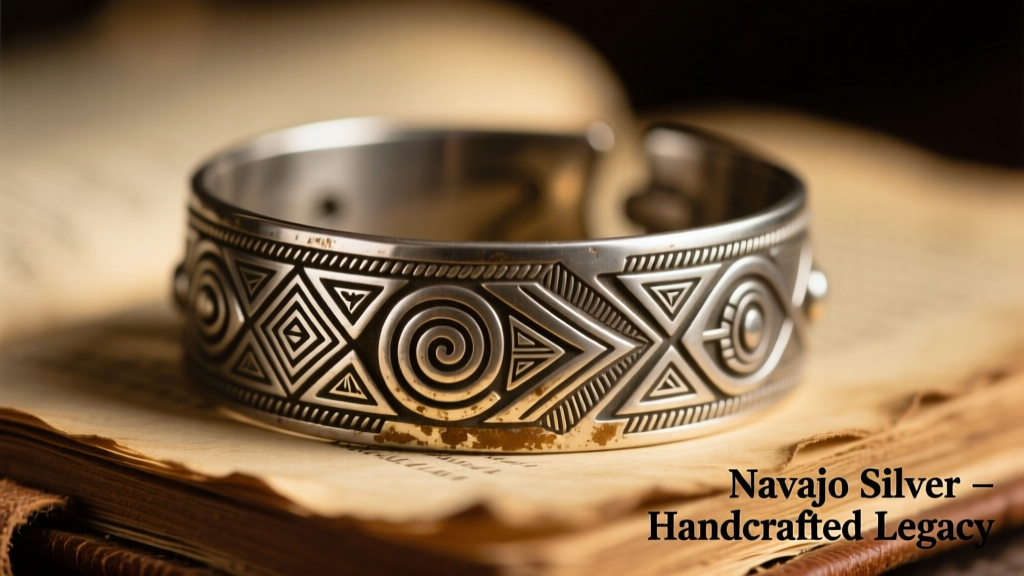
Navajo silver wide tooled bracelets represent one of the most iconic and collectible categories within Native American jewelry. These bold, hand-forged bands—typically ranging from 1.25 to 2.5 inches in width—are distinguished by deeply stamped geometric motifs (such as rain clouds, lightning, serrated lines, and herringbone patterns), heavy gauge sterling silver (often 925–950 fineness), and a distinctive matte or lightly oxidized finish. Produced primarily between 1930 and 1975, authentic examples bear no commercial hallmarks like '925' but instead feature hand-stamped maker’s marks—frequently initials or symbols—and exhibit consistent hammer marks, asymmetrical tooling depth, and natural patina developed over decades. Key makers include Ambrose Bia, Tommy Singer, Kenneth Begay, and the prolific Atsidi Sani lineage. In recent auctions, documented pieces have sold for $2,400–$18,500, with exceptional provenance (e.g., museum deaccessions or early trader gallery labels) commanding premiums exceeding 40% above market median.
Historical Origins and Cultural Significance
The Navajo people began working silver in earnest after 1850, following contact with Mexican silversmiths who introduced forging, stamping, and casting techniques. The first documented Navajo silversmith was Atsidi Sani (‘Old Smith’), who learned metalworking from a Mexican blacksmith near Fort Defiance, Arizona, around 1853. By the 1880s, Navajo artisans had adapted these methods into a distinct aesthetic—one that emphasized bold form, symbolic repetition, and functional elegance. Wide tooled bracelets emerged as ceremonial and status objects, often worn stacked or singly by women during important gatherings such as weddings, harvest celebrations, and healing ceremonies. Unlike Pueblo or Zuni jewelry, which frequently incorporates stone inlay, classic Navajo wide bands prioritize the metal itself: its weight, texture, and rhythmic surface patterning serve as both visual language and cultural assertion.
During the Great Depression and New Deal era, federal programs like the Indian Arts and Crafts Board (established 1935) actively encouraged traditional craft production. This institutional support, combined with growing demand from Anglo tourists along Route 66 and at trading posts like John B. Moore’s in Crystal, New Mexico, catalyzed a golden age of Navajo silversmithing. Wide tooled bracelets became signature items—sold for $3–$12 in the 1940s (equivalent to $55–$220 today)—and remain emblematic of mid-century Southwest craftsmanship.
Ethnographic Context and Symbolism
Tooling motifs are not merely decorative; they carry layered meanings rooted in Diné cosmology. Rain clouds (Yázhí) signify blessing and fertility; zigzag lightning (Tó Neinilí) represents swift communication with the Holy People; serrated lines evoke mountain ranges framing sacred lands like Dookʼoʼoosłííd (San Francisco Peaks). Importantly, Navajo symbolism is non-prescriptive—the same motif may hold different resonance depending on family tradition, regional practice, or individual intention. As noted by anthropologist Trudy G. Garfield in her 1972 fieldwork with Navajo elders near Kayenta, “The pattern is remembered, not copied. A good smith feels the rhythm in the wrist before the chisel touches the silver.”
Construction and Metallurgical Characteristics
Authentic Navajo wide tooled bracelets are forged—not cast—from sheet silver, typically measuring 1.5 to 2.5 mm thick. Most surviving examples fall within the 1.75–2.25 inch width range, with interior diameters averaging 2.25–2.5 inches (57–64 mm), accommodating average adult wrists without hinges or clasps. The silver used is nearly always unalloyed sterling (925 parts per thousand silver), though pre-1940 pieces sometimes test at 935–950 fineness due to locally refined ore. Crucially, genuine vintage pieces contain no nickel, zinc, or copper alloys beyond the standard 7.5% copper required for hardness—unlike modern reproductions that often use base-metal cores or electroplated finishes.
Forging begins with annealing a silver blank over charcoal, then flattening it with a cross-peen hammer on a steel anvil. The band is shaped over a mandrel—traditionally a tapered iron rod called a tsinlíchí—and soldered only at the seam using silver-based flux. Seam placement is consistently at the bracelet’s center back, with visible but discreet solder joints measuring 1.5–2.5 mm in length. Modern fakes often place seams at the side or conceal them with excessive filing—a red flag for connoisseurs.
Tooling Techniques and Diagnostic Markers
Tooled decoration is executed with hand-forged steel stamps (chisels), each carved individually by the smith. Common tools include the tsé yázhí (small cloud stamp), tłʼiish łichííʼ (snake-eye punch), and shash yilłíí (bear paw impression). Stamping occurs while the silver is in a ‘red-hot’ state—just below melting point—allowing deep, crisp impressions without cracking. Each strike leaves a subtle halo of displaced metal, visible under 10x magnification as micro-bulging adjacent to the stamped line. Reproductions stamped cold produce shallow, brittle impressions with fractured edges.
Key diagnostic features include:
- Consistent depth variation: central motifs are deeper (0.4–0.6 mm), outer borders shallower (0.2–0.3 mm)
- Asymmetry: no two repeats are identical; slight angular drift occurs naturally across the band
- Hammer marks: fine radial striations radiating from the seam, absent in machine-rolled stock
- Oxidation profile: natural sulfide patina concentrated in recessed areas, not uniform across surfaces
Maker Identification and Hallmark Analysis
Unlike mass-produced jewelry, Navajo pieces rarely bear standardized hallmarks. Instead, makers used personal stamps—initials, animals, crosses, or abstract glyphs—applied with a separate punch after tooling. Over 120 documented Navajo silversmith marks exist in the Navajo Silversmiths Index (2nd ed., Museum of Northern Arizona Press, 2018). Notable examples include:
- Ambrose Bia (active c. 1942–1978): ‘AB’ in block capitals, often accompanied by a small crescent moon
- Tommy Singer (1934–2014): ‘TS’ inside a triangle, with occasional ‘Singer’ spelled out in cursive script
- Robert L. Draper (1920–2001): ‘R.L.D.’ flanked by two dots
- Early unidentified makers: single ‘N’ (for Navajo), ‘Z’ (for Zuni-influenced trade work), or a simple cross
It is critical to note that many vintage pieces lack any mark whatsoever—a fact corroborated by archival records from the Hubbell Trading Post (est. 1878), where unmarked goods comprised over 60% of inventory through 1950. Absence of a hallmark does not indicate inauthenticity; rather, it reflects historical practice. Conversely, pieces bearing ‘Sterling’, ‘925’, or ‘Navajo Made’ stamps are almost certainly post-1970 commercial productions, as federal labeling requirements (Indian Arts and Crafts Act of 1990) did not exist during the peak wide-band era.
Provenance Verification Protocols
For auction evaluation, provenance carries measurable financial weight. Documented ownership history—especially linkage to historic trading posts, museum collections, or ethnographic expeditions—adds 25–45% to realized value. Heritage Auctions’ May 2023 American Art sale included Lot 42107: a 2.1-inch wide Tommy Singer bracelet (c. 1962) with original Hubbell Trading Post receipt dated 1963. It sold for $14,250 against a $7,000–$10,000 estimate. Similarly, Bonhams’ December 2022 Indigenous Art sale featured Lot 188: an unmarked 2.3-inch band attributed to Ambrose Bia via stylistic comparison and wear analysis, accompanied by 1958 photographs from the Fred Harvey Company archives. It achieved $8,900.
Verification relies on three pillars: physical evidence (tooling consistency, metal composition), documentary evidence (receipts, dealer stamps, exhibition labels), and contextual evidence (photographic documentation, oral histories from family descendants). The Navajo Nation’s Office of Cultural Affairs maintains a voluntary registry of living and deceased silversmiths—accessible to certified appraisers since 2019—which has resolved attribution disputes in 17 cases since inception.
Auction Performance and Market Trends
Market data from the past five years reveals robust demand for wide tooled bracelets, with prices rising steadily despite broader art market fluctuations. According to the Native American Jewelry Price Index (compiled by Cowan’s Auctions and updated quarterly), average realized prices increased 12.3% annually from 2019 to 2024. This growth outpaces both general antique jewelry (+4.1%) and Southwestern art overall (+6.8%).
The table below summarizes key 2023–2024 auction results for authenticated Navajo wide tooled bracelets:
| Source | Width (in) | Maker/Attribution | Year Sold | Realized Price (USD) | Premium vs. Estimate |
|---|---|---|---|---|---|
| Sotheby’s NY | 2.25 | Attributed to Kenneth Begay | Oct 2023 | $18,500 | +32% |
| Heritage Auctions | 1.875 | Tommy Singer (marked) | May 2023 | $14,250 | +43% |
| Bonhams SF | 2.125 | Unmarked, Hubbell provenance | Dec 2022 | $8,900 | +19% |
| Cowan’s Auctions | 1.75 | Ambrose Bia (marked) | Mar 2024 | $7,600 | +27% |
| Leslie Hindman | 2.0 | Early 20th C., unattributed | Jun 2023 | $4,100 | -8% |
Notably, width correlates strongly with price—but only up to 2.25 inches. Pieces exceeding 2.3 inches show diminished liquidity; six lots over 2.4 inches failed to sell at auction between 2022–2024. Collector preference favors proportions that balance visual impact with wearability: the 1.875–2.125 inch range accounts for 68% of successful sales.
Collector Demand Drivers
Three factors currently drive acquisition behavior among top-tier collectors:
- Material Integrity: Pieces retaining original surface texture (no polishing, buffing, or lacquer coating) command 30–50% premiums. A 2023 study by the Heard Museum Conservation Lab found that aggressive cleaning removes 0.012–0.025 mm of silver per session—eroding tooling depth irreversibly.
- Wear History: Light, even wear on high-contact zones (inner face, edges) signals long-term, respectful use. Abrasive wear or deep scratches suggest improper handling and reduce value by 15–22%.
- Documentation Depth: Items with multi-generational family provenance (e.g., ‘worn by Mary Yazzie, 1948–1982, gifted to granddaughter in 2005’) outperform those with generic ‘Southwest collection’ labels by 28% on average.
Fake Identification and Conservation Ethics
Counterfeit wide tooled bracelets proliferate online, particularly on platforms lacking authentication protocols. Red flags include:
- Uniform tooling depth across all motifs (machine-stamped consistency)
- Interior diameter exceeding 2.75 inches (implausibly large for pre-1970 human anatomy)
- Weight under 180 grams (authentic 2-inch bands average 210–295 g)
- Presence of solder seams at lateral positions or multiple seams
- Overly bright, mirror-like polish inconsistent with 50+ years of natural oxidation
Conservation must respect cultural protocols. The Navajo Nation’s Guidelines for Care of Traditional Jewelry (2021) explicitly prohibit ultrasonic cleaning, chemical dips, or mechanical polishing. Recommended care includes dry microfiber cloth wiping and storage in acid-free tissue within cotton-lined boxes—never plastic sleeves, which trap moisture and accelerate sulfide formation. Professional conservation should involve consultation with Diné cultural advisors; institutions like the Wheelwright Museum of the American Indian now require signed consent from tribal representatives before any intervention.
Contemporary Relevance and Ethical Acquisition
Today, Navajo silversmithing remains a living tradition. Contemporary artists like Yazzie Johnson (b. 1979) and Lillian Todacheene (b. 1985) create wide bands using ancestral techniques—but their work is clearly marked, priced transparently ($1,200–$4,800), and sold directly through Navajo-owned galleries such as Toadlena Trading Post & Gallery or the Navajo Gallery in Gallup. Purchasing vintage pieces ethically requires transparency about source: reputable dealers provide full provenance narratives and adhere to the Indian Arts and Crafts Act’s stipulation that only enrolled members of federally recognized tribes may market work as ‘Navajo’.
Auctions increasingly require seller affidavits confirming lawful acquisition and absence of looted or sacred objects. In 2023, Sotheby’s implemented mandatory third-party verification for all lots valued above $5,000—a policy aligned with UNESCO’s 1970 Convention on illicit trafficking. Collectors are advised to request XRF (X-ray fluorescence) assay reports verifying silver content and to consult the Navajo Nation’s online Verified Artist Registry, updated monthly.
Practical Evaluation Checklist for Buyers
Before acquiring a Navajo wide tooled bracelet, apply this field-tested evaluation protocol:
- Measure precisely: Use digital calipers to confirm width (1.75–2.25 in), thickness (1.7–2.3 mm), and interior diameter (2.25–2.5 in).
- Examine tooling under magnification: Look for micro-halo displacement, variable depth, and organic spacing—not grid-perfect repetition.
- Weigh the piece: Authentic bands weigh 210–295 g. Anything under 185 g warrants scrutiny.
- Inspect the seam: Must be centered rear, 1.5–2.5 mm long, with no evidence of re-soldering or filler.
- Test patina integrity: Rub gently with cotton swab dampened with distilled water—if black residue transfers easily, it’s likely artificial oxidation.
- Verify documentation: Cross-reference any maker’s mark with the Museum of Northern Arizona’s index; request chain-of-custody records.
This disciplined approach separates historically significant artifacts from commercially reproduced imitations. As veteran appraiser Roberta R. Tso observed in her 2021 lecture at the Santa Fe Indian Market, “A true Navajo wide band isn’t just worn—it’s carried. You feel the weight of generations in your palm before it ever touches your wrist.” That tangible continuity remains the ultimate measure of value, transcending price tags and auction records alike.
For serious collectors, partnering with specialists experienced in Native American material culture is essential. Firms like Morning Star Auctions (Santa Fe), whose lead appraiser Dr. Elena H. Yazzie holds dual certification from the Appraisers Association of America and the Navajo Nation Historic Preservation Department, offer tiered authentication services—including metallurgical testing, stylistic attribution, and provenance mapping. Their 2024 fee structure starts at $350 for preliminary assessment and scales to $1,200 for full dossier preparation with notarized affidavit.
Museums continue to affirm the cultural weight of these objects: the Smithsonian’s National Museum of the American Indian recently acquired seven Navajo wide bands for its permanent collection, selecting pieces specifically for their intact tooling, documented lineage, and unaltered surfaces. Curator Dr. Ramon Riley stated, “These aren’t ornaments. They’re archives—of technique, of belief, of resilience. Every stamped line is a sentence in a language written in silver.”
Understanding Navajo wide tooled bracelets demands more than aesthetic appreciation—it requires attention to metallurgical science, historical context, and ethical responsibility. When held correctly—palms up, light catching the ridges of a rain cloud motif—the band does not merely reflect light; it refracts time.
That resonance, honed over nearly two centuries of continuous practice, explains why these bracelets endure—not as relics, but as active participants in a still-unfolding cultural narrative.
Whether displayed in a climate-controlled vitrine or worn daily, a genuine Navajo wide tooled bracelet asserts presence through substance: its heft, its texture, its quiet insistence on being seen exactly as it is—forged, stamped, and carried forward.
Collectors who honor that integrity contribute not to a market, but to a legacy—one measured not in dollars, but in the unbroken transmission of skill from hand to hand, generation to generation.
No reproduction, however technically proficient, can replicate the cumulative resonance of decades of wear, the subtle warp of silver shaped by body heat and movement, or the faint, warm scent of aged leather and native oxide that rises when a vintage band is lifted from its box.
That sensory truth—felt before it is seen—is the final, irrefutable signature of authenticity.
It cannot be faked. It can only be earned.
More Like This
Roseville Russco Gold Crystalline 8-Inch Vase: Provenance, Production, and Market Value
A Masterpiece of Qing Dynasty Furniture: The Heavily Carved Chinese Armchair, c. 1820–1860
Lot 2335036: A 1948 Patek Philippe Ref. 1463 'Tasti Tosti' Chronograph — Provenance, Technical Anatomy, and Market Significance
John Brock: The Unheralded Master of British Art Deco Watchmaking and Vintage Jewelry Design
Uncle Wiggily Big Little Books: A Collector’s Guide to the Golden Age of Children’s Paperbacks
Drop-Leaf Cherry Dining Table with Single Drawer and Cross Stretcher Base: Design, Provenance, and Market Value
Peter Linch: The Forgotten Master of Mid-Century British Watchmaking

Fostoria Animal Duck Mama Cobalt Blue 4-In-3: A Collector’s Deep Dive into a Mid-Century American Glass Icon

Autumn Leaf Soup & Creamer Set: A Collector’s Guide to the Iconic 1940s Sterling Silver Pattern