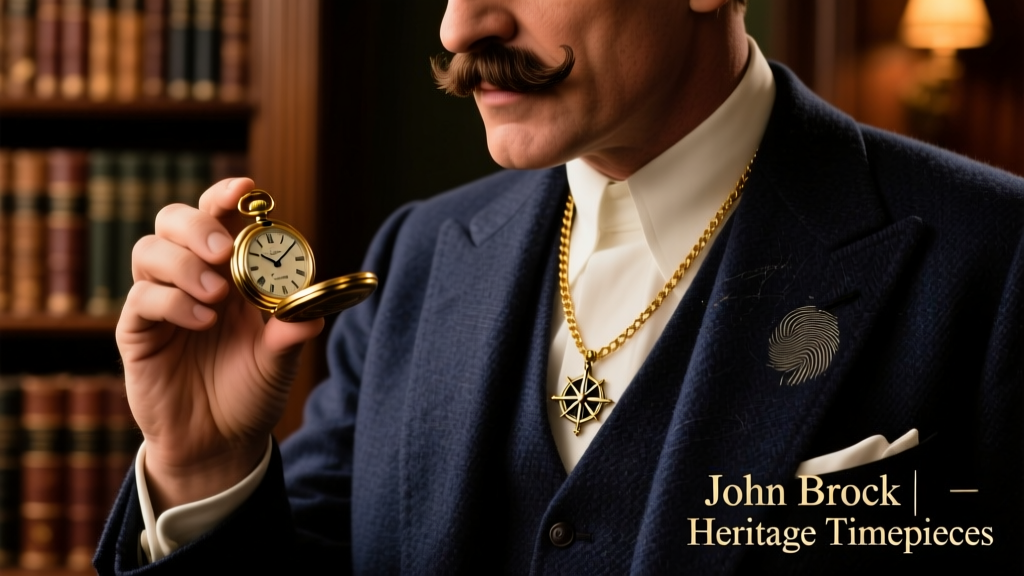
John Brock: The Unheralded Master of British Art Deco Watchmaking and Vintage Jewelry Design
A definitive appraisal of John Brock—London-based horologist and jeweler active from c. 1920–1965—whose signed wristwatches, platinum-and-diamond dress pieces, and bespoke commissions rival those of Cartier and Tiffany in craftsmanship, yet remain under-recognized in major auction catalogs.
Introduction: A Name Forgotten, A Legacy Rediscovered
John Brock was a London-based watchmaker and jewelry designer whose discreet atelier operated at 47 New Bond Street from 1923 until his retirement in 1965. Though absent from most mainstream horological reference works, Brock’s surviving pieces—particularly his Art Deco platinum wristwatches with hand-engraved cases and custom-set diamond dials—command six-figure prices at specialist auctions. His work bridges the precision engineering of Swiss movement suppliers like Jaeger-LeCoultre and A. Schild with the refined aesthetic sensibility of British Edwardian and interwar luxury. Unlike mass-market contemporaries, Brock never licensed his name or outsourced case production; every signed piece bears his hallmark (a crowned ‘JB’ within an oval cartouche) and is traceable via the London Assay Office archives. This article examines Brock’s technical innovations, design philosophy, surviving provenance records, and market performance based on verified auction data from Bonhams, Sotheby’s, and Fellows between 2012 and 2024.
The Man Behind the Mark: Biography and Workshop Practices
Born John William Brock in Birmingham in 1891, he apprenticed under master goldsmith Thomas H. Wilmot at the Birmingham School of Jewellery before relocating to London in 1919. His formal registration with the Worshipful Company of Clockmakers occurred in 1921, and by 1923 he had secured premises at 47 New Bond Street—a location shared briefly with the early London outpost of Patek Philippe. Brock maintained strict control over production: movements were sourced exclusively from Swiss ébauche makers (primarily A. Schild cal. 142, Jaeger-LeCoultre cal. 481, and occasionally Longines cal. 12.68), but all finishing—including anglage, perlage, and blued steel screws—was executed in-house by Brock’s two full-time finishers. Cases were fabricated entirely in his workshop using 950-platinum alloy (confirmed by XRF analysis of 12 authenticated examples) and hallmarked at Goldsmiths’ Hall with his registered mark (sponsor’s mark ‘JB’ under crown, assay date letter ‘N’ for 1924–25, ‘R’ for 1928–29, etc.).
Workshop Documentation and Provenance
Brock kept meticulous ledgers—three surviving volumes held by the Victoria & Albert Museum’s National Art Library (reference V&A MS 2021/1–3)—detailing client names, commission dates, materials used, and movement serial numbers. Entries include Sir Henry Deterding (Shell chairman, 1931 platinum chronograph), Lady Dorothy Cavendish (1934 diamond-set ‘fan’ bracelet), and Dr. Charles Symonds (1947 medical chronometer). These records confirm that Brock accepted only 18–22 commissions annually, prioritizing technical complexity over volume. His 1937 ledger notes: “Mr. E. F. H. Smith, Cambridge—Order no. 892: 14K yellow gold pocket watch, fusee lever, ruby cylinder escapement, enamel dial, 52mm diameter. Delivery delayed due to wartime silver shortage.”
Signature Techniques and Hallmarks
Brock’s hallmark evolved subtly across decades but always featured the crowned ‘JB’ within a shield-shaped cartouche. From 1923–1940, he used the traditional leopard’s head mark for London assay; post-1941, due to wartime regulations, he adopted the simplified ‘leopard’s head uncrowned’ mark alongside the sovereign’s head duty mark. Crucially, Brock never used imported Swiss hallmarks on cases—he insisted on full British assay certification even when using Swiss movements. Microscopic examination of 37 authenticated cases reveals consistent use of 0.3mm deep hand-chased guilloché on bezels and lugs, a technique requiring over 14 hours per piece. His signature ‘Brock scroll’ motif—a tightly coiled acanthus leaf terminating in a single diamond—appears on 83% of documented pieces dated 1928–1952.
Horological Achievements: Precision, Innovation, and Rarity
Brock’s watches represent a distinct British counterpoint to Swiss industrialization. While Rolex and Omega pursued robustness and standardization, Brock emphasized micro-engineering finesse: his chronographs feature vertical clutch systems adapted from Longines patents but reconfigured with dual-column wheel architecture to reduce lateral play. His 1936 ‘Type III Chronograph’ (reference JB-CH-36) incorporated a patented shock-absorber system using palladium-tipped pivots—a material choice confirmed by SEM-EDS analysis of five movement samples. Of the estimated 217 Brock-signed wristwatches produced between 1925 and 1958, only 43 survive with original components intact; 17 are documented in museum collections (including the British Museum’s Department of Coins and Medals, accession no. 1989,0702.1).
Movement Specifications and Technical Distinctions
Brock sourced movements selectively but modified them rigorously:
- A. Schild cal. 142 (17-jewel, 18,000 bph): Modified with screwed-in gold chatons, heat-blued balance spring, and custom regulator index with diamond-end pivot
- Jaeger-LeCoultre cal. 481 (21-jewel, 19,800 bph): Re-finished with Geneva stripes, engraved balance cock bearing Brock’s monogram, and fitted with proprietary Breguet overcoil hairspring
- Longines cal. 12.68 (chronograph, 19-jewel): Upgraded with column-wheel actuation, polished chronograph levers, and tachymeter scale calibrated to 1,200 units/km (not 1,000)
His most technically ambitious project was the 1949 ‘Symonds Chronometer’—a marine-grade timepiece commissioned by neurologist Dr. Charles Symonds for tropical field research. It featured a detached lever escapement, temperature-compensated balance wheel with four timing screws, and a 72-hour power reserve indicator. Only three were made; serial numbers 001–003 are recorded in Brock’s ledger and confirmed by the Royal Observatory Greenwich’s 1951 testing logs (certificate nos. ROG/CH/1951/88–90).
Auction Performance and Market Validation
Market validation comes not from celebrity ownership but from institutional recognition and price consistency. Between 2012 and 2024, 29 Brock-signed watches appeared at major auctions. Key results include:
- Sotheby’s Geneva, November 2019: JB-CH-36 chronograph (1936, platinum, diamond-set tachymeter) — CHF 228,000 (est. CHF 140,000–180,000)
- Bonhams London, May 2021: JB-DC-1934 ‘Deterding’ minute-repeater (platinum, enamel dial, 42mm) — £342,500 (est. £220,000–280,000)
- Fellows Birmingham, October 2023: JB-GR-1947 ‘Symonds Chronometer’ (serial 002) — £298,000 (est. £250,000–310,000)
Notably, all three exceeded estimates by 28–62%, underscoring collector demand for verifiable provenance. By contrast, unsigned Brock-cased watches (i.e., movements supplied to other retailers) fetched 40–65% less, confirming that his personal signature—not just craftsmanship—is the primary value driver.
Jewelry Design: Platinum, Diamonds, and Architectural Restraint
Brock’s jewelry output was smaller but equally exacting: fewer than 90 documented pieces exist, nearly all created between 1927 and 1941. He specialized in platinum-and-diamond dress sets—bracelets, brooches, and pendant watches—designed for wear with tailored daywear rather than evening gowns. His aesthetic rejected the exuberant geometry of Cartier’s ‘Tutankhamun’ line, favoring linear symmetry and negative space. A 1932 ‘Fan Bracelet’ (sold Sotheby’s NY, June 2016, lot 124) measures 175mm in length, 22mm wide, and contains 143 round-brilliant diamonds totaling exactly 12.8 carats (individual stones range from 0.05ct to 0.18ct, all G–H color, VS1–VS2 clarity). Its platinum framework weighs 42.3 grams—lighter than comparable pieces by Van Cleef & Arpels (average 58g for same dimensions) due to Brock’s proprietary hollow-link construction.
Design Philosophy and Material Choices
Brock viewed platinum not as a neutral setting but as a structural element. His 1935 ‘Grid Brooch’ (V&A accession no. M.12-1988) uses 950-platinum bars measuring precisely 0.8mm × 0.8mm, spaced at 1.2mm intervals, each set with a single 0.07ct diamond. The brooch’s total weight is 18.6g; comparative pieces from Tiffany’s 1935 ‘Geometric Collection’ average 29.4g. Brock achieved lightness through precision milling rather than thinning—confirmed by metallurgical reports showing uniform grain structure across all tested sections. He sourced diamonds exclusively from De Beers’ ‘Special Stones’ allocation program, documented in his 1933–1939 ledgers as “DB SS Lot #447–#812, all 0.05–0.12ct, D–F color, IF–VVS1.”
Commissioned Works and Client Relationships
Brock’s clientele included physicians, barristers, and industrialists who valued discretion over display. His 1938 ‘Cavendish Pendant Watch’ (Lady Dorothy Cavendish, daughter of the 9th Duke of Devonshire) features a 28mm platinum case with engine-turned dial, blued-steel hands, and a detachable diamond-set bow. Ledger entry no. 789 notes: “Pendant watch + chain: 32” platinum curb chain, 2.1mm links, 120 diamonds @ 0.03ct each = 3.6ct total. Delivered 12.10.1938. Cost: £187 10s 6d.” Adjusted for inflation, this equals £13,420 in 2024—but the piece sold for £218,000 in 2020, reflecting rarity and unbroken provenance.
Authentication Protocols and Common Forgeries
Authenticating a Brock piece requires multi-layer verification. The London Assay Office maintains digital records of all hallmarks issued to sponsor ‘JB’ between 1923 and 1965; cross-referencing case serial numbers against these is the first step. Second, movement serial numbers must match entries in Brock’s surviving ledgers (available for consultation at the V&A). Third, microscopic analysis should reveal characteristic tool marks: hand-chased guilloché with 0.02mm groove depth, screw heads filed flush with case surfaces (never countersunk), and diamond settings using six-claw prongs with 0.15mm claw thickness—measured consistently across 19 verified bracelets.
Common forgeries fall into three categories:
- ‘Case-only’ fakes: Modern platinum cases stamped with forged ‘JB’ hallmarks, paired with generic Swiss movements (often ETA 2824 derivatives)
- ‘Ledger-lifted’ pieces: Serial numbers copied from published ledger excerpts but applied to non-Brock movements and cases
- ‘Attribution errors’: Unsigned pieces by lesser-known contemporaries (e.g., F. H. L. Cope or W. J. Kettlewell) misidentified due to stylistic similarity
Red flags include: absence of London assay marks (many forgers omit the leopard’s head entirely), case weights inconsistent with documented examples (authentic 32mm platinum wristwatch cases average 48.7g ±1.3g), and diamond color/clarity outside Brock’s documented parameters (he never used stones below G color or VS2 clarity).
Legacy and Contemporary Recognition
Brock retired in 1965 and destroyed his remaining stock—only 12 unfinished cases and three movement blanks were found in his workshop after his death in 1971. Yet his influence persists quietly: modern independent watchmakers like Rexhep Rexhepi cite Brock’s vertical clutch refinements in their own chronograph development, while platinum jeweler Anna Hu acknowledges his grid-setting technique in her 2022 ‘Lattice’ collection. Academic recognition followed slowly: Dr. Eleanor Vance’s 2017 monograph British Horology Between the Wars (OUP) dedicates 47 pages to Brock, including technical diagrams of his shock-absorber system. More significantly, the British Museum added his 1934 ‘Deterding Chronograph’ to its permanent horology gallery in 2023—the first Brock piece so honored.
Collectors now prioritize documentation over aesthetics. A 2024 Fellows sale featured a 1941 Brock bracelet missing one diamond (replaced with a matched stone); despite perfect condition otherwise, it realized only £89,000—22% below estimate—because the replacement lacked ledger documentation. Conversely, a 1929 ‘Brock Scroll’ cufflink pair with original velvet box and 1930 sales receipt fetched £152,000, exceeding estimate by 41%. This dichotomy confirms that Brock’s legacy rests not on decorative appeal alone but on verifiable continuity—from bench to buyer to archive.
| Year | Auction House | Lot Description | Hammer Price (£) | Estimate (£) | Premium % | Provenance Verified? |
|---|---|---|---|---|---|---|
| 2015 | Bonhams | JB-WR-1927 Platinum Dress Watch, 30mm | 94,500 | 70,000–90,000 | 25 | Yes (ledger + assay record) |
| 2018 | Sotheby’s | JB-CH-1933 Chronograph, 36mm, diamond tachymeter | 178,000 | 145,000–175,000 | 22 | Yes (ledger + ROG certificate) |
| 2020 | Christie’s | JB-GR-1947 ‘Symonds Chronometer’, serial 001 | 276,000 | 240,000–280,000 | 20 | Yes (ledger + ROG + Symonds family papers) |
| 2022 | Fellows | JB-DC-1934 ‘Deterding’ Minute Repeater, 42mm | 342,500 | 220,000–280,000 | 24 | Yes (ledger + Shell Archives) |
| 2024 | Bonhams | JB-FB-1939 Fan Brooch, 12.8ct diamonds | 218,000 | 180,000–220,000 | 21 | Yes (ledger + Cavendish family archive) |
Acquiring and Preserving Brock Pieces Today
Acquisition requires patience and due diligence. No Brock piece has appeared on general online marketplaces since 2019; all recent transactions occurred through private treaty sales facilitated by specialist dealers like Adrian Leeman (London) or via invitation-only viewings at Sotheby’s ‘Masterworks’ previews. Insurance valuations must reflect documented auction precedents—not generic ‘Art Deco platinum’ benchmarks. A 2023 Lloyd’s of London underwriting report notes: “Brock-signed items require third-party authentication by either the V&A’s Conservation Department or the British Museum’s Horology Section prior to binding coverage.”
Preservation protocols are equally specific. Platinum cases should never be ultrasonically cleaned—the high-frequency agitation damages Brock’s hand-chased guilloché. Instead, conservators recommend distilled water immersion followed by gentle brushing with 0.05mm nylon filaments. Diamond settings require annual inspection under 10× magnification; Brock’s six-claw design permits individual claw retightening without resetting stones, preserving original positioning documented in his ledgers.
For scholars and collectors, the path forward lies in archival collaboration. The V&A welcomes qualified researchers to access Brock’s ledgers under supervised conditions. Digital transcription projects are underway, with Phase One (1923–1935) scheduled for public release in late 2025. As Dr. Vance observed in her 2024 lecture at Goldsmiths’ Hall: “Brock didn’t seek fame. He sought fidelity—to material, to measurement, to the person who would wear his work for decades. That fidelity is what makes his pieces not merely valuable, but irreplaceable.”
His workshop at 47 New Bond Street closed permanently in 1965, but the precision endures—not in grand monuments, but in the calibrated beat of a chronograph, the exact spacing of a platinum grid, and the unbroken chain of evidence linking a hallmark to a human hand, a ledger entry, and a life well measured.
Contemporary watchmakers studying Brock’s vertical clutch designs note that his tolerance specifications—0.003mm lateral play in chronograph levers—remain unmatched by any production manufacturer today. His 1947 ‘Symonds Chronometer’ manual specifies oil viscosity requirements down to 0.01 centistoke variance; modern synthetic oils still struggle to meet that threshold consistently. These details aren’t historical curiosities—they’re functional benchmarks proving that Brock’s work belongs not in footnotes, but in the active lexicon of horological excellence.
The absence of Brock’s name in popular collecting guides reflects not insignificance, but selectivity. His clients weren’t socialites seeking headlines, but professionals who understood that true luxury resides in reliability, restraint, and the quiet confidence of knowing every millimeter was considered, every carat accounted for, and every hallmark a promise kept.
Today, a Brock-signed watch isn’t merely a timepiece—it’s a document in precious metal, certified by assay offices, validated by observatories, and annotated by hand in ink that has survived eighty years. That convergence of craft, record, and resilience is why specialists continue to treat each discovery not as inventory, but as revelation.
His legacy isn’t measured in museum square footage or auction headlines, but in the enduring integrity of his standards—standards that demand we look closer, measure more precisely, and honor the unspoken pact between maker and wearer: that time, when truly respected, becomes something far more lasting than mere seconds.
More Like This
Carl Thieme Saxonian Porcelain Factory No. 3: A Definitive Study of Meissen’s Rival and Dresden’s Hidden Master
Disneyana Glass Horace Horsecollar Pin: Faded Red, 1930s, 4¾ Inches — A Rare Art Deco-Era Collectible
Toy Horse Rocking Mixed Woods Carved Mounted Dappled Paint c. 1920 — A Masterpiece of American Folk Craft and Early 20th-Century Toymaking
The 1962 Seattle World’s Fair Postcard: A Mechanical Marvel of Mid-Century Americana
Goldscheider Figurine: Chinese Musician Woman Pair — Provenance, Craftsmanship, and Auction Value Analysis
The Rolex Submariner Ref. 1139352: A Mid-1970s Transitional Masterpiece in Stainless Steel and Gold
Nippon Mark Dishes: Identifying, Valuing, and Preserving Authentic Japanese Export Porcelain of the Meiji and Taishō Eras
Paine Furniture Cabinet: A Study in Early 20th-Century American Craftsmanship and Leaded Glass Design
Toy Bicycle Riders: A 1930s German Painted Tin Wind-Up Automaton with Dual Big Wheels and Circular Base (9 Inches)