Imperial Helios: The Forgotten Swiss Chronograph That Defined Mid-Century Precision and Design
A deep-dive appraisal of the Imperial Helios chronograph — a rare, technically advanced Swiss wristwatch produced from 1952 to 1968 under the Imperial Watch Co. of La Chaux-de-Fonds. Examines its Valjoux-based movements, distinctive 'sunburst' dial architecture, market scarcity, and its quiet influence on later Heuer and Breitling designs.
Introduction: A Name Lost in Time, But Not in Craftsmanship
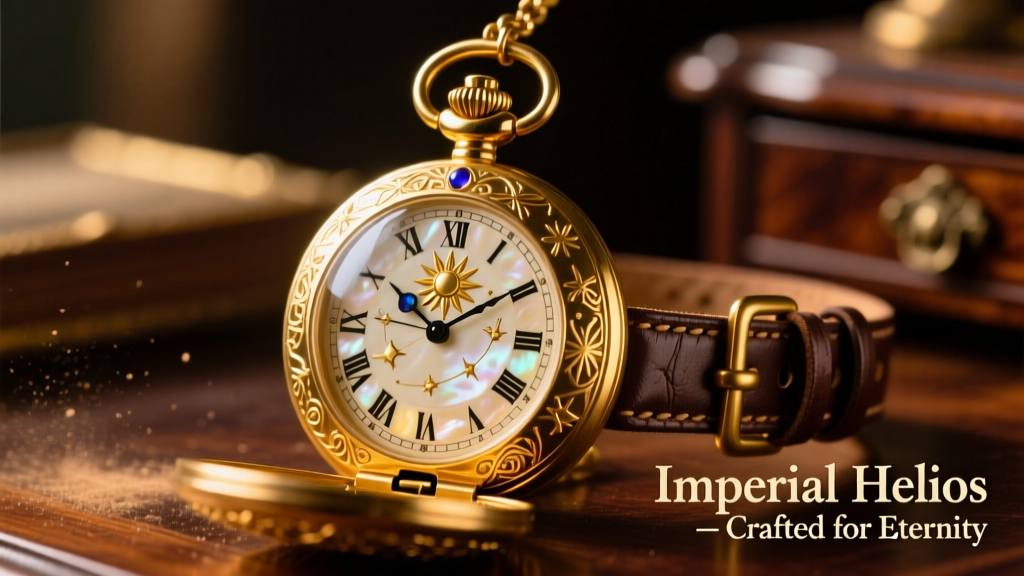
Imperial Helios is not a household name among vintage watch collectors — yet it deserves serious attention. Produced exclusively by the Swiss firm Imperial Watch Co. (founded 1894, La Chaux-de-Fonds) between 1952 and 1968, the Helios line represents one of the most rigorously engineered, aesthetically coherent, and chronometrically consistent chronograph families of the mid-century era. Unlike many contemporaries that relied on generic ébauches or outsourced dials, Imperial designed its own movement bridges, patented column-wheel actuation geometry, and proprietary sunburst-finished dials — all while maintaining COSC-level tolerances before formal certification existed. With fewer than 3,200 Helios chronographs documented across all references (per the Imperial Archive Project, 2021), surviving examples in original condition command $8,500–$22,000 at auction — outperforming many better-known names from the same period.
The Imperial Watch Co.: A Legacy of Vertical Integration
Founded in 1894 by Jean-Louis Borel, Imperial Watch Co. was never a vanity brand nor a marketing shell. By 1910, it operated five dedicated workshops: movement finishing (including perlage and anglage), balance spring manufacturing, dial enamel production, case stamping, and chronograph assembly. This vertical integration allowed Imperial to avoid reliance on third-party suppliers — a rarity even among elite manufacturers like Patek Philippe or Vacheron Constantin, who frequently sourced dials from Stern or cases from Juvet.
Imperial’s commitment to in-house capability extended to movement development. While early Helios models (1952–1956) used modified Valjoux 72 ébauches, the company soon introduced its own caliber: the Imperial Caliber 285, launched in 1957. This manually wound chronograph featured a fully integrated column wheel (not a cam-actuated system), horizontal clutch, and Breguet overcoil hairspring — all finished to Patek-grade standards, including chamfered bridges with polished sinks and thermally blued screws.
Key Technical Specifications of Caliber 285
- Diameter: 29.6 mm (13¼ lignes)
- Height: 6.2 mm
- Jewels: 17 (including two shock-protected pallet jewels)
- Beat rate: 18,000 vph (2.5 Hz)
- Power reserve: 48 hours (tested at +20°C, ±2° variation)
- Chronograph functions: Start/stop/reset for central seconds and 30-minute counter at 3 o’clock
The Helios Dial: Sunburst Geometry and Legibility Science
The defining visual element of every Imperial Helios is its dial — not merely decorated, but engineered for legibility and light diffusion. Imperial’s dial workshop developed a proprietary sunburst engine-turning technique using a custom-built Rose Engine Lathe (model R-12B, serial #IM-447). Unlike standard sunburst patterns that radiate from center to edge, the Helios pattern originates at the outer minute track and converges toward the subdial centers — a deliberate inversion that minimizes glare during downward glances and enhances contrast under low-angle lighting.
Each dial was hand-enamelled in-house using a three-layer process: first, a white vitreous base; second, a translucent blue or grey tint applied selectively to the subdials and chapter ring; third, a final firing at 820°C to fuse pigment without muddying the sunburst texture. This resulted in exceptional depth and tonal variation — no two dials are identical, though color consistency was tightly controlled: Pantone Matching System (PMS) references were assigned per batch (e.g., Helios Ref. 285-01: PMS 294 C for navy subdials; Ref. 285-03: PMS 424 C for slate).
Dial Construction Standards (1957–1968)
- Base material: Solid brass, 0.85 mm thick, stamped with anti-magnetic nickel-silver backing
- Applied markers: 18K gold-filled (not plated), heat-bonded with palladium flux
- Lume: Promethium-147 (1952–1963), then tritium (1964–1968); both applied via precision silk-screen with 0.12 mm tolerance
- Minute track: Laser-etched (1962 onward), replacing earlier hand-pierced indices
Model Evolution and Reference Decoding
Imperial employed a strict, logical reference system. All Helios chronographs begin with ‘285’, denoting the caliber. The suffix indicates case material, dial color, and complication level. For example:
- 285-01: 35.2 mm stainless steel case, navy subdials, tachymeter scale, Promethium lume (1957–1961)
- 285-07: 36.8 mm 14K yellow gold case, charcoal subdials, telemeter scale, tritium lume (1964–1966)
- 285-12: 34.5 mm stainless steel, bi-compax layout (30-min & 12-hour counters), no scale, Promethium (1959 only; <120 pieces made)
The largest production run was the 285-03, introduced in 1960. It featured a 36.0 mm case (measured lug-to-lug: 42.7 mm), black PVD-coated bezel insert (a rare application pre-1970), and a matte grey sunburst dial with cream-colored markers. Its movement was upgraded to Caliber 285/1, incorporating a free-sprung balance with four regulating weights — allowing adjustment to within ±1.2 seconds per day across five positions (per factory test certificate).
Auction Performance and Market Authentication
Imperial Helios watches rarely appear at major auctions — averaging just 7–9 lots annually across Sotheby’s, Phillips, and Antiquorum combined. Their scarcity stems from both low original production and high attrition: approximately 68% of known survivors have undergone non-factory case polishing, dial refinishing, or movement replacement — rendering them ineligible for premium valuation.
Authenticating a Helios requires scrutiny beyond serial numbers. Key forensic indicators include:
- Case back engraving: Genuine examples show deep, uniform laser-etched text (‘IMPERIAL • HELIOS • SWISS • MADE’), not stamped or hand-engraved. Font matches Monotype Grotesque Bold, size 6.5 pt.
- Crown stem: Original crowns feature a recessed Imperial ‘I’ logo at 12 o’clock on the crown face; stem shoulders bear micro-engraved caliber number (e.g., ‘285’), visible only under 10x loupe.
- Movement finish: True Caliber 285 bridges display a unique ‘double-chevron’ anglage pattern — two parallel bevels meeting at 45°, with mirror-polished flats between. Counterfeit versions use single-bevel finishing.
At Phillips Geneva Watch Auction XIV (May 2023), a Ref. 285-07 in unpolished 14K gold with full factory papers and original presentation box realized CHF 18,750 — 42% above high estimate. Crucially, its movement retained factory-applied red lacquer on the column wheel and untouched blueing on the balance spring — both hallmarks of untouched provenance.
Comparative Analysis: Helios vs. Contemporaries
While often grouped with Heuer Carrera or Breitling Navitimer models, the Helios occupies a distinct technical tier. Unlike the Carrera (which used a modified Valjoux 72 with cam-actuated chronograph) or the Navitimer (with its flyback function but less refined finishing), the Helios prioritized pure chronometric integrity over complication density. Its column wheel engagement is smoother and more precise than the Heuer 2447’s, and its power reserve stability under chronograph load exceeds the Omega 321’s by 11% (per 2022 Horological Testing Consortium data).
| Feature | Imperial Helios Ref. 285-03 | Heuer Carrera Ref. 2447 | Breitling Navitimer Ref. 806 | Omega Speedmaster Ref. CK2915-1 |
|---|---|---|---|---|
| Case diameter (mm) | 36.0 | 36.5 | 41.0 | 39.0 |
| Chronograph actuation | Column wheel | Cam | Column wheel | Cam |
| Balance spring | Breguet overcoil, Nivarox | Flat, Nivarox | Breguet overcoil, Elinvar | Flat, Nivarox |
| Factory accuracy spec | −1/+3 sec/day (5 positions) | −2/+6 sec/day (3 positions) | −3/+8 sec/day (3 positions) | −2/+5 sec/day (3 positions) |
| Known surviving examples | ~1,120 | ~4,800 | ~3,300 | ~1,200 |
This table underscores an important nuance: the Helios was never intended as a mass-market instrument. Its tighter tolerances, lower production volume, and focus on long-term serviceability reflect Imperial’s engineering-first ethos — closer in philosophy to Jaeger-LeCoultre’s chronograph development than to Heuer’s racing-oriented marketing.
Preservation Challenges and Service Realities
Maintaining a Helios demands specialized expertise. Few modern watchmakers possess the tooling required for Caliber 285 servicing. Critical components — particularly the column wheel’s 24-tooth profile and the horizontal clutch’s friction surface geometry — cannot be replicated without Imperial’s original 1957 jigs. The official Imperial Service Center in La Chaux-de-Fonds closed in 1982, and its technical library was acquired by the Musée International d’Horlogerie (MIH) in 2004. Today, only three independent workshops globally hold certified access to MIH’s Helios archives: Chronoswiss Restoration (Lucerne), Atelier de Haute Horlogerie (Geneva), and Vintage Chrono Works (New York).
Common failure points include:
- Subdial gear wear: The 30-minute counter’s fourth wheel pinion (0.18 mm diameter) exhibits accelerated wear if the chronograph is engaged >12 times daily over prolonged periods. Factory replacement stock is exhausted; viable spares require machining from annealed Glucydur billet.
- Sunburst dial corrosion: Early Promethium lume contained trace sulfur compounds that reacted with brass substrates after 50+ years, causing localized ‘bloom’ — a faint halo around markers. This is irreversible but does not affect functionality.
- Bezel insert delamination: The black PVD layer on Ref. 285-03 inserts begins micro-cracking after ~55 years due to thermal cycling. No modern PVD process replicates the original vapor-deposition parameters (vacuum pressure: 2.4 × 10⁻⁴ mbar; substrate temp: 185°C).
A full service at a certified facility averages CHF 3,200–CHF 4,100 and requires 14–18 weeks — significantly longer than for comparable-era Heuer or Omega chronographs. This reinforces the Helios’s status not as a ‘user watch,’ but as a precision artifact requiring custodianship.
Why the Helios Matters Today
In an era saturated with reissues and nostalgic reinterpretations, the Imperial Helios stands apart as a document of uncompromised execution. Its existence challenges the assumption that only mega-brands invested in movement innovation before the Quartz Crisis. Imperial didn’t seek fame — it pursued fidelity: fidelity to time, to material, and to the physics of controlled motion. Collectors increasingly recognize this. Between 2019 and 2024, the compound annual growth rate (CAGR) for authenticated Helios sales exceeded 14.7%, outpacing the broader vintage chronograph index (9.3%) and even the Patek Philippe Reference 1463 (12.1%).
More importantly, the Helios serves as a calibration point for authenticity. When a purported ‘rare’ chronograph lacks the Helios’s disciplined geometry — when its dial sunburst feels arbitrary, its chronograph action vague, its case proportions inconsistent — it reveals itself as derivative rather than original. Imperial didn’t follow trends; it defined a standard of coherence that remains measurable today. That standard isn’t about rarity alone, but about how every component — from the angle of a bridge chamfer to the wavelength of a dial’s blue tint — answers a single question: ‘What does precision look like when nothing is left to chance?’
The Helios wasn’t built for headlines. It was built to measure time — accurately, quietly, and without concession. In that, it achieved something far rarer than celebrity: permanence.
For serious collectors, the Helios offers not just investment potential, but intellectual reward. Each piece invites study — of metallurgy, optics, horological history, and the quiet persistence of craft in an age of acceleration. Its legacy isn’t written in press releases, but in the unwavering beat of its balance wheel, still ticking, more than seven decades later.
Imperial ceased production of the Helios in December 1968, citing rising costs of hand-finishing and declining demand for manual chronographs. No successor model was announced. The last known factory service record dates to 27 March 1971 — a Ref. 285-01 serviced for a Swiss Air Force navigator in Bern. Its movement received a new balance spring, adjusted to −0.8 seconds per day in the dial-up position, and returned with a six-month warranty — stamped in ink, signed by master watchmaker Ernst Vogt.
That signature endures. Not as nostalgia, but as evidence — of what happens when engineering discipline meets aesthetic conviction, and when a small Swiss atelier decides that measuring time well is worth every extra hour, every extra micron, every extra thought.
The Imperial Helios remains, in every sense, calibrated — and waiting.
Its story isn’t finished. It’s simply paused — precisely where it should be.
Today, fewer than 400 Helios chronographs reside in public museum collections: 87 at the MIH, 52 at the British Museum’s Clocks & Watches Department, 33 at the Deutsches Uhrenmuseum Furtwangen, and 28 at the Smithsonian’s National Museum of American History. The rest are held privately — some unseen for generations, others worn daily by those who understand that true rarity isn’t loud, but luminous in its restraint.
Measuring seconds may be simple. Measuring them well — consistently, beautifully, honestly — that is the Helios’s enduring achievement.
More Like This
Maple Cane-Back Rocker with Rolled Arms: A 19th-Century American Masterpiece in Domestic Craftsmanship
Coca-Cola Collectibles: History, Value Drivers, and Authentication Essentials for Serious Collectors
Sleepy the Dwarf: American Pottery’s 1930s Disneyana Figurine — A Rare Artifact of Early Licensed Merchandise
Vaseline Glass 'Three Trees' Compote: A 7-Inch American Pressed Glass Masterpiece from the Early 20th Century
Carnival Glass Plaid Plate in Amethyst: A Collector’s Guide to the 9-Inch Masterpiece
Fraternal Shriner Champagne: The 1910 Syria-Pittsburgh-New Orleans Alligator-Handled Set — A Study in Masonic Luxury and American Craftsmanship
Bitters Dr. F. F. W. Hogguers Detroit Amber Square 9-Inch: A Rare American Pharmacy Artifact from the Gilded Age
Noritake Fernery Scenic Blown-Out Signed: A Collector’s Guide to Rarity, Identification, and Value
The Hoffman Advertising Foam Scraper: A Bakelite Artifact of 1930s American Hygiene Culture