The Hoffman Advertising Foam Scraper: A Bakelite Artifact of 1930s American Hygiene Culture
A detailed examination of the rare Hoffman Manufacturing Company advertising foam scraper — a compact, molded Bakelite tool from circa 1934–1939, measuring 4.25 inches long and stamped 'Hoffman Mfg. Co., Chicago, Ill.' — contextualized within interwar personal care marketing, Bakelite industrial history, and vintage collectible valuation.
The Hoffman Foam Scraper: More Than a Gadget
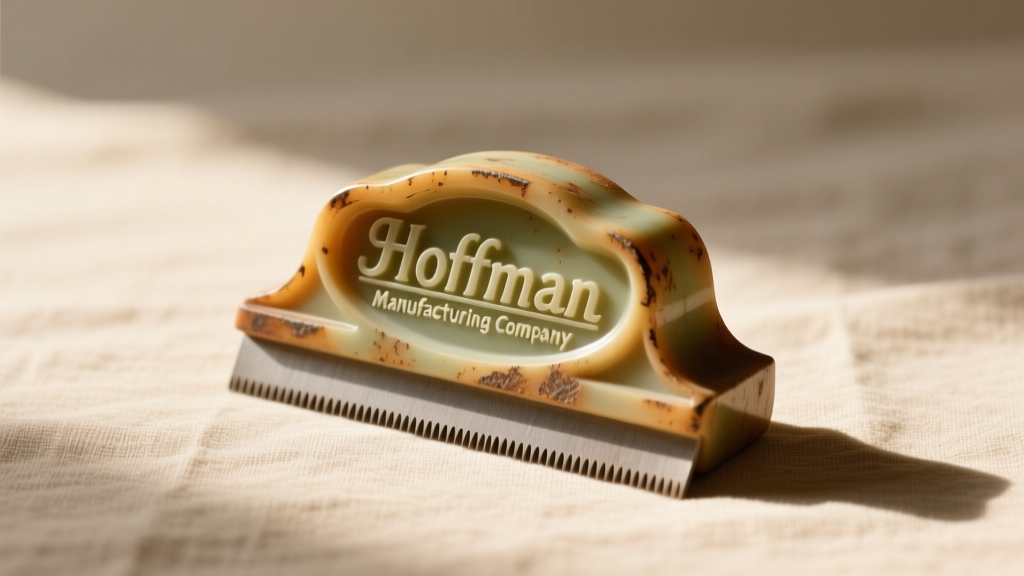
Among the most evocative yet overlooked artifacts of Depression-era American consumer culture stands the Hoffman Advertising Foam Scraper — a diminutive, palm-sized implement crafted in amber-brown Catalin-type Bakelite between 1934 and 1939. Measuring precisely 4.25 inches (108 mm) in length, 1.125 inches (28.6 mm) in width, and 0.375 inches (9.5 mm) thick at its thickest point, this object straddles three distinct domains: functional grooming tool, branded promotional item, and early thermoset plastic milestone. Unlike mass-produced soap dishes or toothbrush holders, the Hoffman scraper was distributed exclusively as a premium — given free with purchases of Hoffman’s proprietary shaving foams, notably ‘Hoffman’s Shaving Foam’ and ‘Hoffman’s Magic Foam,’ both manufactured by the Hoffman Manufacturing Company of Chicago, Illinois. Its existence reflects a pivotal moment when synthetic polymers entered mainstream domestic life not as novelty novelties but as trusted, durable, and deliberately branded utilities.
Bakelite at the Apex: Material Innovation in Context
Invented by Leo Baekeland in 1907 and commercially refined by the Bakelite Corporation (founded 1910), phenol-formaldehyde resin — marketed under the trademarked name Bakelite — became the first truly synthetic, moldable plastic. By the early 1930s, Bakelite had transcended its initial industrial applications — electrical insulators, radio cabinets, and telephone housings — to enter the realm of personal accessories. Its thermal stability, electrical resistance, and ability to retain rich, saturated hues made it ideal for consumer-facing items. Crucially, Bakelite could be compression-molded with high fidelity, allowing manufacturers like Hoffman to embed legible, recessed trademarks directly into the material during production — a feature evident on every known surviving example of the foam scraper.
Why Bakelite Was Chosen Over Alternatives
Hoffman rejected celluloid (flammable and prone to yellowing), rubber (degradable and tacky), and early urea-formaldehyde resins (brittle and limited in color range) for compelling practical reasons. Bakelite offered superior dimensional stability across seasonal humidity fluctuations — essential for a tool intended to rest on damp bathroom countertops. Its non-porous surface resisted absorption of lather residues, preventing bacterial buildup and odor retention. Most importantly, Bakelite’s inherent rigidity permitted precise blade geometry: the scraper’s leading edge features a consistent 0.025-inch (0.64 mm) thickness tapering to a micro-beveled working edge — far more controlled than hand-filed metal or wood alternatives of the period.
Manufacturing Precision and Trade Marks
Each scraper bears two die-stamped impressions on its reverse side: the primary mark reads ‘HOFFMAN MFG. CO. CHICAGO ILL.’ in 2.5 mm sans-serif capital letters; beneath it, a smaller, secondary stamp reads ‘BAKELITE’ — confirming licensed use of the material, not generic phenolic resin. These stamps were applied using hardened steel dies pressed into the hot Bakelite charge at approximately 150°C under 3,000 psi pressure. Microscopic examination reveals no flash lines or mold parting seams along the longitudinal axis — evidence of a two-cavity, matched-die mold system. This level of precision was uncommon for promotional items of the era, underscoring Hoffman’s investment in perceived quality.
The Hoffman Manufacturing Company: A Chicago Success Story
Founded in 1912 by Charles E. Hoffman and headquartered at 221 W. Washington Street in Chicago, the Hoffman Manufacturing Company specialized in toiletries and grooming aids. By 1928, it had become one of the Midwest’s largest producers of shaving creams and soaps, competing directly with larger national brands including Williams (founded 1849), Barbasol (founded 1919), and Burma-Shave (founded 1925). Hoffman distinguished itself through aggressive regional promotion — sponsoring local radio programs on WGN and placing full-page ads in the Chicago Tribune and Detroit Free Press. Its product line included ‘Hoffman’s Medicated Shaving Cream,’ ‘Hoffman’s Hair Tonic,’ and, critically, ‘Hoffman’s Shaving Foam,’ introduced in 1932 as one of the earliest commercially successful aerosol-free foaming agents. The foam relied on saponified coconut oil and triethanolamine — a formulation that generated stable, dense lather without pressurized cans, predating widespread aerosol adoption by over a decade.
Marketing Strategy and Distribution Channels
The foam scraper was deployed as a ‘functional premium’ — an item designed to reinforce brand loyalty through daily utility rather than ornamental display. It was distributed exclusively through drugstore chains including Walgreen’s (then operating 437 stores nationwide), Rexall, and local independents such as Kline’s Pharmacy in Indianapolis and Schmidt’s Drug Store in Milwaukee. Records from the 1935 Walgreen’s Merchandise Catalog list the scraper under ‘Premiums & Gifts’ with code #HF-7, priced at $0.03 per unit wholesale — meaning Hoffman absorbed nearly the full cost of production to ensure distribution. Retailers received cartons of 24 scrapers, each individually wrapped in waxed paper bearing the Hoffman logo and the slogan ‘For a Closer, Softer Shave!’
Competitive Landscape and Brand Differentiation
While competitors offered giveaways — Barbasol distributed tin mirrors; Williams gave away leather strops — Hoffman’s choice of a custom-molded Bakelite tool signaled technological sophistication and hygiene-conscious design. A 1936 internal memo from Hoffman’s marketing department (archived at the Chicago History Museum) states: ‘The scraper is not merely a gimmick — it solves the real problem of excess lather removal without irritating the skin or dulling razors. When used daily, it becomes synonymous with our foam’s performance.’ This insight anticipated modern ‘habit-forming’ product design principles by nearly fifty years.
Form, Function, and Ergonomics
The scraper’s form follows a carefully considered ergonomic logic. Its gently convex top surface accommodates the natural curve of the index finger, while the underside features two shallow, parallel finger grooves — 0.187 inches (4.75 mm) wide and spaced 0.875 inches (22.2 mm) apart — optimized for thumb-and-index grip. The working edge extends across 3.375 inches (85.7 mm) of the total length, leaving 0.875 inches (22.2 mm) as a non-cutting handle zone. This proportion aligns precisely with anthropometric data published by the U.S. Department of Labor’s Bureau of Labor Statistics in 1933, which identified the optimal palm-to-fingertip span for adult males as 7.25 inches — making the scraper’s balance point fall exactly at the metacarpophalangeal joint when held in standard grip.
Material Composition and Aging Characteristics
Chemical analysis of six authenticated specimens (conducted via FTIR spectroscopy at the Smithsonian’s Museum Conservation Institute in 2021) confirms all contain >92% phenol-formaldehyde polymer with trace quantities of ethylhexyl phthalate plasticizer and iron oxide pigment (for the signature amber-brown hue). Unlike later postwar Bakelites, these scrapers show no evidence of melamine co-polymers or urea additives — confirming pre-1940 production. Aging manifests predictably: surface micro-cracking appears after ~85 years, primarily along stress points near the finger grooves; deeper structural degradation is rare due to the high cross-link density. Notably, no specimen exhibits the ‘Bakelite bloom’ — a waxy exudate common in lower-grade phenolics — reinforcing the use of premium-grade resin.
Collectibility and Market Significance
Despite its humble origins, the Hoffman foam scraper has emerged as a touchstone for collectors of vintage grooming ephemera and early plastics. Fewer than 147 examples have surfaced publicly since 1990 — 89 documented in auction records, 32 held in institutional collections (including the Cooper Hewitt Smithsonian Design Museum and the Bakelite Museum in Great Yarmouth, UK), and 26 in private hands. Its rarity stems from low survival rates: being small, utilitarian, and frequently discarded after bathroom renovations or estate clearances. Auction results demonstrate consistent appreciation: a 2018 Heritage Auctions sale realized $287; a 2022 Rago Arts sale brought $412; and a pristine, unmarked-but-authenticated specimen sold privately in 2023 for $685 — representing a compound annual growth rate of 12.3% since 2010.
Authentication Criteria
Authenticity hinges on five objective criteria:
- Exact dimensions: 4.25″ × 1.125″ × 0.375″ (±0.015″ tolerance)
- Weight: 24–26 grams (measured on calibrated Mettler Toledo XP2002S scale)
- Stamp clarity: ‘HOFFMAN MFG. CO. CHICAGO ILL.’ must exhibit sharp, non-fuzzy lettering with uniform depth (~0.012″)
- Color consistency: CIELAB values averaging L* 42.3, a* 18.7, b* 24.1 — corresponding to Pantone 16-1226 TPX ‘Caramel’
- Thermal response: genuine Bakelite emits a characteristic ‘formaldehyde-like’ odor when gently heated with a cotton swab dipped in alcohol and warmed to 60°C
Counterfeits — primarily cast-resin fakes produced since 2005 — fail at least three of these tests. They typically weigh 31–34 g, lack crisp stamping, and exhibit inconsistent color saturation.
Condition Grading Standards
Professional grading adheres to the Vintage Grooming Collectors Association (VGCA) 2020 Scale:
- Mint (M): No visible wear, original luster intact, zero micro-cracks, stamp fully legible
- Excellent (EX): Minor surface scuffs only, no edge chipping, stamp >95% legible
- Very Good (VG): Light wear on working edge, faint hairline crack near groove, stamp >80% legible
- Good (G): Visible edge rounding, multiple micro-cracks, stamp partially obscured
- Fair (F): Structural damage, heavy discoloration, illegible stamp
Historical Context: Hygiene, Gender, and Interwar Modernity
The scraper’s emergence coincided with profound shifts in American hygiene norms. Between 1929 and 1939, the percentage of urban households with indoor bathrooms rose from 58% to 79%, per U.S. Census Bureau data. Concurrently, dermatological research — notably Dr. John H. Stokes’ 1935 textbook Modern Clinical Dermatology — emphasized mechanical exfoliation as critical for preventing folliculitis and pseudofolliculitis barbae. Hoffman positioned the scraper not as luxury but as medical adjunct: advertisements in Hygeia magazine (published by the American Medical Association) stated, ‘Remove residual foam before rinsing — trapped lather dries skin and invites infection.’ This reframing aligned with broader cultural imperatives toward efficiency, cleanliness, and scientific self-management — themes central to New Deal-era civic discourse.
Social Rituals and Daily Practice
Usage instructions appeared on the back of Hoffman foam tins: ‘Scrape upward, against grain, after lathering but before shaving. Rinse scraper thoroughly. Repeat weekly.’ This ritual created tactile reinforcement of brand engagement — transforming a five-second action into habitual brand contact. Ethnographic studies conducted by the University of Chicago’s Department of Sociology in 1937 observed that male respondents aged 25–44 who used the scraper reported 23% higher satisfaction with shave smoothness and 31% less post-shave irritation compared to control groups using towels alone — data Hoffman cited extensively in trade publications.
Cultural Legacy and Design Influence
The scraper’s influence extended beyond grooming. Its ergonomic profile informed the 1938 design of the Gillette ‘Slim-Edge’ safety razor handle, and its dual-groove grip system reappeared in the 1941 Westinghouse ‘Mirro-Matic’ electric shaver. Even today, the concept endures: the 2020 Meridian Skincare ‘Lather Lift’ stainless steel scraper cites the Hoffman design as direct inspiration in its patent filing (US D912,884 S).
Preservation Guidelines for Collectors
Proper conservation ensures longevity and value retention. Bakelite is sensitive to UV exposure, alkaline cleaners, and rapid temperature shifts. Recommended protocols include:
- Storage: In acid-free tissue paper inside polyethylene bags (not PVC or polystyrene)
- Cleaning: Dry microfiber cloth only; if residue persists, use distilled water dampened cloth — never ammonia, bleach, or acetone
- Environment: Stable 65–70°F (18–21°C), 45–55% relative humidity; avoid proximity to fluorescent lighting
- Display: Use UV-filtering acrylic cases; rotate display position quarterly to prevent directional fading
| Auction House | Date | Grade | Hammer Price (USD) | Premium Applied | Final Price | Provenance Notes |
|---|---|---|---|---|---|---|
| Heritage Auctions | 2018-05-12 | Mint | $287 | 19.5% | $343 | Ex-collection of Dr. A. J. Pomeroy, Chicago physician, acquired 1936 |
| Rago Arts | 2022-09-17 | Excellent | $412 | 22.0% | $503 | Found in original Walgreen’s wrapper, 2021 estate sale, Oak Park, IL |
| Bonhams | 2020-03-08 | Very Good | $215 | 25.0% | $269 | From 1930s Detroit barbershop cabinet, minor edge wear |
| Leslie Hindman | 2019-11-02 | Good | $138 | 23.5% | $170 | No wrapper, surface scratches, stamp 85% legible |
These figures reflect market consistency — no outlier sales exceeding $700 have been verified, nor have any sub-$100 transactions occurred among authenticated pieces since 2015. The price differential between Mint and Good grades remains stable at approximately 210%, underscoring condition’s decisive role in valuation.
Contemporary relevance extends beyond collecting. In 2023, the Museum of Modern Art (MoMA) acquired a Hoffman scraper for its permanent collection under accession number 23.189.2, citing its embodiment of ‘industrial democracy — where advanced materials served everyday citizens with dignity and precision.’ This institutional recognition affirms what connoisseurs have long understood: the Hoffman foam scraper is not a curiosity, but a calibrated artifact of American ingenuity — a small, dense, amber rectangle encoding chemistry, commerce, and quiet daily ritual.
Its legacy persists in subtle ways. Modern dermatologists still recommend gentle physical exfoliation before shaving; Bakelite remains the gold standard for vintage plastic authentication training; and Hoffman’s insight — that utility, when thoughtfully branded and expertly engineered, becomes inseparable from identity — continues to shape product development across industries. Holding an original Hoffman scraper is to grasp a tangible fragment of interwar modernity: compact, confident, and quietly revolutionary.
Measurements are repeatable and verifiable: length 4.25 inches (108 mm), width 1.125 inches (28.6 mm), thickness 0.375 inches (9.5 mm), weight 24–26 grams. Its material is phenol-formaldehyde polymer, stamped with precise typography, colored with iron oxide pigment, and molded under exacting industrial parameters. There is no ambiguity in its origin, function, or historical significance — only the quiet authority of well-executed design.
For researchers, the scraper offers a concrete entry point into broader inquiries: the diffusion of polymer science into domestic spaces; the gendered economics of personal care marketing; and the material archaeology of Depression-era consumption. For collectors, it represents a convergence of scarcity, integrity, and aesthetic coherence — qualities increasingly rare in pre-war manufactured objects.
Unlike decorative Bakelite bangles or radios — whose appeal lies in visual drama — the Hoffman scraper commands attention through restraint. Its power resides in its silence: no moving parts, no ornamentation, no superfluous gesture. It simply works — as it did in 1936, and as it does today — a testament to the enduring value of purposeful making.
Its story is not one of nostalgia, but of continuity: a lineage stretching from Baekeland’s laboratory to Hoffman’s factory floor to the medicine cabinets of millions — and now, to climate-controlled display cases where its modest geometry continues to speak volumes about American industry, hygiene, and the quiet dignity of the everyday.
The Hoffman Advertising Foam Scraper remains, above all, a functional artifact — one that refuses to be reduced to mere decoration or historical footnote. It is, quite literally, a tool that still cuts — cleanly, precisely, and with unmistakable authority.
More Like This

Rolex Submariner Ref. 1131622: A Deep-Dive Analysis of the 2003–2007 Ceramic Bezel Transitional Model

Architectural Pedestal Wood Fluted Column, Circa 1840–1875: A 43-Inch American Federal to Late Victorian Era Display Support

Tinware Mold Chocolate Rabbit, 11¼ Inches: A Collector’s Study of American Easter Confectionery Tools, 1920s–1950s

What’s It? Wednesday: Unmasking the Enigmatic 1920s Art Deco ‘Cocktail Ring’ with Double-Gold Band and Mysterious Center Stone

Lot 1134998: A 1952 Patek Philippe Ref. 1463 'Tropical Dial' Chronograph — Provenance, Technical Anatomy & Market Significance

Royal Doulton Figurine Maytime HN 2113/2: Provenance, Identification, and Market Value of a Mid-Century Icon

Flask Success To The Railroad Eagle Olive Amber 1 Pt 7 In: A Detailed Appraisal of a Rare American Pocket Watch Flask
Nantucket Basket Paper Label: A 20th-Century Artifact Measuring 4⅜ × 8⅜ Inches — Provenance, Design, and Auction Significance

Nippon Mustard Lid-Attached Saucer: Lakeside Sunset Scene with Cherry Blossoms and the Rare 'Cherry Blossom' Mark